
AMD's New Phenom II X6 1100T - Have Six for Christmas
AMD has announced a bunch of new processors before the end of 2010. They are incremental upgrades to its existing lineup, including a new flagship 6-core processor, the Phenom II X6 1100T Black Edition. We investigate it along with other recent SKUs like the Phenom II X6 1075T, Phenom II X4 970 and the Athlon II X4 645.
AMD - Hanging in there
2011 may herald the age of 'fusion', what with both AMD and Intel merging graphics processors into the main die of their CPUs, but that doesn't mean traditional CPUs are going away anytime soon. Intel's upcoming and will undoubtedly raise the bar for integrated graphics, but enthusiasts demand the performance that only discrete graphics can deliver.
On that front, AMD has limited options to offer. Brazos is a mobile platform while the K10 derived Llano is not expected till the middle of the year. One likely has to wait till Q3 2011 to see AMD's new Bulldozer architecture that replaces the current K10 platform. It only means that for the desktop, AMD will be relying on variants of its existing Phenom II/Athlon II for the next six months at least. AMD has long conceded the high-end desktop segment to Intel with none of its processors, even its 6-cores above the US$250 mark.
With its latest 6-core processor, a new flagship desktop 'Black Edition' processor that comes with unlocked multipliers, it does seem that AMD continues to give you more value for your cores. At US$265, the new AMD Phenom II X6 1100T Black Edition stays comfortably below the US$300 mark, pitting it against Intel's LGA1156 Core i5/i7 processors. The other 6-core processors have also gotten a price revision in the past few weeks and the former top AMD 6-core, the for instance is now at US$235.
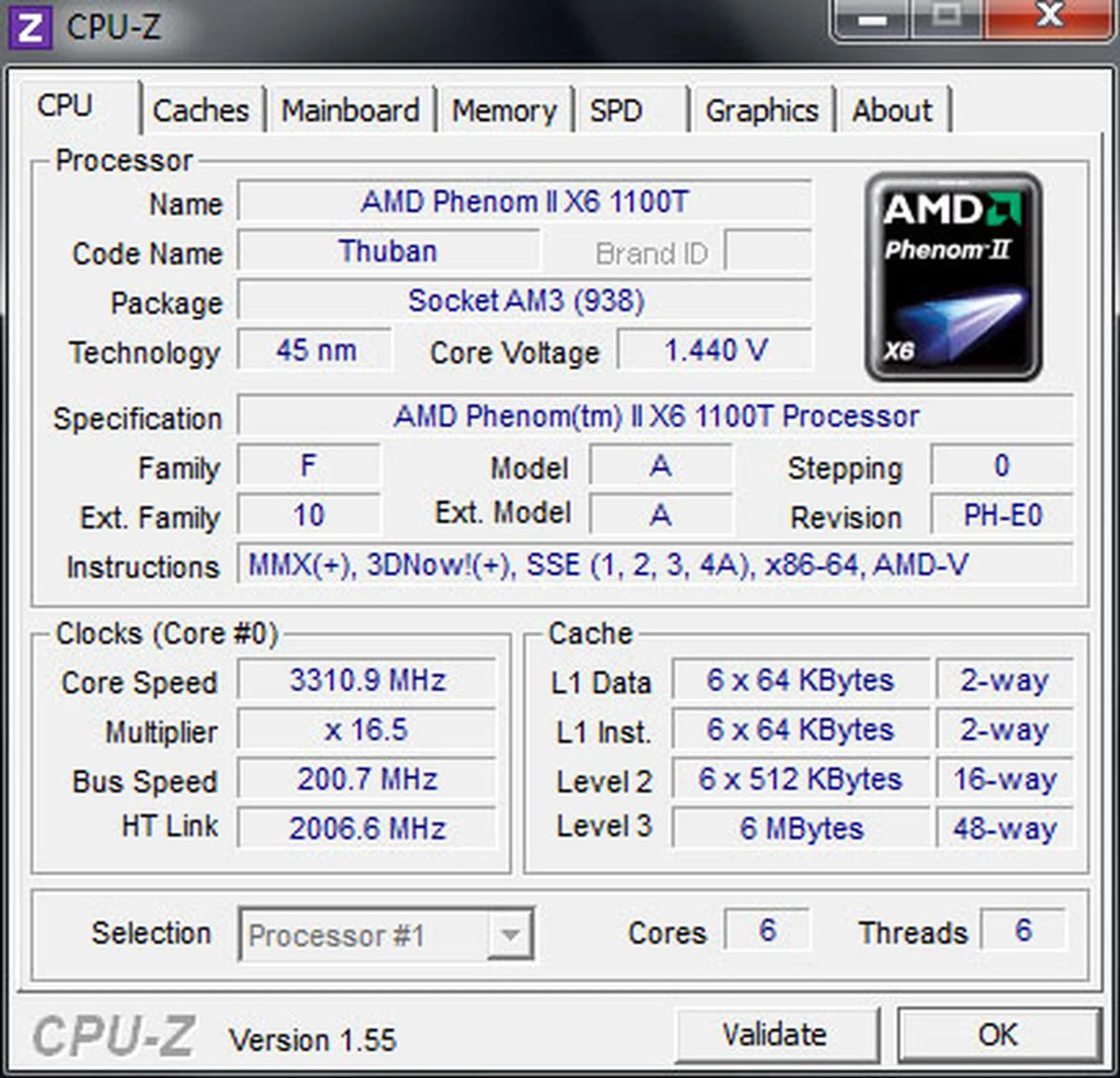
AMD's new flagship desktop processor, the Phenom II X6 1100T Black Edition comes with unlocked multipliers and starts from 3.3GHz.
Along with the new 6-core, AMD also released two new entries to its lineup, a Phenom II X2 565 and an Athlon II X3 455, both of which are incremental upgrades (100MHz) over the Phenom II X2 560 and Athlon II X3 450 that debuted in September. Hence for this December update we get the following:
Processor Model | Clock Speed | L2 Cache | L3 Cache | HyperTransport Bus | Max TDP (W) | Retail Price (US$) | Availability |
AMD Phenom II X6 1100T Black Edition | 3.3GHz (3.7GHz Turbo Core) | 512KB x 6 | 6MB | 2.0GHz | 125W | ~265 | Now |
AMD Phenom II X2 565 | 3.4GHz | 512KBx 2 | 6MB | 2.0GHz | 80W | ~115 | Now |
AMDAthlon IIX3 455 | 3.3GHz | 512KBx 3 | N.A | 2.0GHz | 95W | ~87 | Now |
Since we didn't manage to feature AMD's last round of processor updates in September, we also took the opportunity now to update the benchmarks and include them in this article. Hence, we'll be looking at the following AMD processors that were released then, all of which are incremental speed bumps to the existing lineup. (While the Phenom II X2 560, the Athlon II X3 450 and the Athlon II X2 265 were also released back then, we won't be covering them today.)
Processor Model | Clock Speed | L2 Cache | L3 Cache | HyperTransport Bus | Max TDP (W) | Retail Price (US$) | Availability |
AMD Phenom II X6 1075T | 3.0GHz (3.5GHz Turbo Core) | 512KB x 6 | 6MB | 2.0GHz | 125W | ~200 | Now |
AMD Phenom II X4 970 Black Edition | 3.5GHz | 512KBx 4 | 6MB | 2.0GHz | 125W | ~186 | Now |
AMDAthlon IIX4 645 | 3.1GHz | 512KBx 4 | N.A | 2.0GHz | 95W | ~118 | Now |
Test Setup
We'll be testing four of AMD's newer processors, from the entry level Athlon II X4 to the new flagship Phenom II X6 1100T and with prices ranging from less than US$100 to almost US$300. Given such a wide range of prices and performance, we have included a total of 12 processors from both AMD and Intel in this roundup for comparison. The newer AMD processors being reviewed in this article are in bold italics. Here's how they fall in line:
Above US$220
- Phenom II X6 1100T Black Edition (US$265)
- Phenom II X6 1090T Black Edition (US$229)
- Core i7-870 (US$280)
From US$150 to US$200
- Phenom II X6 1075T (US$199)
- Phenom II X6 1055T (US$179)
- Phenom II X4 970 (US$186)
- Phenom II X4 965 (US$160)
- Core i5-760 (US$205)
Below US$150
- Athlon II X4 645 (US$118)
- Athlon II X4 635 (US$99)
- Core i3-550 (US$125)
- Core i3-530 (US$120)
Also, to make the benchmark graphs easier to read given the large number of comparisons, we have decided to use three different colors to differentiate the three groupings of processors above. The processors under review will be represented by a flat solid color while the comparisons have a color gradient. Hopefully that will help you distinguish between them. The test configurations used are listed below:
Intel Core i5/i3 Test Configuration
- Intel Core i5-760 and Core i3-530
- MSI P55-GD85 (BIOS 1.37)
- 2 x 1GB Kingston HyperX DDR3-1333 (CAS 7-7-7-20)
- Zotac GeForce GTX 260 O.C (ForceWare 197.45)
- Western Digital Caviar Black 1TB SATA 6Gbps (one single NTFS partition)
- Intel INF 9.1.0.1025
- Microsoft Windows 7 Ultimate (64-bit)
AMD Phenom II X4/X6 Test Configuration
- AMD Phenom II X6 1090T, 1075T, 1055T, Phenom II X4 970, 965, Athlon II X4 645 and 635
- ASUS Crosshair IV Formula (AMD 890FX + SB850, 0702 BIOS)
- 2 x 1GB Kingston HyperX DDR3-1333 (7-7-7-20)
- Zotac GeForce GTX 260 O.C (ForceWare 197.45)
- AMD Chipset driver
- Western Digital Caviar Black 1TB SATA 6Gbps (one single NTFS partition)
- Microsoft Windows 7 Ultimate (64-bit)
Benchmarks
We have gone with a 64-bit OS since our last processor review and the benchmarks are also 64-bit versions when available. The following benchmarks were used in this review:
- BAPCo SYSmark 2007 Preview (ver 1.05)
- Futuremark PCMark Vantage (ver 1.03.1, 64-bit)
- Lightwave 3D 9.0 (64-bit)
- 3ds Max 8 (SP2)
- Cinebench 11.5 (64-bit)
- Handbrake 0.9.4
- Futuremark 3DMark Vantage (ver 1.03.1)
- Far Cry 2
- Battlefield Bad Company 2
Results - SYSmark 2007 Preview
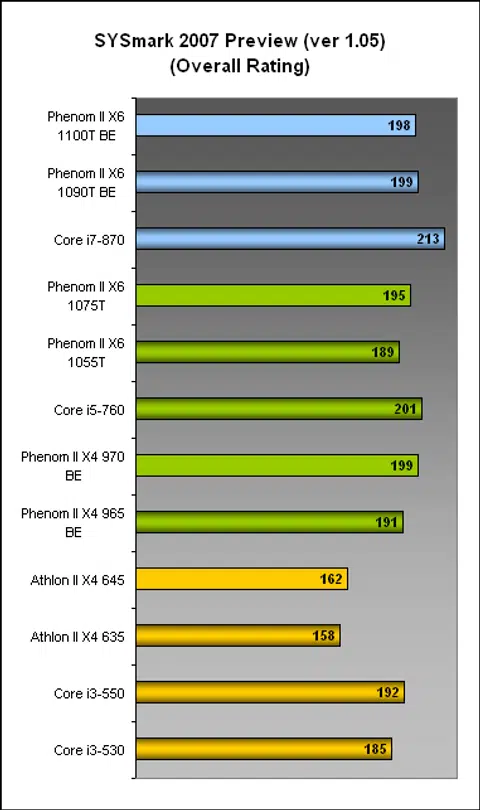
As a system-wide benchmark suite, SYSmark 2007 contains many of the applications you would find on a desktop, but it's not the most up to date benchmark, especially for gauging intense multi-core performance. However, it's still a fair benchmark given that good multi-threaded mainstream applications continue to be rare. Here, Intel's Core architecture maintains its advantage with the i7-870 significantly faster than the new Phenom II X6 1100T, which is just about level with the 1090T due to its minor 100MHz clock boost. Even the Core i5-760 is competitive enough to see off the AMD contingent. The other newer 6-core, the Phenom II X6 1075T was not too far from the top too with its score of 195.
As for the AMD quad-cores, the 970 is predictably a small bump above the 965, which means one does fancy it against the more costly i5-760. The Athlon II X4 645 is also slightly ahead of the 635, but both processors were never close to Intel's Core i3, its likely competitors in that price bracket.
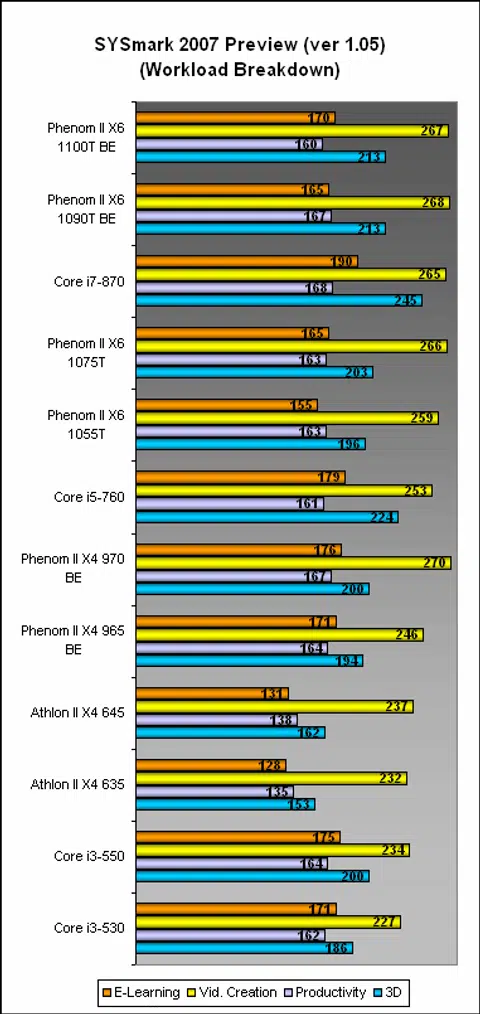
A closer look at the breakdown showed that even in Video Creation, the 6-cores weren't exactly racing away with the top scores, which confirms the limitations of this application when it comes to true multi-core evaluation. However, it's to be noted that most of the applications in the test suite still represent the average person using the system on a day-to-day basis. We'll focus on further aspects of system usage in other following benchmarks.
Results - Futuremark PCMark Vantage
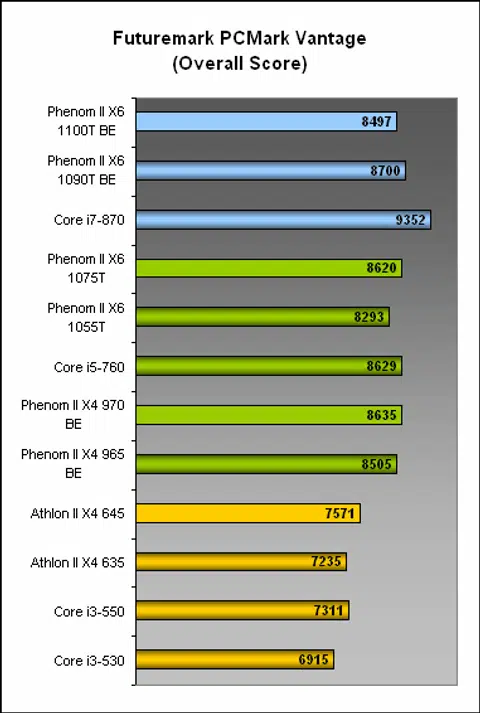
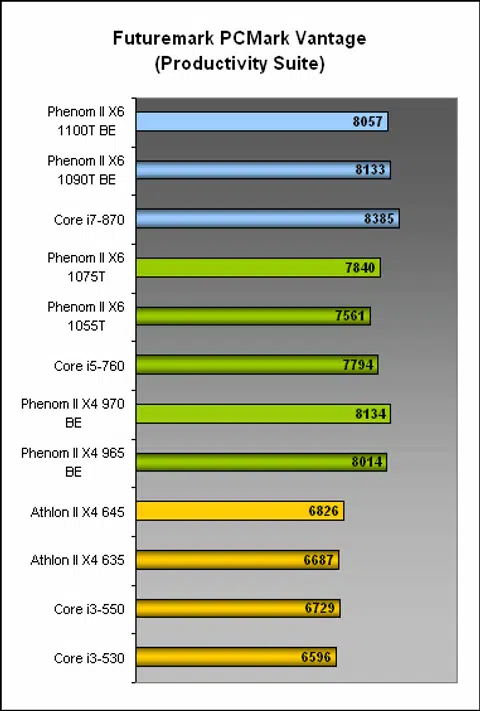
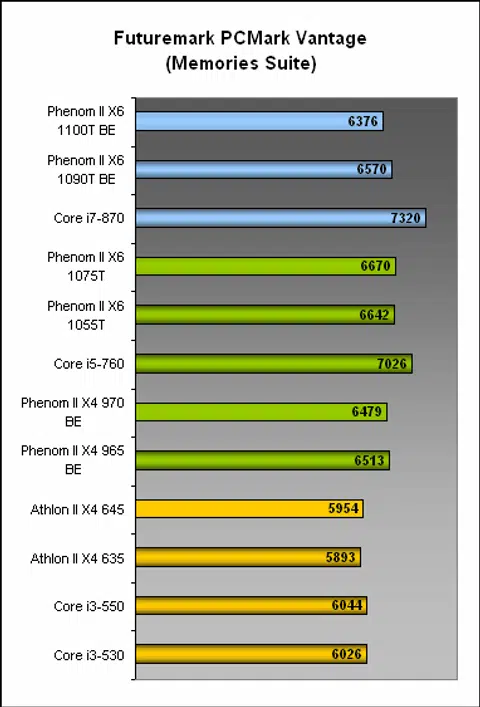
Again, Intel's Core i7-870 stood out from the rest here for the overall PCMark Vantage score, with the remaining AMD quad and 6-core processors roughly in the same performance bracket behind together with the other Intel quad-core compared, the Core i5-760. The Phenom II X6 1100T didn't quite manage to distinguish itself from the rest, but that was expected given the increment clock gain. As for the Phenom II X6 1075T and the Phenom II X4, they compared well against the Core i5-760, its main price competitor here.
The good news for AMD is that in the entry level segment, its inexpensive Athlon II quad-cores comfortably held off the dual-core Core i3 from Intel.
Results - Lightwave 3D 9.0
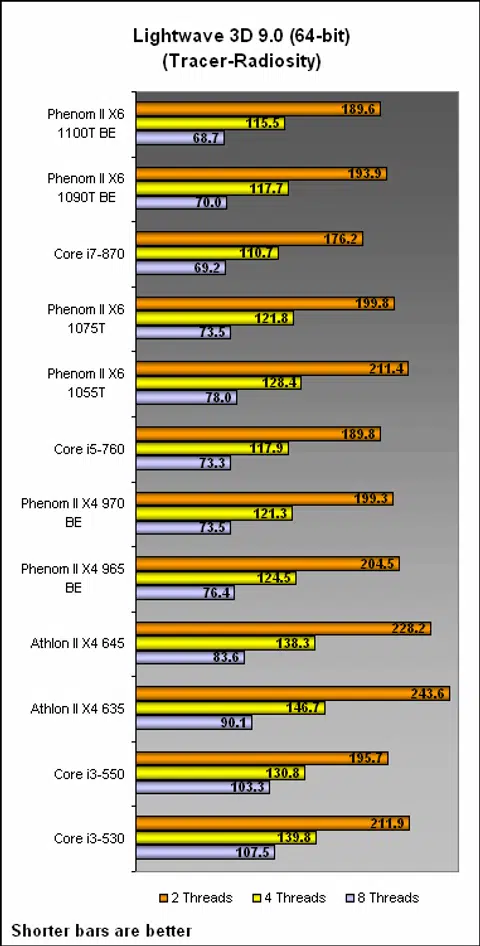
Since Lightwave was expected to favor multi-core processors, the presence of HyperThreading on the Core i7-870 wasn't much of an advantage. The 1100T only emerged tops for the 8-threads workload in Tracer-Radiosity. For the 2 and 4-threads, the Core i7-870 was the better processor. It was a similar situation for the Phenom II X6 1075T and the Phenom II X4 970, which were lumped together with the Core i5-760 performance-wise. Meanwhile, the Core i3 processors were very strong competitors until the 8-threads workloads.
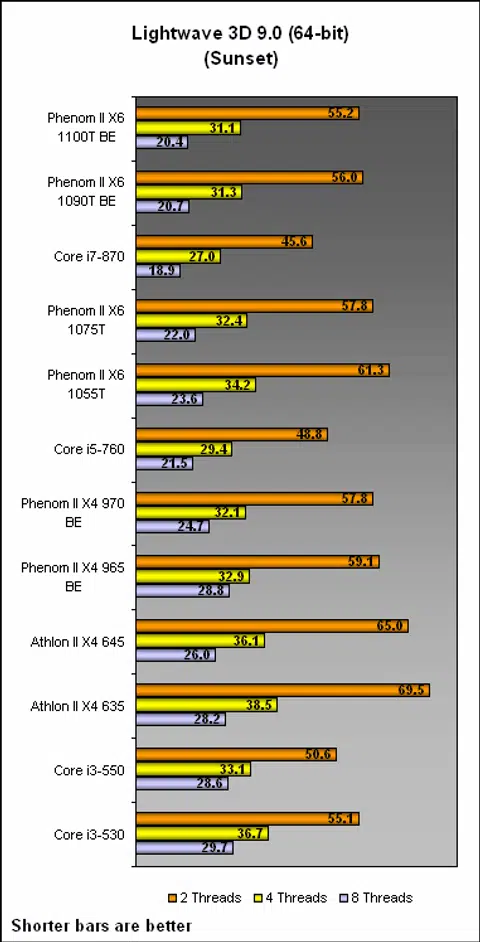
This order of things were more or less repeated in the Sunset scenario for the AMD processors, though the Intel processors looked even stronger here, winning the AMD contingent with a greater margin.
Results - Cinebench 11.5 & Handbrake 0.9.4
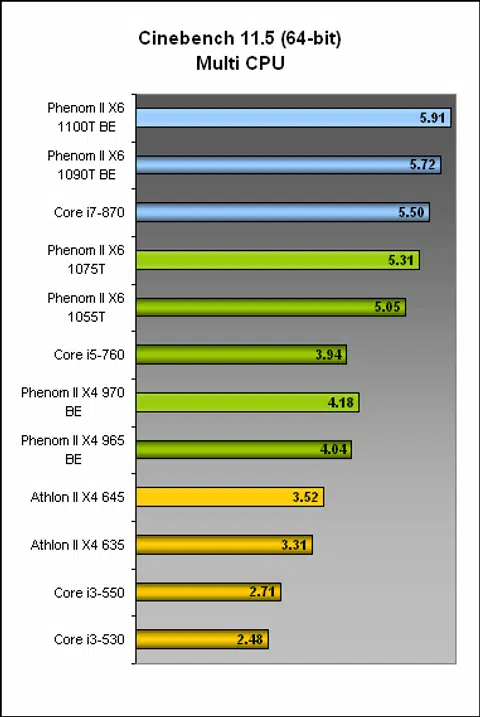
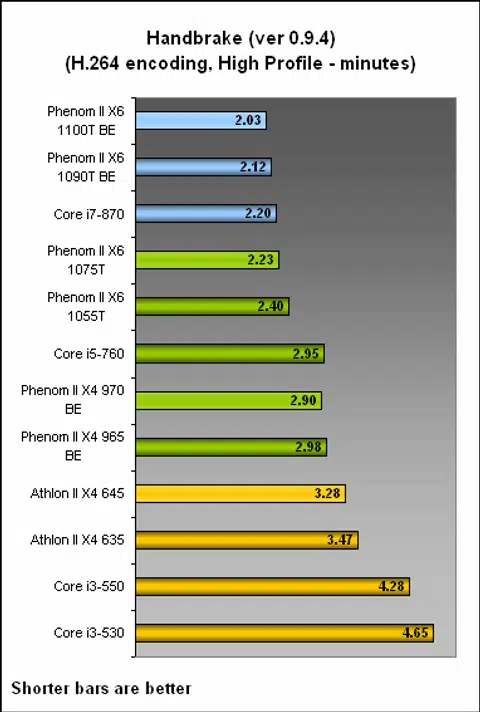
Of course, if multi-core processing is what you require, then these two benchmarks should interest you most. It's here, in these encoding tests that AMD's 6-core processors take an undisputed lead. That's however not enough for the Phenom II X6 1075T to beat the Core i7-870. Interestingly, AMD seems to have placed the Phenom II X4 970 in quite a good position against the Core i5-760. Both processors were very close, with each side chalking a win each. In the more budget category, the AMD Athlon II X4 processors were leading the Intel competitors by a fair bit.
Results - 3ds Max 8 (SP2)
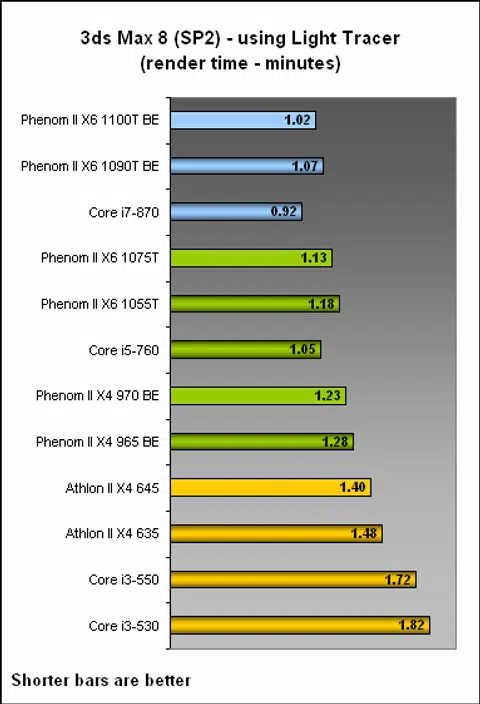
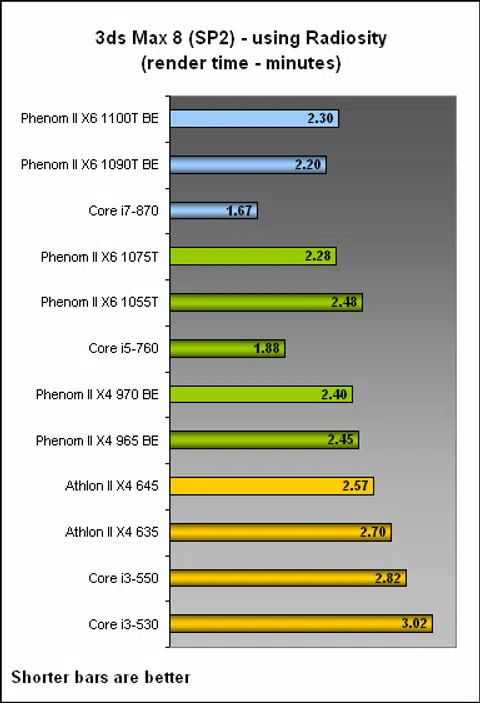
It was less of a win for AMD in 3ds Max 8, where both the Core i7-870 and the i5-760 managed to do better than their AMD competitors. At least AMD's Athlon II quad-cores were faster than the dual-core Intel Core i3.
Results - Futuremark 3DMark Vantage
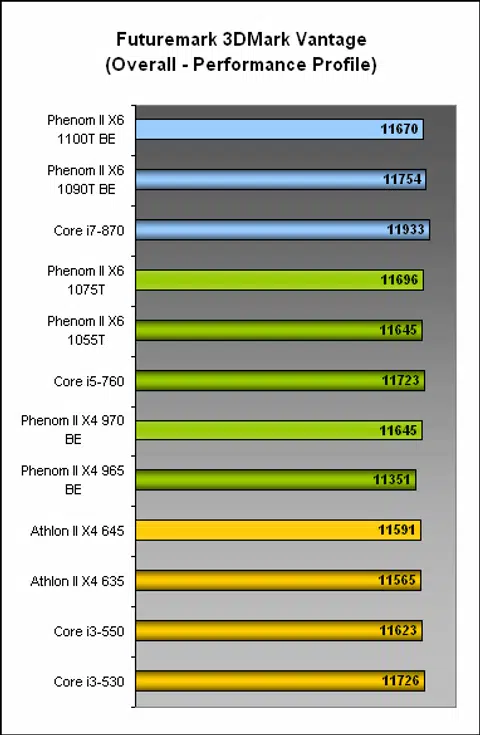
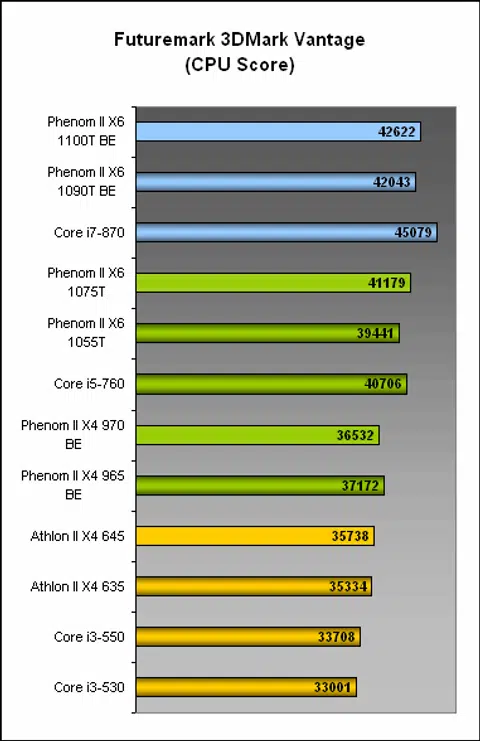
The overall score in 3DMark is generally determined by the graphics card, which is why most of the scores are similar. The CPU portion however showed the usual suspects pulling ahead. Intel's Core i7-870 maintained its strong showing while the Core i5-760 found it hard going against the Phenom II X6 1075T. The Phenom II X4 970 meanwhile slipped behind the i5-760. As for the Athlon II X4s, there were no surprises here as they fended off the Core i3 as they should.
Results - Far Cry 2 & Battlefield Bad Company 2
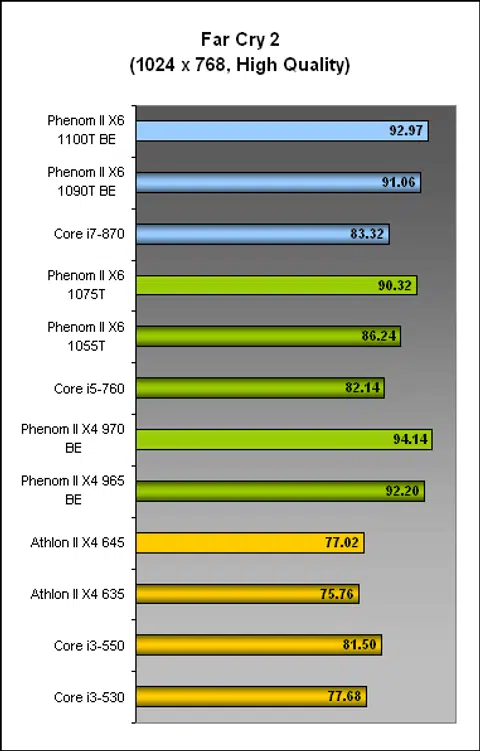
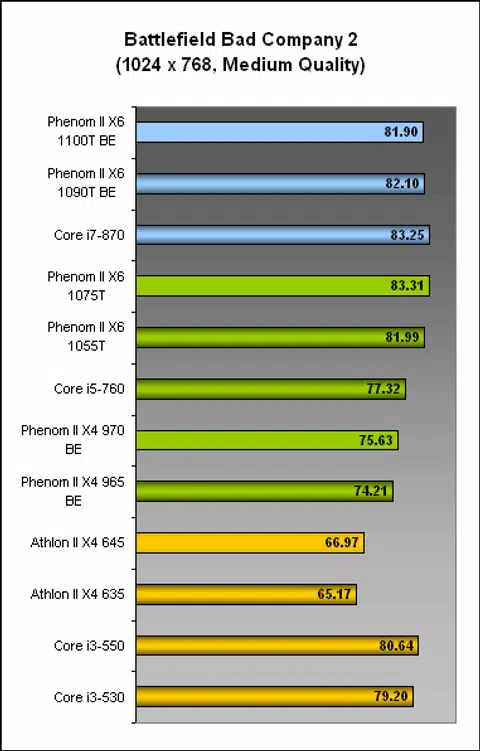
Far Cry 2 was surprisingly lead by AMD processors, with the Phenom II X4 970 topping the charts. The Intel Core processors didn't do that well against the 6-cores, though at the lower end of the spectrum, the Core i3 processors were equal to the Athlon II X4. Battlefield Bad Company 2 appeared to favor clock speeds over the actual number of cores. We found the Core i3 doing very well here, which could be due to their higher frequencies compared to say the Core i5-760 for example.
Power Consumption
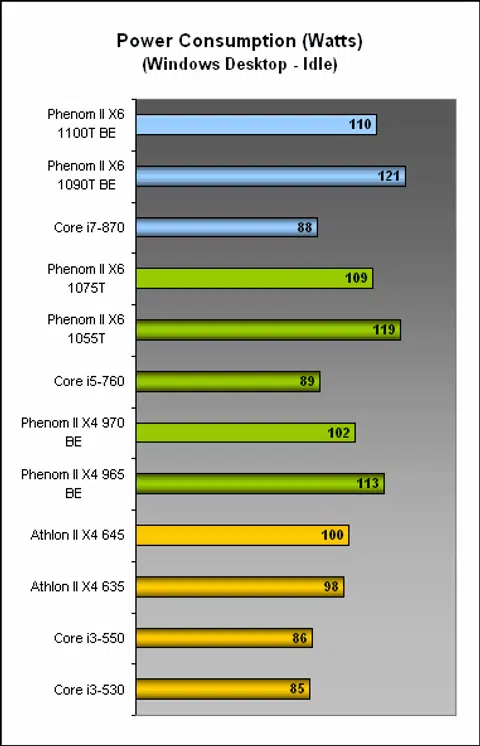
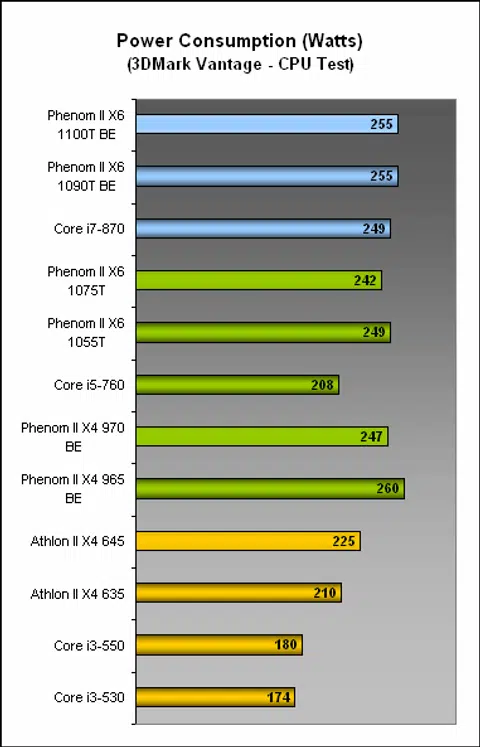
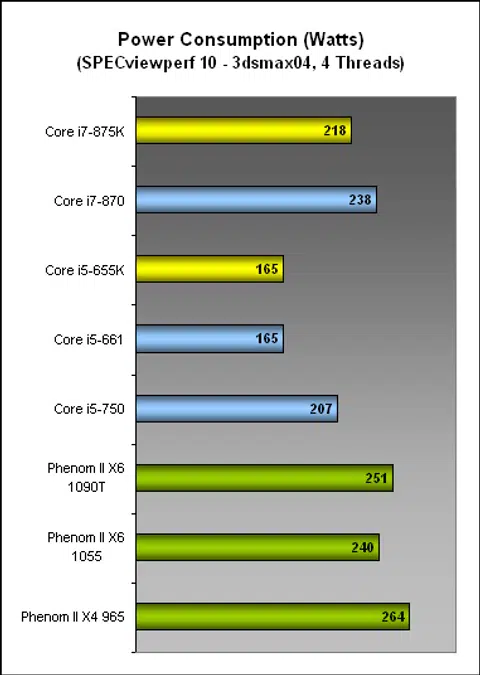
Power consumption is one area where Intel remains pretty much untouchable, especially its 32nm products. Despite some distinct improvements for the newer AMD processors - the 1100T draws less power at idle than the 1090T - AMD's 45nm process basically makes it impossible for its processors to catch up. However it was good to note that all the newer (September 2010 and later) AMD Phenom processors have become more energy efficient. At least AMD's trying.
Overclocking
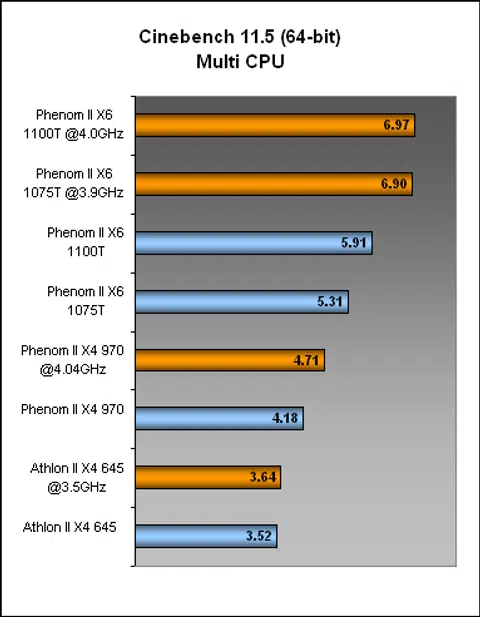
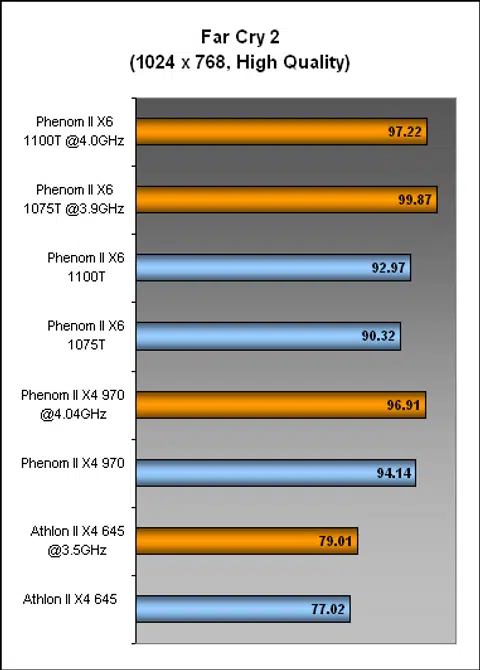
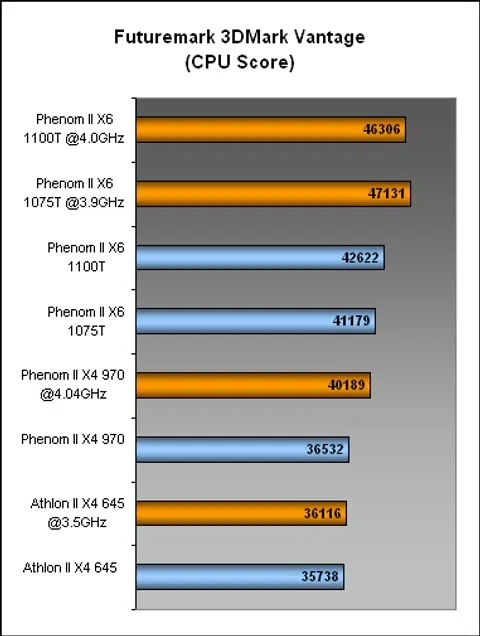
Along with the better energy efficiency, the new AMD processors all had some decent overclocking headroom. We were mainly pushing the multipliers up for the 'Black Edition' processors, with barely any increase in CPU voltage. Yet we could get up to 700MHz increase over the base frequency. Of course, this was done by turning off Turbo Core, so don't expect to get up to 4.5GHz for example without a more thorough overclocking run.
The Phenom II X6 1100T reached 4.0GHz from its default 3.3GHz, the X6 1075T hit 3.9GHz from its 3.0GHz default, the Phenom II X4 970 hit 4.04GHz from its 3.5GHz default and the Athlon II X4 645 had the lowest amount, going from 3.1GHz to 3.5GHz.
Conclusion
For the first half 2011, AMD will probably be focusing on its upcoming Fusion branded platforms. These processors with integrated graphics won't get the hardcore enthusiasts too excited, but it's an opportunity for AMD to expand its almost non-existent market share in ultra-portables and netbooks. That means the current Phenom II architecture will be mostly unchanged. No doubt, AMD will continue to tweak and release new, incremental models, but besides more energy efficiency improvements, there doesn't seem to be much AMD can do to break Intel's performance upper hand.
Hence, the September and now the December round of processor releases from AMD. These are minor upgrades and then even further minor upgrades to that. What consumers get is slightly better performance at around the same price or with a small price bump. Considering that AMD's top processors are now under US$300, it's a relatively narrow range for them to maneuver, so there are some overlaps in pricing, especially moving from a quad-core to a 6-core variants.
Back to the AMD processors under review here, the Phenom II X6 1100T Black Edition goes for US$265, making it the most costly desktop processor from AMD. It's however less than the US$280 that Intel is asking for its Core i7-870. Clock for clock, Intel is the faster processor. Where AMD stands out is when the applications make use of its greater number of cores. Cinebench and Handbrake, and other video encoding tools should benefit from the 1100T. We also saw some of that advantage in Far Cry 2, but many games will favor the Core i7-870. Hence, at the very least, the Phenom II X6 1100T is decent value against the Intel in the right circumstances.
Throw in the improved energy efficiency in the 1100T against the older 1090T and the US$36 premium of the 1100T against its AMD rival becomes more palatable.
The other 6-core, the Phenom II X6 1075T gets the same lower power consumption as the 1100T and at US$200, it goes head to head against Intel's mainstream quad-core, the Core i5-760. While the Intel processor remains unbeatable for power draw and has the edge in SYSmark, the Phenom II X6 1075T does pretty well in the gaming benchmarks against the 760 and obviously the 1075T wins for the multi-threaded apps. All-in-all, it's a very competitive situation for AMD.
If you can't make the US$200 price bracket for the 1075T, the top AMD quad-core, the US$186 Phenom II X4 970 is an option. It comes with similarly lowered power consumption compared to its 965 predecessor, along with a small performance gain. Again, Intel's main contender in its price bracket is the Core i5-760. In this match-up between quad-cores, the 970 is also pretty competitive, beating the Intel in rendering performance benchmarks like Cinebench. It's more or less equal to the 760 in other benchmarks like SYSmark, though if all you want is lower power consumption, Intel is the choice.
We finally move to the entry level quad-cores from AMD, where the Athlon II X4 645 is a 100MHz jump over the 635. Against Intel's dual-core Core i3 in this price segment, they actually don't fare too well in lightly threaded apps, thanks to Intel's architecture. They do get the boost in multi-threaded apps but for uses like gaming, we have to give it to the Intel competitors. More so when the AMD at US$118 is only slightly less than the US$125 Core i3-550. Unless you really need a cheap quad-core for video encoding, we'll recommend Intel for a more balanced system. There is still the motherboard price consideration, for which AMD boards have historically cost less and it's still the case. So while the overall motherboard and CPU price point could be slightly better for AMD, we're reviewing the processor's competency in this article.
 |  |
| |
 | |
 |  |
Our articles may contain affiliate links. If you buy through these links, we may earn a small commission.