

Intel Core Ultra 3 series launched with new X7 and X9 models
Intel’s much-awaited Panther Lake platform is officially launched, and here all the processor models and what it means when buying your next-gen laptop.
At Intel’s press conference today at CES 2026, CEO Lip-Bu Tan wasted no time taking the stage to reinforce what Intel has been busy with and echoed my thoughts from our prior Intel Tech Tour in September that they’ve been eagle-eyed on getting their next-gen Intel Core Ultra 3 processors out to retail. And they are on track, with pre-orders beginning from today, 6 January, and global availability starting late this month from 27 January. Intel also added that they plan to deliver many more design wins throughout the first half of 2026, and we can expect further processors in the series, like the non-Ultra versions, too.
We’ve a detailed story on all the nuts and bolts about the Intel Core Ultra 3 series, including what was improved and why it was a focus for this launch. In this article, let’s get down to the processor models that are launched for this new platform, right after a quick summary of technical highlights.
Highlights of the new processor platform
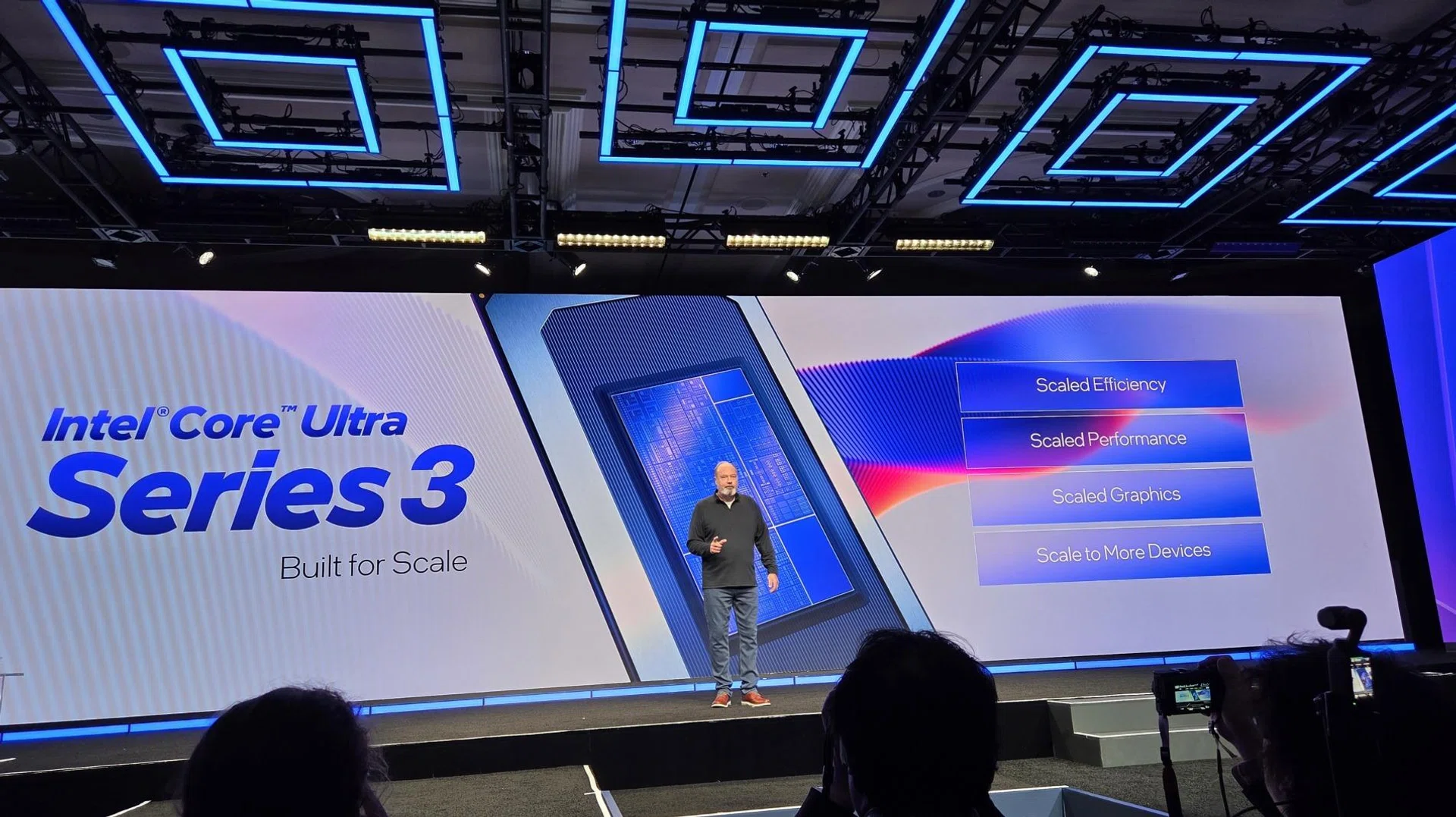
Intel’s Core Ultra 3 series (codename Panther Lake) platform marks one of the company’s most ambitious leaps in years, bringing together its cutting-edge Intel 18A process node, new RibbonFET transistors, and PowerVia backside power delivery to deliver significant gains in performance and efficiency across the board. Consumers can expect up to 50% higher CPU and GPU performance compared to the previous generation (Lunar Lake and Arrow Lake), thanks to redesigned Cougar Cove P‑cores, Darkmont E‑cores, larger caches, smarter power management, and a return of the memory‑side cache.
The new Xe3 GPU—available with up to 12 cores—pushes integrated graphics into entry‑level discrete GPU territory, offering up to 120 AI TOPS and new features like multi‑frame generation (XeSS‑MFG) for smoother gaming. AI performance also gets a boost with the redesigned NPU5, which delivers higher throughput in a smaller silicon footprint. Connectivity too sees a rare generational jump with Wi‑Fi 7 Release 2, Bluetooth 6.0 with extended range and device‑distance sensing, and integrated Thunderbolt 4.
Fundamentally, the Core Ultra 3 series is available is a scalable offering that’s designed with three base configurations starting from an 8C + 4Xe for the thin and light laptops, stepping up to 16C + 4Xe for creators and gamers who need more power and to couple it with discrete GPUs, and finally an 16C + 12Xe offering that’s expressly made for high-performance edge computing, robotics, handheld gaming consoles and can even double up for thin and light gaming machines.
| Type | 8-core | 16-core | 16-core 12Xe |
|---|---|---|---|
| CPU Cores | Up to 8 | Up to 16 | Up to 16 |
| GPU Cores | Up to 4 Xe3 cores | Up to 4 Xe3 cores | Up to 12 Xe3 cores |
| NPU | NPU5 | NPU5 | NPU5 |
| Memory (LPDDR5x) | Up to 64GB (6800MT/s) | Up to 96GB (8533MT/s) | Up to 96GB (9600MT/s) |
| I/O | 12 PCIe lanes | 20 PCIe lanes | 12 PCIe lanes |
The new Core Ultra 3 series processor SKUs

Intel debuts a new X7 and X9 processor class designation
To demarcate the most powerful new models with the most capabilities, which is the 16C + 12Xe config, after consulting industry partners, Intel has debuted the Core Ultra X7 and Core Ultra X9 designations to these processors. These build on the exiting Core Ultra 7 and Core Ultra 9 classes, but the X-edition denotes the use of the 12Xe graphics core. Most other processor models use a 4Xe graphics core (or its derivative, hence you can even see some with just two graphics cores).
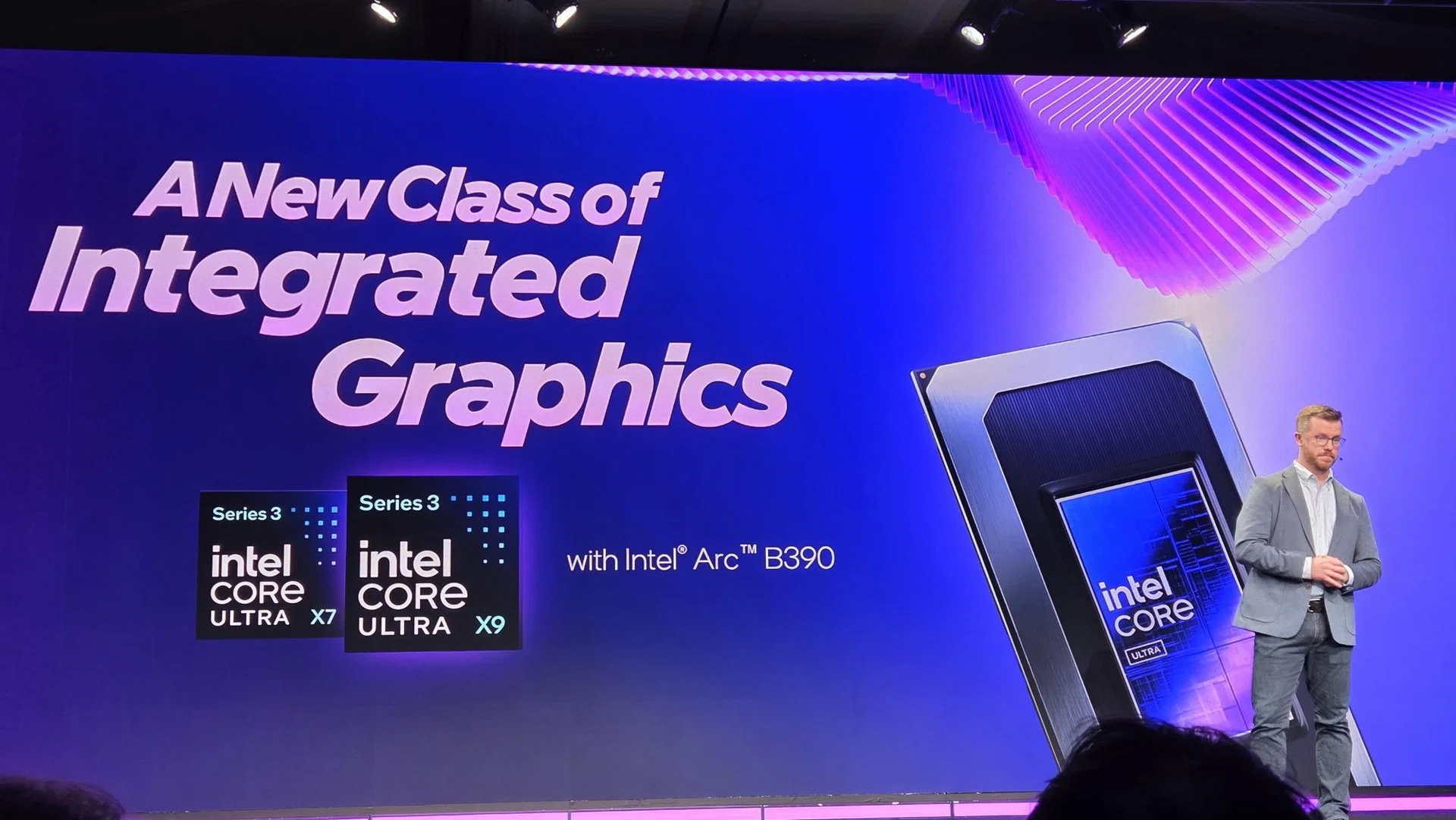
Additionally, the X7 and X9 based laptops will feature not just one Intel sticker to denote the processor class, but also the Intel Arc graphics sticker for easier recognition on the retail-front. Lastly, the new official name of the 12Xe graphics engine is Intel Arc B390. This is still a technical marketing name for use on specs sheets, but it will unlikely be called out in any other way besides the X7 and X9 processor stickers together with an Intel Arc graphics sticker at the retail front.
What can you expect? Intel’s tests indicate you can expect the same performance from a laptop equipped with a GeForce RTX 4050 GPU. What’s more interesting is that the power draw of such a laptop is measured around 60W, but Panther Lake’s top CPU – the Core Ultra X9 388H with Intel Arc B390 integrated graphics, can deliver similar performance at just 45W sustained platform power draw. Impressive stats that we would love to also test out with retail-ready laptops shipping in the coming month.

Intel also states that it’s over 70% faster than their fastest Lunar Lake processor and AMD’s HX370-based laptop on Full HD resolution gaming. Needless to say, Intel isn’t going to hold back on Qualcomm either, sharing that it can’t run many of the games in their test portfolio and those that do run, they come up far slower. However, we’ve to caveat that this is against their older Snapdragon X Elite class processors and not the more recently launched X2 Elite. So we’ll have to dig in further in time to come for a more even comparison, though we don’t think the game compatibility support is going to improve overnight.
What’s common to all the Core Ultra 3 processors?
1) A powerful NPU all through the stack
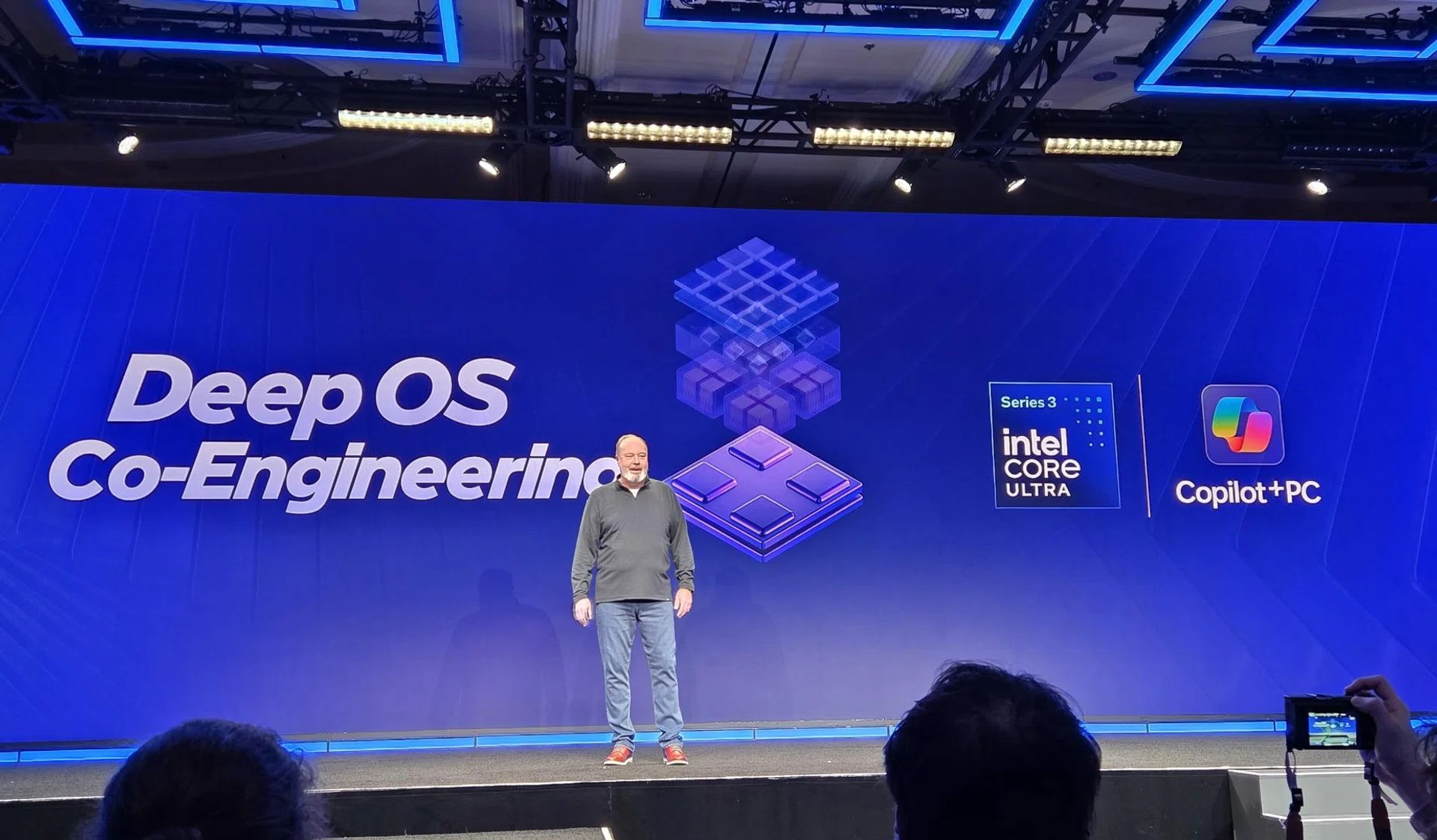
I would have to say the highlight would be the all-new NPU5 engine that’s used throughout – be it an Ultra 9, Ultra 7 or Ultra 5 class of processors. More than the same engine type, their throughput is mostly the same, ranging between 46 and 50 NPU TOPS in performance. This indicates that the NPU5 engine is mostly intact across the classes, and throughput varies only due to other factors such as processor speed, cache size, and memory speed/size.
With so much core NPU power, the entire Intel Core Ultra 3 series line-up is also Microsoft CoPilot+ AI PC compliant from the get-go. Here’s more reading on this marketing schema and what tools are accessible for such laptops and systems.
2) New Xe3 graphics engine everywhere
Another commonality is that all the processor SKUs use the new Intel Xe3 graphics engine, so their technical competence and feature support are identical across the ranks, though only the X7 and X9 parts use the 12-core graphics engine (Intel Arc B390). While we’re at this, do note that there’s an interesting 10-core Xe3 GPU with an Intel Arc B370 marketing name in the Core Ultra 5 338H part, but it’s strangely not assigned to the X-class range.
3) Large addressable memory size
Almost all the processor models support up to 128GB of DDR5 or 96GB of LP5x memory, which is a big jump in addressable memory over past processors. The only problem now is that the memory market hasn’t been kind to the entire industry, with limited production of consumer-class memory, which is increasing the cost of acquiring this memory. If you haven’t noticed, memory silicon producers are gearing up for enterprise memory needs (thanks to the rise of AI adoption across businesses), because it translates to far higher margins. While this is an industry-wide limitation, it’s not clear when it might correct itself; for now, we’ll just compare the platform's technical capabilities and competence.
4) Multiple thermal design envelopes to suit different platforms/configurations/chassis
The last point to take note are that the base power for all the Intel Core Ultra 3 series is designed at 25W and goes up to 55W for maximum power turbo power output, the “H” class chips can go up to 65 or even 80W to deliver the extra processing power required to sustain higher maximum turbo speeds across its P-cores. This is probably why all the 16 and 12-core processors are H-class chips.
In Summary
For consumers, Intel Core Ultra Series 3 represents a meaningful step forward with faster performance, smarter AI acceleration, far stronger graphics, better battery efficiency, and next-generation wireless capabilities—all arriving after this month.
Wait, there’s more.
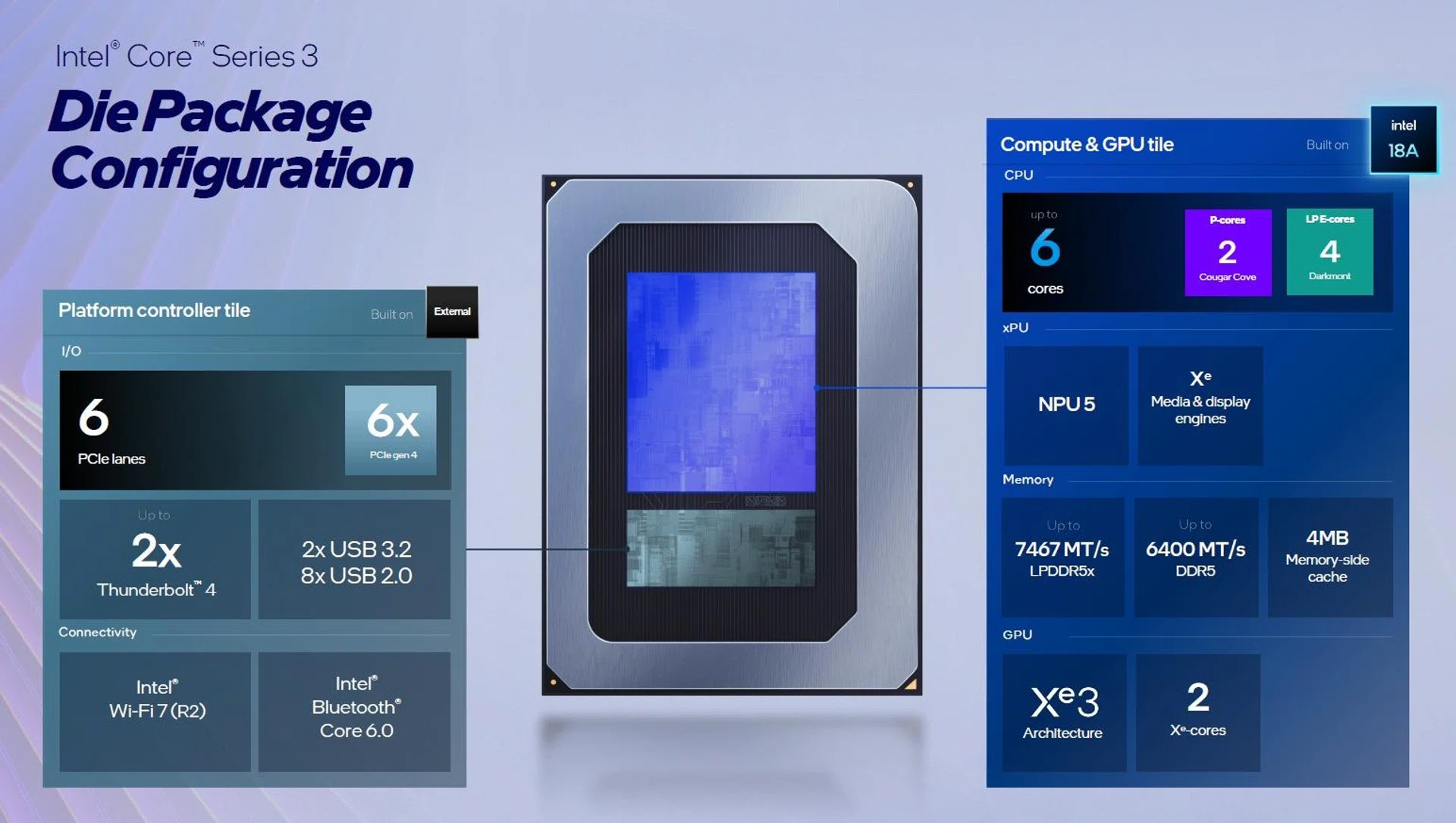
You didn’t really think the launch was an exhaustive one without the non-Ultra line-up? Here’s a preview of the Core Series 3 processor configuration that would likely take up the Core 3 and Core 5 marketing line-up. No details have been shared today about the processor stack, but it’s safe to assume it will happen sometime in the first half of 2026. Intel did promise they’ll have more updates throughout the year. Of interest is that the main processing tile is configured differently, with the GPU integrated into the same compute tile, and everything is manufactured on the new Intel 18A process node. Meanwhile, the platform controller tile is using an external supplier, but it doesn’t seem to be part of the same die package. We’ll update this space when there’s more information.
And don’t forget Edge Computing
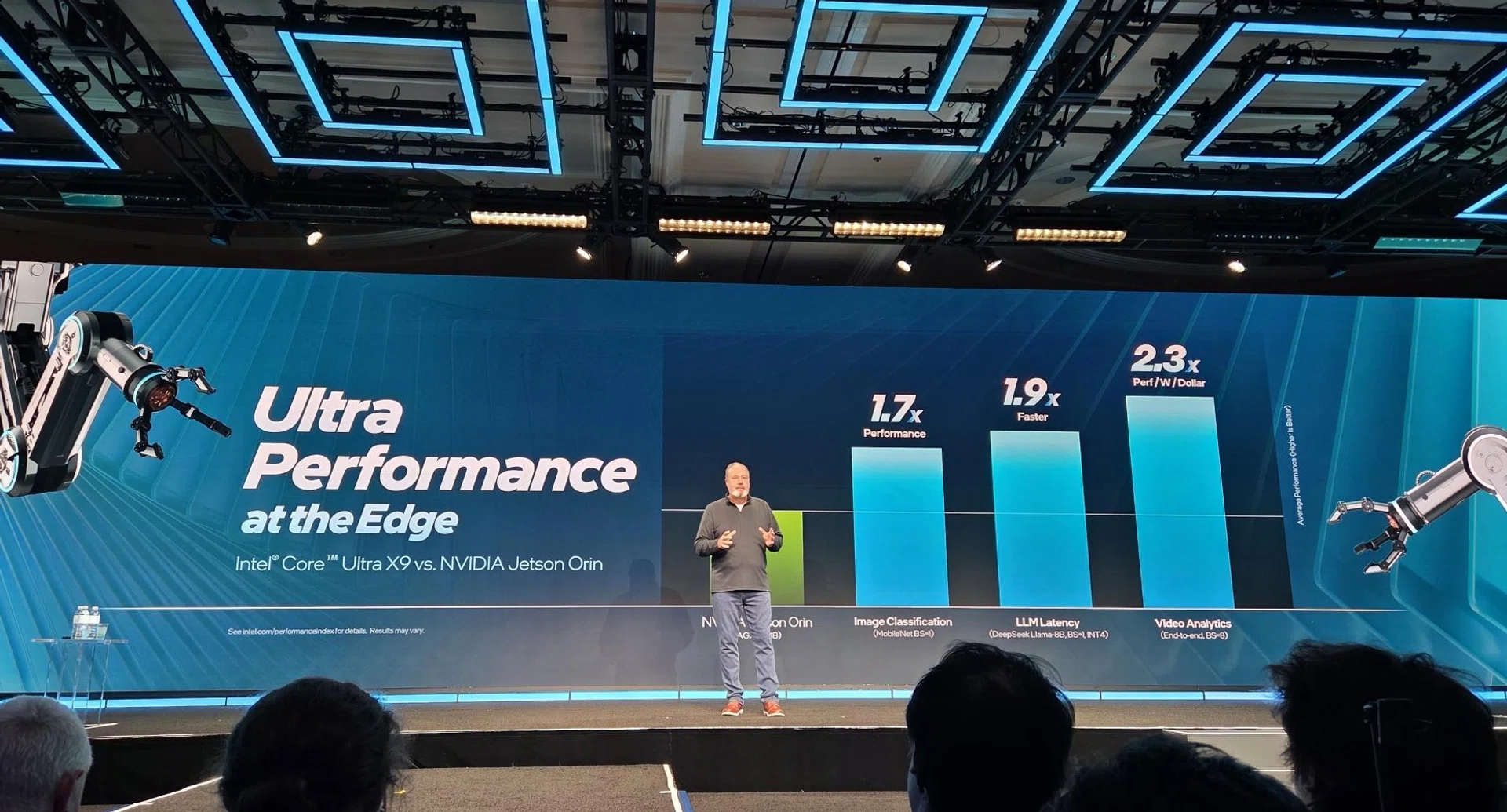
What Intel spent time announcing today is also the Core Ultra 3 series for edge computing, thus reinforcing their focus on rolling this platform of processors at scale. They were most confident in sharing some test scenarios showing how NVIDIA’s Jetson AGX Orin 64GB compares with an Intel Core Ultra X9 388H where team blue comes out ahead in image classification, LLM latency and video analytics workloads. Lastly, the edge-certified version of the Intel Core 3 processors will be available starting in Q2 2026.