
ASUS TUF Gaming Radeon RX 9070 XT OC Edition review: Strong 4K performance at a steep price
It's one of the best-looking Radeon RX 9070 XT graphics card too.
#asus #tufgaming #amd

Note: This review was first published on 18 March 2025.

This TUF Gaming is easily one of the best-looking RX 9070 XT cards around. Photo: HWZ
It’s not a stretch to say that AMD’s newest GPUs, the mid-range Radeon RX 9070 series (read our review here), are selling immensely well at retail. Thanks in part to NVIDIA dropping the ball with their own mainstream model – the GeForce RTX 5070 – but also because the RX 9070 XT offers outstanding performance for US$599. NVIDIA’s own equivalent would be the GeForce RTX 5070 Ti, but that card’s SRP starts from US$749.
In short, if you’re looking for a new mid-range (or mainstream) graphics card then the smart money is on the Radeon RX 9070 XT. Like this ASUS TUF Gaming Radeon RX 9070 XT OC Edition that we are reviewing today.
Unlike its flashier siblings from the premium ROG Astral and Strix series that are known for featuring RGB and overclocking, graphics cards from the TUF Gaming line have a more tone-down design and are geared towards value-oriented gamers. That’s not to say ASUS has cheapen out here. The TUF Gaming Radeon RX 9070 XT is still built with quality components that ASUS says were “selected for performance and durability”. These include high-grade chokes and MOSFETs as well as capacitors that meet military-grade certification, all of which were soldered to the PCB with ASUS’ Auto-Extreme manufacturing. Apparently, this automates as much of the process as possible to avoid human error on solder joints.
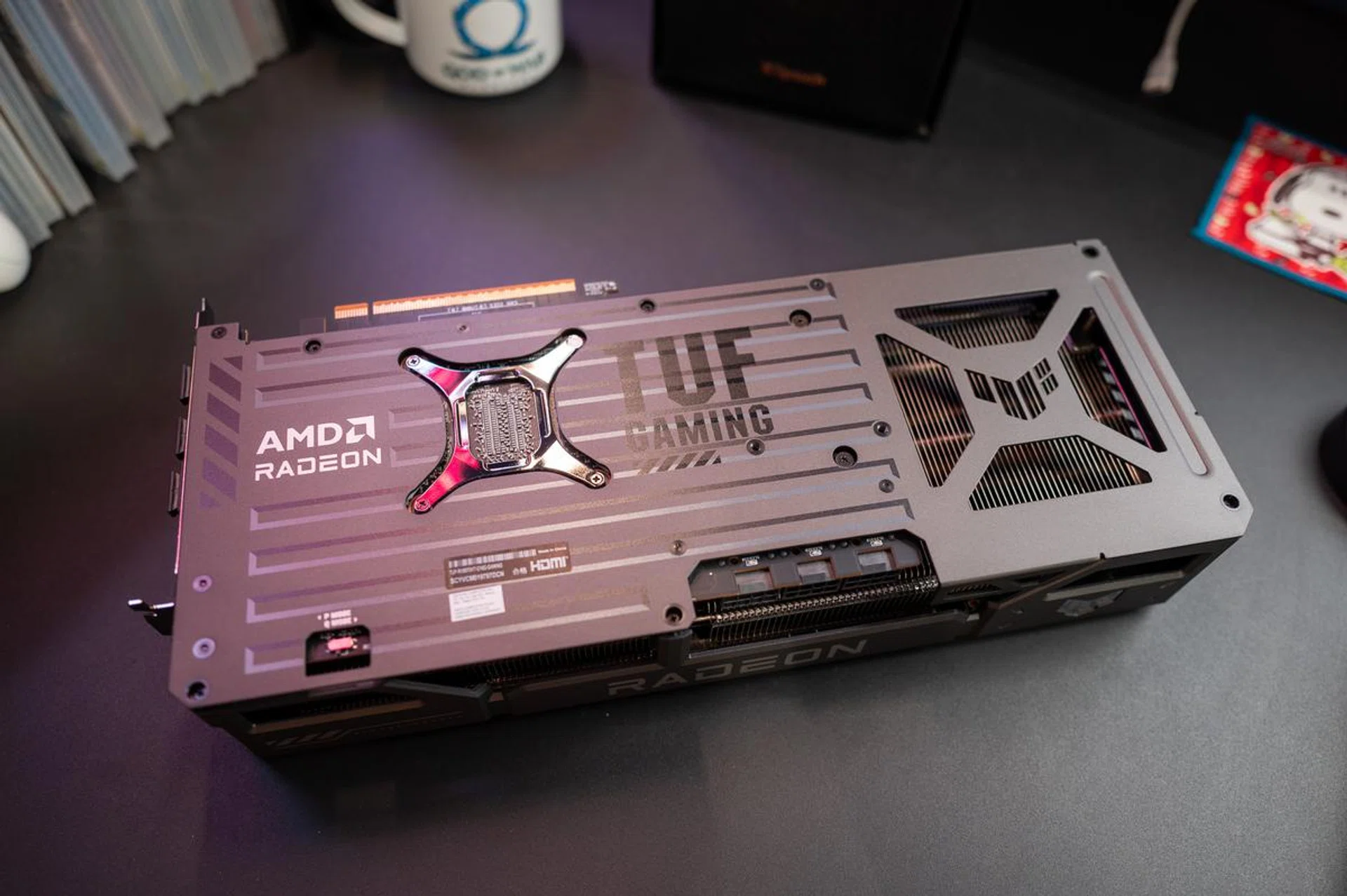
The build is solid and robust too. As one would expect from ASUS' TUF Gaming line. Photo: HWZ
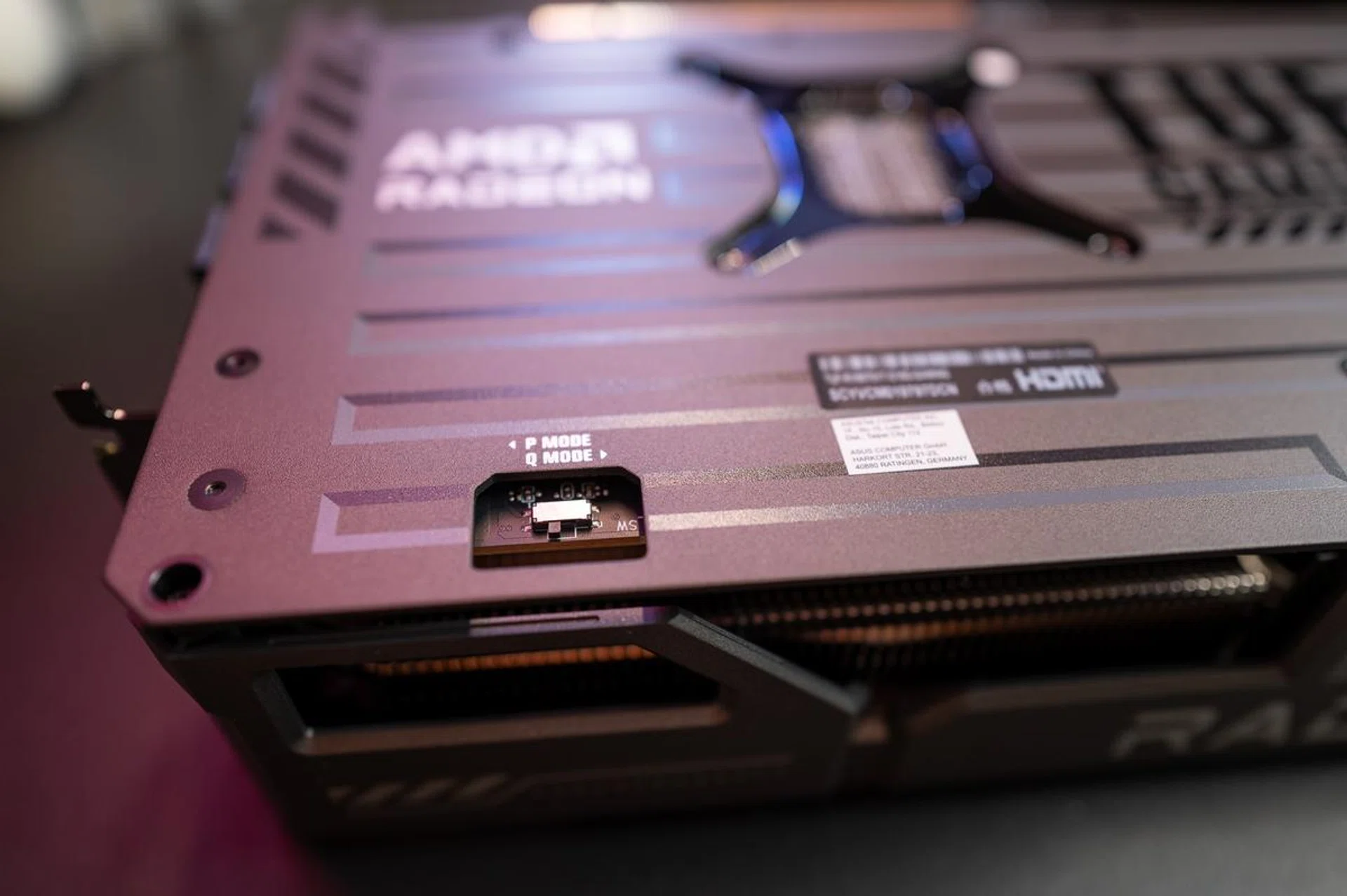
While you can switch between "Performance" and "Quite" modes, there's no compelling reason to choose the latter. Photo: HWZ

The TUF Gaming Radeon RX 9070 XT OC Edition is pretty big too. Photo: HWZ
In terms of looks, this TUF Gaming card does live it up to its moniker. There’s a certain “toughness” element to its diecast shroud and aluminum backplate, and its industrial theme and dark-ish grey and silver tones give the card a more neutral style that allows for easy mixing with different components in your PC. Cooling is provided by three fans, with the two outer fans spinning anticlockwise, while the middle fan spins clockwise, to reduce turbulence. They also only spin up when the GPU temperature hits 55-degree Celsius and above. RGB is almost non-existent with the TUF RX 9070 XT, with only the TUF logo lighting up when powered.
Overall, it’s a really solid card to look at and its heft gives added assurances to its build quality. Perhaps my only gripe is that the card uses three 8-pin PCIe power connectors, unlike the Powercolor Hellhound Radeon RX 9070 XT that we reviewed earlier, which uses just two. I’m neutral about NVIDIA’s single 12V-2x6 power connector despite reading about cable melting incidents when used with GeForce RTX 5090 cards, but even that has got to be a more elegant and tidy solution than having three power connectors jutting out of the side of the TUF RX 9070 XT card.
PowerColor Hellhound Radeon RX 9070 XT (Reference card) | ASUS TUF Gaming Radeon RX 9070 XT | |
GPU | Navi 48 (RDNA 4) | Navi 48 (RDNA 4) |
Process | 5nm | 5nm |
Foundry | TSMC | TSMC |
Transistors | 53.9 Billion | 53.9 Billion |
Compute Units | 64 | 64 |
Game Clock (MHz) | 2460 | 2520 |
Boost Clock (MHz) | 3010 | 3060 |
VRAM | 16GB GDDR6 | 16GB GDDR6 |
Memory Bus | 256-bit | 256-bit |
Memory Bandwidth | 644.6 GB/s | 644.6 GB/s |
TDP | 304W | 304W |
Price | US$599 /S$1,079 (via Techyard) | S$1,349 |
Specifications-wise, the TUF Radeon RX 9070 XT is similar to the Powercolor Hellhound that we used as our reference RX 9070 XT card. Except that it is an OC (aka overclocked) variant, so it’s got a faster (albeit just slightly) clock speed right out of the box. But does that extra oomph translate to better performance? Let’s find out.
Our test rig
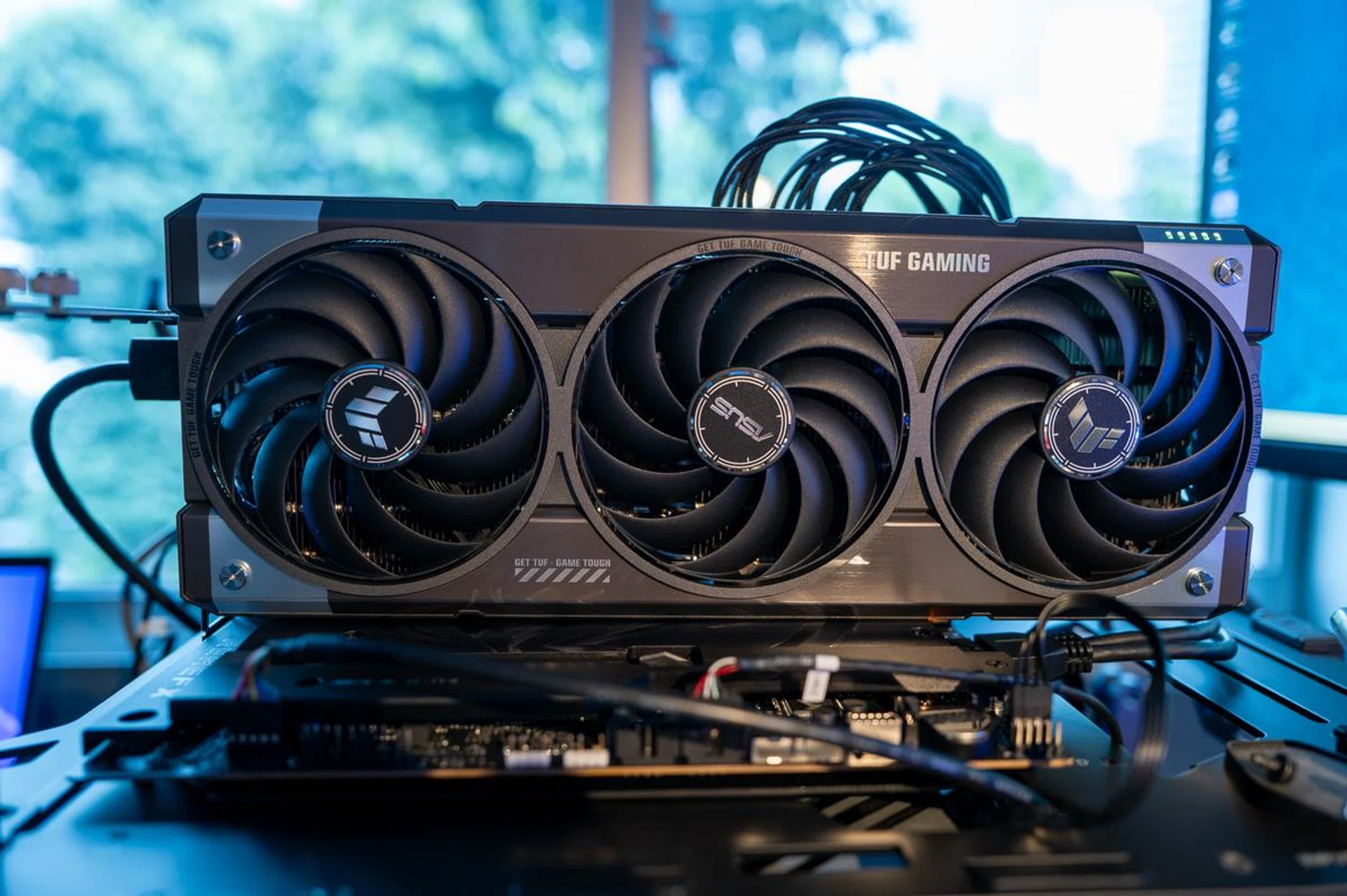
If you're an RGB lover, then the TUF Gaming line might not be up to your taste. Photo: HWZ
Our test machine remains unchanged from the one used in our Radeon RX 9070 and RX 9070 XT review and comes with the following specifications:
- AMD Ryzen 9 9950X
- ROG Maximus Z890 Hero
- Samsung 990 Pro 1TB SSD
- Kingston Fury 32GB DDR5
- Windows 11 Home 64-bit
- ASUS ROG Swift OLED PG32UCDM 4K Gaming Monitor
As the first partner’s card (ASUS, Gigabyte, Sapphire, etc), we’ll measure the TUF Radeon RX 9070 XT OC’s performance against the Powercolor Hellhound Radeon RX 9070 XT.
Gaming performance (rasterisation)
My game list includes a mixture of old and recent games to test the TUF RX 9070 XT's performance, and while the list isn’t exhaustive by any measure there are enough different game engines and APIs variety to give us an idea of broader performance trends.
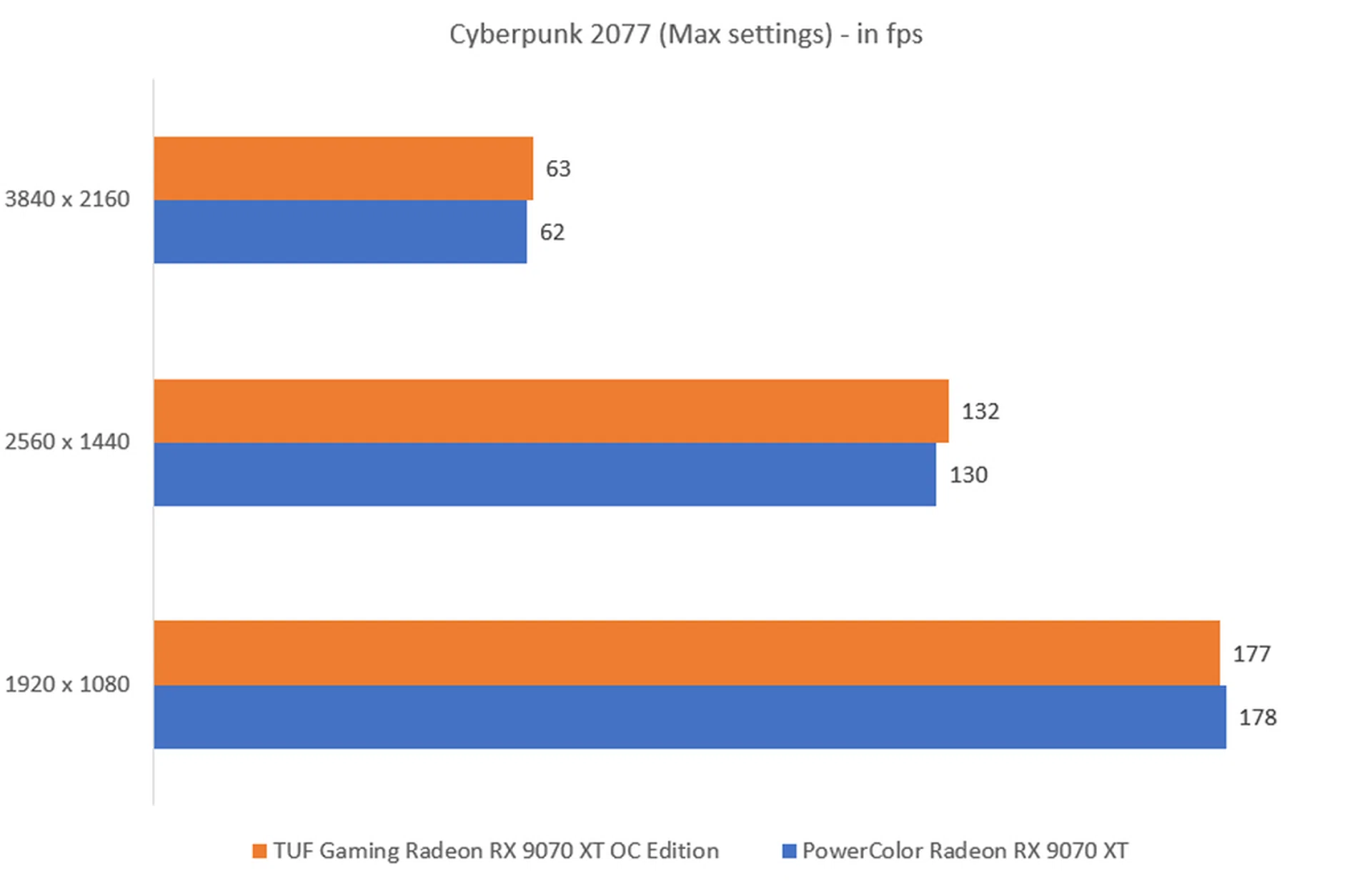
The higher the fps, the better.
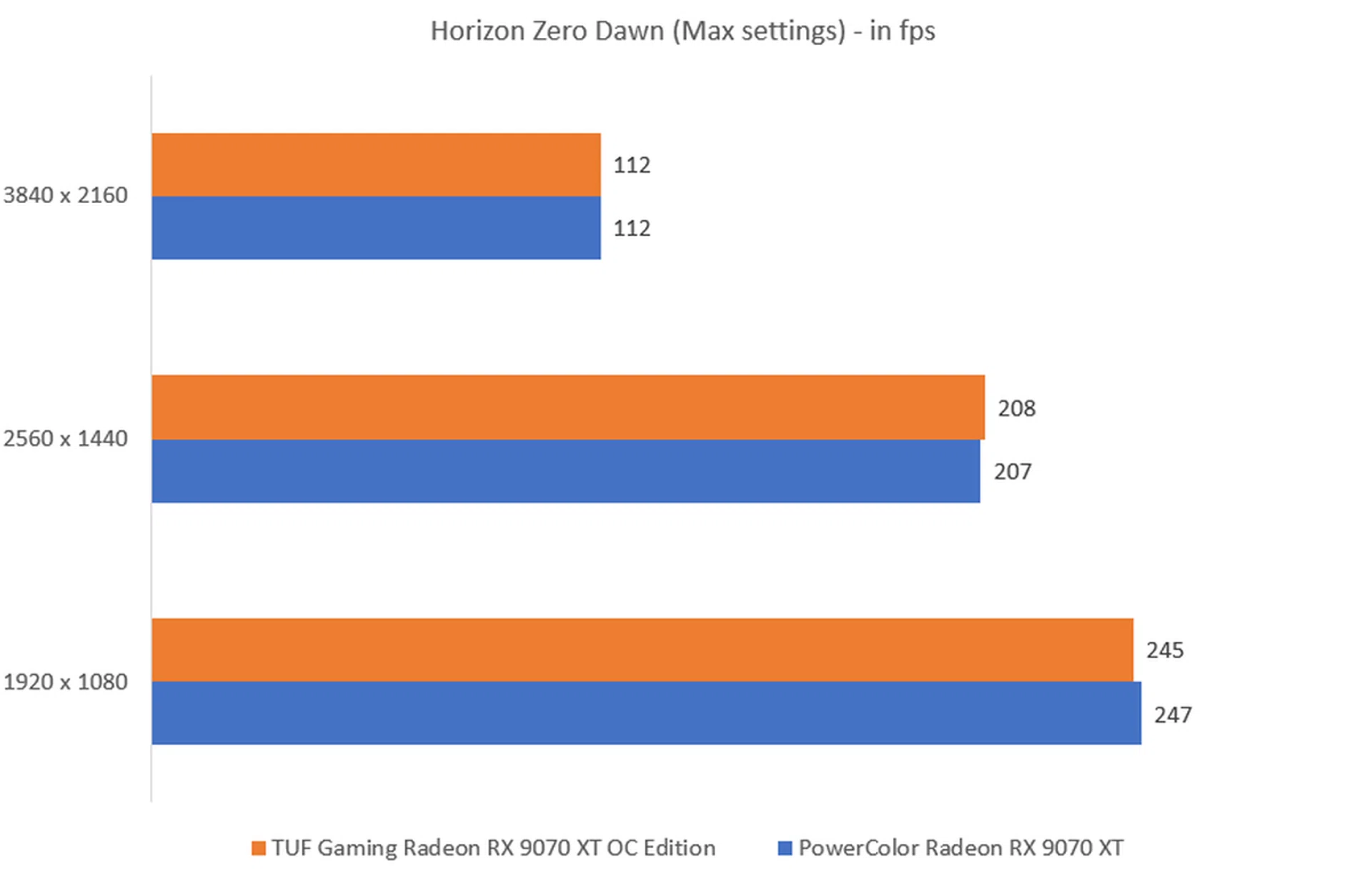
The higher the fps, the better.
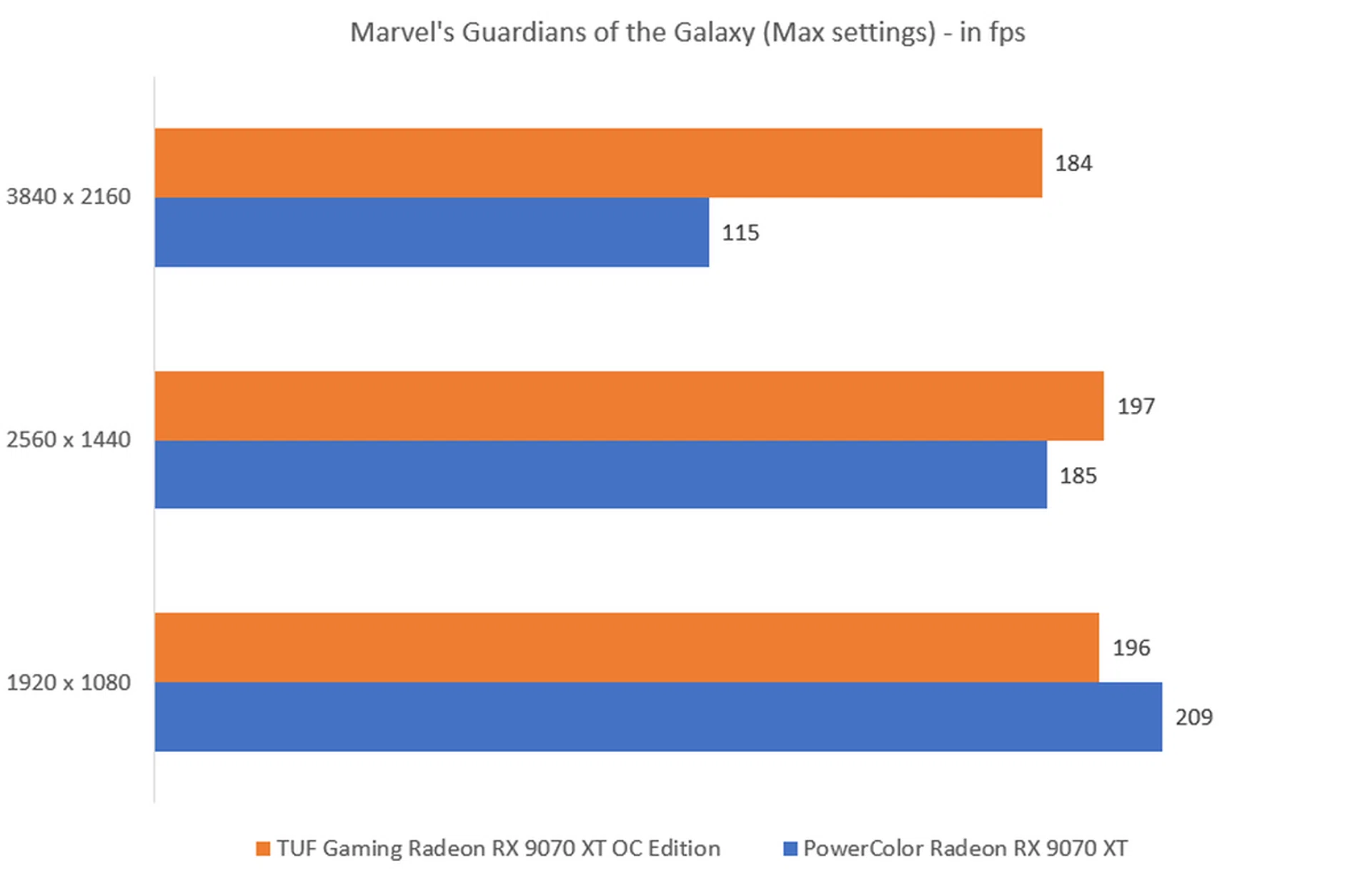
The higher the fps, the better.
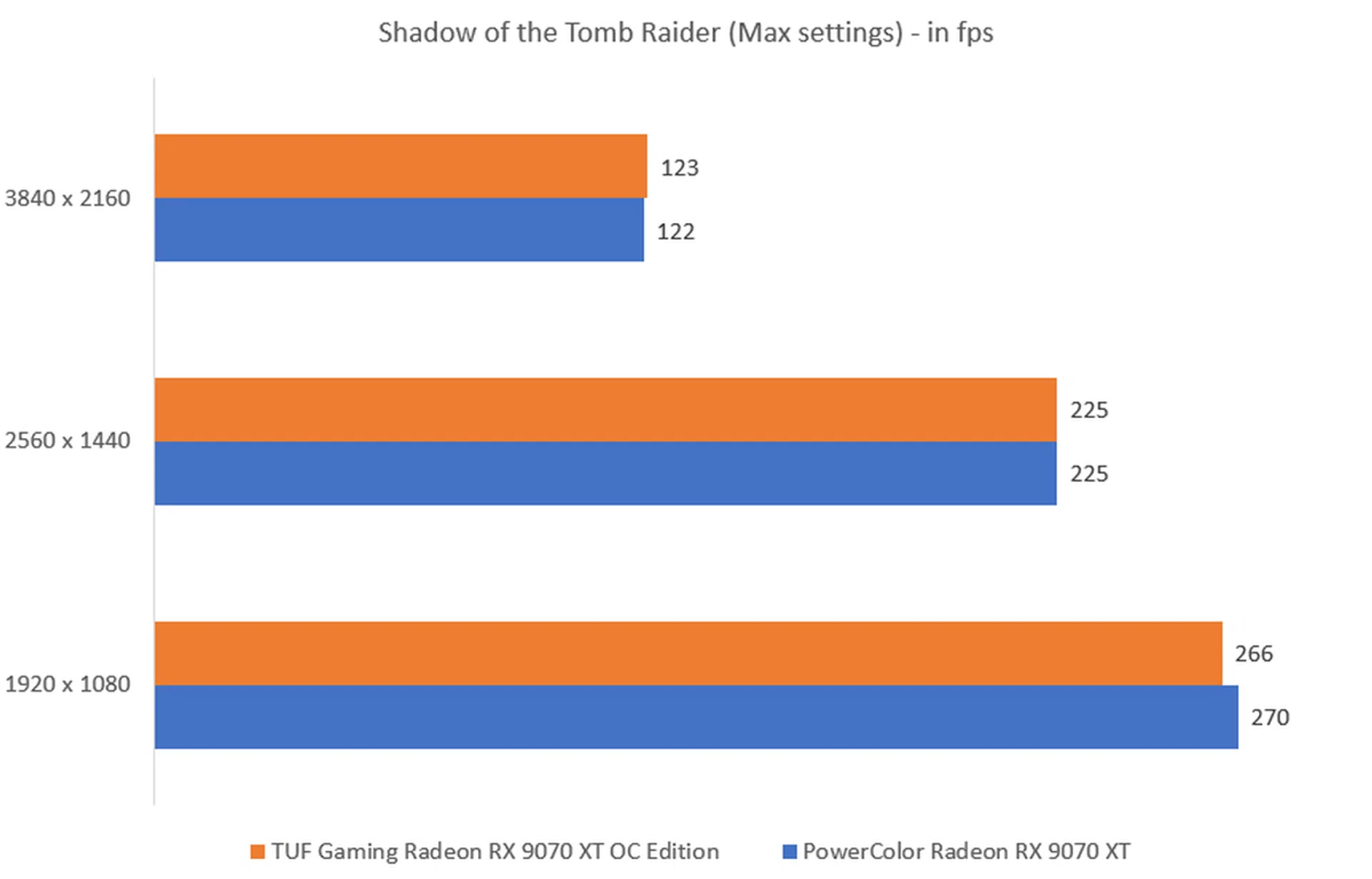
The higher the fps, the better.
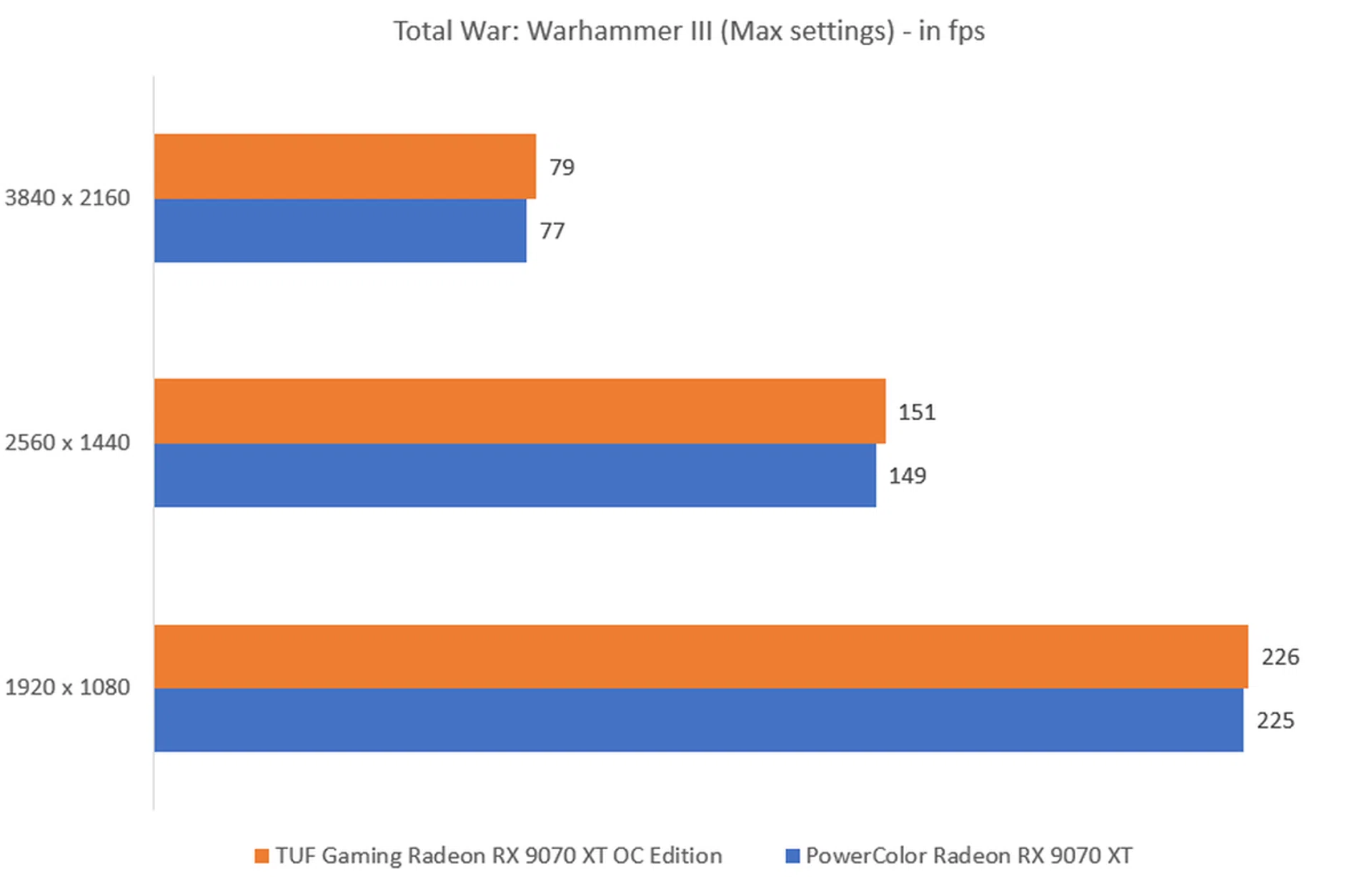
The higher the fps, the better.
In rasterisation performance, the TUF card pretty much outperformed our Powercolor reference card especially at 1440p and 4K resolutions. That is not surprising however, since it has a wee bit faster clock speed. But it's odd to see how the Powercolor card falls so much behind the TUF Gaming card in Marvel's Guardians of the Galaxy at 4K. I've ran the same benchmark with both cards multiple times and the results came out the same; I suspect a driver issue is at play here.
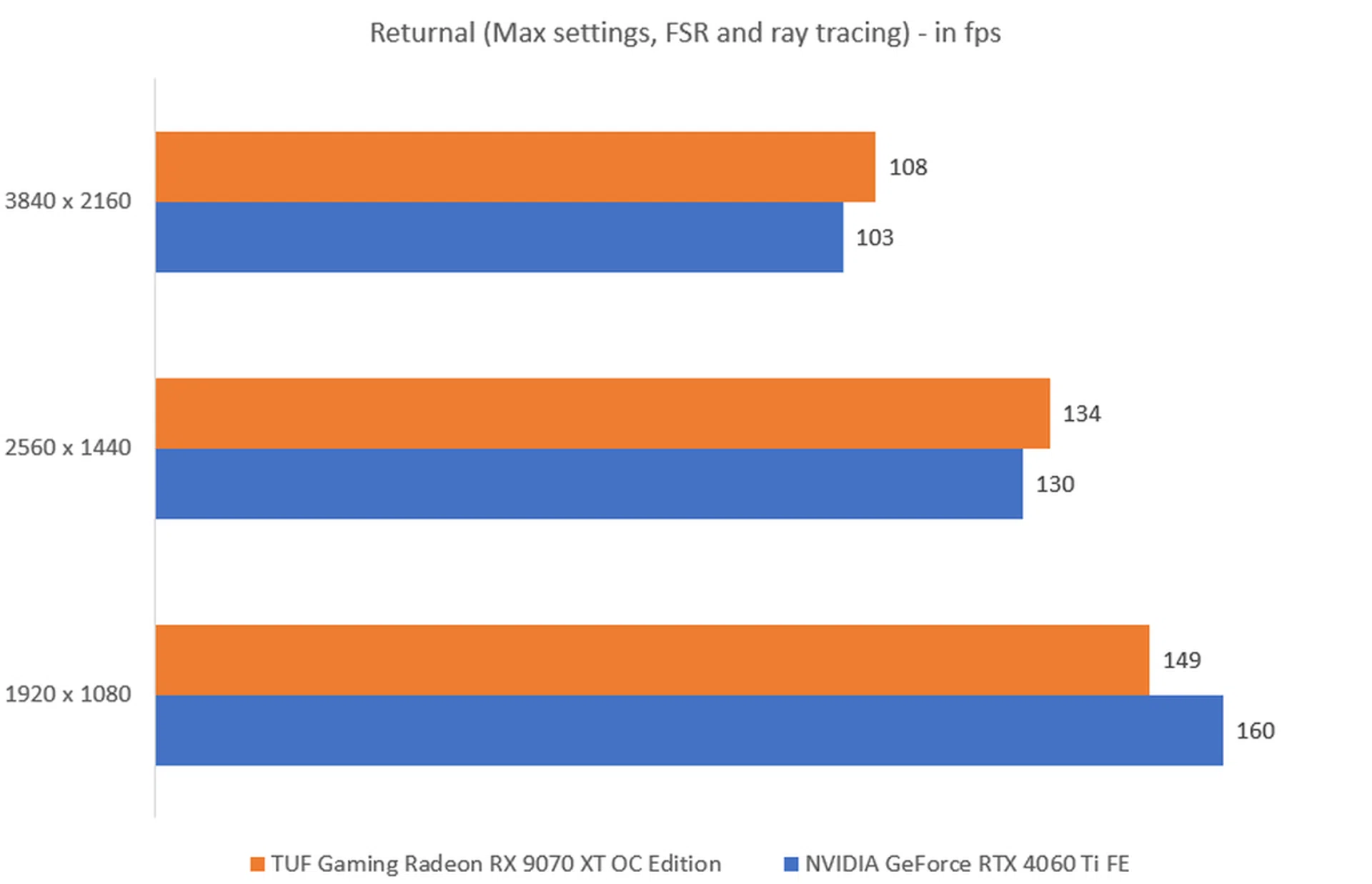
The higher the fps, the better.
Elsewhere, I also tested both cards with Returnal but with FSR and ray tracing turned on. The result pretty much mirrors the rasterisation benchmarks earlier, with the TUF Gaming card performing better at higher resolutions but somewhat behind the Powercolor card at 1080p.
Power and Temperature
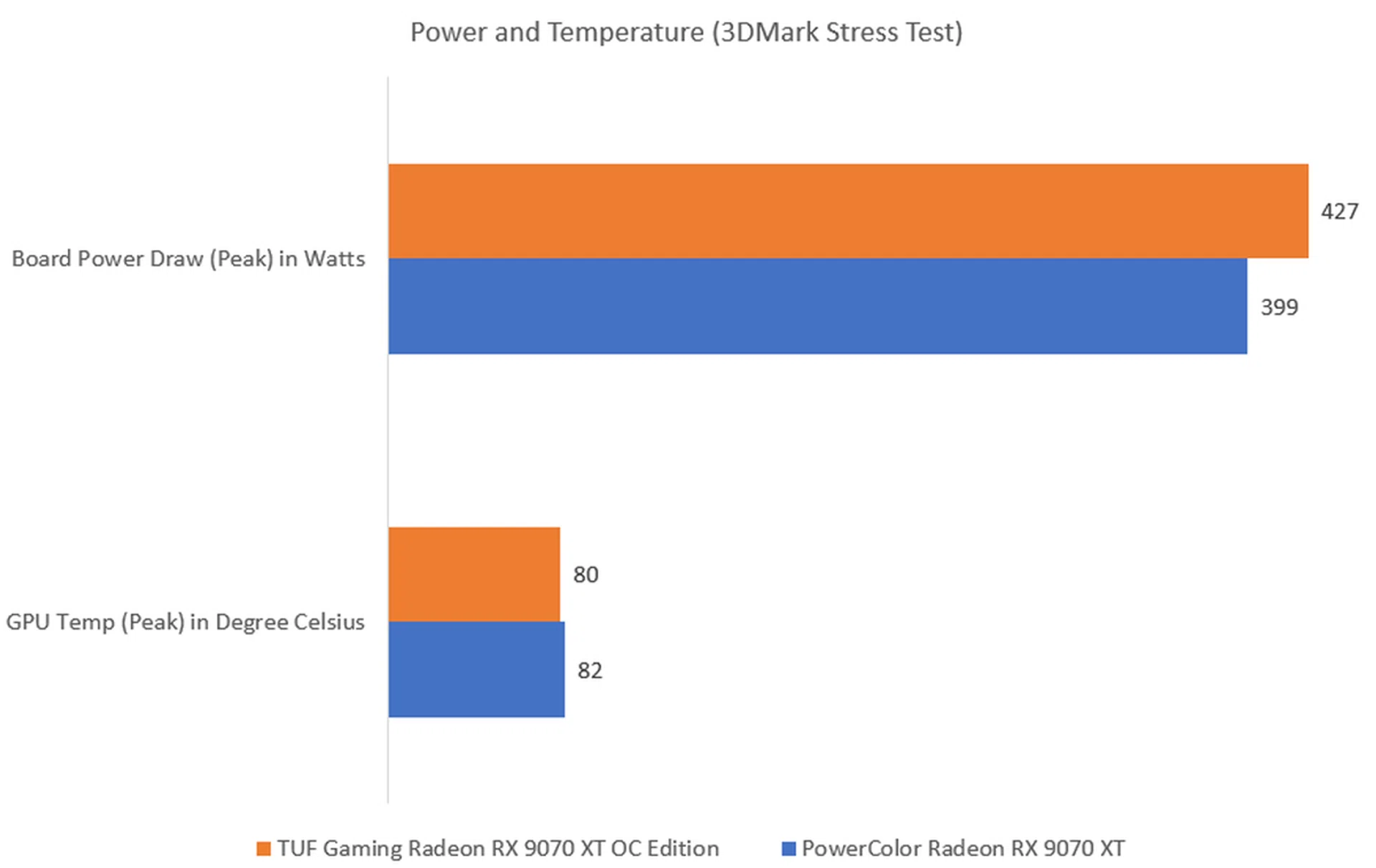
The lower the power and wattage, the better.
While both card comes with the same 304W TDP, the TUF Gaming card draws more power for two very simple and obvious reasons: It comes with a factory overclocked GPU (hence the "OC" moniker), and unlike the Powercolor card that has no RGB, lights on the TUF logo take up extra power juice too. As we review more incoming Radeon RX 9070 XT cards, we'll have a better idea of how TUF Gaming Radeon RX 9070 XT OC Edition compares with the competitions.
Final thoughts
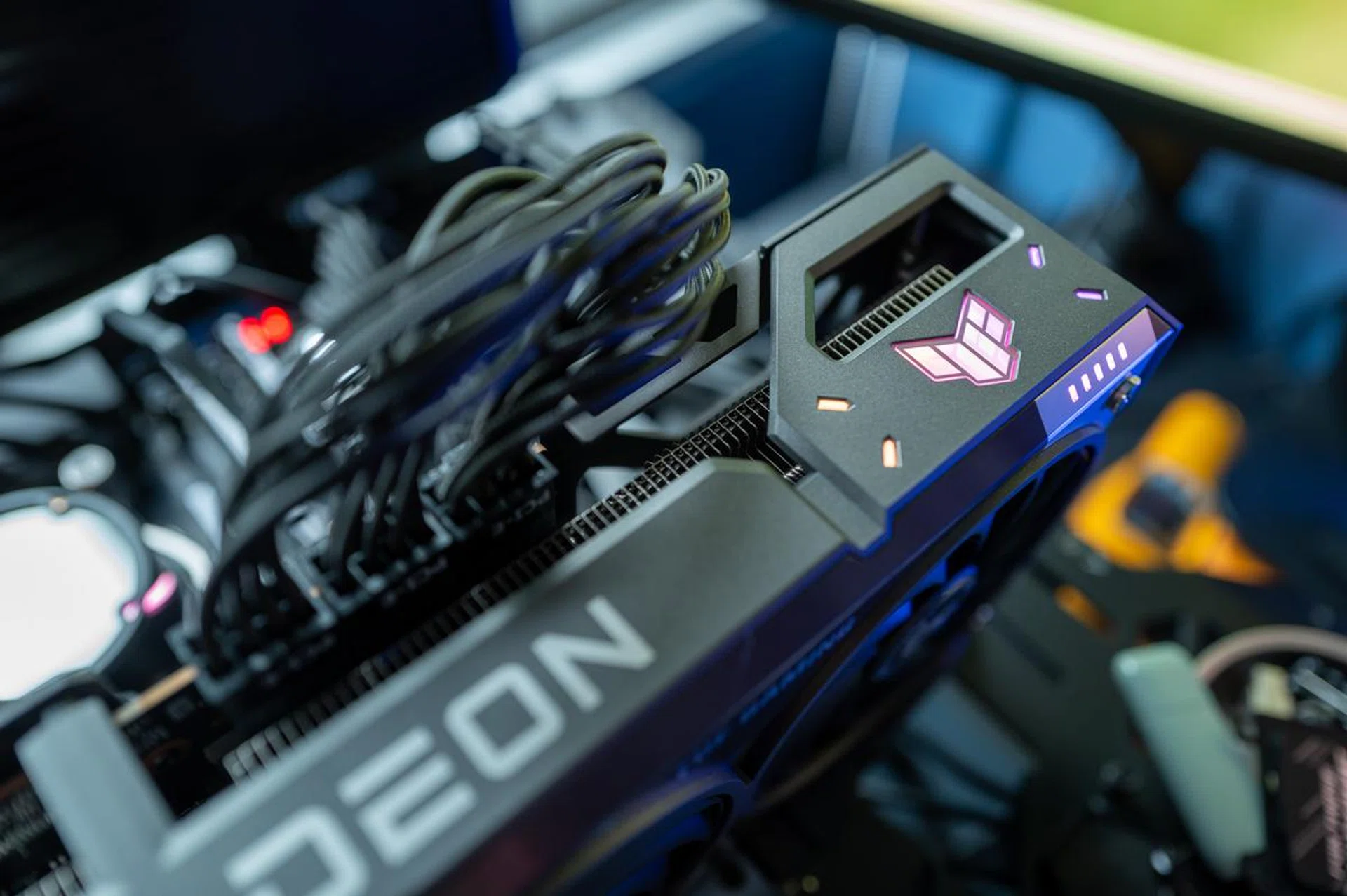
Having to use 3 power connectors is getting a bit ridiculous in 2025. Photo: HWZ
Ultimately, the ASUS TUF Gaming Radeon RX 9070 XT OC makes a compelling case if raw power, exceptional cooling, and a bold industrial aesthetic are your top priorities. In typical TUF fashion, ASUS has delivered a card that comfortably exceeds the stock RX 9070 XT’s capabilities, offering stable and consistently high frame rates across the games tested on, complemented by an impressively quiet triple-fan cooling setup. The refreshed look and restrained RGB lighting keep things tastefully minimal, and would fit into most DIY PC builds (unless you're going for an all-white theme).
Yet, as with all NVIDIA and AMD GPUs of this generation, there are some caveats. This TUF Gaming Radeon card, at S$1,349, is priced significantly higher than AMD's suggested US$599 mark – even after taking the current exchange rate into consideration. So, if sheer value-per-dollar is your main concern then the TUF GAming Radeon RX 9070 XT OC becomes a lot harder to recommend. And then there’s the substantial form factor; the card occupy over three slots, making it one of the biggest Radeon RX 9070 XT card around. Not to mention its heft means you'll have to use a graphics card stabiliser too (thankfully, included in the package)
That said, if budget isn't your foremost worry and you're after dependable performance wrapped in rugged, understated styling, then the ASUS TUF Gaming RX 9070 XT OC could comfortably find its way onto your shortlist. Just be prepared to pay a premium.
Our articles may contain affiliate links. If you buy through these links, we may earn a small commission.