
ASUS refreshes its monitor lineup with ROG Strix and ProArt displays
Among the new announcements are a dual-mode ROG Strix display and a 6K ProArt display.
#asus #rog #gaming

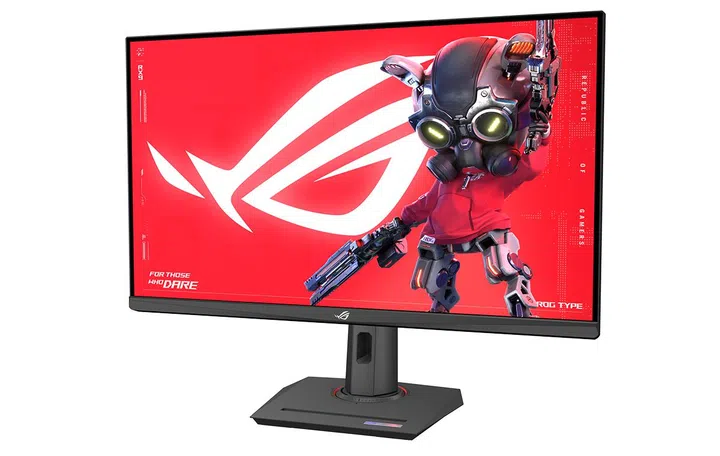
The ROG Strix XG32UCG features dual-mode 4K and FHD at different refresh rates. (Image source: ASUS)
As we build up to CES 2025 happening in January next year, ASUS has announced a slate of new monitors, including a new ROG Strix gaming monitor, three new high-resolution ProArt displays, as well as new ZenScreen monitors.
The highlight of this announcement is the ROG Strix XG32UCG, a 31.5-inch IPS gaming monitor. The main draw of this display is its dual-mode functionality; users can switch between 4K@160Hz or FHD@320Hz via a hotkey. The main use case ASUS is pushing for is immersion, and one can imagine switching to 1080p with a higher refresh rate for FPS gameplay, with 4K reserved for AAA games that have impressive graphics at the forefront.
Additionally, the XG32UCG also supports FreeSync Premium support for AMD graphics cards and G-Sync for NVIDIA ones. Connectivity options include Displayport 1.4, HDMI 2.1, and a USB-C port with 15W Power Delivery.
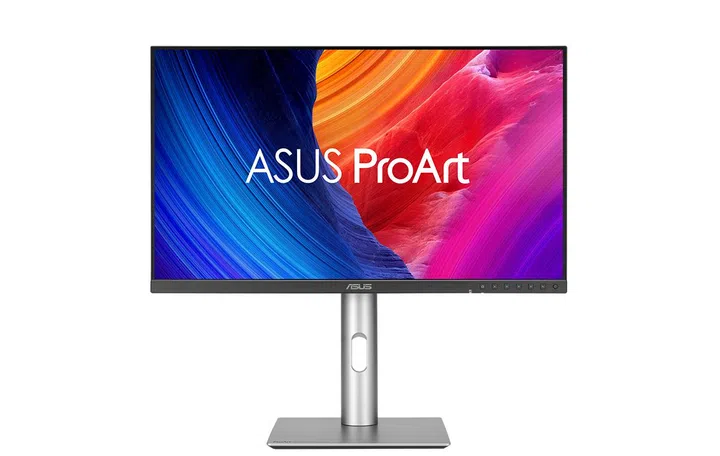
The ASUS ProArt Display 6K PA32QCV. (Image source: ASUS)
For its ProArt line of creativity-focused monitors, ASUS is doubling down on resolution. The 32-inch ProArt Display 6K PA32QCV features a 6016x3384 resolution, coming down to 216 pixels per inch (PPI). In terms of colour reproduction, the PA32QCV has 98% DCI-P3 and 100% sRGB coverage, is Calman verified, and is calibrated for Delta E<2 colour accuracy. The monitor also features ASUS's LuxPixel technology, with a proprietary anti-glare and low-reflection coating that doesn't compromise on image quality.
The PA32QCV also features a myriad of connection options, including two Thunderbolt 4 ports with 96W Power Delivery and daisy-chain support, a USB hub, as well as the usual DisplayPort 1.4 and HDMI 2.1 ports. Built-in Auto KVM also helps with workflow, with the ability to switch the monitor's connections between two devices with a single mouse and keyboard. And while it may look unassuming at first, the monitor stand provides tilt, swivel, pivot and height adjustment capabilities.
If 6K is too overkill, ASUS has also announced two new 4K monitors, the ProArt Display PA32UCE and PA27UCGE, which are of 32-inch and 27-inch sizes respectively. While 'only' 4K, ASUS is highlighting the practical features of these monitors, including the 600-nits brightness, 98% DCI-P3 gamut coverage and Delta E<1 colour accuracy. These monitors also support HLG and HDR10 formats, and the PA27UCGE specifically supports a 160Hz refresh rate. Both monitors also have a built-in flip colorimeter with support for auto and self-calibration.
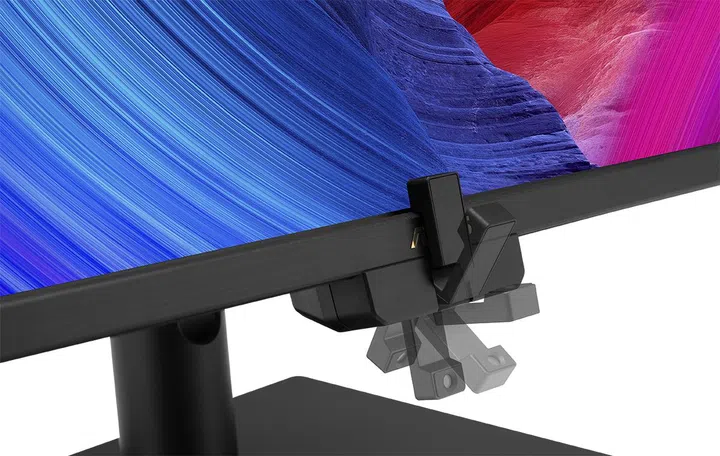
The colorimeter on the PA32UCE and PA27UCGE. (Image source: ASUS)
The PA32UCE and PA27UCGE also include ASUS's LuxPixel technology, the same anti-glare and low-reflection coating as the PA32QCV, and various connectivity options. While there's no Thunderbolt to be found here, it does include DisplayPort over USB-C with 96W Power Delivery, as well as more conventional DisplayPort and HDMI ports, along with a USB hub.
Finally, ASUS has also announced three new ZenScreen monitors:
- MS32UC, a 32-inch UHD IPS display with 98% DCI-P3 gamut coverage and support for HLG and HDR10,
- MB27ACF, a 27-inch QHD IPS display with a 100Hz refresh rate, and which measures at 5.4mm at its thickest point and weighs less than 3kg,
- MB169CK, a 15.6-inch FHD portable monitor that features a detachable 360° kickstand, a cutout that enables the monitor to be attached to a wall mount, along with connectivity options such as two USB-C ports, mini-HDMI and a headphone jack.
Pricing and availability details for these monitors are not out yet, but considering that ASUS is announcing this ahead of CES 2025, we may hear about these monitors again once the convention begins on 7 January next year.
Our articles may contain affiliate links. If you buy through these links, we may earn a small commission.