
Qualcomm unveils new mid-range Snapdragon SoCs and Gigabit LTE modem
Qualcomm has announced the Snapdragon 425, 435, and 625 SoCs, three new entry-level and mid-range chips. It also unveiled the Snapdragon X16 LTE modem, the first commercially available LTE modem to offer Gigabit-class download speeds.

Qualcomm has announced three new mid-range Snapdragon processors and a blazing-fast Gigabit LTE modem in the period leading up to MWC in Barcelona next week. We expect the company to unveil more details about its upcoming flagship Snapdragon 820 SoC then, and this latest announcement appears to lay the groundwork for that key reveal.
The new Snapdragon 425, 435, and 625 SoCs are intended to bring faster LTE speeds, improved performance, and better battery-life to entry-level and mid-range smartphones. All of them utilize Cortex-A53 CPU cores and support features like LTE with carrier aggregation, 802.11ac Wi-Fi with MU-MIMO technology, dual camera image signal processors (ISP), and the Qualcomm Hexagon digital signal processor (DSP) for dedicated multimedia and sensor processing.
Quick Charge, Qualcomm’s own fast-charging technology, is also supported. All three SoCs are pin- and software-compatible with each other, which should lower costs for manufacturers as there’s no need to pursue separate development tracks for entry-level and higher-end devices.
Qualcomm is touting much-improved battery life on the octa-core Snapdragon 625, which it says supports up to 35% lower power consumption than its predecessor, the Snapdragon 617. That’s thanks to the fact that this is the first mid-range SoC from Qualcomm to be built on the more efficient 14nm FinFET process, which could make the difference between your phone dying during dinner and it being able to last until you go to bed.

On top of that, the Snapdragon 625 includes an integrated X9 LTE modem with peak upload speeds of up to 150Mbps to support faster sharing of photos and videos. The chip also features an Adreno 506 GPU and support for dual high-resolution cameras (24MP back, 13MP front) and advanced post-processing effects.
The more modest Snapdragon 435 is also an octa-core Cortex A53 model, but it is paired with a slightly weaker Adreno 505 GPU and an X8 LTE modem that offers download speeds of up to 300Mbps and upload speeds up to 100Mbps. It is intended primarily for smooth user interactions at 1080p resolutions, and includes dual ISPs for 21MP photos and support for things like hybrid autofocus.

Finally, the Snapdragon 425 serves as the new entry-point to the Snapdragon 400 series, replacing the older Snapdragon 410 processor found in many low-end smartphones. It features a quad-core Cortex-A53 CPU and Adreno 308 GPU, the latter of which is actually quite a dated part from two generations back and supports up to 720p resolutions at 60fps.
The dual ISPs enable photos up to 16MPs, and the chip features the slowest modem of all the new SoCs – an X6 LTE modem with upload speeds up to 75Mbps. Qualcomm expects the chip to allow for more cost-effective smartphones tailored for China and other emerging markets.
All three SoCs are expected to begin sampling to customers in mid-2016, and to reach commercial devices in the second half of the year.

Qualcomm’s new Category 16 modem provides considerable cause for excitement. It is built on the 14nm FinFET process, and can reach download speeds of up to 1Gbps, the elusive upper limit of 4G LTE. However, upload speeds are less impressive, at just 150Mbps, but it’s still quite something to finally hear about a Gigabit LTE chipset. In comparison, the X12 LTE modem that will come with the upcoming Snapdragon 820 SoC supports up to LTE Category 12 for downlink, with speeds up to 600Mbps.
The new modem will offer Gigabit speeds using the same amount of spectrum as Category 9 LTE devices, using carrier aggregation and 4x4 MIMO technology (current devices use 2x2 MIMO at most) to receive 10 unique data streams (100Mbps per stream) via only three 20MHz carriers.
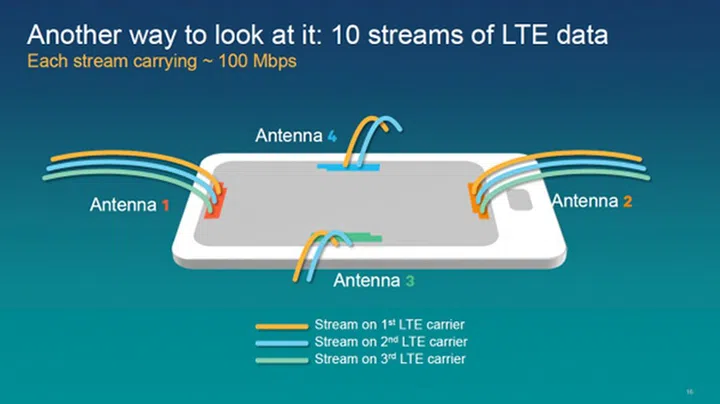
Image Source: Golem.de
In addition, Qualcomm hopes to make it easier for global carriers to offer Gigabit speeds by allowing them to utilize the free unlicensed spectrum to increase the number of supported LTE connections on their networks. The Snapdragon X16's combination of LTE-U and Licensed Assisted Access (LAA), the global standard for LTE in the unlicensed spectrum, will potentially open the door to greater network capacities and faster networks.
The Snapdragon X16 modem will also pave the way for Qualcomm to evolve its modem product line to serve a wide range of connected applications, ranging from ultra-fast mobile broadband to power-efficient connectivity for IoT devices. The company envisions the new chipset in a variety of connected platforms, including smartphones, tablets, cars, and even drones and VR headsets. Furthermore, the 1Gbps download speed opens up the way to high-bandwidth applications like live streaming of VR content and quicker access to cloud-based services.

Still, that’s all nice and well in theory, but it remains to be seen how much impact a Gigabit-class modem will have in practice as most consumers are likely to see lower speeds over the next few years at the very least. Just consider the fact that OpenSignal recently ranked Singapore as the fastest country with LTE, with a download speed of 37Mbps. In fact, the global average sits at just 13.5Mbps.
The existence of carrier data caps will be another limiting factor, and 1Gbps speeds make little difference in daily tasks like Web browsing. Instead, the biggest difference will be felt in applications like video streaming, which is where small data caps are the greatest setback.
The X16 modem is expected to arrive on devices in the second half of 2016. In the meantime, we can only hope that we won’t have to wait for too long before carriers begin launching higher-speed networks with larger data caps.
Source: Qualcomm (1), (2)
Our articles may contain affiliate links. If you buy through these links, we may earn a small commission.