
Apple iPhone X performance review (updated with battery life performance!)
The Apple iPhone X won't be available until this Friday (3rd November) but we've managed to get our hands on a review unit ahead of time to test its performance capabilities. For this article, we'll be running the X through a lot more benchmarks than we do in our usual reviews, just to see how good it really is.


Update (3rd November): We've updated this review with battery life performance. Skip to the bottom of the page to check it out.
The Apple iPhone X won't be available until this Friday (3rd November) but we've managed to get our hands on a review unit ahead of time to test its performance capabilities. For this article, we'll be running the X through a lot more benchmarks than we do in our usual reviews, just to see how good it really is.
Like the iPhone 8 and 8 Plus, the iPhone X uses Apple's new A11 Bionic processor, a hexa-core chip with two performance cores that are 25 percent faster than the A10, and four high-efficiency cores that the company says are 70 percent faster that the old model. There’s also a new Apple-designed GPU that’s 30 percent faster, with the same performance as the A10, but only consumes half the power.
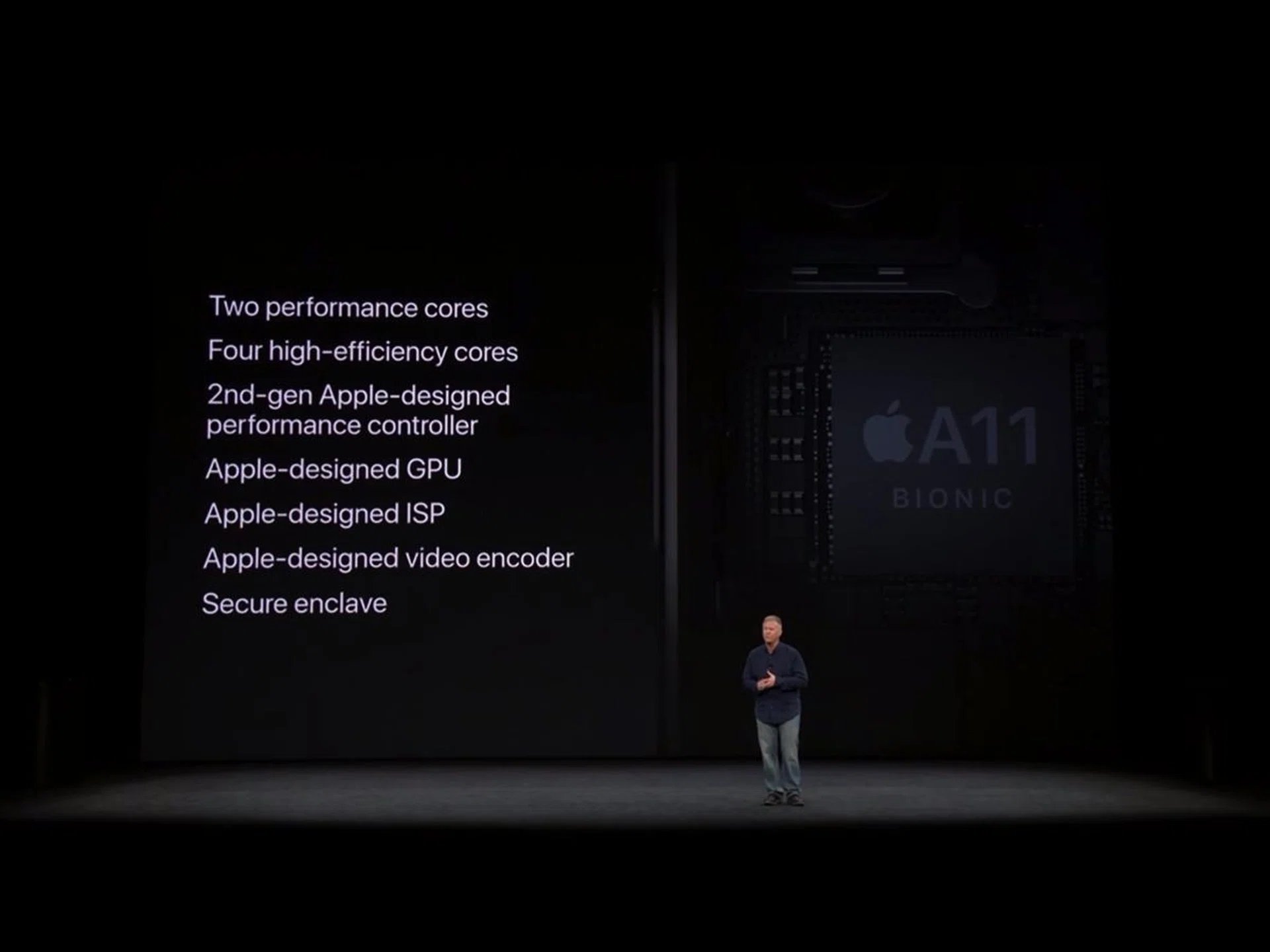
Like the 8 Plus, the iPhone X has 3GB RAM. While that doesn't sound like much compared to the 6GB or even 8GB RAM we've started seeing on Android phones, smartphones really don't need that much RAM.
I mentioned this in my iPhone 8 review but it's worth repeating here: unlike a PC where opening a ton of browser tabs can severely slow down your computer, iOS and Android have automatic memory management that offloads inactive tabs from active RAM usage. While you can split-screen multitask on most smartphones, you're still generally limited to just two side-by-side windows, which limits the amount of RAM you require. Mobile games also tend to be optimized to only require 1 or 2GB of RAM, which is why we didn't see much performance improvement from phones with huge amounts of RAM like the 8GB OnePlus 5.
Sunspider Javascript
SunSpider JavaScript measures the browsing performance of a device when processing JavaScript. It not only takes into consideration the underlying hardware performance, but also assesses how optimized a particular platform is at delivering a high-speed web browsing experience.
Apple has always performed really well on this benchmark due to how well optimized Safari is for Apple's processors and that trend continues with the X. Apple remains the only manufacturer to record sub-150 ms results in this benchmark! In terms of actual user experience, the web browsing experience on the X is lightning fast, smooth and lag-free.

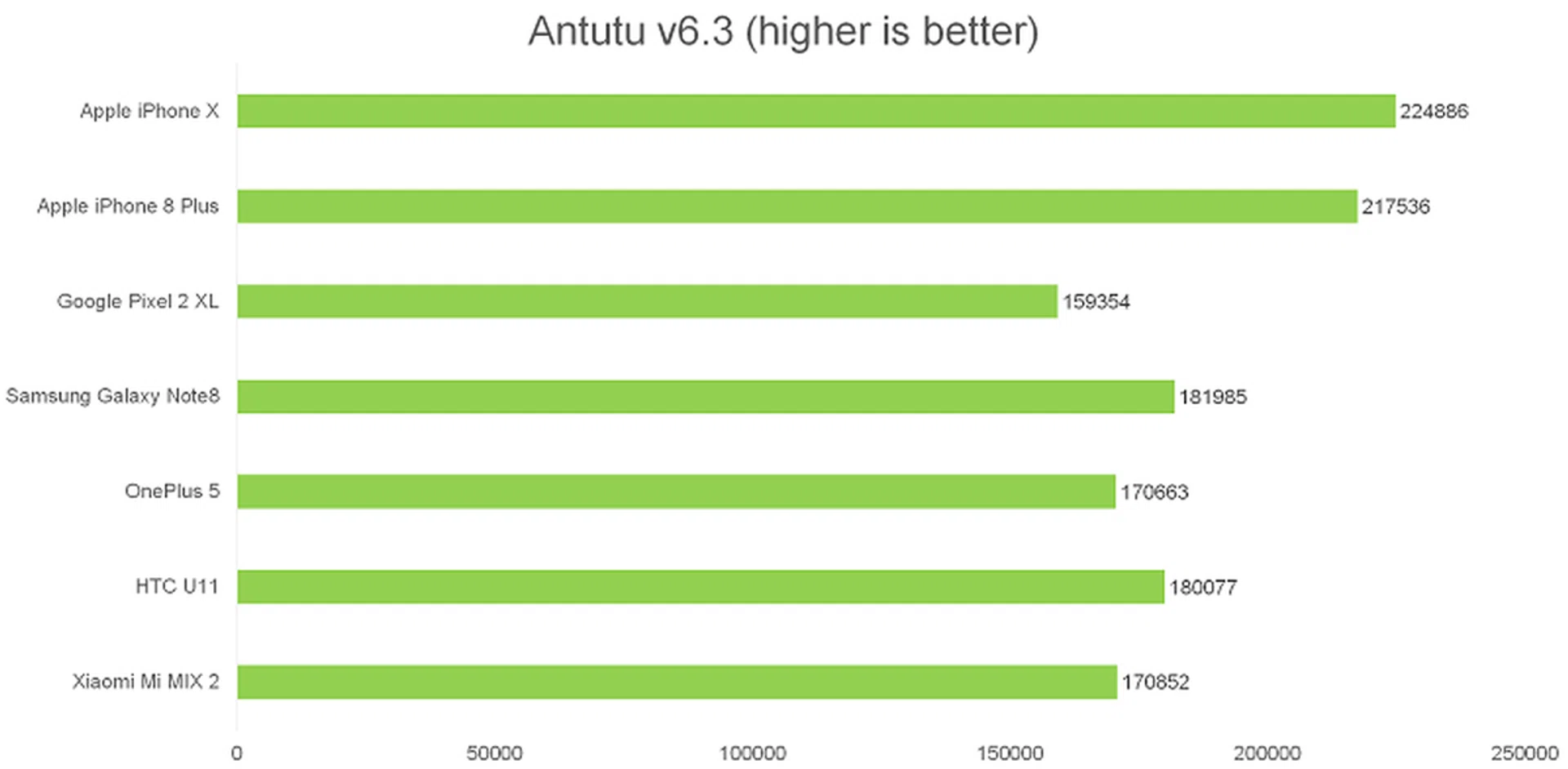
Antutu
AnTuTu is an all-in-one benchmark that tests CPU, GPU, memory, and storage. The CPU benchmark evaluates both integer and floating-point performance, the GPU tests assess 2D and 3D performance, the memory test measures available memory bandwidth and latency, and the storage tests gauge the read and write speeds of a device's flash memory.
Surprisingly, the X scored a little higher than the 8 Plus, despite running on essentially identical specs. It's possible that the A11 was actually built with the X in mind, and is therefore slightly better optimized for it, or iOS 11.1 (which the X is running on) gives a slight performance boost over iOS 11 (which the 8 Plus is currently running on). When the iOS 11.1 update is available for the 8 Plus we'll re-test it to see if its score changes.
Both the 8 Plus and X were way ahead of all of our Android devices.
Basemark OS II
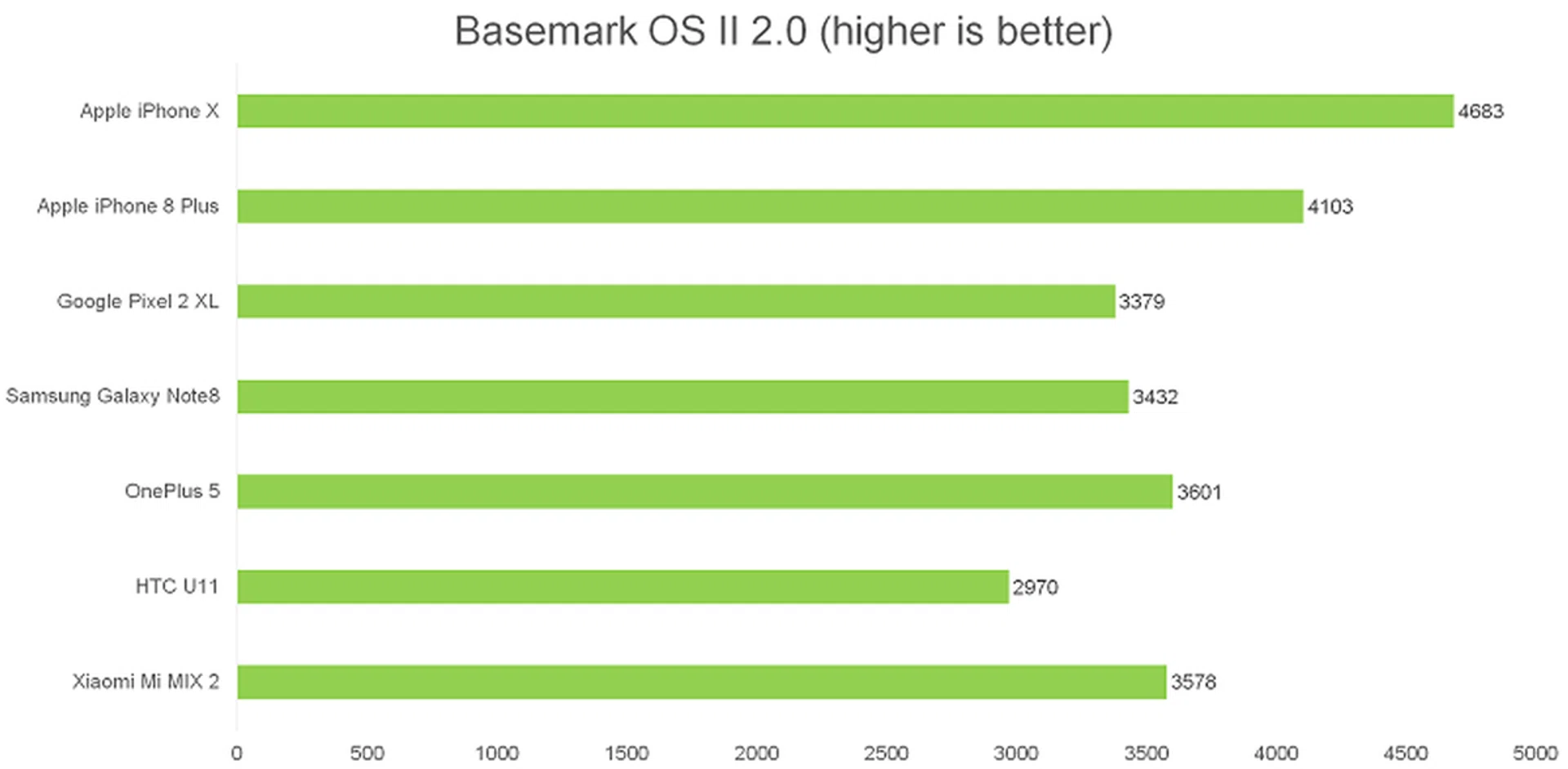
Basemark OS II is an all-in-one benchmarking tool that measures overall performance through a comprehensive suite of tests including system, internal and external memory, graphics, web browsing, and CPU consumption.
We saw the X pull even further ahead of the 8 Plus here. Once again no Android device even came close to Apple's scores.
3DMark Sling Shot
3DMark Sling Shot is an advanced 3D graphics benchmark that tests the full range of OpenGL ES 3.0 API features including multiple render targets, instanced rendering, uniform buffers and transform feedback. The test also includes impressive volumetric lighting and post-processing effects. We're running this benchmark in Unlimited mode, which ignores screen resolutions.
The X was once again dominant in this benchmark, and again posted a slightly better score than the 8 Plus.
GFXBench Manhattan
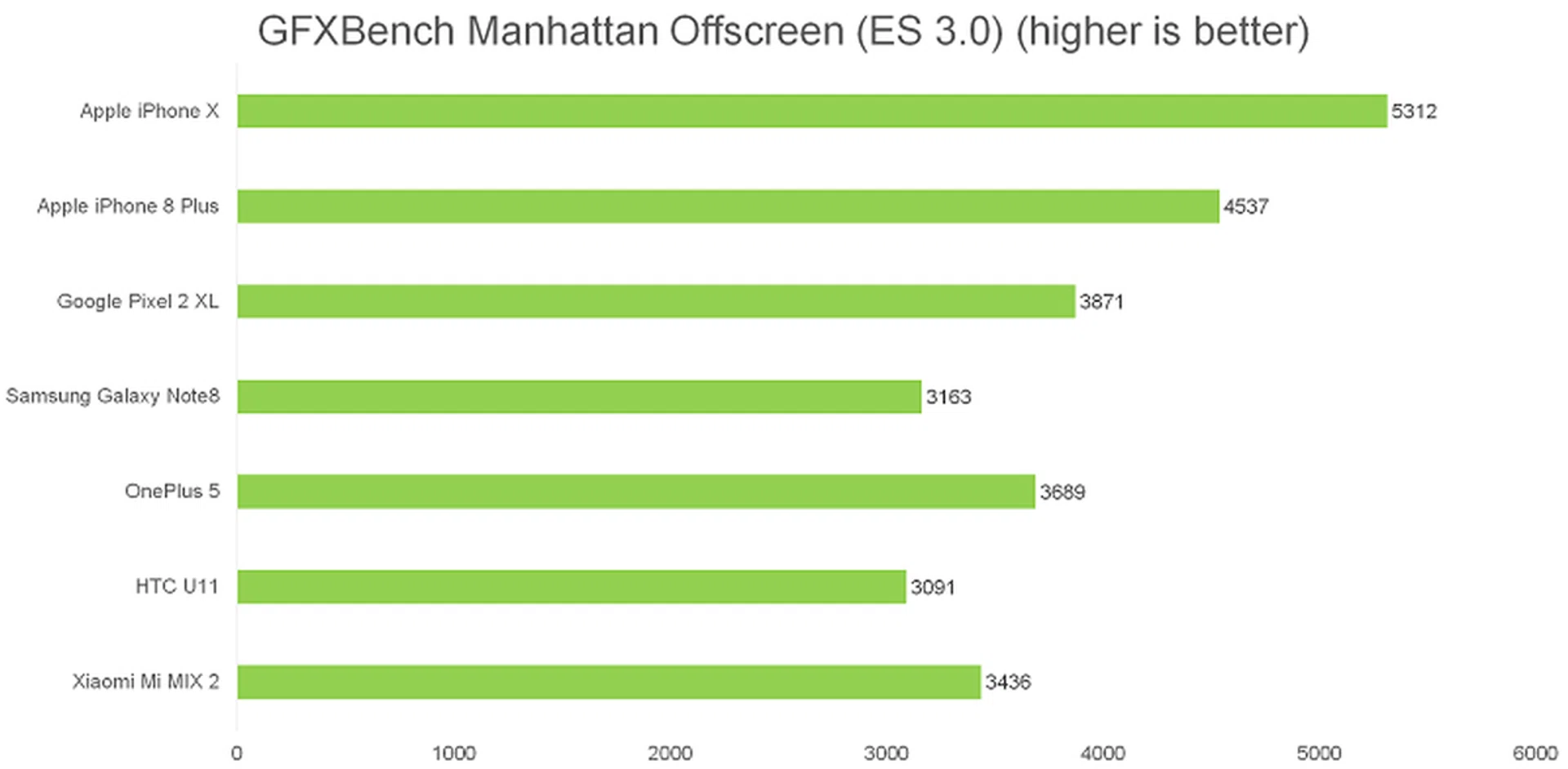
GFXBench Manhattan is a complex OpenGL ES 3.0-based test that uses a deferred shading graphics pipeline. The benchmark employs multiple render targets (MRTS) and diffuse and specular lighting calculated for more than 60 lights. The test also features cube map reflection and emission, triplanar mapping, instanced mesh rendering, and a Theora-based video playback system that leverages asynchronous texture streaming. We're running this test in Offscreen mode at 1080p to eliminate differences in screen resolution.
As we saw in Basemark OS II, the X once again scored significantly higher than the 8 Plus, making me wonder if Apple really did build the A11 with the X's architecture in mind. As usual, no Android device even came close to the X.
Battery Life
Our standard battery test for mobile phones has the following parameters:
- Looping a 720p video with screen brightness and volume at 100%
- Wi-Fi and Bluetooth connectivity turned on
- Constant data streaming through email and Twitter
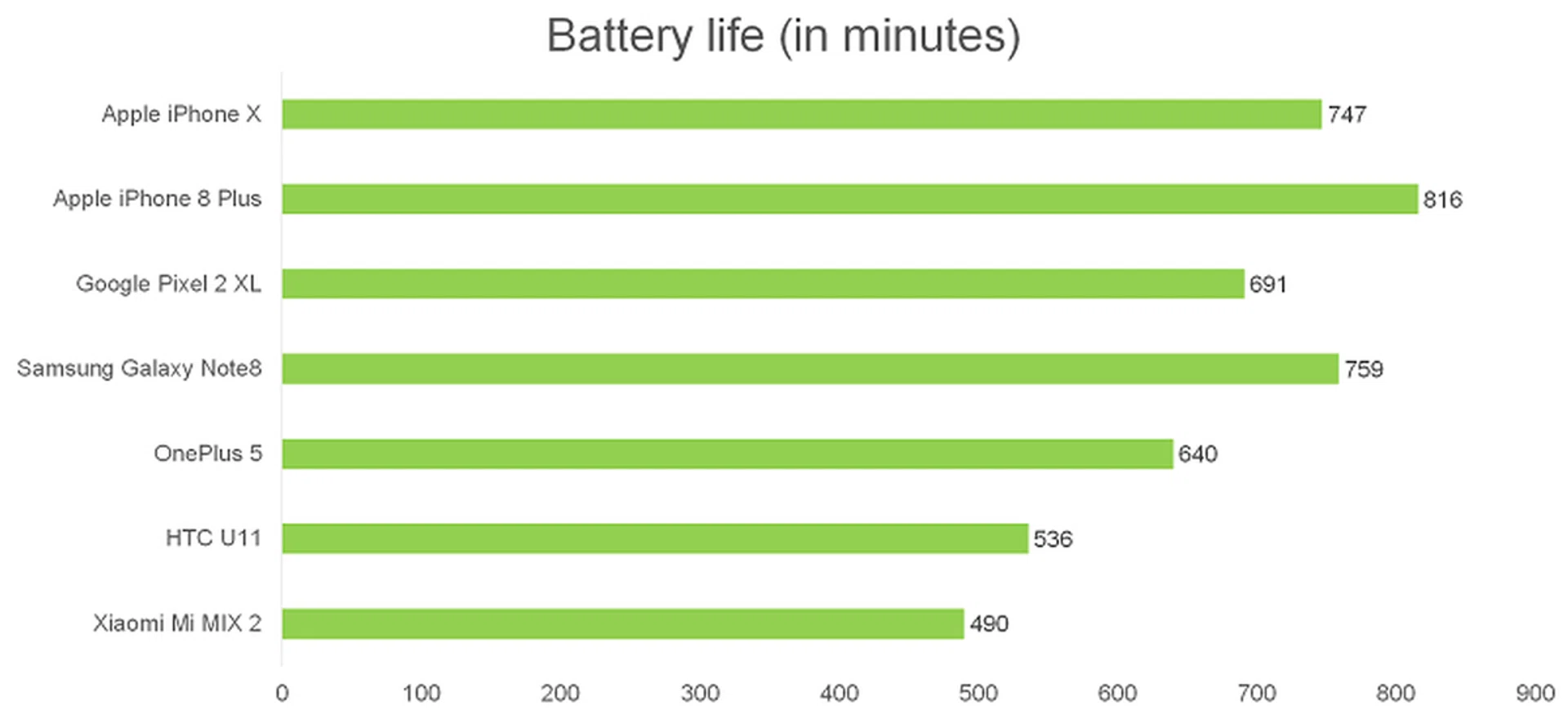
The iPhone X actually has the largest capacity battery out of the three 2017 iPhones, with a 2,716mAh capacity unit. It also has a more power efficient, albeit larger and higher resolution, OLED display. Despite this, the X didn't last as long as the 8 Plus in our battery life benchmark, although it was still very good, running for twelve and a half hours. That's nearly two hours longer than the iPhone 8.
So given its larger battery and more power efficient display, why didn't the X last longer than the 8 Plus? Apple's batteries are actually relatively small compared to its Android competition, but even with a smaller battery, they've fared really well. This is a testament to how power efficient Apple's processors are and how well optimized the iPhones run. It's possible that the A11 and iOS are so well optimized that even the addition of an OLED screen can't squeeze extra battery life out of the iPhone X.
The other likely culprit is Face ID. While the facial recognition technology isn't on all the time (you have to raise the screen to wake it or press the side button to activate it), it does appear to be always on while the screen is in use - even when you're just watching a video like in our battery benchmark. Face ID requires a turn of sensors and projectors to operate, and I suspect it's the main reason the iPhone X doesn't last as long as the 8 Plus.
Conclusion
The iPhone X is without a doubt the most powerful smartphone around right now, and honestly, nothing else even comes close. It was absolutely dominant on every benchmark in a way I've never seen before, with the X easily outperforming rival flagship Android phones by 40 to 50 percent. Its closest competitor is Apple's own iPhone 8 Plus, which, despite running on the same processor and RAM, still wasn't able to keep up with the X.
Of course, benchmarks aren't everything and the X has a lot more to offer than just lightning fast performance. A full review of the X with an in-depth look at all of its new features, including its 5.8-inch Super Retina HD OLED display, Face ID, animoji and more, will be coming soon.
In the meantime, check out these articles for everything X:
- First impressions of the new iPhone X, iPhone 8 and iPhone 8 Plus
- In pictures: iPhone X
- Hands-on with the brand new iPhone X (video)
- Why the iPhone X is called the iPhone X
- Why the iPhone X’s high prices might work out for you, even if you don’t buy one
- Some notes on iPhone X and iPhone 8's wireless and wired charging capabilities
- iPhone X price plan comparison
Our articles may contain affiliate links. If you buy through these links, we may earn a small commission.