Oppo Reno & Reno 10x Zoom compared: To zoom or not to?
We put Oppo's latest Reno 10x Zoom and Reno smartphones through their paces to see how their performance compares.
Note: This article was first published on 23 August 2019.
Overview

Side-by-side, the Reno and Reno 10X Zoom are barely distinguishable from each other.
The Oppo Reno 10x Zoom and Oppo Reno were released in Shanghai back in April. And like the Find X from last year, these are again bezel-less, notch-less phones whose front faces are almost entirely display. It has a screen-to-body ratio of 93.1%. Oppo calls this Panoramic Screen Design, and the Reno 10x Zoom has a 6.6-inch display, while the smaller Reno has a 6.4-inch one.
The Reno 10x Zoom also boasts top-of-the-line specs, with Qualcomm’s latest Snapdragon 855 processor, 8GB of RAM, and 256GB storage as standard. Meanwhile, the slightly smaller Reno is the more modest option, with a mid-range Snapdragon 710 processor, 8GB of RAM, and 256GB of storage standard.
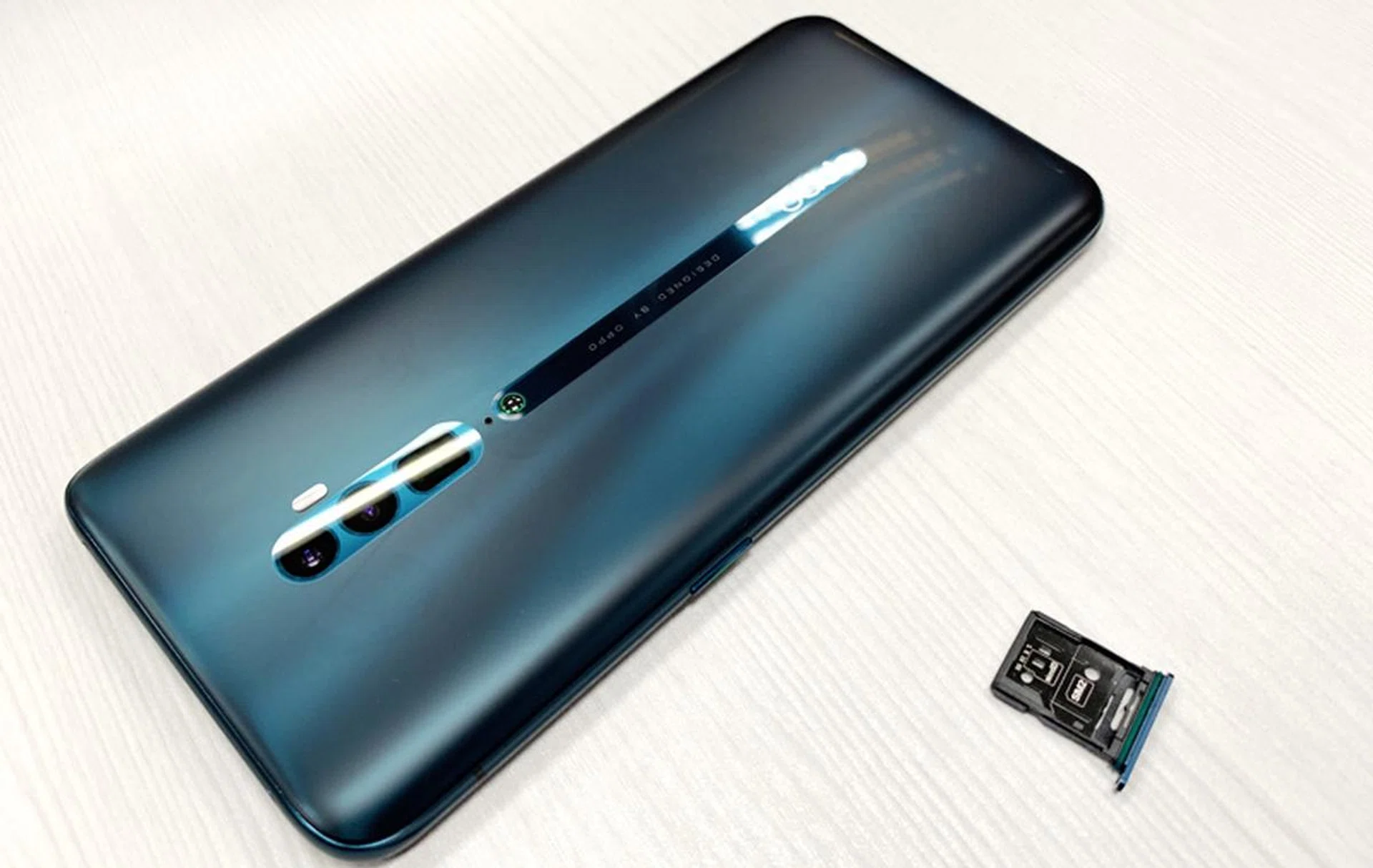
Only the Reno 10X Zoom gives you the option of additional storage.
it’s worth noting that only the Reno 10x Zoom gives you the option of additional storage by way of a MicroSD card (maximum 256GB capacity) in the SIM slot. And that’s not all. The Reno 10x Zoom packs a periscope-style camera they first previewed at MWC Barcelona 2017 that allows them to work around the size constraints of mobile phones to introduce a camera with better optical zoom.
The Reno 10x Zoom's has a triple rear camera setup that consists of the following cameras:
- 48MP F1.7 main lens
- 8MP F2.2 wide-angle lens
- 13MP F3.0 telephoto lens
Together, the lenses cover an equivalent range of a 16-160mm lens, hence the “10x” moniker to the phone. The Reno 10x Zoom also has a 16MP F2.0 front camera for selfies which is housed in a rising structure that slides up when activated. This looks very much like a fish's fin,and also houses a front-facing soft light, receiver, and rear flash.
The Reno on the other hand, has the same 16MP F2.0 front-facing camera for selfies and it has a two-camera rear setup with the following cameras:
- 48MP F1.7 main lens
- 5MP F2.4 wide-angle lens
In summary, the Reno 10x Zoom is a full-featured flagship smartphone with a solid triple rear camera setup and a beautiful 6.6-inch AMOLED on-cell display, while the smaller Reno is more of a mid-range offering, with a 6.4-inch one and a dual rear camera setup.
Here’s the full set of specifications for both phones.
Design

Both screens have a resolution of 2,340 x 1,080 pixels.
Like the Find X, the displays of the Reno 10x Zoom and the Reno are the main things that stand out. That’s a 6.6-inch screen for the Reno 10x Zoom, and a 6.4-inch screen for the Reno. Both phones have an impressive 93.1% screen-to-body ratio and the same 2,340 by 1,080 pixels resolution.
Compared to the Find X, both Reno phones seem to be slightly less rounded, making for more nicely proportioned displays. The same dual-curve display presents itself here too, and this seems to further slim the phones visually. The glass backs have a very nice frosted finish that allow for a subtle interplay between light and dark depending on your viewing angle.
The Reno and Reno 10X Zoom are quite nicely proportioned.
Oppo has built the camera systems on both phones so that they’re completely below the glass surface, resulting in a truly flat surface that’s great to hold. The only exceptions of course, being the little knobs that have been strategically placed so the cameras are never actually in contact with the surface.
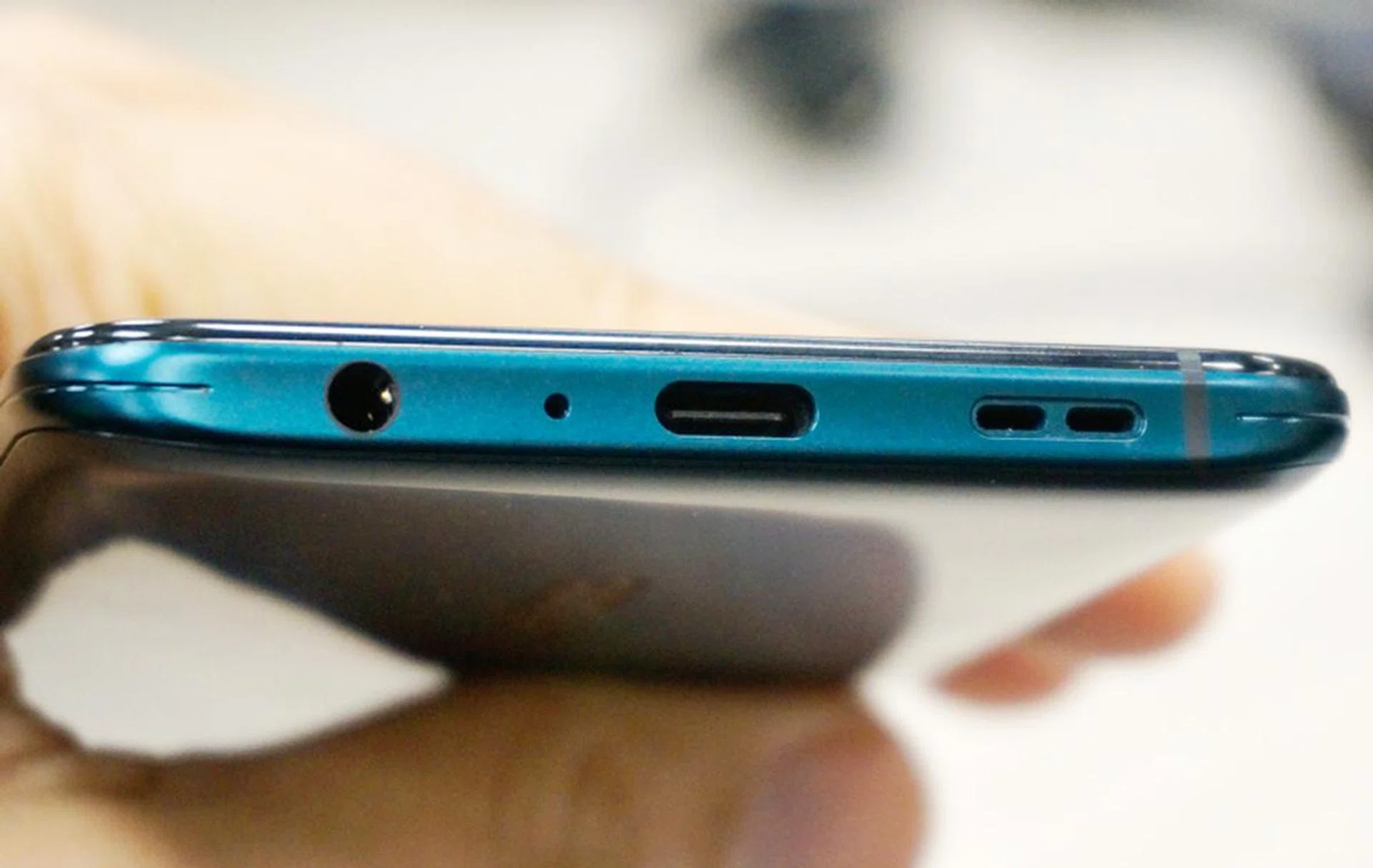
On the sides, you'll find only the power button, and the usual volume control buttons. Something that's notably different between the two is where the SIM card holder is found. With the Reno 10x Zoom, this is at the bottom of the phone. With the Reno, this is space has been taken up by the 3.5mm audio jack, so it's been moved to the side, beside the volume buttons.

The 3.5mm audio jack on the Reno means the SIM card slot has to be moved to the side.
Measuring 77.2 x 162.0 x 9.3mm compared to the 74.3 x 156.6 x 9.0mm of the Reno 10, the Reno 10x Zoom doesn’t feel much larger than the Reno in the hands despite the difference in screen size. You will feel the weight difference though, as the Reno 10x Zoom weighs 215g compared to the 185g of the Reno. Otherwise, from a physical perspective, everything is pretty much the same, right down to the placement of the buttons - volume buttons on the right, power/hold button on the left. Both phones use USB-C for charging and transfer.
Oppo has also added fingerprint scanning as an option for biometric security, using an under-display scanner to preserve the all-display front. If you choose to use face recognition instead, the selfie camera pops very swiftly, then retracts once the screen is unlocked. Fingerprint scanning was generally pretty fast and accurate though, so we didn't find ourselves using the selfie camera much. On that note, the construct of the selfie camera means the phone isn't going to be very water or dust resistant.
Display
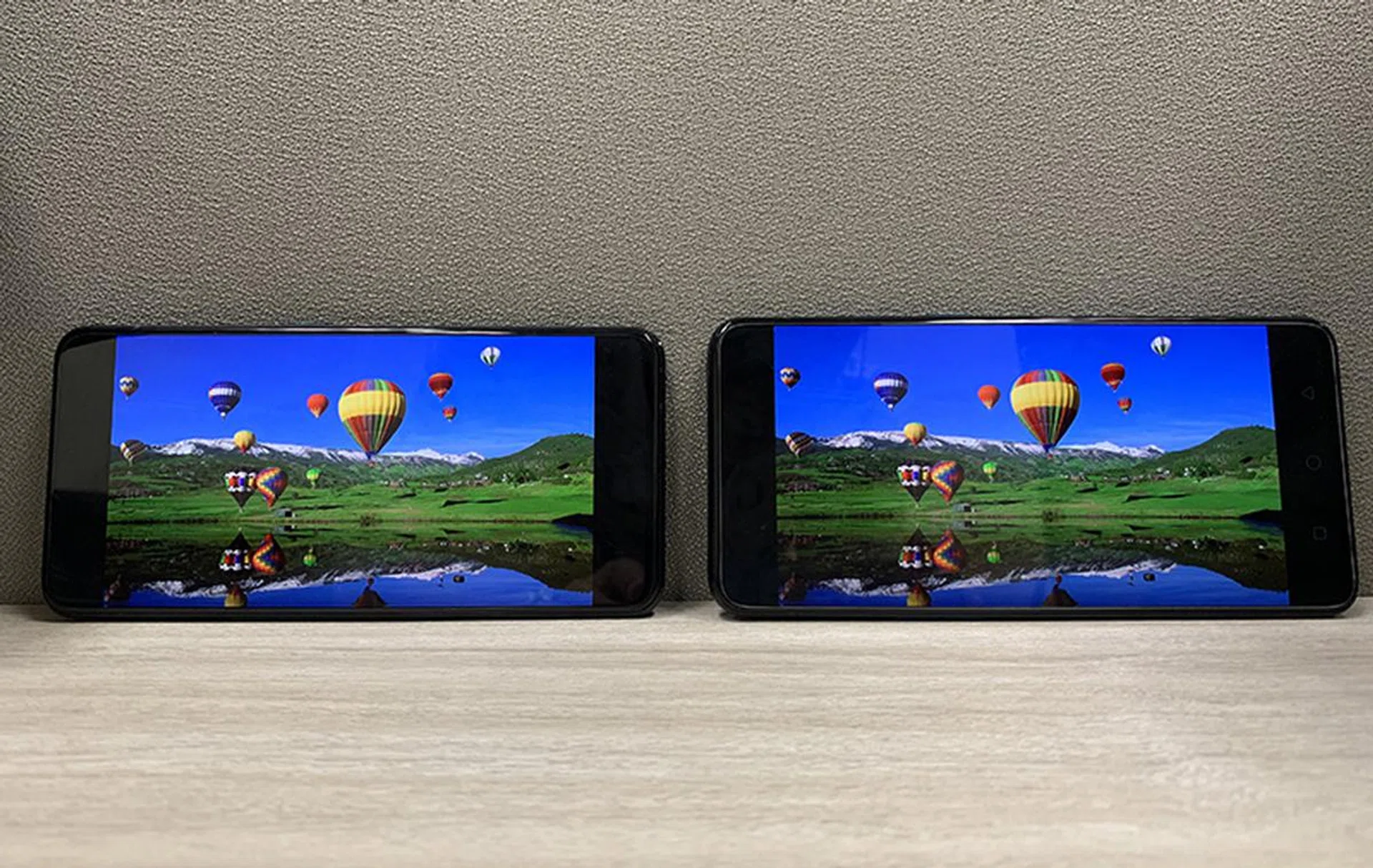
The displays for both phones are very similar.
Those hoping for the gorgeous QHD+AMOLED Fluid display on the OnePlus 7 Pro will be a little disappointed here, as the Reno 10x Zoom and the Reno follow the Find X with Full HD+ 2,340 x 1,080 AMOLED displays instead. Since resolution is the same and screen size differs, the Reno actually has the denser display with a pixel count of 402 pixels per inch while the Reno 10x Zoom has a slightly less dense pixel count of 387 pixels per inch. That said, the difference, even with the two phones side by side, is imperceptible. The displays are similarly rated and capable of displaying 16.7 million colours in the same 19.5:9 aspect ratio. Also, they support the entire DCI-P3 colour space while using 8% less power.
While there are no officially published specifications on how bright the screens go, we put them side-by-side with a Huawei P30 Pro (600 nits) and Samsung Galaxy Note 9 (710 nits) at max brightness, and the screens certainly hold their own. In any case, they’re easy to read even in bright daylight.

Only basic colour adjustments are available.
Oppo has also taken low light reading into consideration, with a “Night Shield” mode that adjusts the colour temperature of the screen to reduce blue light, thus preventing eye strain. Of course, there’s also the “Low-brightness Flicker-free Eye Care” mode we mentioned in our earlier hands-on piece, which makes it less tiring to view the screen in the dark.
If you’re the type who likes having the screen on at all times, both phones offer this option by way of a “Screen Clock’ option. As before, this will also show notifications as they come in. Oppo again warns you that enabling this option lowers battery life, and cuts the display if the phones’ battery falls below 10%. Gorilla Glass 6 is used for the screen, and it appears Oppo even adds a screen protector for you straight out of the box, along with a basic phone cover so you’re ready to go from the start.
Audio
Despite having both USB-C and 3.5mm, only the 3.5mm jack can be used for audio on the Reno.
Now, here’s where things get a little different. The Reno has both a USB-C port for charging and a 3.5mm audio jack, though it's worth pointing out that you won’t be able to use the USB-C port for audio. The included earphones look a lot like Apple’s Airpods, and so suffer the same issues – there’s no way to adjust the fit so if they don’t fit you well, you get poor bass and zero passive noise isolation. Performance for this is as you would expect from bundled earphones: decent in the mids, but with no real strengths to speak about.

The included earbuds you get from the Reno 10X Zoom (on the left) are much better than what you get with the Reno.
The Reno 10x Zoom however, comes bundled with much nicer USB-C in-ear headphones that deliver better detail and actually sound pretty decent. Vocals are pretty well rendered, and you can actually get a sense of separation with these. It’s still lacking some in the bass regions, but are definitely capable of providing an enjoyable listening session if you don’t want to pick up something separate.
Both phones performed similarly when playing audio through their stereo speakers. The soundstage is small but the midrange is sweet you shouldn’t have issues picking up the vocal track when watching movies and gaming. However, one thing that must be noted is the imbalance between speakers. The speakers above the display are noticeably softer which throws off the stereo effect.
Software

ColorOS 6 brings the drawer mode back.
The Reno and Reno 10x Zoom both run Oppo’s latest OS – ColorOS 6. It’s based on Android 9 and adds a few new tricks and leans heavily on AI to improve overall performance. For example, if you have many apps left open and some haven't been used in a while, the phone will automatically pause them, saving battery life.
You can now finally choose to have an app drawer on the home screen, and also options to have more apps displayed on your home screen (choose between a 4x6 or a 5x6 layout). The stock apps now reflect Google’s Material design, so everything is as minimalist as possible.

You can also do swipe gestures from both sides of the phone.
You’ll also get greater customization over the navigation keys so you can stick to the standard Android buttons, use swipe gestures from either side, or bottom, or hide them altogether. ColorOS also comes with a feature called Riding Mode under the Smart Driving section. This mutes everything except incoming calls so you won’t be tempted to look at your phone while on the road.
How about the camera?
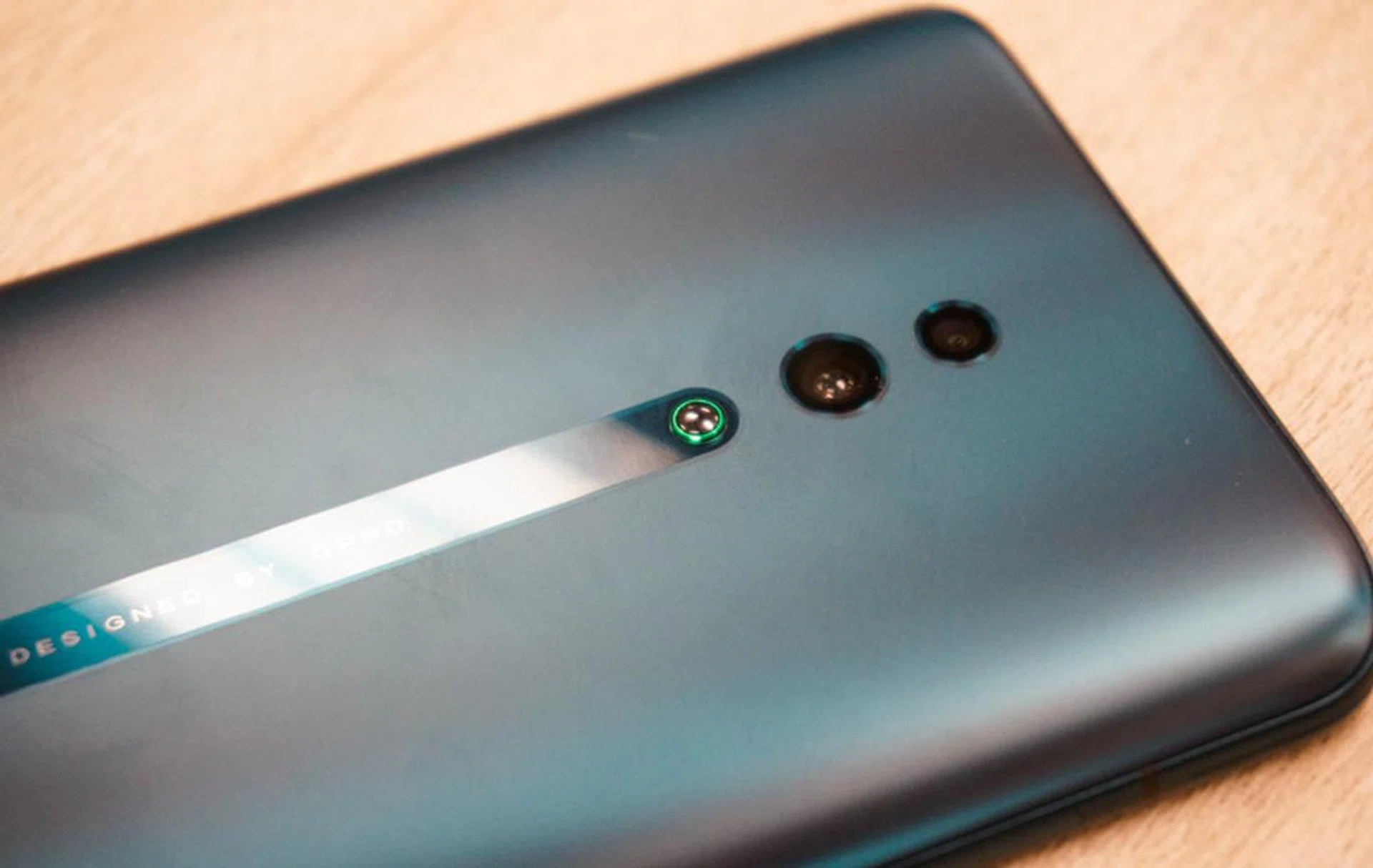
The Reno only has two cameras on the rear.
Now, on to the camera system. The Reno has a dual 48MP F1.7 and 5MP F2.4 camera system on the rear, and a 16MP F2.0 camera on the front, while the Reno 10x Zoom has a 48MP F1.7, 8MP F2.2 and 13MP F3.0 triple camera system on the rear that’s also matched with a 16MP F2.0 camera on the front.
Both use Phase Detect Auto Focus (PDAF) for faster focusing, but the Reno 10x Zoom also has the added advantage of dual OIS when working with slower shutter speeds, and of course the ability to do the equivalent of 10x telephoto zoom by combining information from all three cameras. This telephoto zoom works in both stills capture and video, but in video mode you lose the ability to zoom out further.
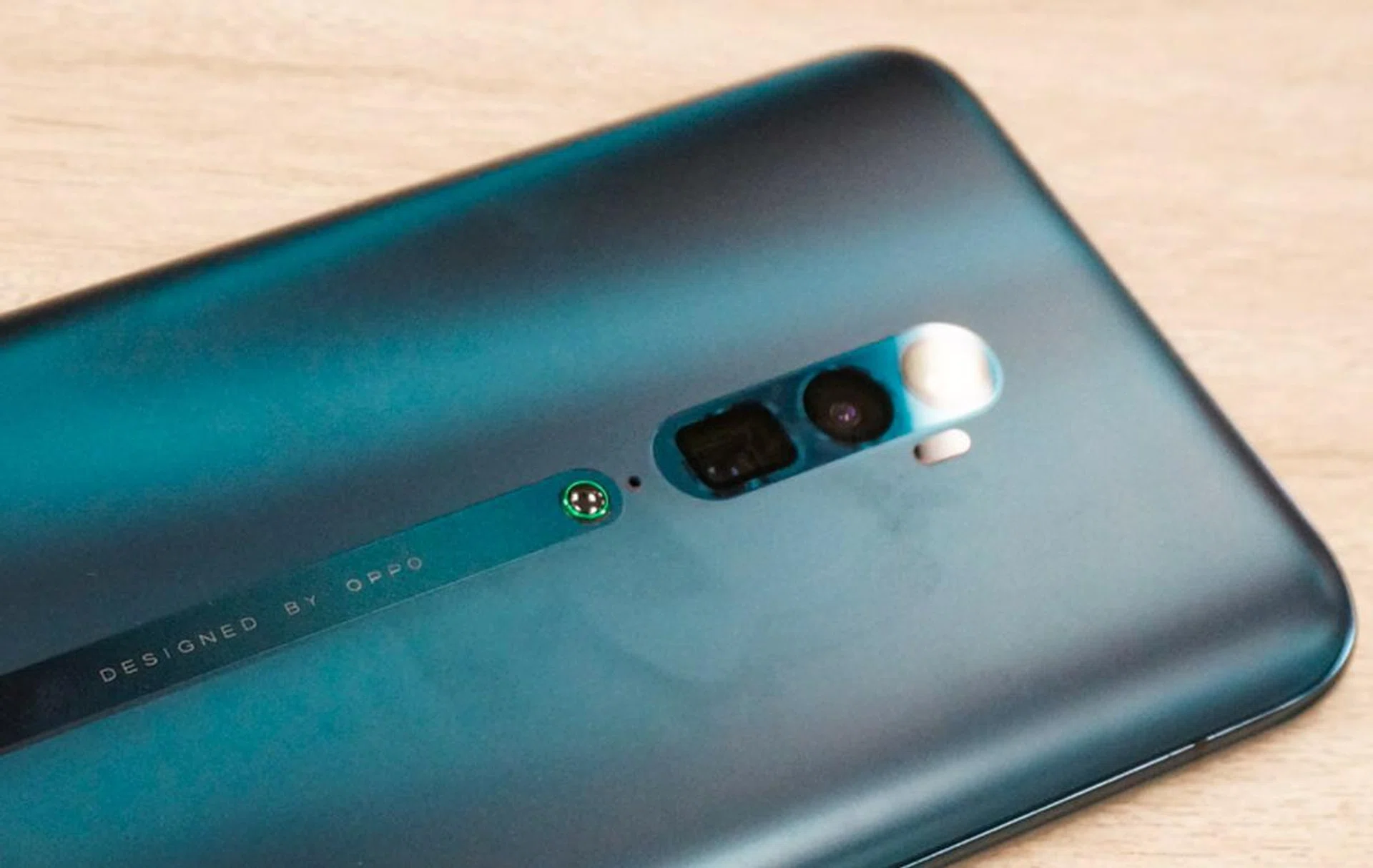
The Reno 10X Zoom on the other hand, has a triple camera setup.
It’s worth noting that while the Reno will also allow you to zoom in up to 10x, this is software-based and simply doesn’t get you good results. The Reno 10x Zoom will do the same up to an equivalent of 60x zoom, but the images get too noisy to use.
Given that both phones have the same main camera, it’s not surprising that images taken in good light are pretty similar. As you can see from the studio scene below, there’s really very little difference between them, with the exception that the images from the Reno are slightly warmer.

Reno 10x Zoom studio capture. (Click for full resolution image)

Reno 10x Zoom studio capture- 100% crop

Reno studio capture. (Click for full resolution image)

Reno studio capture- 100% crop.
Move on to low light situations though, and the two systems behave vastly differently. The Reno 10x Zoom seems to have a one-stop advantage in exposure, capturing at the lower ISO of 2,133 vs the Reno, which takes the image at an ISO of 5,324. Obviously, this results in images from the Reno to be noisier, but because both phones seem to have similar dynamic ranges, there isn’t much more detail from the Reno 10x Zoom’s capture.

Reno 10x Zoom night capture. (Click for full resolution image)

Reno 10x Zoom night capture- 100% crop.

Reno night capture. (Click for full resolution image)

Reno night capture- 100% crop.
Finally, let’s look at what the Reno 10x Zoom can do with its telephoto zoom! The first image below was taken with the camera at the normal 1x setting so you get an idea of just how far away we were standing. The following one is what you get with 10x zoom. That’s certainly impressive, but view it at 100% and you’ll realize that the image is actually fairly noisy. There isn’t much true detail as a result, so these images are probably best viewed on your phone.

From where we standing, you can barely make out people on the sky bridge.

Reno 10x Zoom - 10x zoom. (Click for full resolution image)
For comparison, here’s the same shot taken with the Huawei P30 Pro. For some reason, the P30 Pro delivers an image with quite a bit more saturation at the full 10x zoom compared to when you take the shot at the regular 1x zoom. The image is a little bit cleaner than what you get on the Reno 10x Zoom, and you get a bit more meaningful detail back. We'd say the quality of the 10x zoom on the Reno to be just a bit behind that of the P30 Pro.

For some reason, the sky is less saturated in this wide shot from the Huawei P30 Pro.

Huawei P30 Pro - 10x zoom. (Click for full resolution image)
And those crazy fin-like selfie cameras?
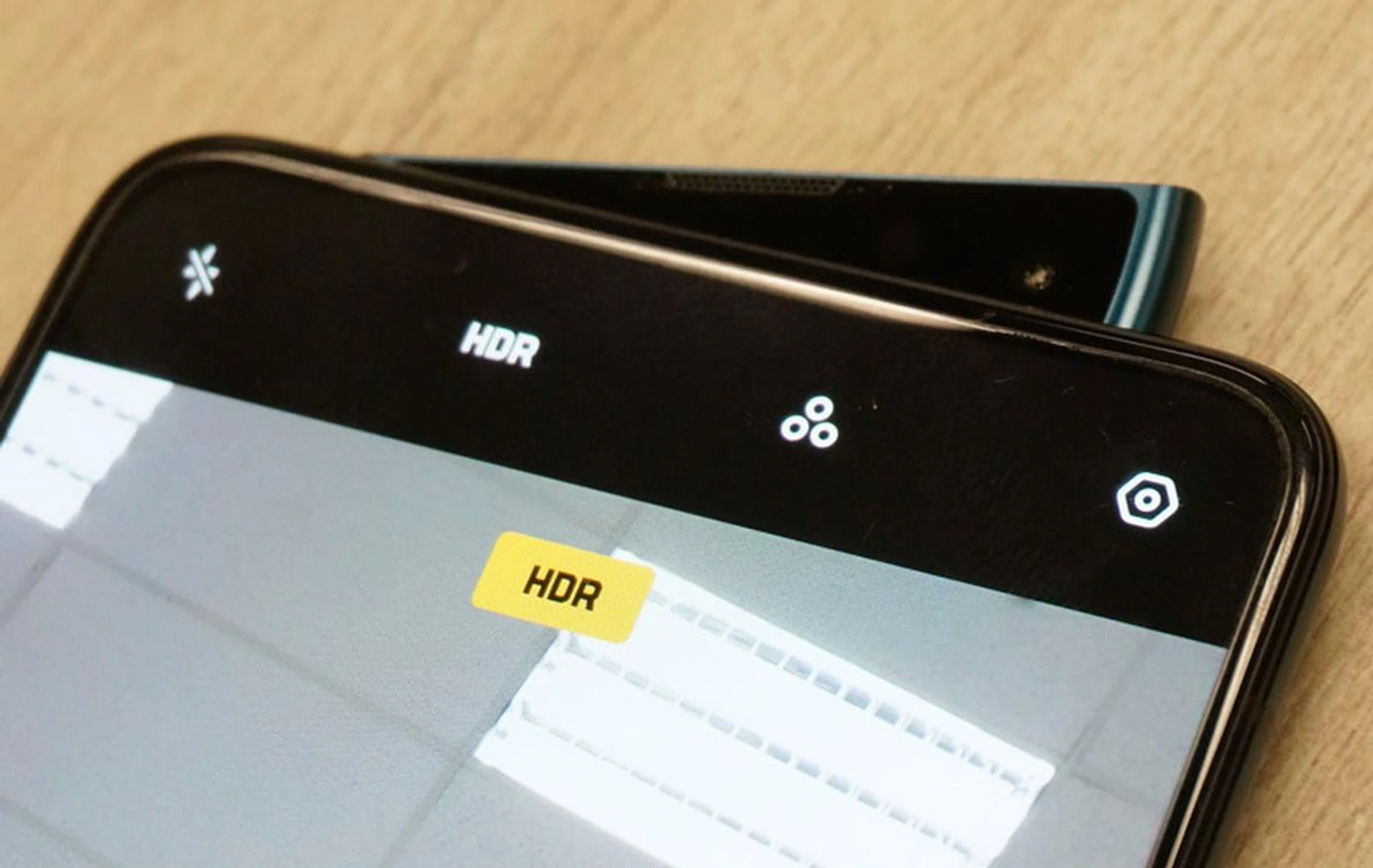
They’re probably the most distinctive thing about these phones to be honest. These pop up and down pretty quickly. We tried test dropping the phone onto a mattress with the selfie camera engaged, and are happy to report that they will indeed retract automatically. More importantly, they do so well before the phone hits the floor,so the camera stays protected.

Reno 10x Zoom front camera. (Click for full resolution image)

Reno front camera.(Click for full resolution image)
Both the Reno 10x Zoom and the Reno use 16MP Front facing cameras, so it’s no surprise that they perform similarly here. Colour balance is good, and we didn’t see significant issues with skin tones, but the resolution certainly isn’t close to what you can get with the rear camera.

Plenty of filters for your selfies.
Something to note for those who like using filters is that these can be applied to the front camera too, in both photo and video recording mode. Beauty mode is of course a default for stills capture, and you can do a whole range of adjustments like thinning your face or sharpening your chin.
Benchmark Performance
Prices for the Reno start from just S$849 while prices for the Reno 10x Zoom start from S$1,199, a difference of just S$350. But how does the performance compare?
For starters, the Reno 10x Zoom uses Qualcomm’s latest Snapdragon 855 processor and pairs that with a Adreno 640 GPU, putting it ahead on processing grunt compared to the Reno which has just the Snapdragon 710 and Adreno 616 GPU respectively. It also has a larger 4,065mAh battery compared to the 3765mAh one found in the Reno. Both phones are running the latest version of ColorOS 6, so let’s see how the two phones compare in our benchmark testing!
JetStream 2
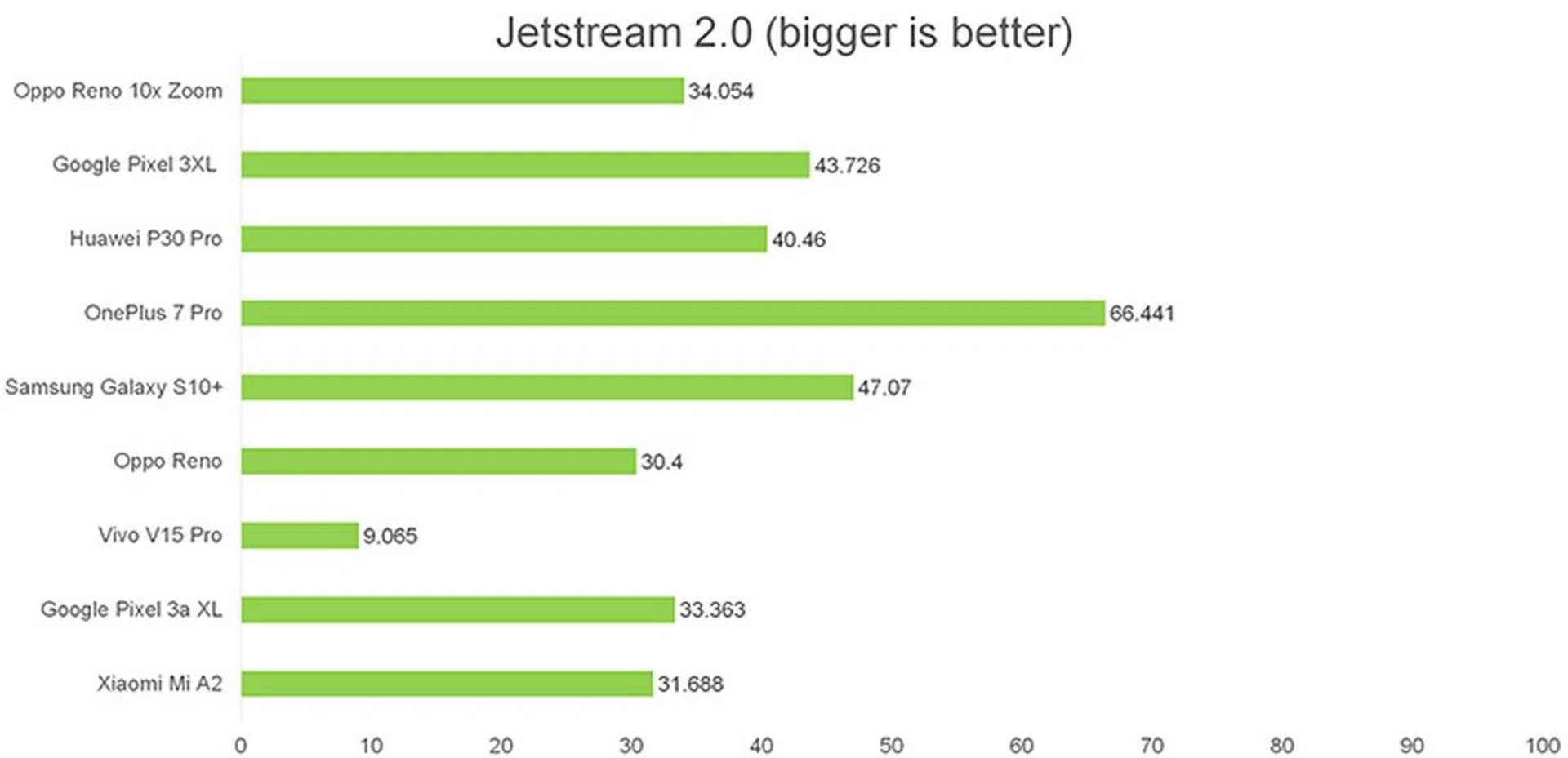
JetStream 2 measures the browsing performance of a device when processing JavaScript. It not only takes into consideration the underlying hardware performance, but also assesses how optimized a particular platform is in delivering a high-speed web browsing experience.
On this, the Reno turns in a score of 30.4, falling slightly behind the Pixel 3a XL and Mi A2. That's a little disappointing given it's using a higher end Snapdragon 710 processor compared to the 660 and 670 series processors on the competition.
Meanwhile the Reno 10x Zoom only does slightly better at 34.054. That lags behind the OnePlus 7 Pro’s 66.441 quite a bit, and trails the likes of the Galaxy Note 9 and the P30 Pro. Given that Reno 10x Zoom is using the same processor as the OnePlus 7 Pro (the Snapdragon 855), we'd put this down to general hardware and software optimization issues, plus the fact the OnePlus 7 Pro has faster UFS 3.0 storage.
Geekbench 4.2
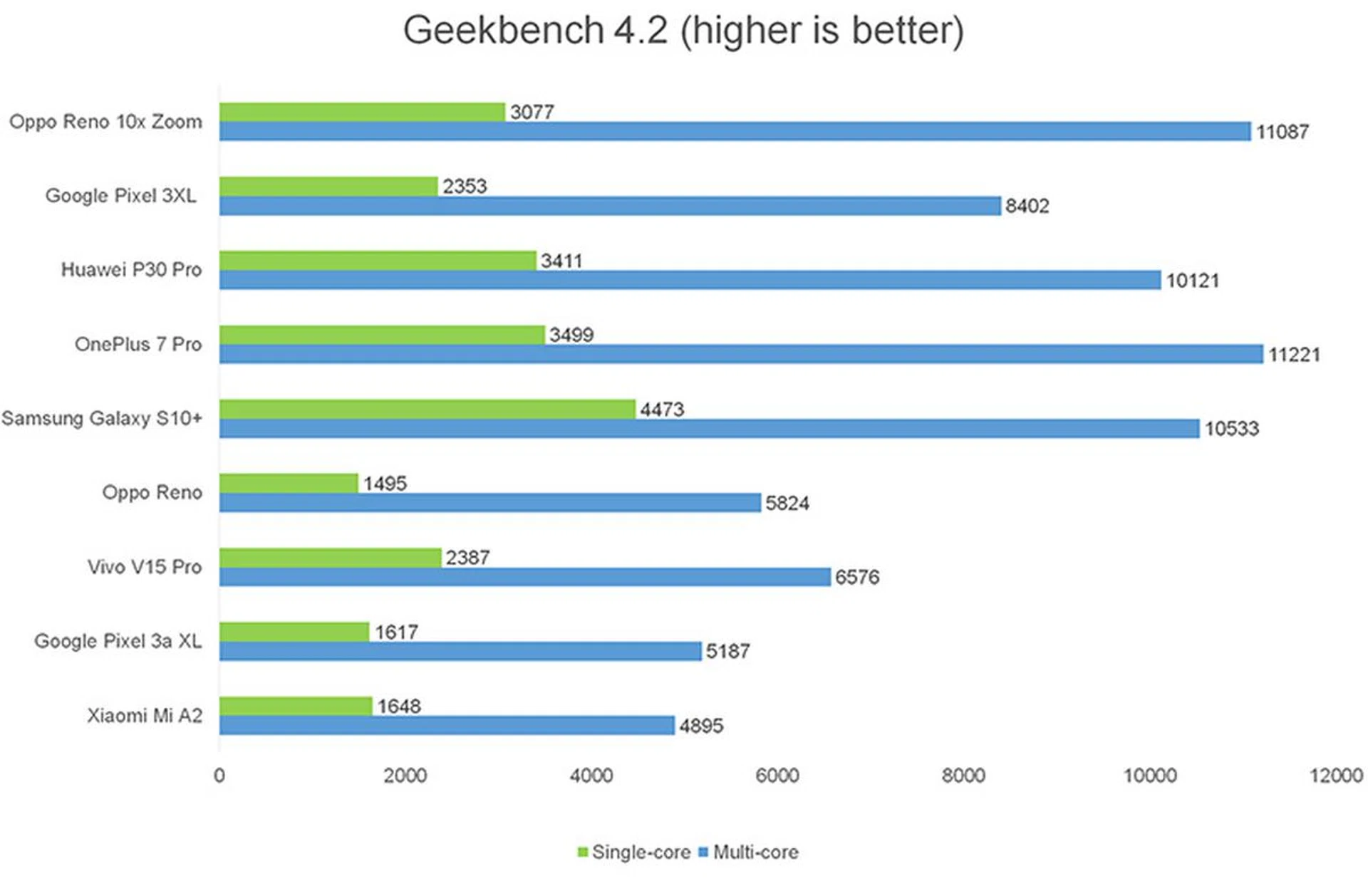
Geekbench CPU is a cross-platform processor benchmark that tests both single-core and multi-core performance with workloads that simulate real-world usage. Geekbench 4 scores are calibrated against a baseline score of 4000 (which is the score of an Intel Core i7-6600U CPU processor).
Here we see the prowess of the Snapdragon 855 octa-core processor as the Reno 10x Zoom and the OnePlus 7 Pro pull away from the Samsung S10+'s Exynos 9820 and the Huawei P30 Pro's Kirin 980 in both single and multi-core tests.
Antutu v.7.2.2
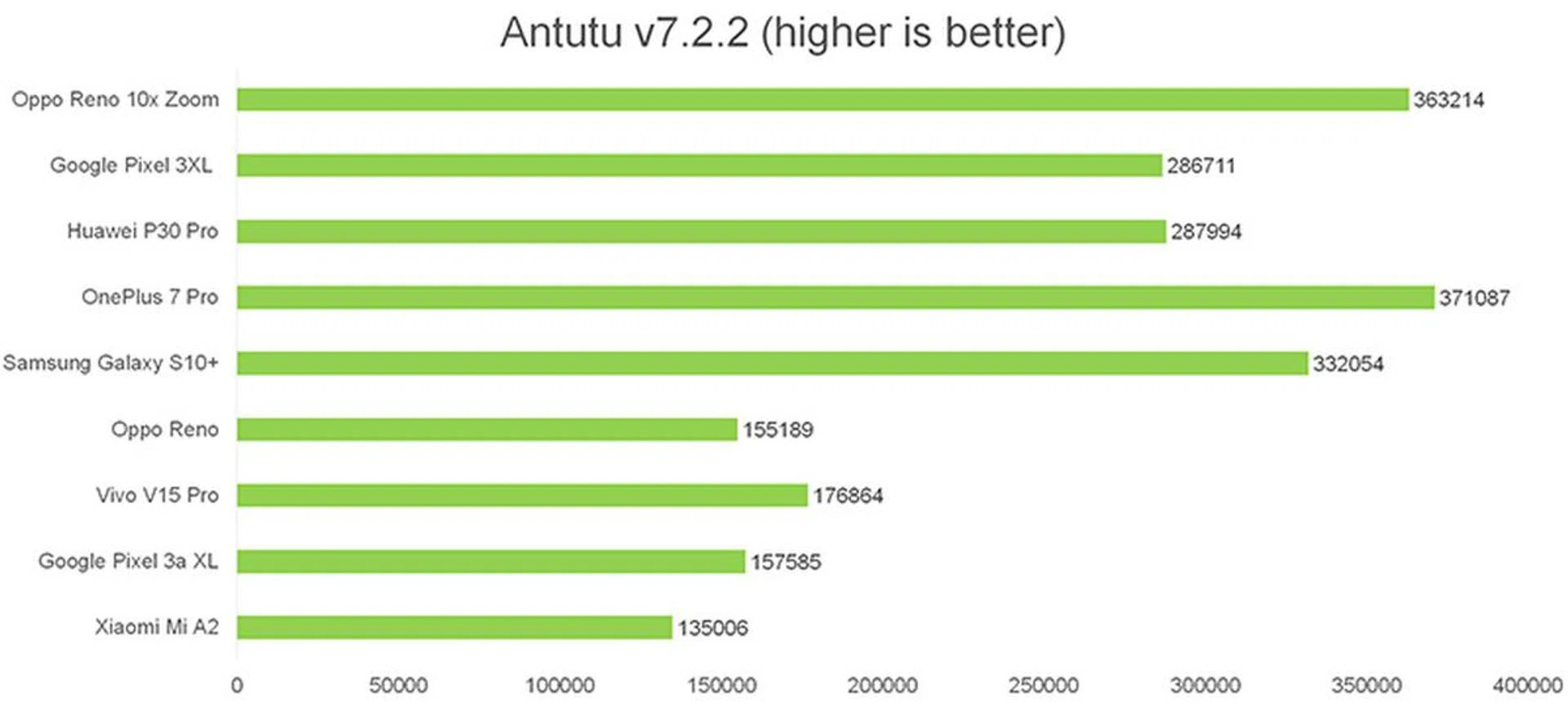
AnTuTu is an all-in-one benchmark that tests CPU, GPU, memory, and storage. The CPU benchmark evaluates both integer and floating-point performance, the GPU tests assess 2D and 3D performance, the memory test measures available memory bandwidth and latency, and the storage tests gauge the read and write speeds of a device's flash memory.
The Reno returns a respectable score of 155,189 for this, putting it ahead of the Mi A2 and close to the Pixel 3a XL. The Reno 10x Zoom on the other hand, turns in an impressive score of 363,214 on this, trailing only the OnePlus 7 Pro’s 371,087.
3DMark Sling Shot Extreme
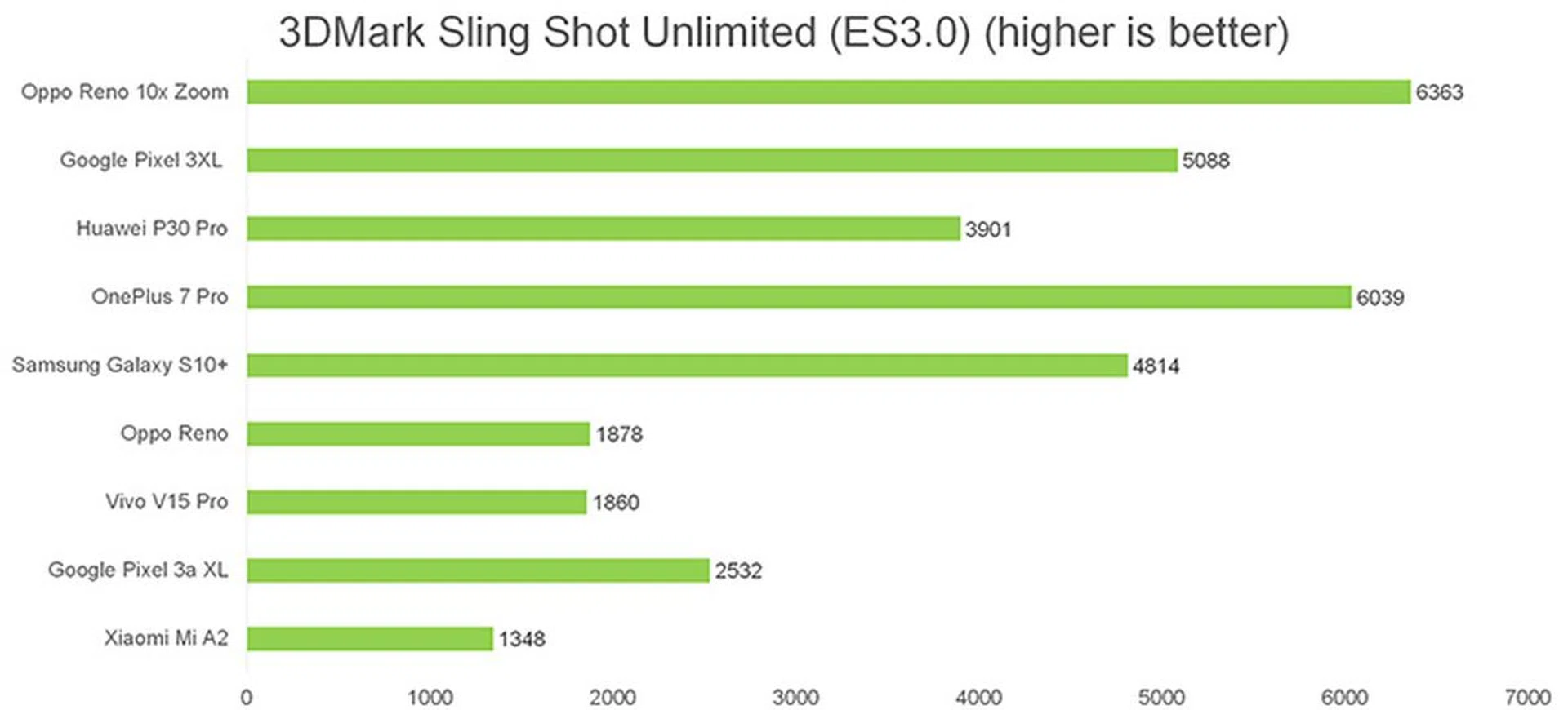
3DMark Sling Shot Extreme is an advanced 3D graphics benchmark that tests the full range of OpenGL ES 3.1 and ES 3.0 API features including multiple render targets, instanced rendering, uniform buffers and transform feedback. The test also includes impressive volumetric lighting and post-processing effects.
The Snapdragon 855s do well here, with both the Reno 10x Zoom and the OnePlus 7 Pro leading the pack. Perhaps reflecting the slight difference in RAM (8GB vs 6GB), the Reno 10x Zoom scores 6,363 compared to the 6,039 of the OnePlus 7 Pro.
The Reno turns in a lower score of 1,878 here given the difference in both CPU and GPU power, way behind the Pixel 3a XL and only slightly ahead of the Vivo V15 Pro.
Battery Life
Our standard battery test for mobile phones has the following parameters:
- Looping a 720p video with screen brightness and volume at 100%
- Wi-Fi and Bluetooth connectivity turned on
- Constant data streaming through email and Twitter
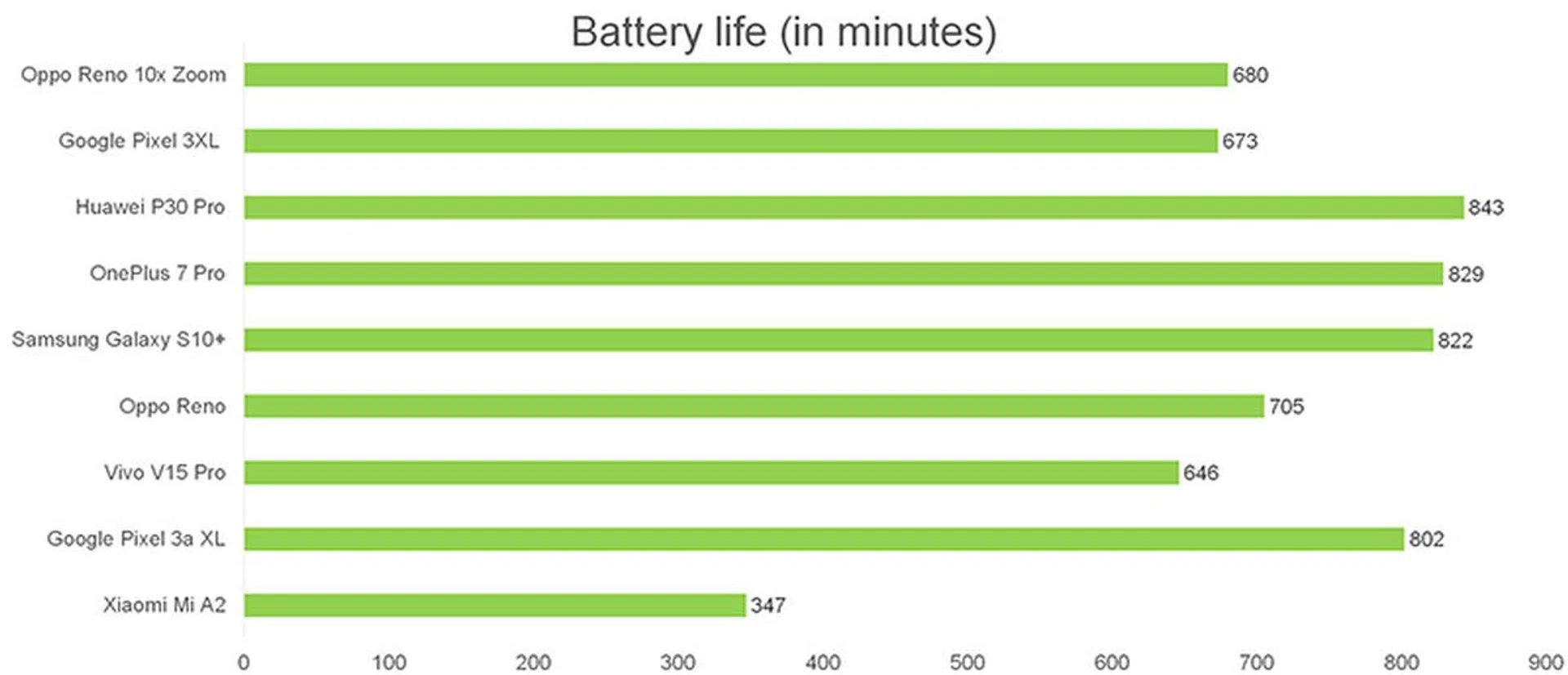
On this, you’d expect the Reno 10x Zoom to again have an advantage thanks to its larger 4,065mAh battery, but the Reno actually clocked 20 minutes longer with the smaller battery.
In fact, compared to the other phones, the Reno 10x Zoom underperformed, considering the Huawei P30 Pro lasted 843 minutes (4,200mAh battery), the OnePlus 7 Pro went 829 minutes (4,000mAh battery), and the Samsung Galaxy S10+ lasted 822 minutes (4,100mAh battery).
The Oppo Reno did better relative to the competition, squeezing 705 minutes out of it's 3,765mAh battery. That's about an hour more than the V15 Pro (3,700mAh battery), but almost an hour and a half less than the Pixel 3a XL (3,700mAh).
Both phones support Reno’s VOOC 3.0 fast charge feature, which gets you back to 43% charge after 30 minutes with the Reno and 51% charge with the Reno 10x Zoom.
Conclusion
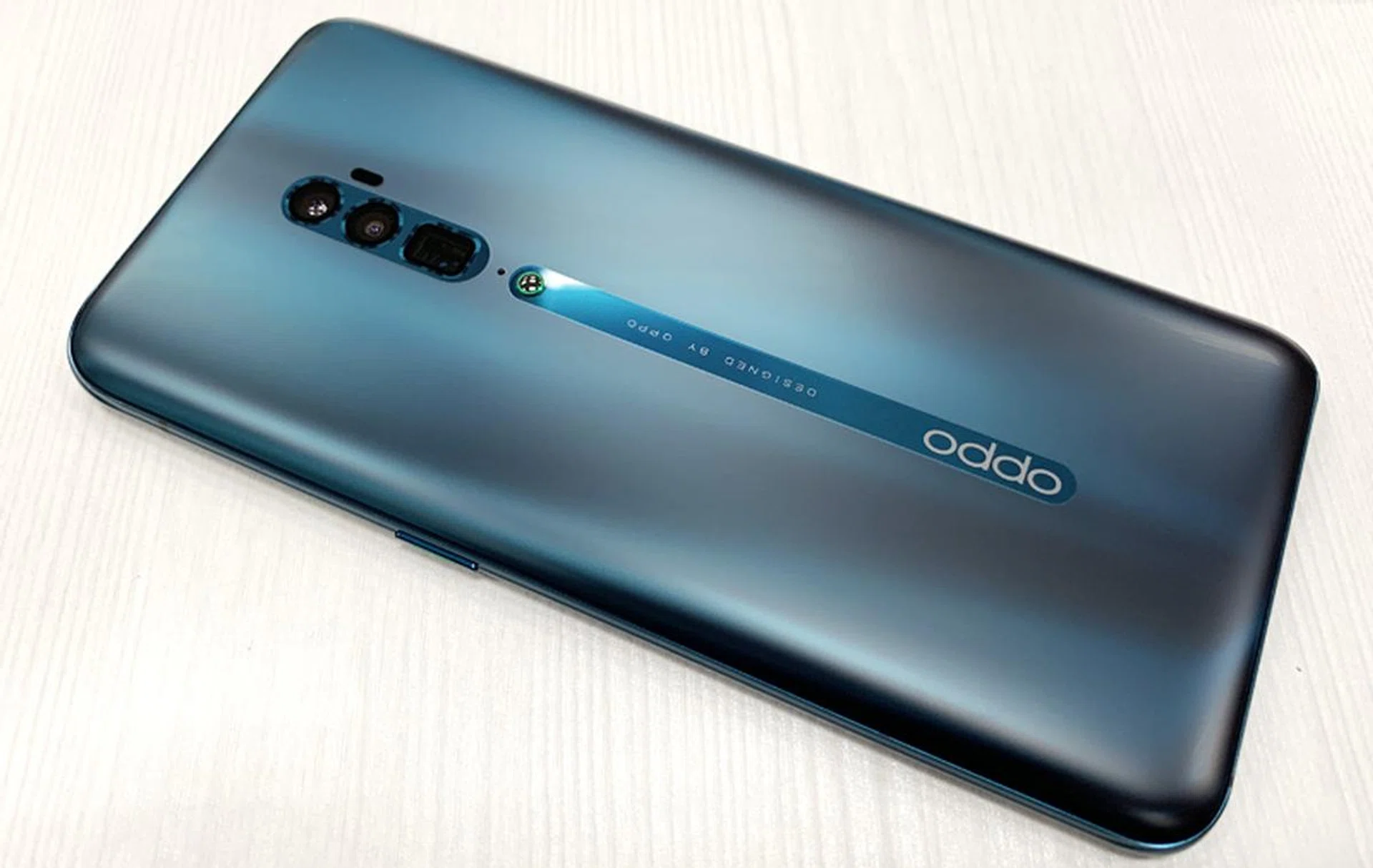
The Reno 10x Zoom is a worthy flagship contender.
If you’re looking for flagship-level performance at a lower price, the Oppo Reno 10x Zoom is a no-brainer. For S$1,199 (8GB RAM, 256GB Storage) you get a flagship-level smartphone that out performs most of its competition, many times falling within the top three. That’s S$200 cheaper than the Huawei P30 Pro was at launch, and just a bit more than the OnePlus 7 Pro (S$1,168), so the phone is certainly competitively priced.
Model | Oppo Reno 10x Zoom | Google Pixel 3XL (64GB) | Huawei P30 Pro | OnePlus 7 Pro (12GB/256GB) | Samsung Galaxy S10+ (256GB) |
Price | S$1,199 | S$1,399 | S$1,398 | S$1,278 | S$1,598 |
Street Price | S$929~S$1,504 | S$800~S$1,000 | S$788~S$1,398 | S$820~S$1,209 | S$1,160~S$1,268 |
The phone looks good, and the pop-up selfie camera will certainly be a talking point for any occasion, while the main camera takes full advantage of the 48MP sensor to give great images too. Meanwhile, ColorOS 6 adds on some much-requested options that make the interface just that bit better so the experience is on par with the competition. It seems the only glaring things missing were wireless charging and some form of water and dust resistance. If these features are important to you, you'll have to look elsewhere, otherwise, all things considered, the Reno 10x Zoom offers compelling performance and a great feature set at a rather attractive price.
Model | Oppo Reno | Google Pixel 3a XL (64GB) | Vivo V15 Pro | XiaomiMi A2 |
Price | S$849 | S$779 | S$699 | S$369 |
Street Price | S$520~S$809 | $670~S$779 | $399~$699 | $188~$330 |
Conversely, we wouldn’t pick up the Reno unless you really wanted the extra battery life or a smaller phone. As you can see from the table above, it's the most expensive of the phones we compared, but hardly turned in the best performance. The Google Pixel 3a XL would be our pick if you wanted best performance at this price point.
Otherwise, you’re likely to be better served paying the extra S$350 to get the Reno 10x Zoom for the improved processing performance and better camera. If only design matters and you really like the looks of the Reno, we’d point you to the Reno Z, which retails for just S$399. This doesn’t have a pop-up selfie camera, but has the same overall aesthetic and a larger 4,035mAh battery.
Design | Features | User-friendliness | Performance | Value | Overall | |
8.5 | 8.0 | 8.0 | 8.5 | 8.0 | ||
8.5 | 8.0 | 8.0 | 7.5 | 7.0 |