
Intel joins the AI party with its Nervana Neural Network Processor
Intel has announced its Nervana Neural Network Processor (NNP) family, the company’s first chips built expressly for AI and training deep learning algorithms.

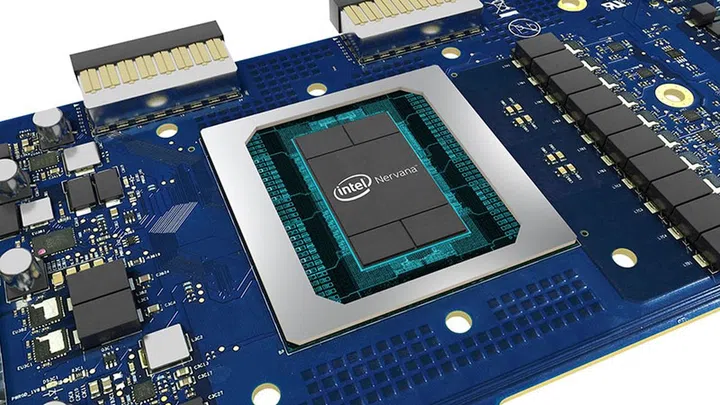
Image Source: Intel
Intel may be among the biggest chipmakers in the world, but it’s largely missed out on all the hype surrounding artificial intelligence (AI). Intel’s chips are fast, but they’re not the best at tasks like computer vision, image and voice recognition, or machine learning.
It’s now looking to change that with the Nervana Neural Network Processor (NNP) family, the company’s first chips built expressly for AI.
The chips are expected to begin shipping by the end of 2017, and they’re intended to help Intel get a leg up in neural network training, a key aspect of machine learning.
Intel’s response to the AI wave has been to snap up a variety of companies that focus on the area, such as chipmaker Movidius and Mobileye, a company that makes chips for vision-based autonomous vehicles.
The Nervana NNPs owe a lot to deep learning startup Nervana Systems, which Intel acquired in August 2016. The chips have been under development for the past three and a half years, starting out as the Nervana Engine application-specific integrated circuit (ASIC), which promised optimized performance for deep learning.
After Intel’s acquisition, the Nervana Engine then resurfaced as the Lake Crest deep learning architecture, with features such as a high-bandwidth interconnect and HBM2 memory.

Image Source: AnandTech
Today’s Nervana NNP goes after the data center training market, and it’ll go head-to-head with things like NVIDIA’s Volta-based Tesla products. NVIDIA has a huge lead in AI, largely because GPUs also happen to be the best at training deep learning algorithms, so Intel’s looking to step up here.
Intel says the chips can scale quite effectively too, thanks to high-speed interconnects on and off the chip that allow for massive bi-directional data transfer. This means multiple chips could be linked together and function as a large virtual chip to better accommodate larger models and data sets.
The company also roped in Facebook in the development of the chip, but it’s not stopping here. Intel has big plans for AI computing, and it thinks its hardware could see use in areas like health care, social media, the automotive industry, and even weather forecasting.
Multiple generations of Nervana NNP products are in the pipeline, and the chipmaker says it is on track to exceed the goal it set last year of improving AI performance by a 100 times by 2020. Already, there's talk of the successor to this generation of Nervana chips, codenamed Knights Crest, which would be a bootable Xeon processor with Nervana technology built in.
Source: Intel
Our articles may contain affiliate links. If you buy through these links, we may earn a small commission.