
IBM and NUS announce intent to set up a new AI research and innovation centre
It is hoped that once the new centre is ready in 2025, it will carry out research into Green AI and AI safety.
#ibm #nus #ai

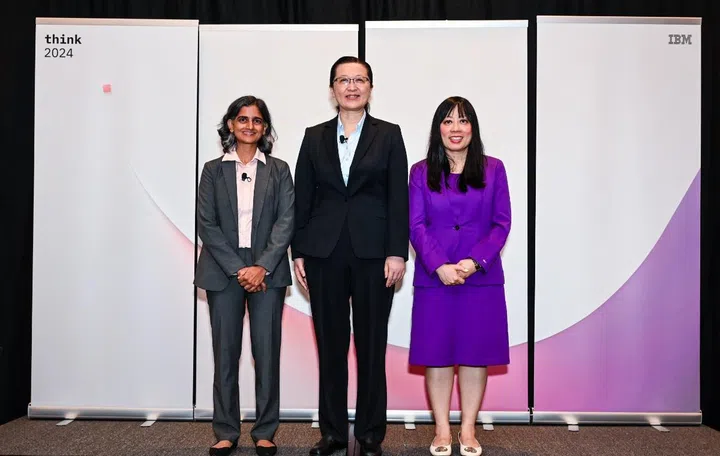
From left to right: Priya Nagpurkar, Vice President, Hybrid Cloud and AI Platform, IBM Research, Professor Liu Bin, Deputy President (Research & Technology), NUS; Catherine Lian, General Manager and Technology Leader, IBM ASEAN. Image source: IBM.
IBM and the National University of Singapore (NUS) announced the intention to establish a new AI research and innovation centre as part of Singapore’s National AI Strategy. The centre will serve as an innovation platform for Singapore agencies, academic and research institutions, as well as companies to jointly conduct AI research.
Expected to be ready in 2025 and located at NUS, the centre will house a full-stack of AI-optimised computing infrastructure that will operate on the IBM watsonx data and AI platform and Red Hat hybrid cloud platform.
According to a spokesperson, the proposed centre be conducting research in Green AI and AI Safety, although this will be confirmed once the centre opens. Unfortunaltey the number of students to be taught at the centre couldn’t be confirmed.
Professor Liu Bin, NUS Deputy President (Research and Technology), said:
We are very excited about this opportunity to collaborate with IBM. We envision a future where an open ecosystem is most vital to harness the best of collective intelligence. Building on the new NUS AI Institute announced earlier this year and the University’s commitment to green computing and sustainability, we aim to be the leading force in addressing rising industry demand for AI intelligence, cultivating a robust talent pool and contributing to Singapore’s decarbonization efforts.
The centre's initial research is expected to cover:
- Developing AI technologies and methodologies that are energy-efficient and environmentally friendly to help reduce the carbon footprint and resource consumption associated with AI development and deployment. Some examples would be creating energy-efficient AI models; and optimising algorithms to run on smaller, less powerful devices without significant performance loss; and leveraging AI to address environmental challenges such as climate modelling and optimising energy grids.
- AI Safety will look at how AI systems can be designed, developed, and deployed in ways that are safe, reliable, and achieves beneficial outcomes. Some possible examples could be enhancing robustness of AI systems so that they can perform reliably; protecting AI systems from malicious attacks; and addressing and mitigating biases in AI systems.
This isn't the first such move by IBM. Earlier this year, it signed an agreement with NTU on Quantum computing.
Our articles may contain affiliate links. If you buy through these links, we may earn a small commission.