
Casio Exilim EX-100 Premium Compact - Almost An All-Round Performer
Not intending to compete on specs, Casio has released the Exilim EX-100, a premium point-and-shoot camera that is able to shoot at F2.8 throughout its 10.7x optical zoom range. But with so many premium compacts around, where does the EX-100 stand?

Introduction
Many people assume that any tech gadget with the latest and most impressive hardware should therefore be the best. It’s an easy way for consumers to compare products. For example, a camera with a 20-megapixel sensor should theoretically outperform one with a 12-megapixel sensor.
But having the best hardware doesn’t always equate to having the best performance and value, and that’s why not every company aims to compete in the specs race. Casio has adopted this approach with it recently announced Exilim EX-100, where it’s marketed more as an ideal lifestyle companion rather than a camera boasting the latest and greatest hardware.
But that’s not to say the EX-100 has lackluster features. The camera has the ability to shoot at F2.8 throughout its zoom range, and also has Casio’s Intelligent Bracketing function, which shoots nine continuous images while varying the settings of two parameters such as contrast and saturation.
Wait a minute, a Casio camera you say? You may not associate Casio with leading digital compact cameras, but the Japanese company is looking to change that with the Exilim EX-100.
For those who aren’t familiar with photography, the wider the aperture (in the EX-100’s case it’s F2.8 and the smaller the figure, the better), the more light you can capture. This is useful in low-light situations as a wider aperture lets you shoot with a faster shutter speed, which helps reduce camera shake in your pictures. A wider aperture also helps you keep your focus area sharp and crisp while your background gets blurred as though it has been post-processed in your photo editing software. Also known has "bokeh" effect, it helps capture an aesthetically pleasing shot where it gives the shot more depth and presence to what matters most in your photo.
It’s common for a compact camera’s aperture to narrow down as you zoom in closer to your subject. Unlike a standard compact, the EX-100 is able to shoot at its widest aperture even when you’re fully zoomed in, which is very useful in maintaining all the advantages of a wide aperture and taking advantage of it in no matter the zoom level used.
Design and Handling
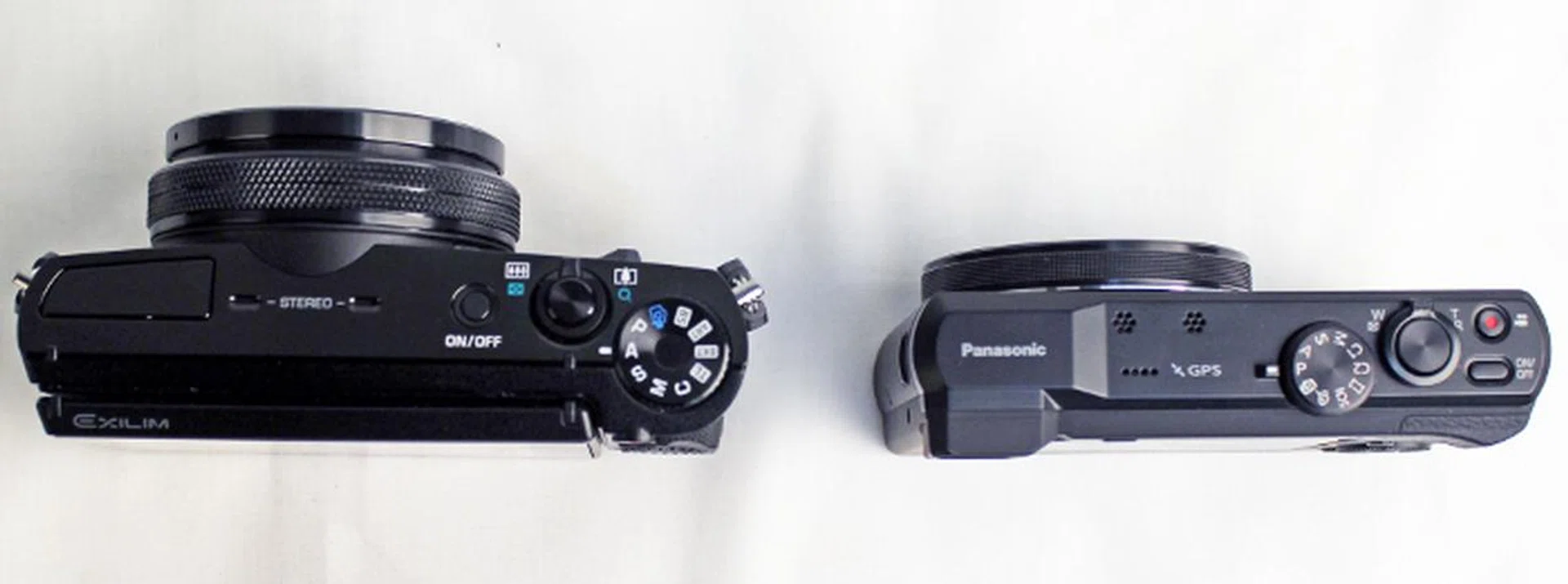
Just for illustration purposes, pictured here is the Casio EX-100 (left) and Panasonic TZ-60. The Panasonic TZ-60 is a compact superzoom with 30x optical zoom, but the Casio EX-100 has the ability to shoot at F2.8 throughout its 10.7x optical zoom. As you can see, the Casio EX-100 has a thicker lens barrel to account for the larger glass needed for the constant wide aperture. The Casio EX-100 isn't a direct competitor of the compact superzoom category, but it does have some features that make it a suitable travel compact.
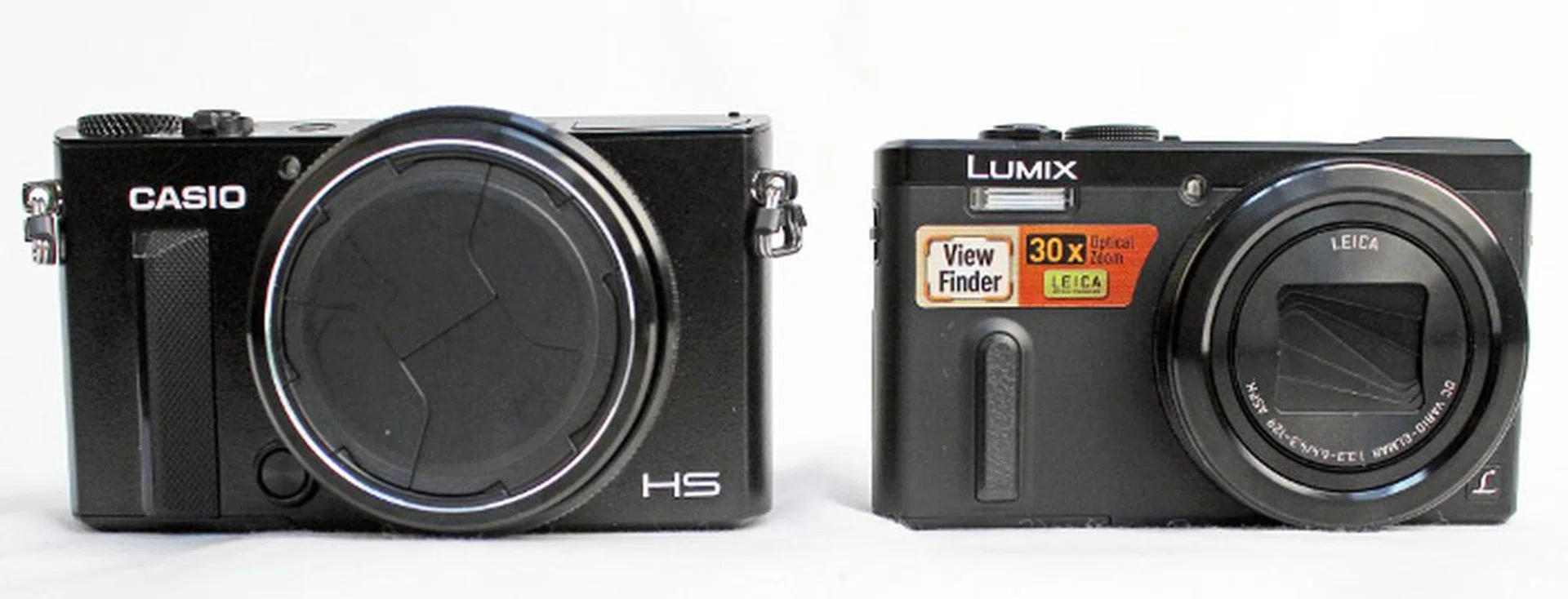
In terms of height, the Casio EX-100 is slightly taller than the Panasonic TZ-60. The Casio EX-100 is thicker as it also comes with a tilt display.
The first thing that you will notice about the EX-100 is its size. The camera is chunkier than your average point-and-shoot. But that’s because the EX-100 comes with a display that can be flipped up, which increases the overall dimensions of the camera. And don’t forget, when a camera has a wider constant aperture, the glass used in its lens construction is generally larger and heavier.
The EX-100 does have a reassuring heft to it, and the die-cast magnesium body also contributes to its solid and sturdy feel. There’s a textured finger grip on the front, which helps with holding onto the camera. We would have preferred it to be rubber instead of plastic though. The EX-100 comes with a control ring, and you can assign various functions to the ring such as setting white balance, ISO and zooming in and out like how you would with a DSLR lens.
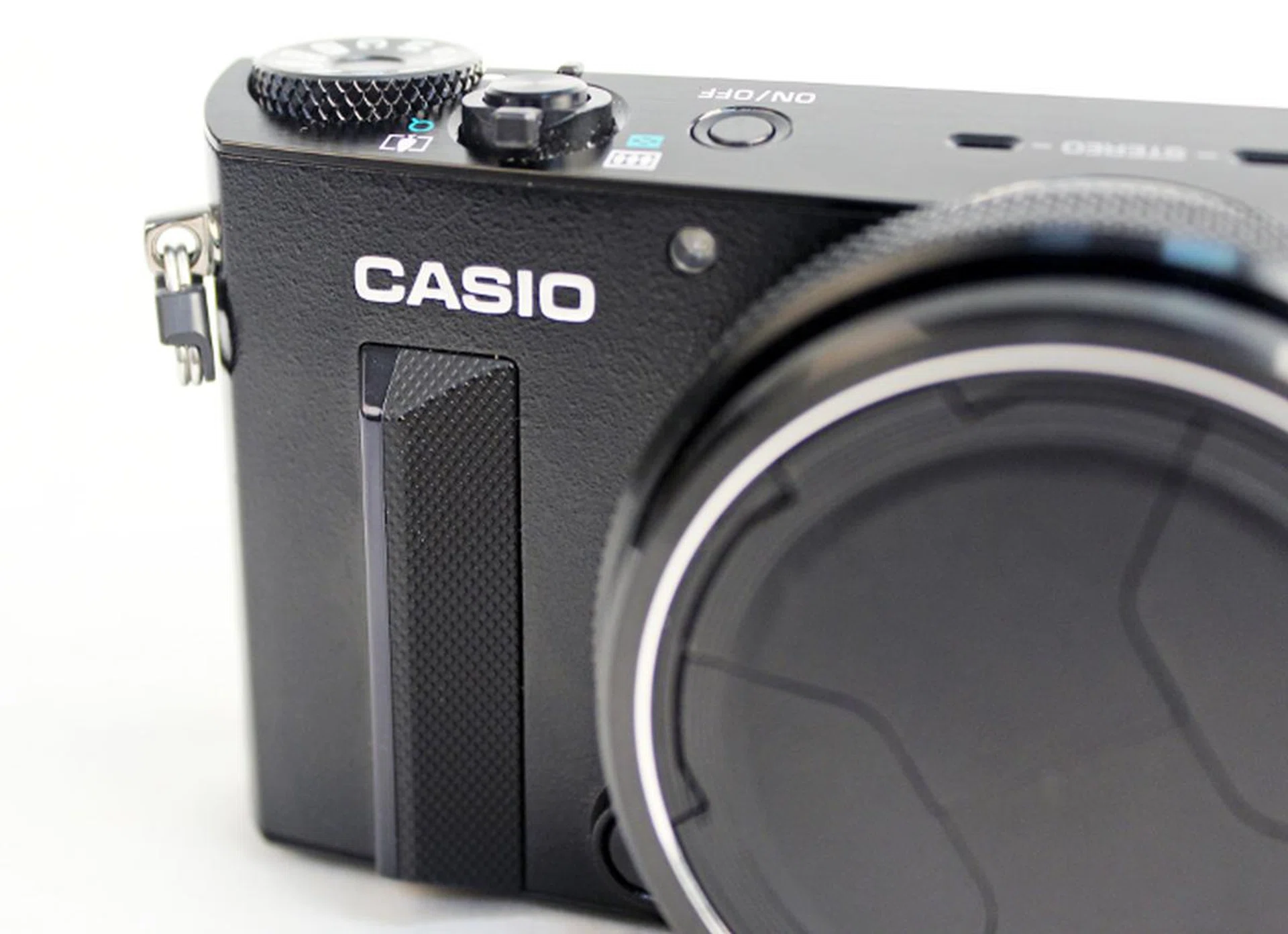
The Exilim EX-100 has a textured plastic grip on the front. A rubber one would have provided more grip, but the current grip does its job pretty well.
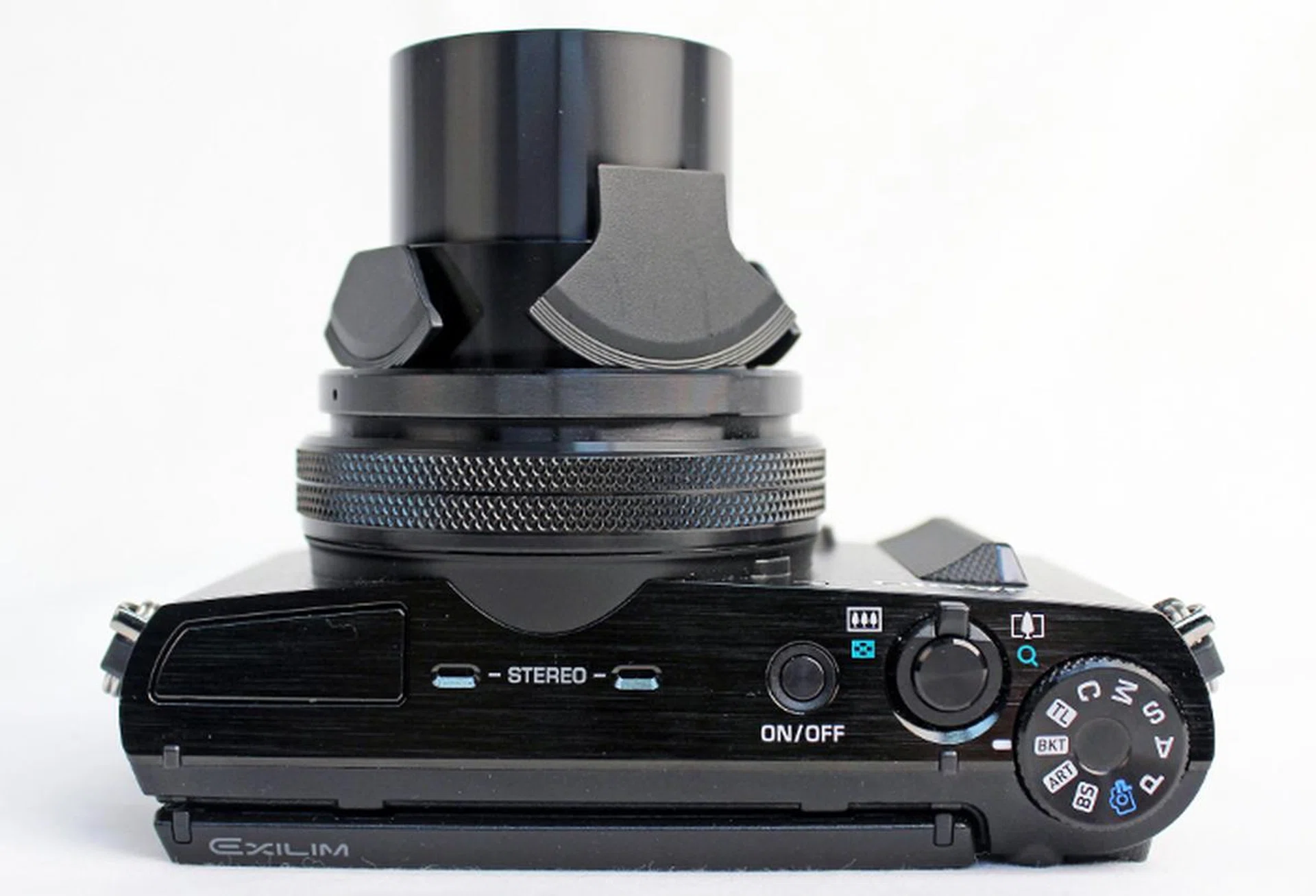
The EX-100 with its lens fully racked out. Also note that you don't have to worry about maintaining a lens cap - it's part of the camera's design.
Thoughtfully, there’s a shutter button on the front, below the lens, which can come in handy for taking selfies with the screen tilted up. It can also be used during playback mode. For example, while you’re viewing images on the camera, the front shutter button can be assigned functions such as sending the image you’re viewing to a smartphone over Wi-Fi, which does help to save time and button presses to select an image and manually sending it over.
The top plate of the camera is pretty standard with the power button, zoom lever, mode dial and a pop-up flash.

The display cam be flipped up to take selfies. Flipping up the display will also power on the camera when it's powered off.
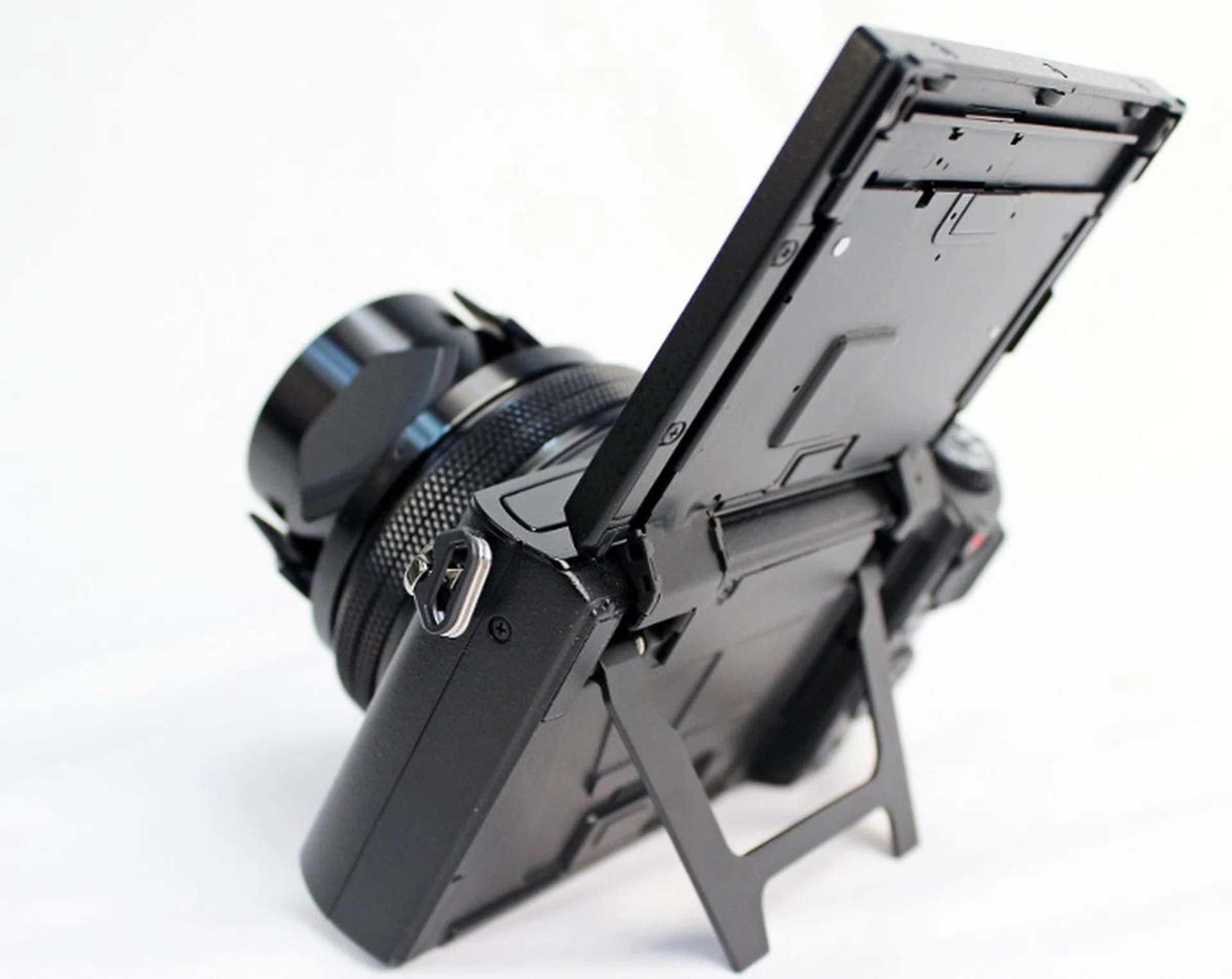
There's also a built-in stand beneath the display so you can set it on a surface when taking timed shots or selfies. These are small enhancements that bring about better camera usability for the masses.
On the rear you have the 3.5-inch 921,600-dot LCD display which can be can flipped up or down as mentioned earlier. Flipping up the screen when the camera is turned off will also power up the camera. The display isn’t touch-enabled, so you will have to use the d-pad to select settings and set the autofocus area. There’s a built-in stand right behind the display, which you can use to set the camera on a surface for timed shots.
You'll also find a textured thumb rest on the rear, with the ring button below it. The ring button lets you assign functions to the control ring as iterated earlier.
User Interface and Camera Performance
The EX-100’s user interface is quite easy to navigate. Pressing the Set button will bring up a list of shooting settings such as white balance and ISO. The EX-100 also comes with the usual assortment of preset modes, but the EX-100 takes it further with its Intelligent Bracketing mode.
We’re sure most of us have experienced situations where there’s a small window of opportunity such as shooting a fast-moving object. Unsure of whether the camera’s Auto setting will do a good job, we usually have to shoot in manual mode while having to decide the shooting settings such as aperture, white balance or contrast within a short span of time.
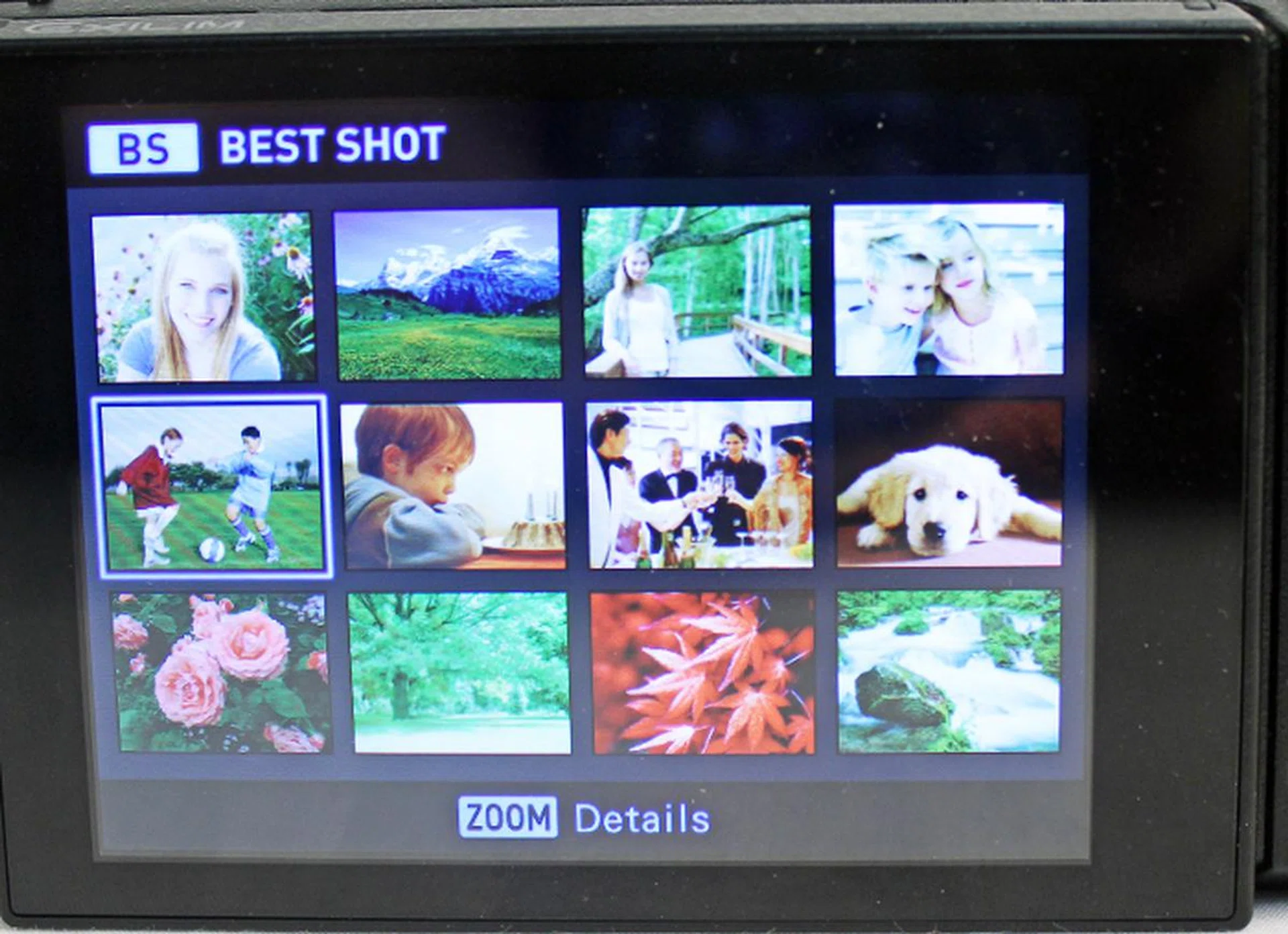
The EX-100 comes with quite a number of preset shooting modes to cater to those not familiar with manual controls.
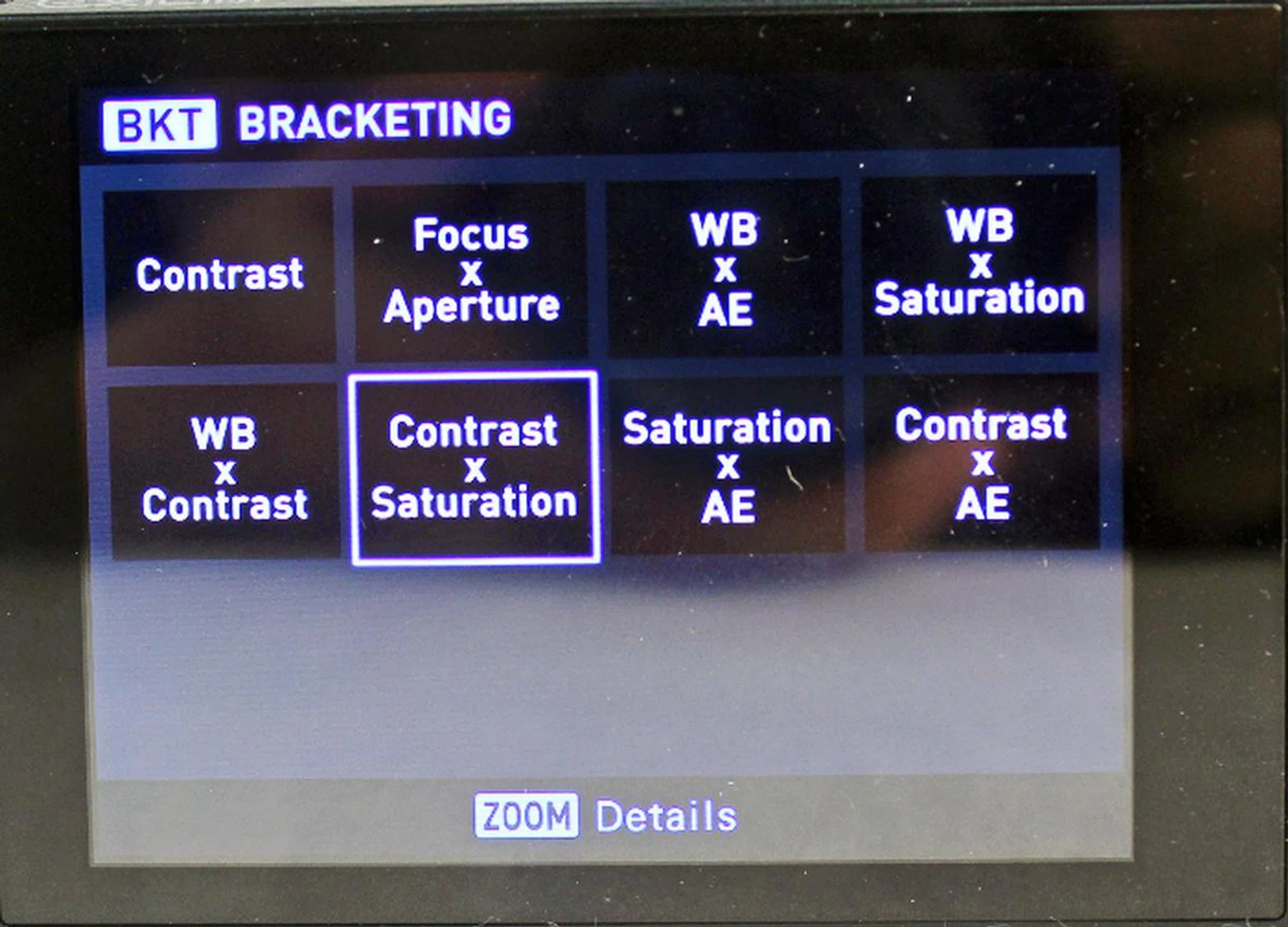
The EX-100's Intelligent Bracketing function offers various combinations of shoot settings so you can get different results without having to manually adjust the setting multiple times.
The EX-100’s Intelligent Bracketing mode helps by shooting nine images continuously while varying the settings of two parameters such as contrast and saturation. The good news is that all nine images are saved so you can choose the best-looking image of the bunch, while not having to worry about having to get the settings right on the first try.
For those coming from a smartphone shooting background, not having a touchscreen to set the autofocus area may feel a bit restrictive. But you do get the set the size of the AF area, as well as move it around the screen with the d-pad. The bad news is that you can't set the AF point while shooting in Best Shot mode or Premium Auto. So setting the AF point is restricted to the manual shooting modes and the Program mode. And if your camera happens to be set in Spot focus mode, it may not occur to those less familiar with photography that you cannot move the AF point, which is set in the middle of the screen.
The EX-100 has an optical zoom range of 10.7x, and we found the image stabilization performed quite well even at the longest end. In terms of resolution the EX-100 scored 2,000 (vertically and horizontally). When shooting up to ISO200, the camera does a good job of keeping noise to a minimum while still retaining details. Between ISO200 and ISO400 noise starts to creep in, while details start to meld together when you hit ISO800. Images right out of the camera possess colors that are quite accurate and vibrant without being overly saturated. Besides the below photo spread, you can find even more examples of it imaging quality in our earlier preview article.
The EX-100's larger camera size also affords it a larger battery, and its battery life is rated at 390 shots, which is more than the standard premium compact camera.
Below are sample photographs shot with the Casio Exilim EX-100. The photos have not been post-processed and are copyright to SPH Magazines. They are provided for your reference only and we ask that you do not reproduce them elsewhere. Click for the full-resolution images.

f/3.2 at 46mm, 1/60sec, ISO80

f/2.8 at 42mm, 1/400sec, ISO80

f/2.8 at 42mm, 1/125sec, ISO80 (shot with macro focus)

f/5.6 at 28mm, 1/60sec, ISO1250
Conclusion
When it comes to features, the Casio EX-100 definitely does not lose out. The ability to shoot at F2.8 throughout its 10.7x optical zoom range is something that you will appreciate when shooting in low light and achieving bokeh effects at any zoom level. The EX-100 also makes things easy for the casual shutterbug with its variety of shooting modes and its Intelligent Bracketing mode. The latter mode shoots nine images that have varying settings based on two pre-set parameters, which gives users a wider selection to choose from based on a single framed shot, without having to worry about getting the settings for the parameters right and reduce the chance of missing the right moment. You can vet your photos at leisure to choose your most preferred shot.
While the upcoming Sony RX100 III III is one of the few that does match up to the EX-100 in terms of wide aperture when shooting at the longest end, the RX100 III sacrifices reach as it only offers 2.9x optical zoom. The Exilim EX-100 would make a great everyday camera if it weren't for its size and price. Its size can be attributed to the tilt display, the size of its 10.7x optical zoom lens and its big glass (a common feature of lenses that can shoot at wide apertures throughout their zoom range), but some might not be able to accept a point-and-shoot that's larger than the smaller mirrorless system cameras.
What the EX-100 has going against it most is its price. At S$1,199, the EX-100 is much pricier than most of the competition. This also leads to another problem where the EX-100 is a jack of all trades but master of none.
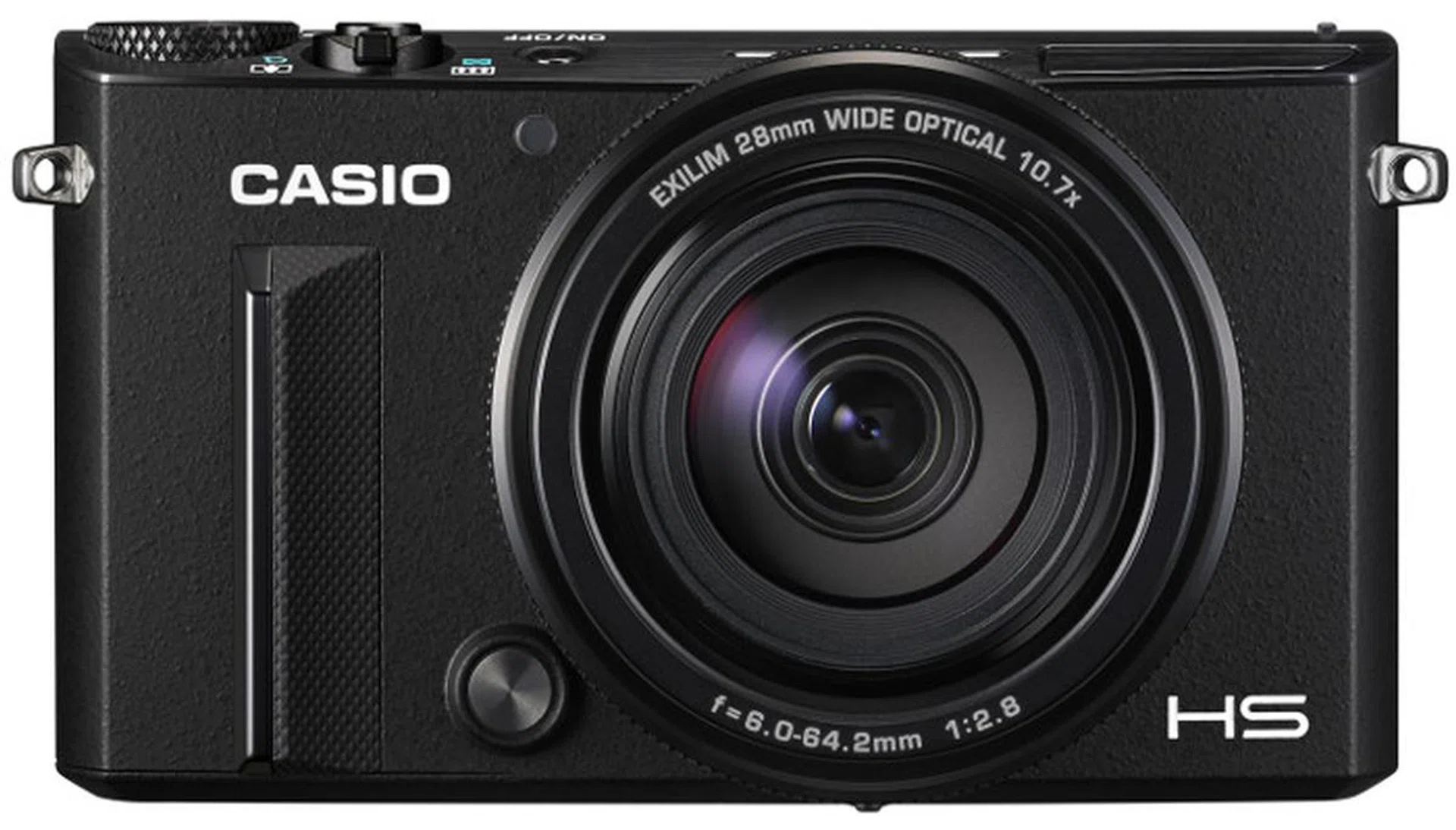
Users expecting the best image quality and noise control will gravitate towards the Sony Cyber-shot RX100 III and its 1-inch sensor. For those who prefer a more subdued price tag but with reasonable performance, there’s the Panasonic Lumix LX7 or the Panasonic Lumix LF1 which offers a bit more reach (7.1x optical zoom) but has a smaller aperture at the long end (F5.9). The Canon PowerShot S120 is also another good alternative.
And because of the EX-100's price tag, it also steps into the territory of entry level mirrorless system cameras. With compact models such as the NX Mini and Panasonic GM1, you do wonder where the Casio Exilim EX-100 truly stands. But then again, not everyone likes switching out lenses, so the more casual shooters may prefer a solid point-and-shoot over a mirrorless system camera.
This is exactly where the Casio EX-100 sits - to offer best point-and-shoot camera for travel that blends good imaging quality that bests any superzoom compact, selfie friendly with tiltable screen and shooting functions, has a reasonable zoom range and being able to shoot at F2.8 throughout for artistic photo captures (bokeh effect). If you can look past its asking price and chunky build, the Casio EX-100 fits the bill perfectly for users who need a carefree camera that will go the distance and cover most of what's needed for shutterbugs without needing to venture into advanced cameras, managing lenses or even knowing photography techniques.
Our articles may contain affiliate links. If you buy through these links, we may earn a small commission.