
Anker 25,000mAh 165W power bank review: Better than your ex-power bank
The word salad in its name hints at its capabilities: 25,000mAh capacity with a maximum 165W combined charging speed, replete with multiple, built-in USB-C cables to spare you from searching and having to borrow one. #powerbank #charging #mobile #laptop #phone #tablet #anker
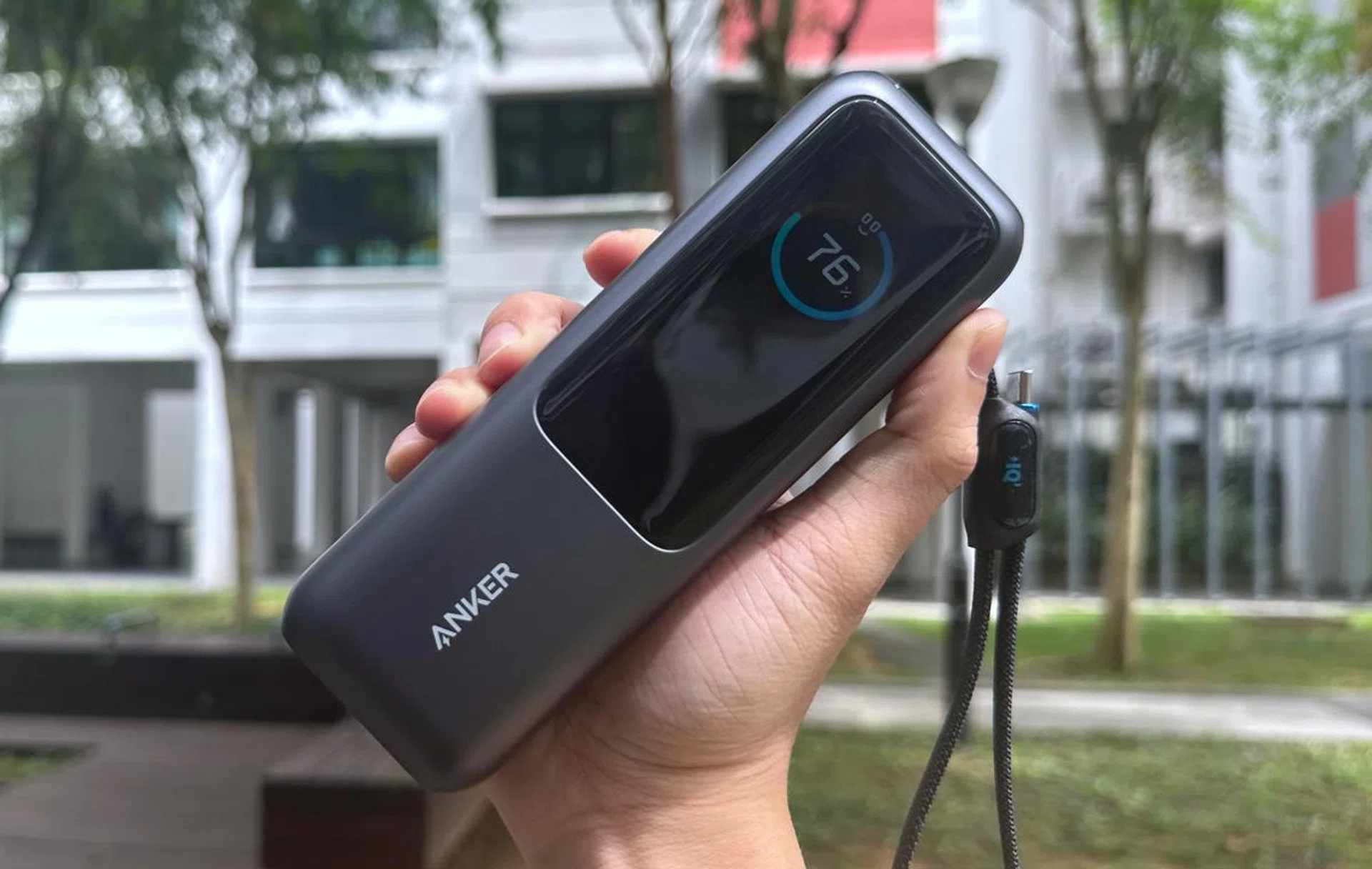
Electrodes, ready
It takes a fair amount of courage to announce a humble power bank at an international consumer tech conference, but that’s precisely what Anker did earlier this year.
First announced at CES 2025, the S$159.99 Anker 25,000mAh Power Bank (165W, Built-In and Retractable Cables) debuted with a host of features that would make many other power banks look like children’s toys.
The word salad in its name hints at its capabilities: 25,000mAh capacity with a maximum 165W combined charging speed, replete with multiple, built-in USB-C cables to spare you from searching and having to borrow one.
It has a huge tank of juice, enough charging speed to support some laptops and notebooks, and has a display to tell you what it’s doing. While this power bank looks and sounds simple, it’s deceptively smart.
Our review would be two-fold: knowing its charging capabilities would be an obvious priority, but what sets authentic, high-quality power banks apart from the chaff is the user experience, which is informed by its design and handling in real-world use.
Let’s go.
Compact umbrella form factor pays off in spades

Anker 25,000mAh Power Bank (165W, Built-In and Retractable Cables). Photo: HWZ.
First things first. This power bank is almost 600g, but has a minimally intrusive and space-friendly shape.
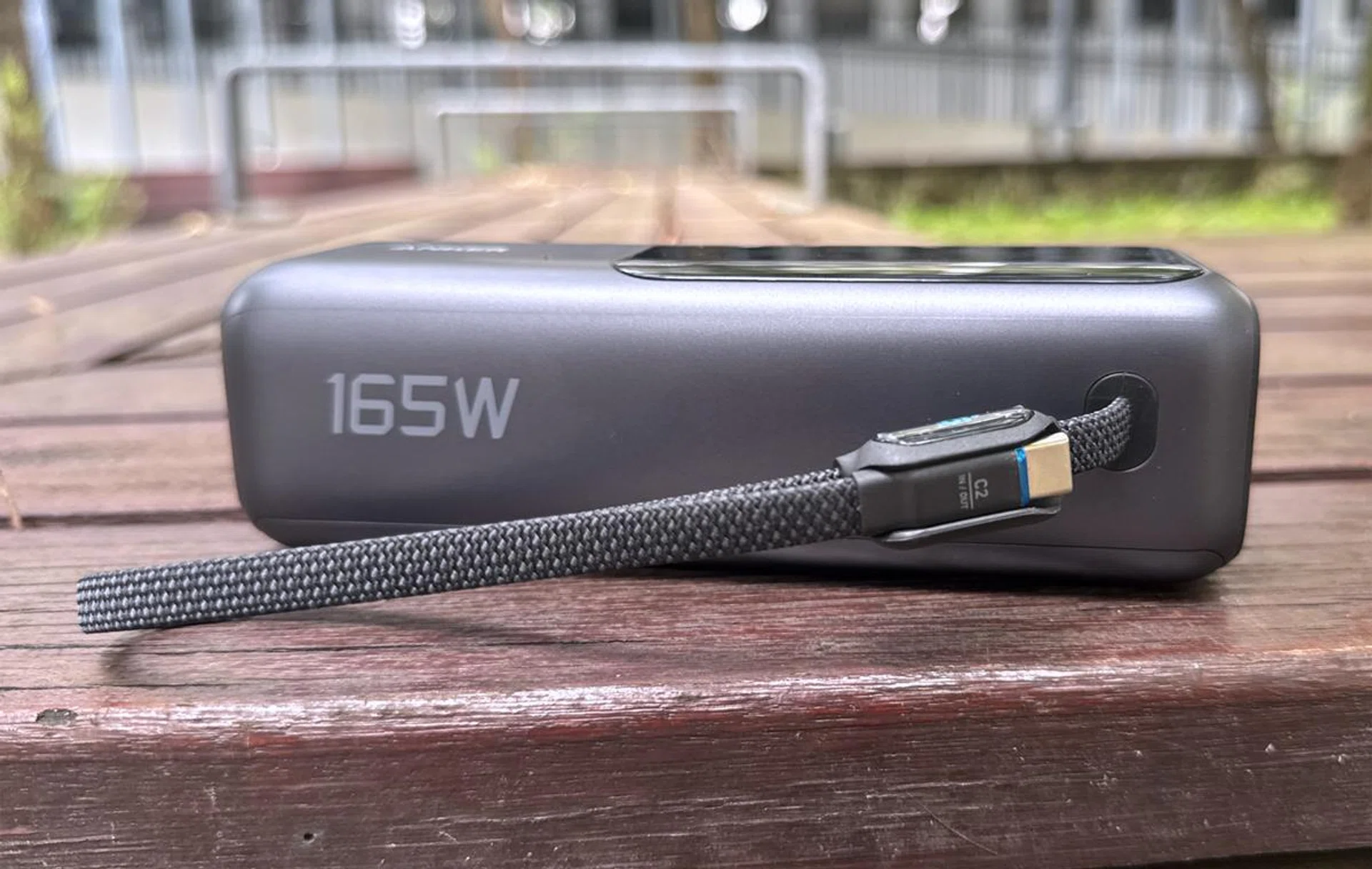
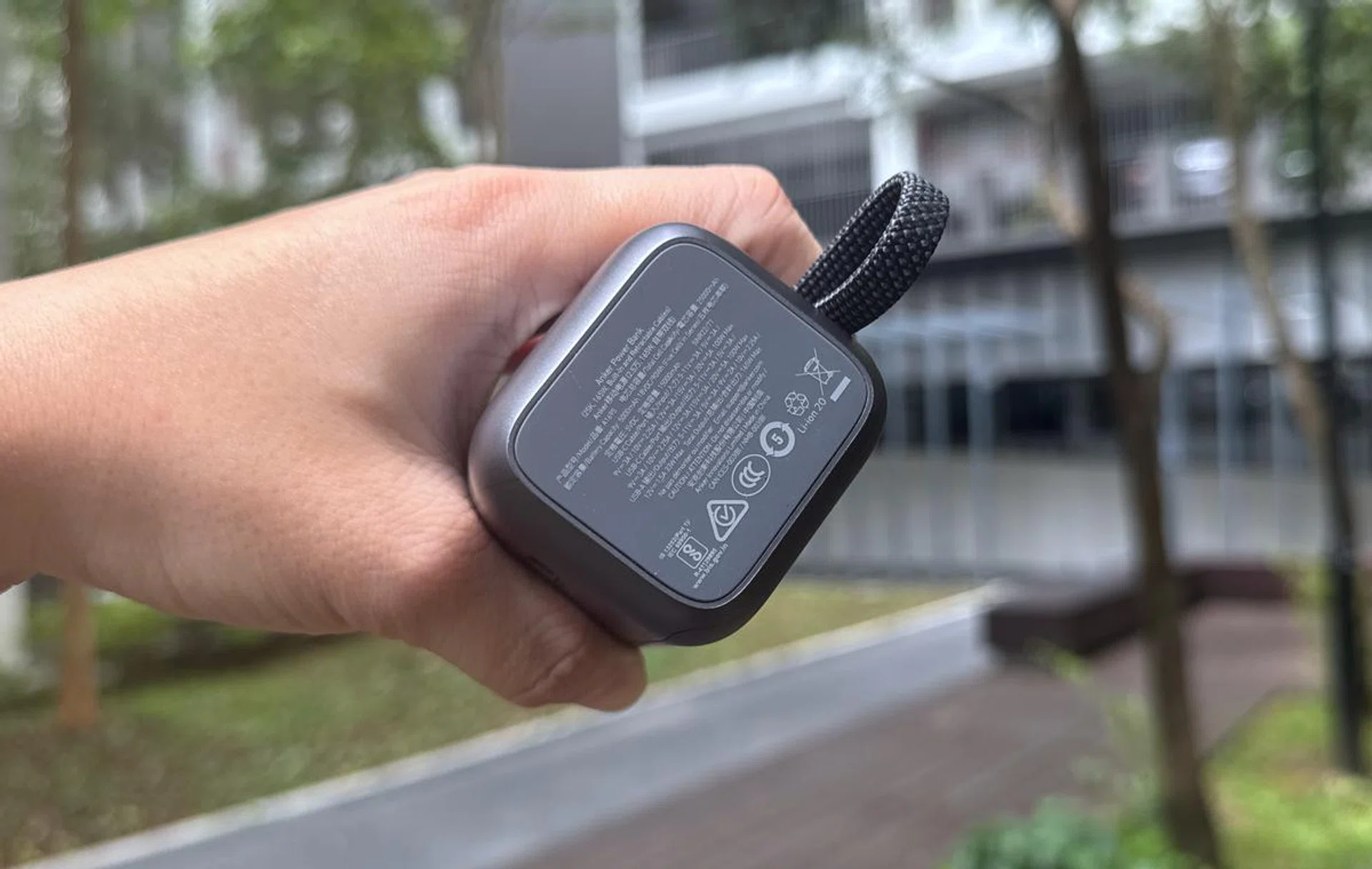
It packs a silhouette similar to a portable, folding umbrella. The "strap" is actually an external cloth-braided flat USB-C cable tucked like a lanyard, making it look like a compact brolly from afar.
Despite its peculiar shape, Anker's power bank plays well into its bulk. You can slot it into your bag’s umbrella compartment or the plane seat’s bottle pocket. Its elongated girth fits politely into most shoulder-slung handbags while leaving plenty of space for other belongings.
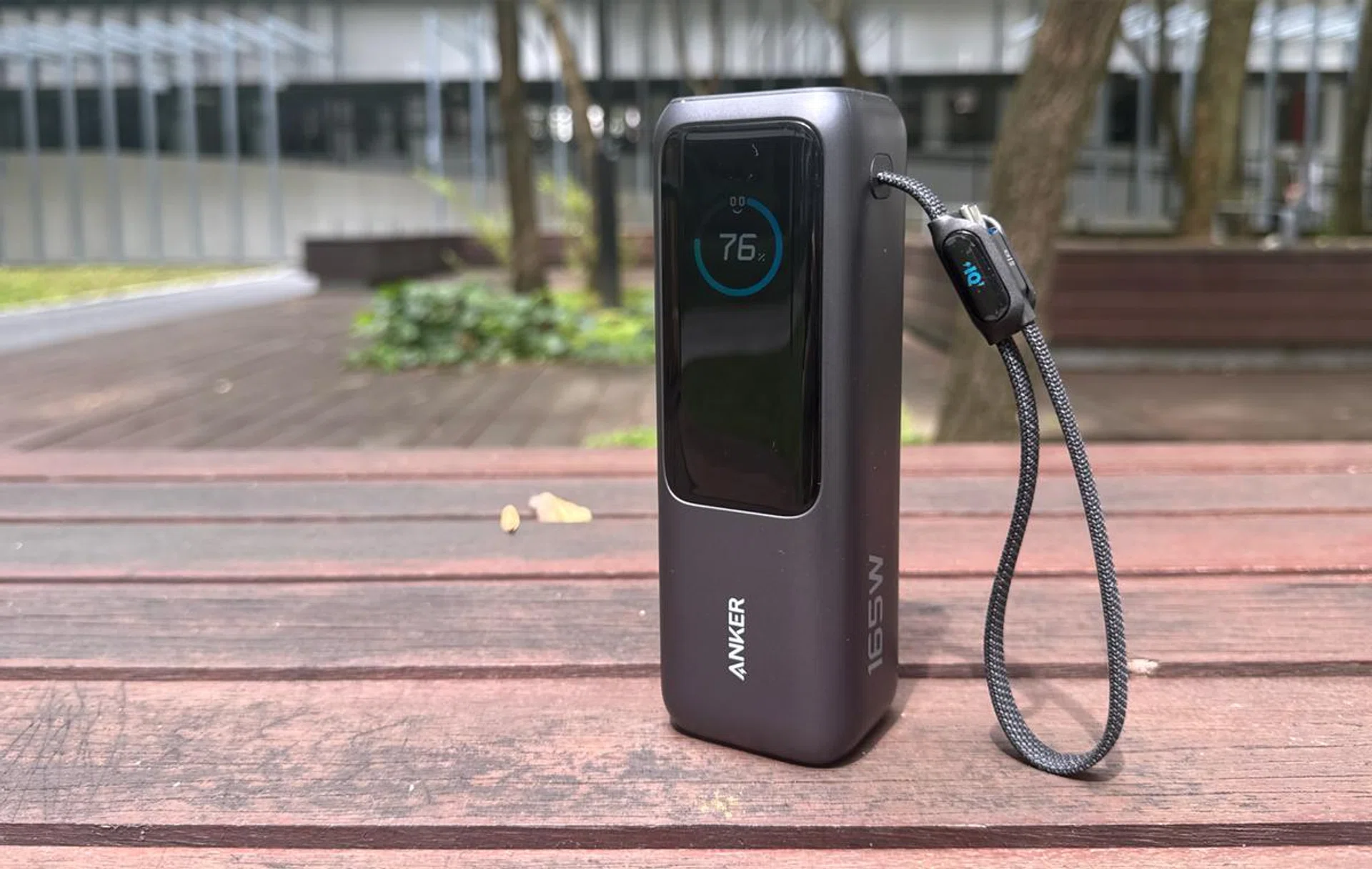
Anker 25,000mAh Power Bank (165W, Built-In and Retractable Cables). Photo: HWZ.
While it can be laid down length-wise, Anker also makes the power bank a standing one. Its flat base and portrait-oriented display panel hint at this. This upright position is most handy when you need to charge devices in very small spaces (like the flaccid tray tables bolted to the back of seats in planes or chartered coaches).
The cables are the cherry on top of the whole power bank cake
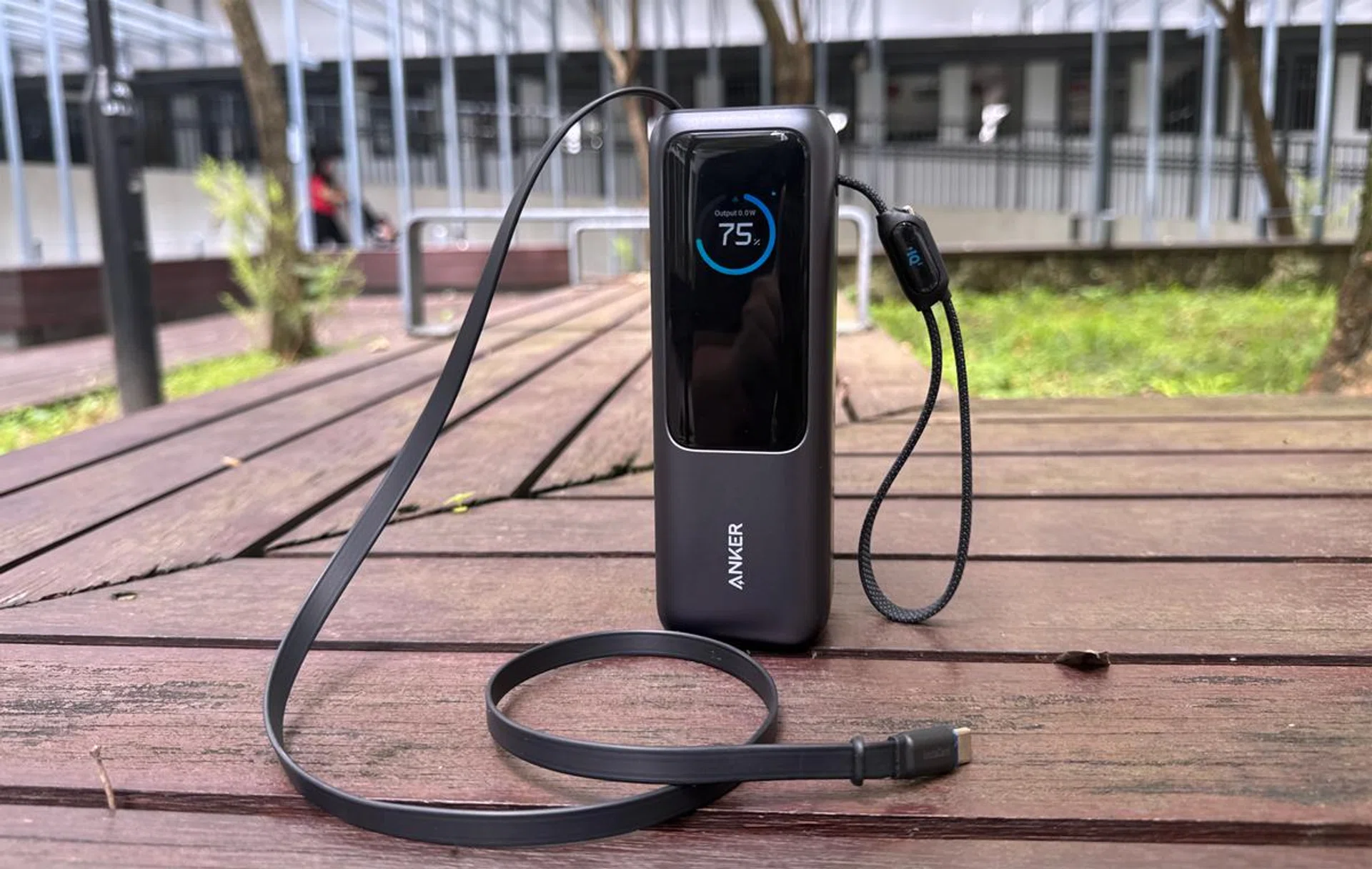
Anker 25,000mAh Power Bank (165W, Built-In and Retractable Cables). Photo: HWZ.
As the name implies, this 165W power bank has more than one attached cable.
The visible, strap-like one (30cm long) has a tiny clip that holds the USB-C head in place when it’s not in use. While Anker said this cable is rated to tolerate up to 20kg in weight, we strongly do not recommend damaging a precious, unremovable cable this way.
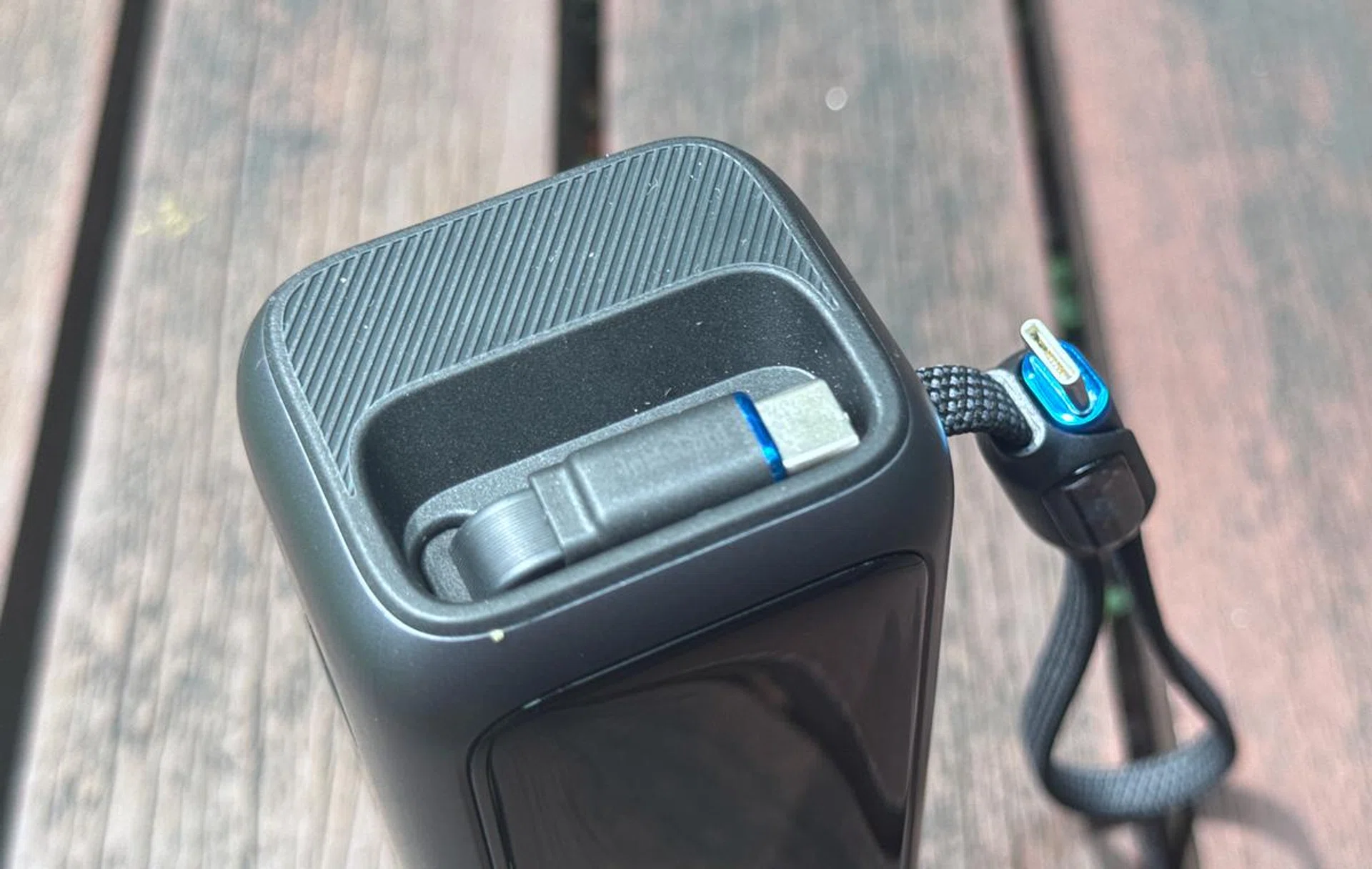
Anker 25,000mAh Power Bank (165W, Built-In and Retractable Cables). Photo: HWZ.
The other built-in, fully retractable USB-C cable (70cm) with rubber-polymer insulation is hidden on the opposite side of its base. To charge with this, you’ll only need to pull out your desired length. The 70cm cable also automatically winds back into the body after you give it a light tug.
The cool bit is that both cables are equally rated at 100W maximum charging when only one is in use, so you don’t have to second-guess whether the provided cables can handle high power needs.
A comprehensive display, even for a simple task
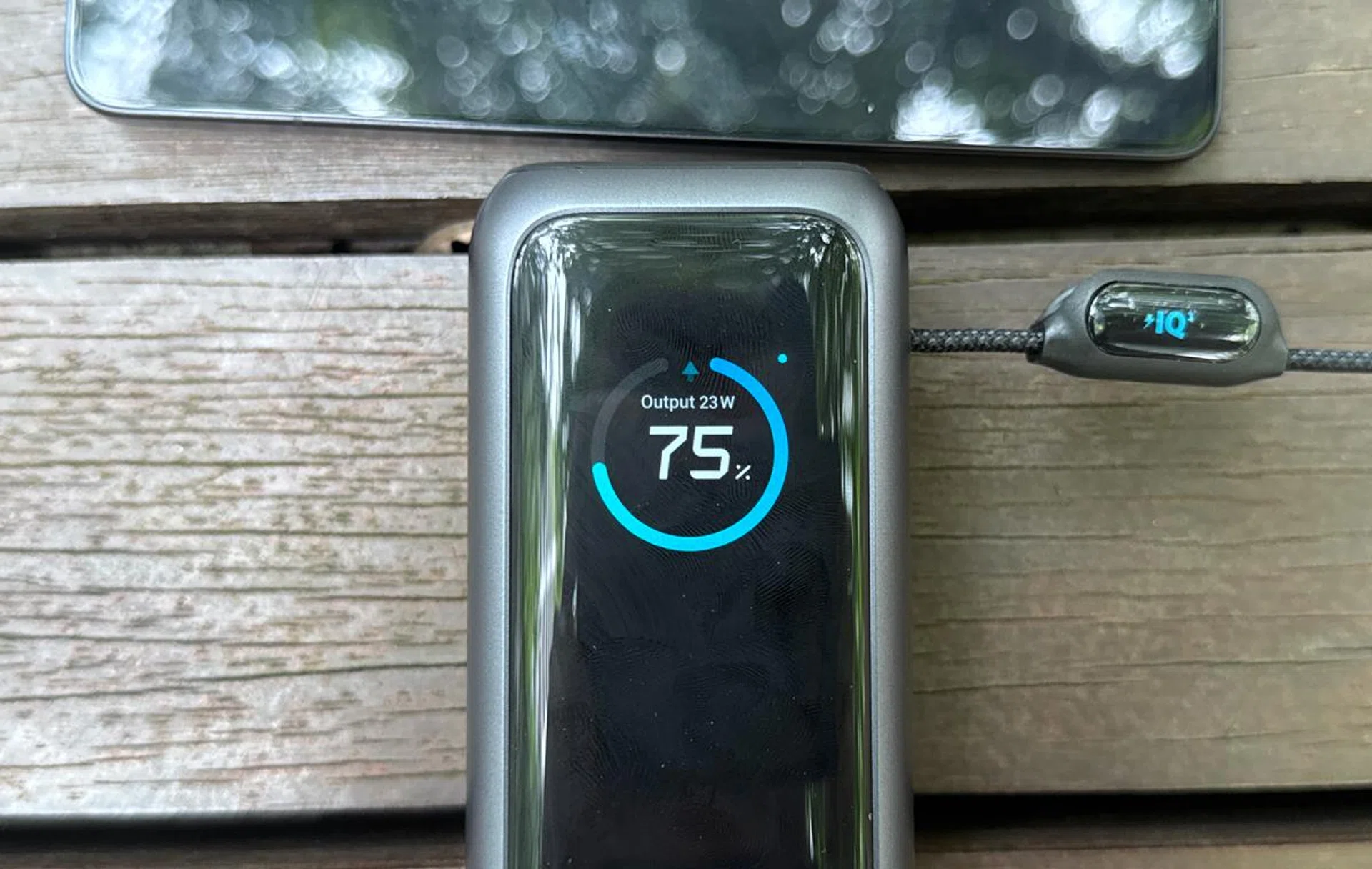
Anker 25,000mAh Power Bank (165W, Built-In and Retractable Cables). Photo: HWZ.
The power bank’s display is invaluable, as it goes beyond typical power banks that only tell you its remaining charge.

Anker 25,000mAh Power Bank (165W, Built-In and Retractable Cables). Photo: HWZ.
When you plug in a device, the real-time display shows which ports are actively dispensing energy (in blue), and at what wattage each. After a few seconds, the display switches to standby mode, showing the power bank’s remaining capacity (in %) and total output (in W) at any given moment.
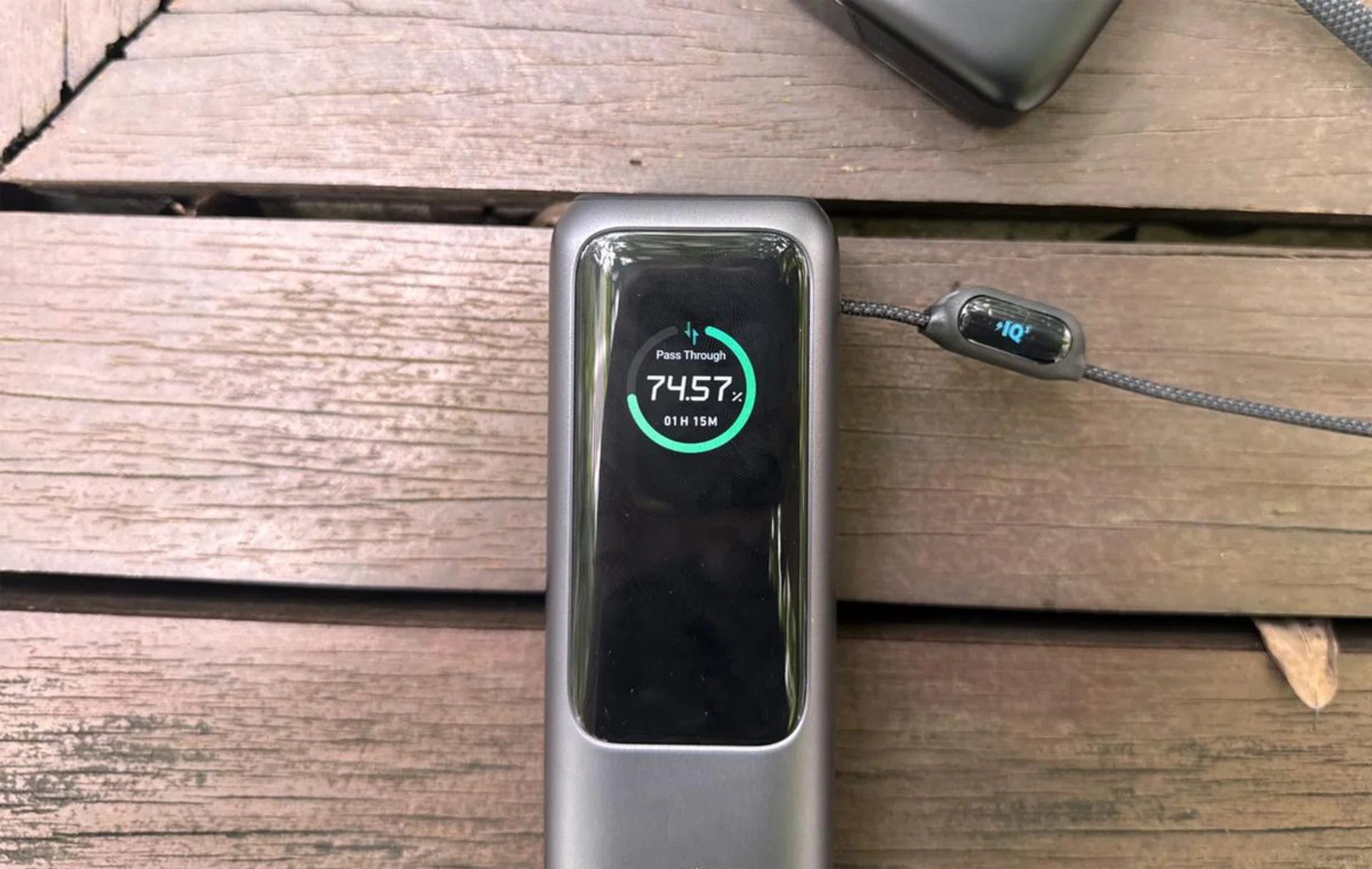
Anker 25,000mAh Power Bank (165W, Built-In and Retractable Cables). Photo: HWZ.
When charging up the power bank, the display elements switch to green. It also shows the current capacity in %, how quickly it’s storing up power (in W), and most importantly, the estimated time it takes to reach 100%.

Anker 25,000mAh Power Bank (165W, Built-In and Retractable Cables). Photo: HWZ.
Pressing the side-mounted button (shaped like an old iPhone’s fingerprint sensor) cycles the display through its five menus.
In addition to what’s mentioned above, you can see the power bank's temperature (which cuts off charging when it overheats) and the number of cycles the battery has gone through (with an estimated battery health showing its longevity).
Longtime users of lower-grade power banks would know such information is not easily available. Some power banks don’t even tell you how much charge they have, or they do a terrible job with weird flashing lights that resemble Morse code having a heart attack.
This Anker one, however, goes further by telling you everything you need to know about it, so that you quickly understand if your power bank is ready to go, especially if you’re outside.
Is this power bank flight-safe?

Anker 25,000mAh Power Bank (165W, Built-In and Retractable Cables). Photo: HWZ.
For travel-loving friends, readers, and anyone else who travels for work: Yes, this power bank can be legally and safely carried onto flights.
Assuming a standard battery voltage of 3.7V, the Anker power bank’s 25,000mAh capacity works out to 92.5Wh. That’s below the 100Wh limit for lithium-based power banks to be brought into commercial planes without needing prior approval (per IATA’s guidelines, which can be found in the PDFs hosted here).
In our experience, its odd size and shape might attract the attention of airport security, so it’s best to have it in an easy-to-reach pocket or bag slot for a smoother boarding clearance. They’d usually wave you back into the line once they see the USB cables sticking out of the device.
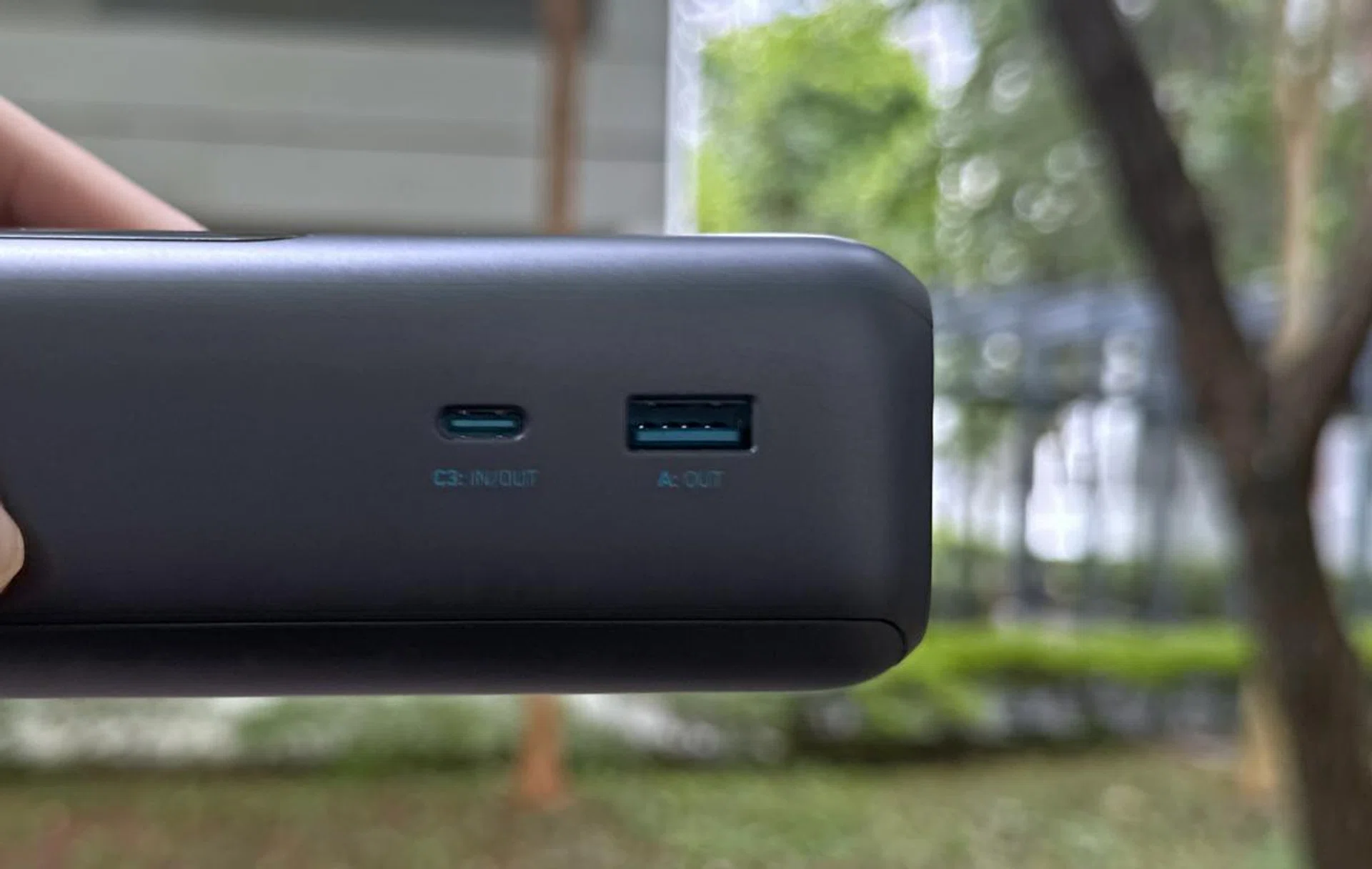
Anker 25,000mAh Power Bank (165W, Built-In and Retractable Cables). Photo: HWZ.
There’s little to fault about its functionality, but we have ideas on how it could be even better. One, it only has two additional ports (1x USB-C, 1x USB-A) besides its built-in cables, and we felt that the power bank could afford to squeeze in maybe two more ports for added versatility.
Two, its longest built-in cable at 70cm still feels a little too short, especially when you need to tether to the power bank while it’s safely tucked away in a bag.
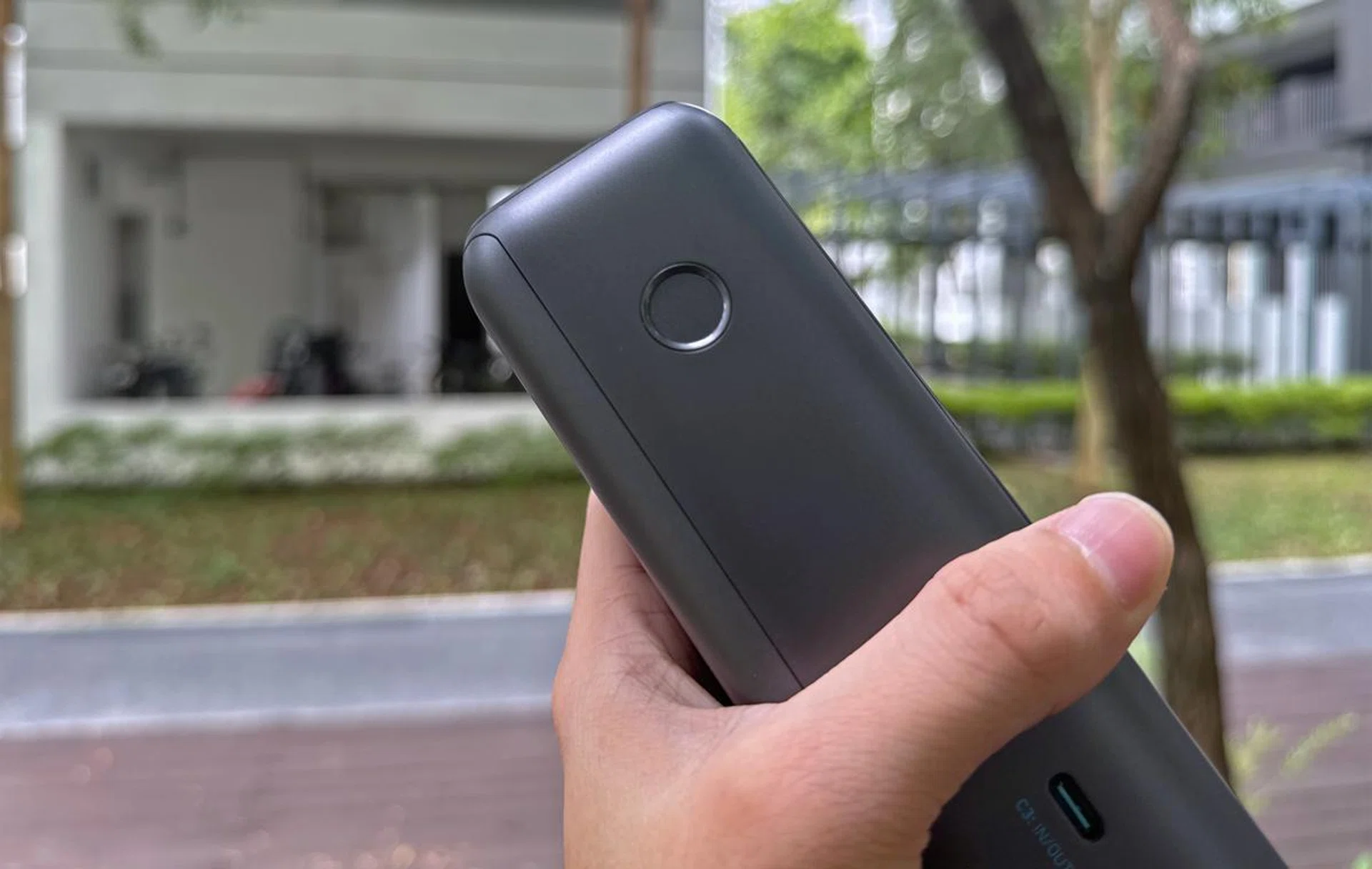
Anker 25,000mAh Power Bank (165W, Built-In and Retractable Cables). Photo: HWZ.
Those are minor disadvantages because the Anker power bank has one significant plus point: its two attached USB-C cables and free USB-C port can charge the power bank. Most power banks only have one port that receives charge, but Anker's one ensures you don't have to guess or choose your favourite hole.
All in all, the Anker Power Bank (25K, 165W) is a very well-designed power bank that makes other OEM brands look more like disposable batteries in comparison. It should be, because it costs S$159.99.
Charging, discharging, and recharging
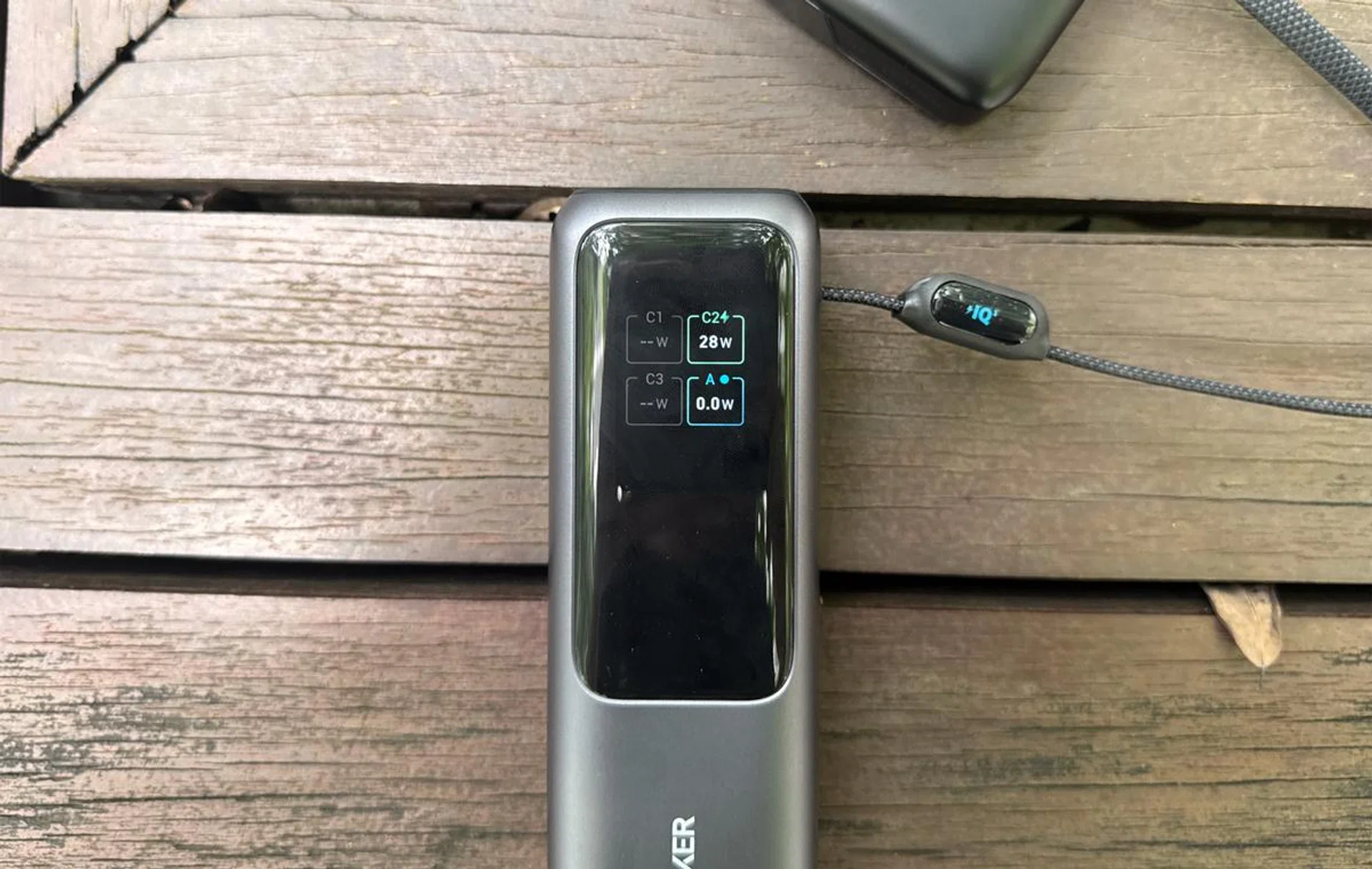
Anker 25,000mAh Power Bank (165W, Built-In and Retractable Cables). Photo: HWZ.
We’ll first talk about charging up the 25,000mAh Anker power bank before we cover how it dispenses to other devices.
In our trials, a 15W non-compatible adapter takes, on average, five hours to fully charge the power bank from 0%. It's much faster if you have compatible alternatives, like how the above example shows it receiving at 28W.
If you can achieve 20W or higher, the power bank enables pass-through charging. This means you can also dispense to other devices while it's getting juiced up, acting as an emergency option if you're short on ports and cables.
The good news is that the power bank is compatible with a wide variety of adapters. If you have something that carries PD 3.0, QC 2.0, PPS, SCP, UFCS, AFC, or Apple 2.4A charging profiles, you can easily get more than 15W flowing into the Anker power bank, significantly reducing charging time.
Note: To determine whether you have any of these charging protocols, look at the label on your adapter or search for the adapter’s product page and specifications online. Besides these, the supported combos are listed as a Voltage/Ampere (V/A) that gives you the Wattage (W) when you multiply them together. Your mileage may vary.
Also, like nearly all modern electronic devices and accessories with built-in safety features, the power bank deliberately slows down its intake when approaching full capacity.
Finally, the power bank can only dispense at its maximum 100W when it has more than 25% capacity left in the tank. So, it’s unlikely you will see your device or the power bank doing the full 100W speed, unless your device is close to conking out.
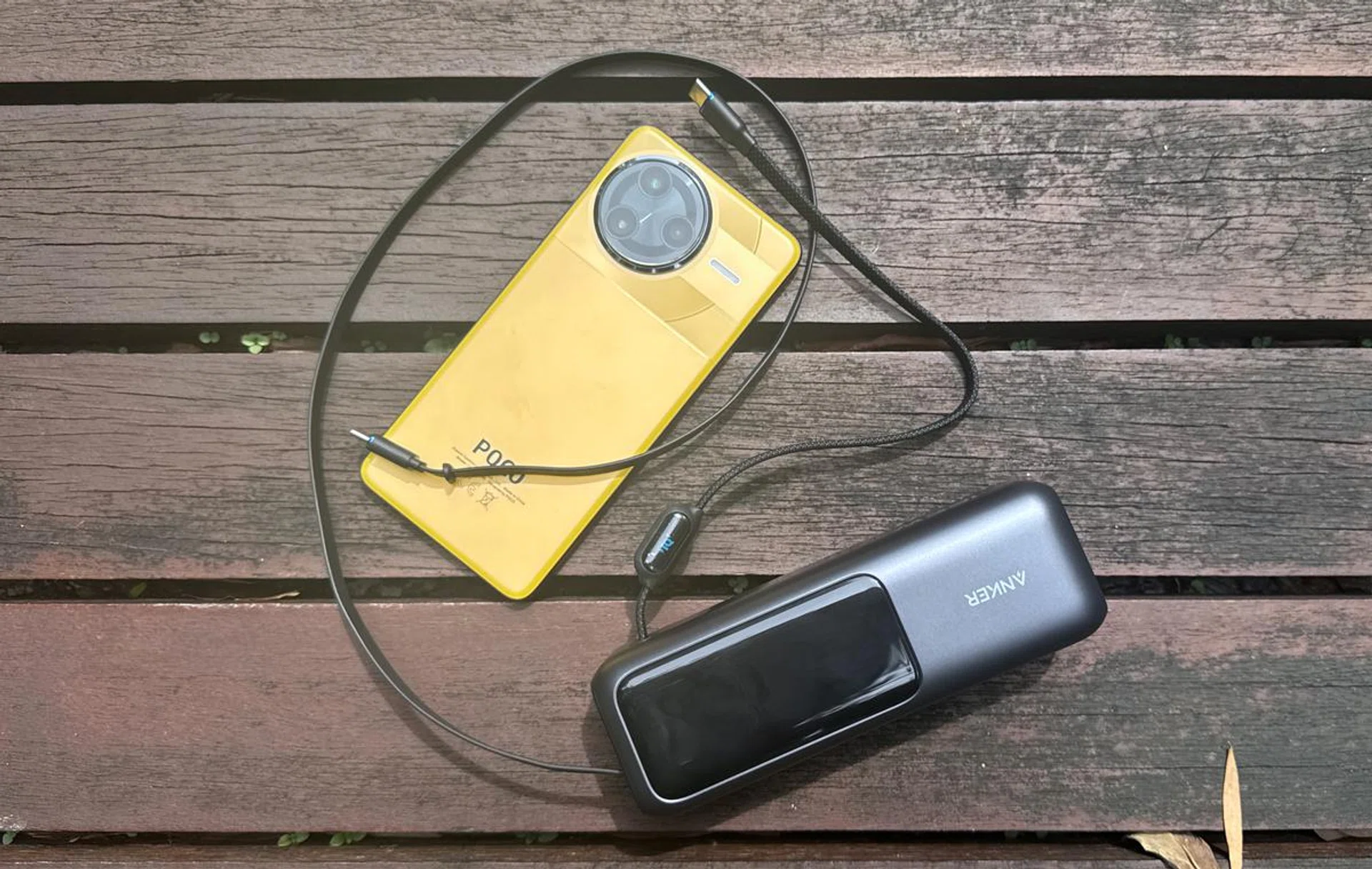
Anker 25,000mAh Power Bank (165W, Built-In and Retractable Cables). Photo: HWZ.
Dispensing the charge from the power bank to your devices has a slightly different story. On paper, Anker claims 165W maximum charging for devices, which is only somewhat true.
Consumer tech nerds would know that numbers like these are an aggregate, just like how Wi-Fi routers and their maximum Mbps speeds are derived by adding up the maximum speed per band.
In this power bank’s case, the maximum USB-C port/cable output is 100W when only one is in use.
When two of its USB-C cables or ports are deployed, it can achieve the maximum 165W, but it’s 100W on one cable and 65W on the other. That’s still sufficient for two standard Windows-based corporate laptops.
The USB-A port can offer a maximum of 33W. If you plug in another device via its USB-C, the second port has 100W output (hence, a maximum of 133W via this combo).
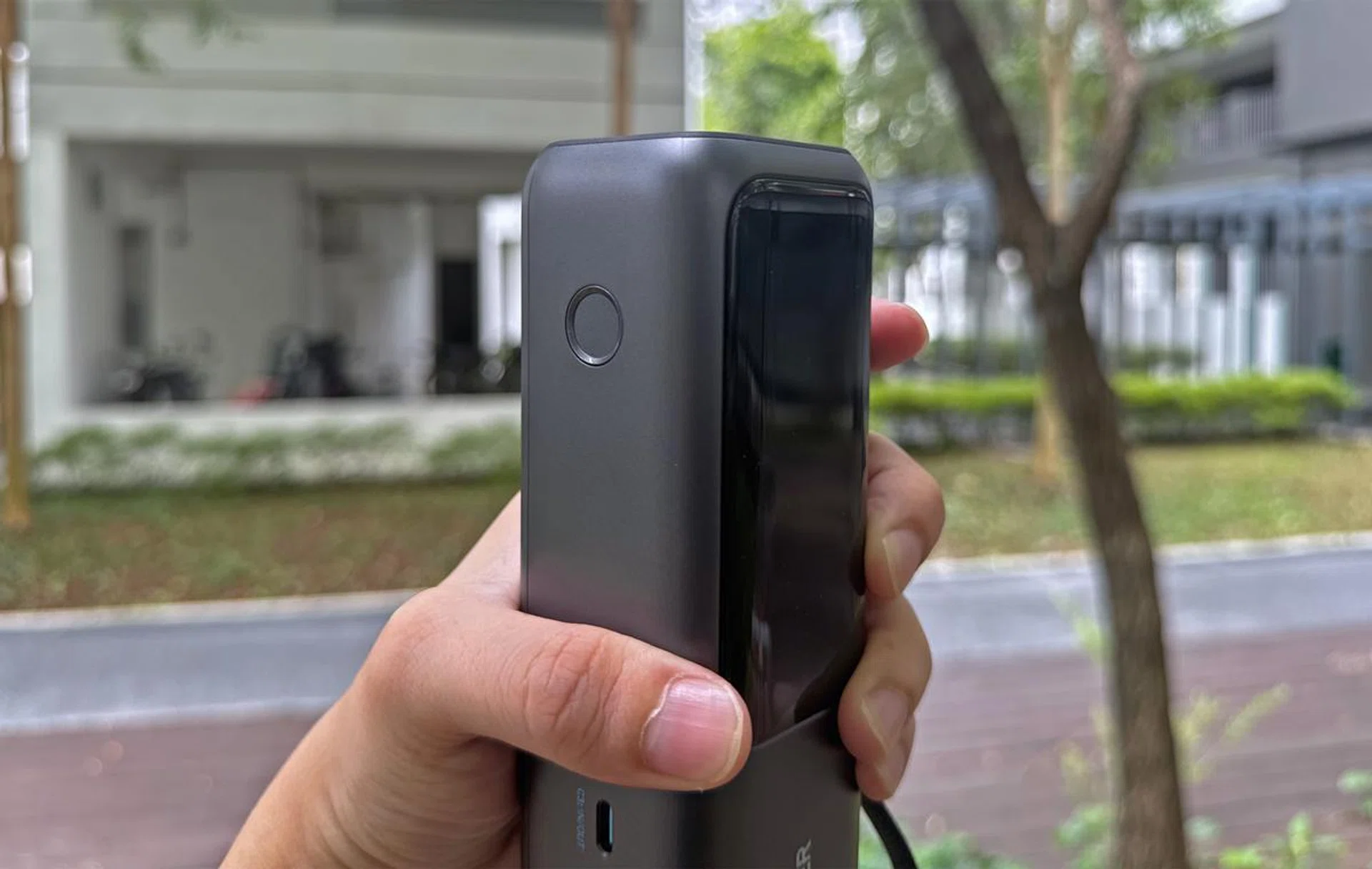
Anker 25,000mAh Power Bank (165W, Built-In and Retractable Cables). Photo: HWZ.
What’s interesting about this power bank is that it is truly universal in what it charges.
All its ports and cables have a Huawei-specific charging profile (10V/2.25A). It also has a weirdly scaling 5~11V/3A charging profile, which is a unique UFCS protocol that was standardised across Huawei, OPPO, Realme, Vivo, and Xiaomi devices.
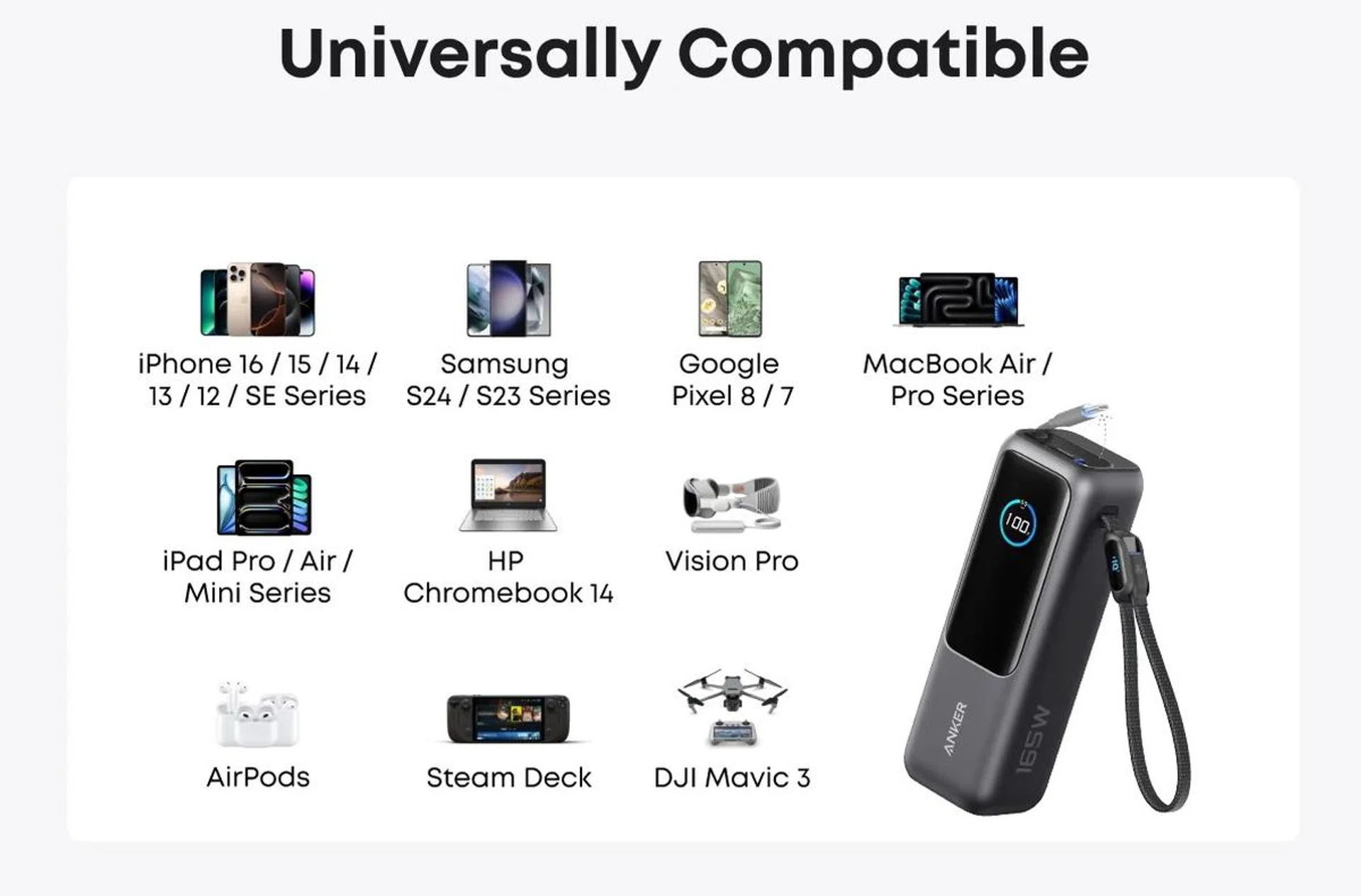
Devices that the Anker 25K 165W Power Bank can charge. Source: Anker Singapore.
In its own materials, Anker also claimed it can support a 16-inch Apple MacBook Pro (M3), but note that the power bank’s 100W is still nowhere near the Apple laptop’s included 140W charger. Charging is still possible, but don’t expect it to be as fast as a compatible wall plug.
I’ve also tried it with various USB-C devices, ranging from a PS5 Pro game controller to a portable electric nose trimmer. This is in addition to my personal and work tablets, laptops, and phones across many standard operating systems.
For example, the nose trimmer drew a modest 5W, while a Lenovo ThinkPad notebook could do the full rated 45W. The speed can vary widely in tested phones and laptops, depending on how much charging is left, and what maximum speeds they can reach.
Also, as the resident Android phone reviewer of the HWZ, I got to try it out with many different flagship phones across many brands. Expectedly, these devices charge the fastest when they are below 50% and slowly taper off to 0.1W when fully charged.
The power bank has never failed when I randomly plugged into laptops I could find, much to the bewilderment and sporting attitude of consensual strangers, colleagues, acquaintances, and friends.
Goodbye, whatever power bank that came before this
Anker 25,000mAh Power Bank (165W, Built-In and Retractable Cables). Photo: HWZ.
Simply put, the Anker 25,000mAh Power Bank (165W, Built-In and Retractable Cables) could keep up with every portable device and accessory I’ve thrown at it. Its charging speed is as expected, and its two built-in cables are extremely valuable and versatile, no matter the laptop or device type.
As long as I don’t try to overextend its capabilities (like expecting 100W flow just to charge 1%), it has proven to be a reliable companion for topping off multiple devices when I'm deployed on long trips without access to reliable charging.
Anker 25,000mAh Power Bank (165W, Built-In and Retractable Cables). Photo: HWZ.
A true perk of its 25,000mAh maximum capacity meant there was no need to ration how much each portable device deserved. I can use it to fill up my personal phone, top off another handset I’m reviewing, stay connected on my work laptop, and blow the rest of my load inside a portable gaming console whenever I'm occupied with work.
Where it exceeds my expectations is in the detailed charging metrics shared via its little display. It's reassuring to plan around estimated charging speeds by reading the wattage and clearly indicating its performance, which is something I couldn’t get from other basic power banks I've used before.
By the time I felt ready to write this review, I'd already forgotten about my ex-power bank (which could charge laptops reasonably, too). Like any healthy relationship, there's no looking back after experiencing a proper power bank that treats you right.
Anker 25,000mAh Power Bank (165W, Built-In and Retractable Cables). Photo: HWZ.
That said, there are still ways Anker can improve this gadget. A longer built-in cable (100cm at least) would give it far more leeway for placement in very small spaces, and it also helps if I wanted the power bank to be further away for a less cluttered-looking desk.
My only gripe is that Anker should have made some effort to give this power bank a proper name. Having two names longer than a sentence paired with half an SKU number makes it harder to tell other folks about this trusty power tumbler. We even had to invent an abbreviated version to accommodate this review.
To Anker’s great fortune, we can share its official URLs to make looking for this nifty little power bank easier.
Anker 25,000mAh Power Bank (165W, Built-In and Retractable Cables). Photo: HWZ.
The Anker 25,000mAh Power Bank (165W, Built-In and Retractable Cables) is officially retailing at S$159.99 on the Anker website, Lazada, and Shopee platforms.

Specification | Dimensions |
SKU/Model number | A1695H11 |
Capacity | 25,000mAh (real capacity 15,970mAh to 17,300mAh accounting for voltage conversion) |
Cables | 1x 30cm built-in USB-C, 1x 70cm built-in USB-C |
Ports | 1x USB-C, 1x USB-A |
USB-C Input (stored charge) | 5-11V /3A (15-33W), 5V/3A (15W),9V/3A (27W),10V/2.25A (22.5W), 12V/3A (36W),15V/3A (45W),20V/5A (100W) |
USB-C Output (to other devices) | 5-11V /3A (15-33W), 5V/3A (15W),9V/3A (27W),10V/2.25A (22.5W), 12V/3A (36W),15V/3A (45W),20V/5A (100W) |
USB-A Output (to other devices) | 5-11V /3A (15-33W), 5V/3A (15W),9V/2A (18W),10V/2.25A (22.5W), 12V/1.5A (33W) |
Charging Protocols | PD3.0, QC3.0, PPS, SCP, UFCS, AFC, Apple 2.4A |
Size | 15.7 x 5.4 x 4.9cm |
Weight | 595g |
Price | S$159.99 |
Our articles may contain affiliate links. If you buy through these links, we may earn a small commission.