
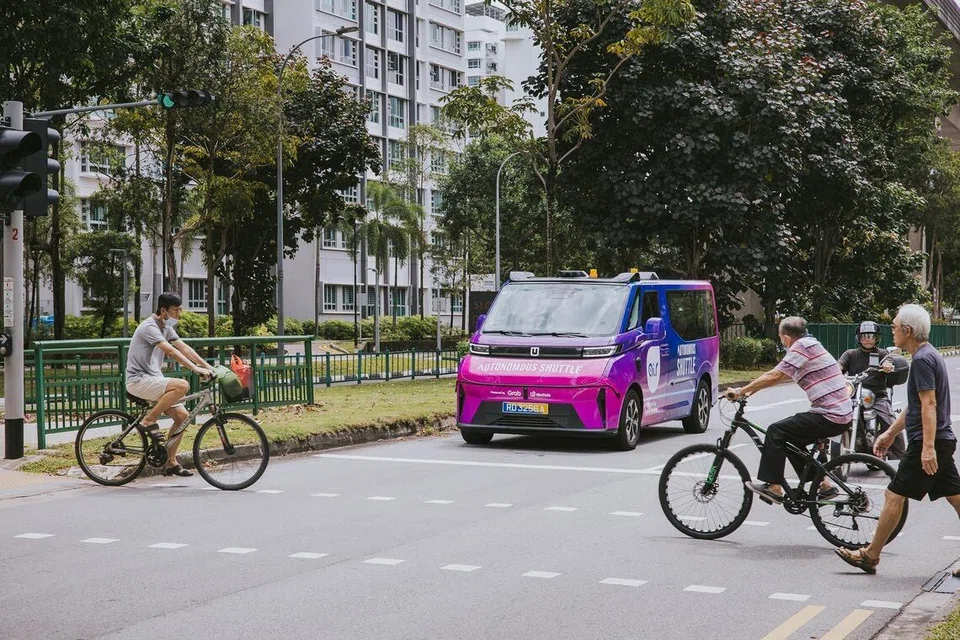
Testing of autonomous vehicles in Punggol will be stepped up, with the Land Transport Authority (LTA) giving approval to allow a fleet of 11 driverless vehicles to be tested on two shuttle service routes.
This follows the first autonomous vehicle test in Punggol in mid-October.
The tests are being run by ride-hailing giant Grab in partnership with WeRide, a Guangzhou-based autonomous vehicle company that has been operating in Singapore since 2024. The companies expect their self-driving vehicles to be ready to transport their first group of public passengers in early 2026.
More than 100 test runs have been completed since mid-October, the companies told The Straits Times, but did not say how many vehicles were involved.
The firms added that they plan to increase the number of test runs with the driverless vehicles by up to four times by the end of 2025.
Mr Alejandro Osorio, managing director of Grab Singapore, said the tests are essential to ensure that the community has “smooth, secure and meaningful journeys”.
In response to ST, LTA said the approval granted is part of assessment tests ahead of the roll-out of the public shuttle service.
Training for the first batch of more than 10 safety operators is ongoing, according to the two companies. The trainees are progressing to on-the-road training in Punggol, following theory lessons and closed-circuit training.
Safety operators are required to be on board the autonomous vehicles to provide real-time supervision during testing, as well as during the initial phase of public rides.
The two shuttle service routes operated by Grab and WeRide will connect residents in Punggol to key amenities such as Punggol Coast MRT station, Punggol Coast Bus Interchange, malls and the polyclinic.
These tests aim to collect real-world data, as well as refine the vehicles’ driving capabilities. These include maintaining proper distance from objects, navigating common and complex scenarios such as tight turns on narrow residential roads and carparks, as well as efficiently picking up and dropping off passengers at designated points.
The development work also includes localising the artificial intelligence software to factor in the road infrastructure in Punggol, traffic flows, as well as behaviours of road users and pedestrians. The tests will enable the vehicles to learn how to handle weather conditions such as sudden rain and intense sun glare.
An eight-seater driverless vehicle from the fleet is currently being used for safety operator training at the Centre of Excellence for Testing and Research of Autonomous Vehicles at Nanyang Technological University. This vehicle will be deployed in Punggol for the tests later in 2025.
Besides the Grab and WeRide joint effort, transport giant ComfortDelGro will also be operating a driverless shuttle route in Punggol with vehicles supplied by Pony.ai, a Chinese autonomous driving company.
The first driverless shuttle route will start serving the public by the second quarter of 2026. Members of the community will be invited to try out the service at no charge, before commercial service starts later in the year.
In September, Acting Transport Minister Jeffrey Siow said there are plans to have between 100 and 150 self-driving vehicles in Singapore by the end of 2026 as part of a major push for such vehicles to be deployed across the island in the next five years.
Note: This article was written by Lee Nian Tjoe and first appeared in The Straits Times on 13 November 2025.
Source: The Straits Times