
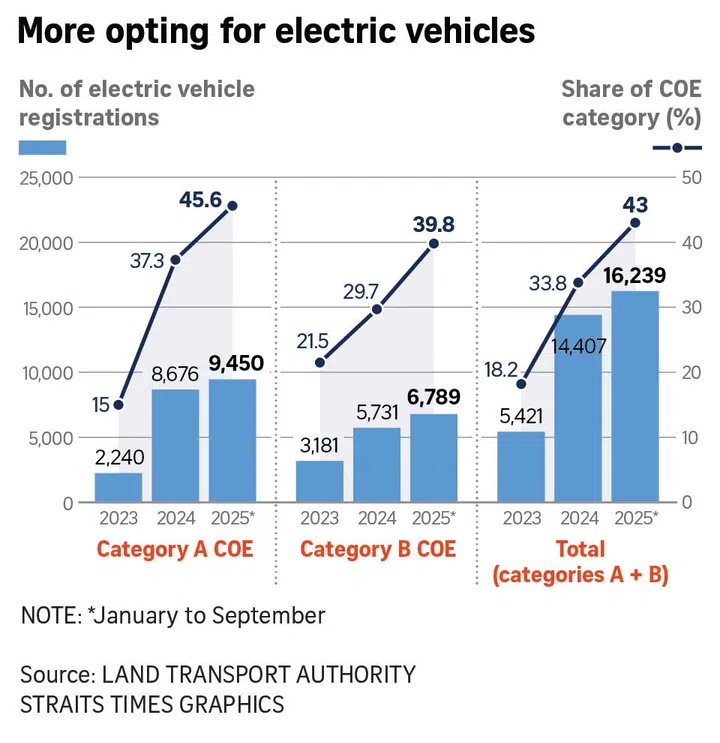
The adoption rate of electric vehicles (EVs) in Singapore is gathering pace, with 43 per cent of new car registrations in the first nine months of 2025 being that of electric cars.
EVs accounted for 33.8 per cent of new car sales in the whole of 2024, and 18.2 per cent in 2023.
They also made up 45.6 per cent of Category A certificate of entitlement (COE) registrations in the first nine months of 2025, up from 37.3 per cent for the whole of 2024 and 15 per cent in 2023.
The share of EVs in Category B registrations between January and September stood at 39.8 per cent, up from 29.7 per cent in the whole of 2024 and 21.5 per cent in 2023.
EVs with up to 110kW of power are registered using a Category A COE, while more powerful electric cars are registered with Category B certificates.
Land Transport Authority (LTA) data till the end of September shows that there were 41,732 electric cars on the road, representing 6.3 per cent of the total car population. This is up from 4 per cent as at the end of 2024 and 1.8 per cent in 2023.
Historically, Category A COEs have cost less than Category B ones, but the price gap has narrowed with the arrival of more lower-powered electric cars.
At the latest tender exercise in October, the Category A COE premium ended at $122,000, which was $9,889 – or 7.5 per cent – below Category B’s. This was narrower than the $10,990, or 9.6 per cent, gap in October 2024, and the $44,001, or 29.3 per cent, gap in October 2023.
Brands including BMW, BYD, Kia and Tesla have specially tuned the power outputs of certain models just for Singapore, to fit within a Category A COE’s requirement.
Checks by The Straits Times found that 15 out of 38 Category A COE electric cars are also available in Category B COE versions.
Apart from the difference in power output, such models often sport virtually identical features, from panoramic glass roofs and ventilated front seats to premium sound systems.
Consumer acceptance for EVs is rising, as many models on the market are not only more competitively priced than non-electric cars, but also have more technology and features, noted Mr Neo Tiam Ting, president of the Singapore Vehicle Traders Association.
He expects EV adoption to continue to rise, especially in the Category A COE segment, as dealers introduce more tuned-down versions of their premium models in an effort to take advantage of the relatively lower premium.
The generous tax incentives for electric cars, which lower their upfront cost, is another key driver behind the heightened demand, said Mr Neo.
EV incentives will be cut by $10,000 from Jan 1, 2026, to $30,000, but this is still a substantial benefit that makes EVs more affordable to buyers, he said.
The growing EV charging network has also made it more convenient to juice up electric cars, nudging non-EV drivers to go electric, Mr Neo added.
There are more than 25,000 EV charging points islandwide, with close to half of them being publicly accessible. Singapore is on track to have 60,000 charging points by 2030.
Ms Charissa He, 36, a media communications professional, switched to a Tesla Model 3 from a petrol-engine family car in 2024.
Charging is convenient, as there are enough EV chargers at her condominium, she said.
While her car has been tuned down to be Category A COE-compliant, Ms He and her husband have never felt the performance to be lacking.
“When the time comes to replace the Tesla, our next car will likely still be an EV because we enjoy the drive,” she said.
Note: This article was written by Lee Nian Tjoe and first appeared in The Straits Times on 02 November 2025.
Source: The Straits Times