
Note: This feature was first published on 21 July 2023.

Will AI just be a lot of smoke blown in to cover corporate mistakes? (Image source: Unsplash.)
Did you know that 74% of executives are all in for generative AI in the workplace? According to Capgemini Research Institute’s latest report, ‘Harnessing the value of generative AI: Top use cases across industries’, which surveyed 800 organisations to examine the transformative force of generative AI (GAI) for innovation across enterprises, the majority of executives believe that the benefits posed by GAI outweigh the associated concerns like copyright infringement or security.
But where and how can AI make the right impact on improving workplace outcomes? To better understand how companies can embrace AI in the workplace, we spoke further with Microsoft and Salesforce, who are pushing for increased use of AI.
To AI or not to AI

ChatGPT is a generative AI platform used to create content based on the parameters set out by a user. (Image source: Unsplash.)
Recently, our Editor-in-Chief attended an AI roundtable that was organised by Salesforce, around the rise of AI and its impact on the workforce. With local dignitaries lending their voices to this discussion, it was a resounding affirmation that GAI will transform the jobs and roles of today to make us more effective and that it's up to us to embrace change and put things like generative AI to good use.
However, there are many forms of "AI", and it's best to differentiate them. For example, there is a difference between generative AI like ChatGPT and predictive AI. Predictive AI is programmed to predict future events or outcomes based on analysing data. Generative AI creates new content like images, music, or text based on adjusting rules or parameters. Each has its uses within a company.

Gavin Barfield, Vice President & Chief Technology Officer, Solutions for Salesforce ASEAN. (Image source: Salesforce.)
Gavin Barfield, Vice President & Chief Technology Officer, Solutions for Salesforce ASEAN, felt that AI is only as valuable as the data it’s trained on. “For it to deliver business values like driving efficiency and personalised customer recommendations, it needs to be trained on the company’s proprietary data — such as records of customer preferences or past purchasing information. Layering generative AI technology on top of company-specific information can generate outputs that are contextual, relevant, and accurate,” he said.
Poh Yong Keat, Technology Lead at Microsoft Singapore, said that for organisations looking to maximise resources and focus on strategic priorities, predictive AI allows them to analyse financial data at speed to identify areas of overspending or enhance their understanding of performance metrics such as website traffic, customer engagement, or employee productivity.
Booting out Inefficiencies

Poh Yong Keat, Technology Lead at Microsoft Singapore. (Image source: Microsoft.)
Poh also spoke about overcoming the Digital Debt that staff experienced. This occurs when the volume of communication drowns out much of the focused concentration required for creativity on the job and this has an impact on innovation because people get disrupted and have less focus time. This was also reflected in Microsoft's Work Trend Index (WTI) annual report, which we've summarised here.
Poh added that AI could help overcome this, as when weighed down by digital debt, AI can also provide employees with personalised recommendations in various ways to manage time and prioritise tasks. But he cautioned against complacency, “As the volume of data that businesses collect grows at staggering rates, organisations must foster a robust data culture that ensures AI models can harness the full potential of data to drive innovation.”

Some areas where AI can be used within an enterprise. (Image source: Statista.)
It is this time and task management that could see the most benefit from AI.
With AI-powered tools, Poh explained that companies can break down silos and supercharge productivity and collaboration for their workforce. For example, by adding AI to a productivity tool like Outlook, users can be notified about emails or tasks that have not been responded to and documents that require follow-up attention can be brought up. This saves employees from having to trawl through reams of emails, folders, and messages as they struggle to stay on top of tasks. This enables them to better manage workloads from day to day. “By harnessing massive untapped reservoirs of data and insights from communication materials, AI models can generate responses and recommendations anchored in business content so employees can dedicate time to more meaningful and purposeful work experiences,” he went on to say.
In fact, Microsoft has begun adding AI to more than just its productivity tools. À la Google, it is allowing users to use AI to enhance searching via Visual Search in Chat. This means a user can upload images and search the web for information about the image leveraging OpenAI’s GPT-4 model. And a layer of security has been added to Bing Chat to create Bing Chat Enterprise. With Bing Chat Enterprise, user and business data are protected and will not leak outside the organisation as the chat data is not saved, and Microsoft has no eyes-on access to it either.
Barfield gave the example of Salesforce incorporating generative AI into the user experience of the productivity tool Slack. Slack GPT allows users to do things like automatically summarising all unread Slack messages that came in while they went on leave so they can get up to speed quicker. Users can also communicate more effectively by using Slack GPT to tweak their draft messages, distil content, adjust the tone, and more. Marketing teams, for example, will be able to auto-generate copy and images for blogs, email campaigns, social, and advertising directly into a channel for team collaboration. Barfield said that all of these productivity power-ups can help users work smarter, learn faster and communicate better.
Automating repetitive workflows

AI can be of great use in a company. (Image source: Microsoft.)
Another area where AI can be of help is in the automation of repetitive workflows.
However, IDC warned in its IDC FutureScape : Worldwide Artificial Intelligence and Automation 2023 Predictions — Asia/Pacific (Excluding Japan) Implications report that persistent talent gaps will drive 55% of IT organisations to invest in AI skills by 2023, both to run automated IT operations and to support business end users adopting AI and automation solutions.
Workflow automation using AI replaces tedious and manual tasks with automated processes, which helps companies accelerate productivity and provide better customer and employee experiences, at scale. To make the best use of it, companies can start by identifying work streams that are repetitive, manual and prone to human error and encode these processes into automation tools. With generative AI, this process is simplified drastically as users can now create and modify automation using a conversational interface.

Places where AI is already being used in businesses. (Image source: Statista.)
“With AI systems now starting to leverage multiple data sources, multimodal AI outperforms single-modal AI to deliver more accurate results across a wide range of applications. Organisations are looking to maximise returns on existing technology investments, as opposed to investing in large transformation programs. AI will be leveraged for increased employee productivity, optimised supply chains, and enhanced customer experience,” according to Deepika Giri, Associate Vice President, Big Data & AI, IDC Asia/Pacific including Japan (APJ) Research.
According to Barfield, Salesforce combined Einstein GPT, its generative AI CRM technology, and real-time Data Cloud capabilities with the company’s suite of automation tools, Flow, to help customers automate complex workflows and trigger actions based on real-time changes. Barfield said that users can simply describe the automated workflows they want to build and see them built in real-time, instead of having to build each workflow manually.
Poh agreed saying that AI can support workflow automation to streamline operations by leveraging natural language processing capabilities. An AI-powered platform like the Copilot in Power Automate allows organisations to create flows in a language naturally understood by describing what they need through multiple steps of a conversation.
Powered by real-time data, marketers for example, can use it to optimise the retail experience by offering in-store discounts at the right moment. Commerce professionals can also use it to power dynamic pricing in e-commerce by automatically adjusting prices based on real-time demand and supply – as well as updating inventory levels and availability information.
How do security and privacy come into play?

Privacy always remains a concern. (Image source: Microsoft.)
AI must go hand-in-hand with trust, encapsulating security, privacy, compliance, ethics and more. A trust-first culture, one that respects data privacy and security, should be embedded across the entire AI development process, from data collection to deployment. Some best practices that companies can consider implementing include obtaining customers’ consent to use their data in training and evaluating AI models, having an acceptable policy outlining the proper use of data, showing data provenance - a documented trail that can prove data’s origins and where it currently sits, and adhering to the data privacy regulations in the region.
Both Poh and Barfield added that it is important for any AI implementation to be guided by security, compliance and safety concerns and a measured approach to ensure that technology strategies developed for the workplace are guided by ethical principles.
Public and private sector partnerships, such as Singapore’s AI Verify Foundation, which Salesforce is a part of, are examples of how to combine the expertise of policymakers, researchers, and industry experts to enhance compliance and privacy regulations for the growing AI sector. By tapping into the global open-source community, the foundation is working on developing AI testing framework and tools Barfield said.
Could AI replace us?
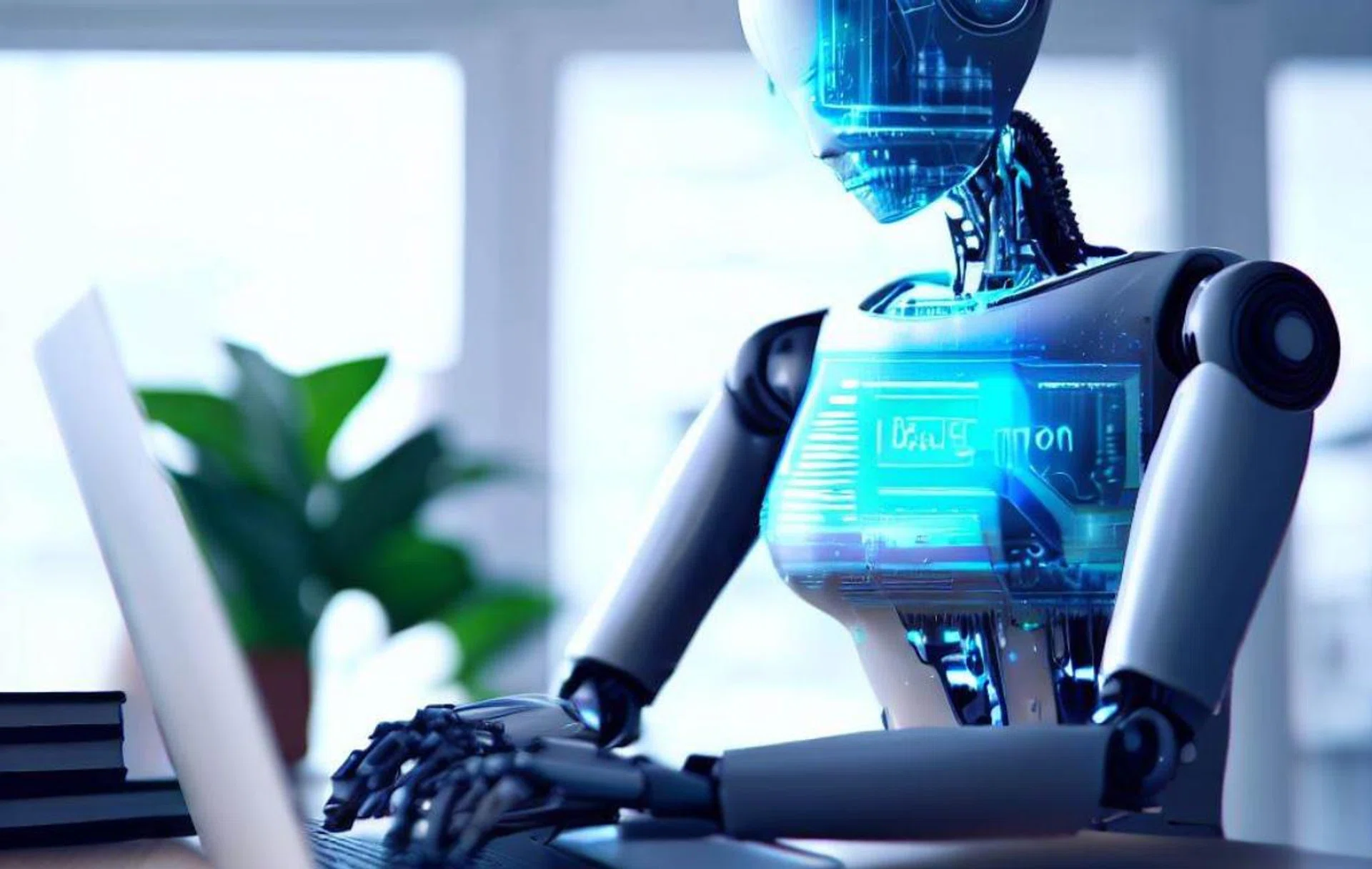
(Image source: Illustrated with Microsoft Bing Image Creator, powered by DALL-E generative AI engine.)
As for the fear of AI replacing staff in the office, IDC said in its report that by 2026, AI-driven features will be embedded across business technology categories, and 65% of organisations will actively use such features to drive better outcomes without relying on technical AI talent.
Poh and Barfield both agree with this view with Poh quoting from Microsoft’s latest Work Trend Index (WTI) 2023 have identified a new "AI-employee alliance" where more employees in Singapore would delegate their work to AI to reduce their workload. He said that while 67% of employees in Singapore are worried AI will replace their jobs, even more (81%) would delegate as much work as possible to AI to lessen their workload.
According to Barfield, not enough attention has been paid to the obstacles the workforce faces in getting their jobs done and how AI could help to lower these barriers at work.
As AI becomes pervasive, it is driving empowerment and access for many in the workforce, automating mundane tasks, enabling quicker service delivery, allowing personalisation at scale, and boosting workforce productivity – rather than replacing jobs. -- Gavin Barfield, VP & CTO, Solutions for Salesforce ASEAN.
What the future holds
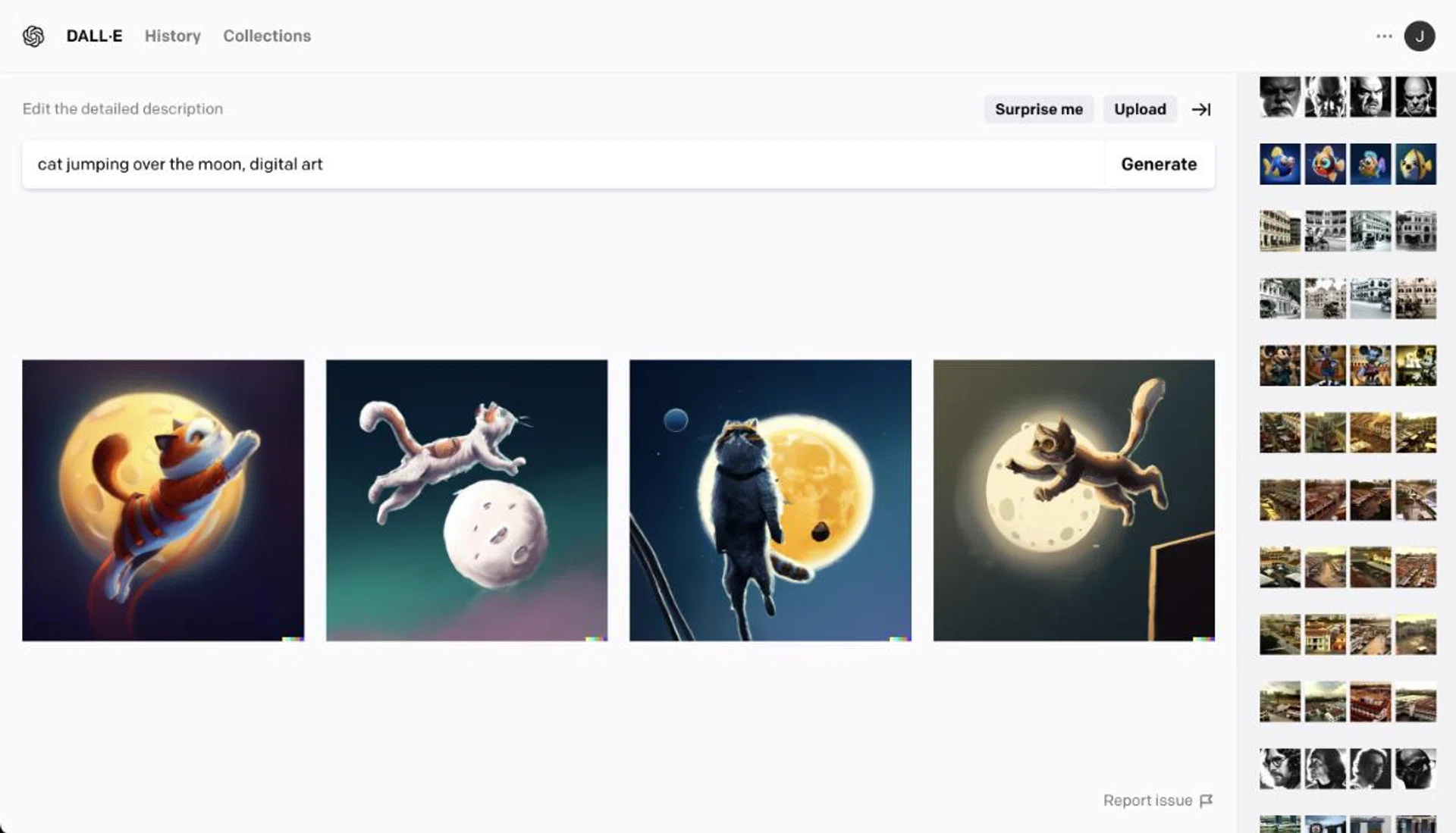
The image generator we used to create the previous image above. (Image source: Microsoft.)
According to IDC, by 2026, 75% of large Asia/Pacific enterprises will rely on AI-infused processes to enhance asset efficiency, streamline supply chains, and improve product quality across diverse and distributed environments.
But Microsoft’s WTI report says that 71% (almost 3 in 4) of people in Singapore don’t have the right skills to get work done and essentially, 85% of leaders believe their people don’t have the right AI skills. That said, the Salesforce Digital Skills Survey found that fortunately, nearly all workers surveyed (97%) believe in upskilling to obtain the necessary AI skill sets. Even on the recruiting front, there has been more emphasis on such skills. Here's a snapshot from Statista that shows how AI skills rank as part of tech skills looked out for by recruiters:-
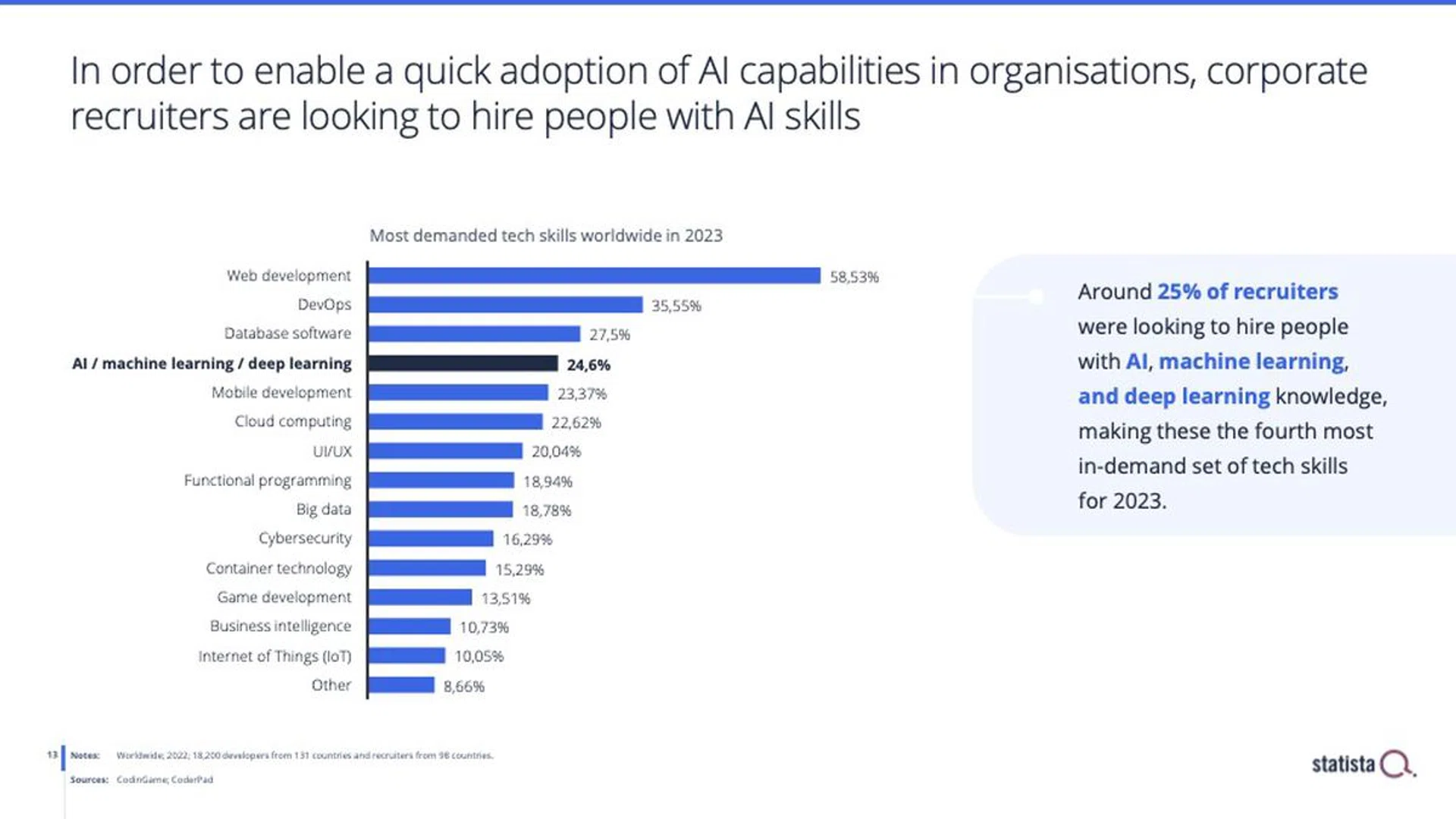
The demand for workers with some form of AI tech skills is growing. (Image source: Statista.)
Poh said that while it is important for employees to embrace a growth mindset and consider how they can use emerging technologies to do more, companies also play a critical role in empowering workers with AI skills for the future of work.
Four key steps for businesses to embrace AI
Here are some next steps for businesses to consider when deciding how best to embrace AI:-
- Understanding that it is more important to know how to use AI effectively than to know how it works.
- Growing one's AI aptitude by being willing to experiment and learning the boundaries of AI tools. This helps to generate preferred outcomes that will assist many organisations in improving workflows.
- Companies need to figure out what aspects and processes where AI can help their business the most and work towards defining this.
- They also need to ensure that they have the right people, tech and culture in place to embrace the change. Talent acquisition and training help approach AI with the right mindset and the willingness to develop the necessary skills to move forward,
For more reading, you can check out our adjoining feature on embracing AI.
Our articles may contain affiliate links. If you buy through these links, we may earn a small commission.