
AI, quantum computing, and interdisciplinary research can reshape science, says Heng Swee Keat
Heng Swee Keat, chairman of the National Research Foundation, outlined three key trends at the 14th Global Young Scientists Summit.
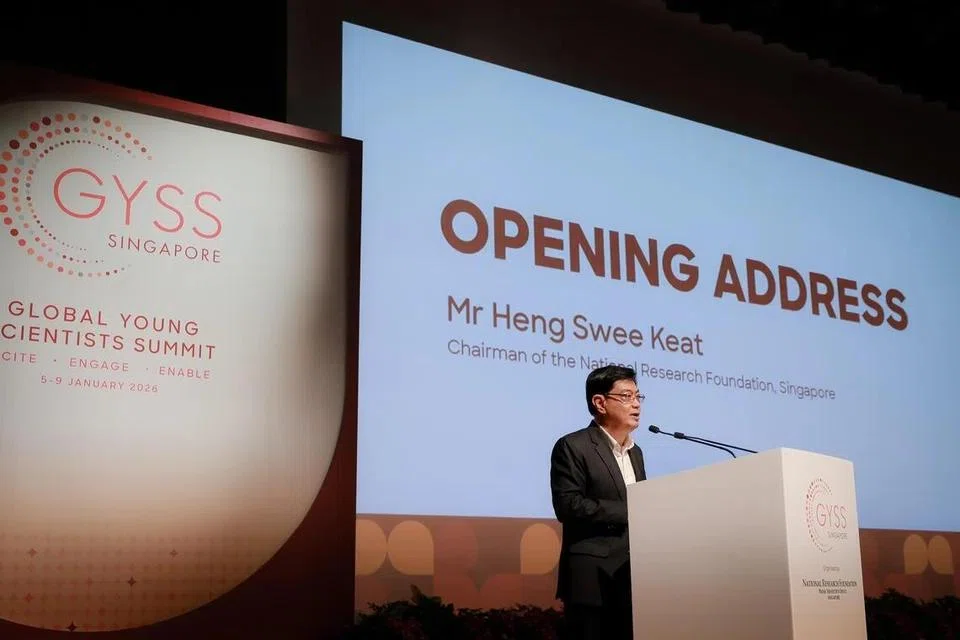
As the world is in the midst of a revolution in artificial intelligence (AI) and machine learning capabilities, the research and innovation field will also be impacted in fundamental ways, said National Research Foundation (NRF) chairman Heng Swee Keat.
Speaking at the opening ceremony of the 14th Global Young Scientists Summit on Jan 6, he outlined the three key trends that are set to shape the future of science.
The first is AI, which provides scientists with techniques and tools of immense sophistication that can be applied to increasingly complex and difficult scientific problems, he said.
However, these developments would also raise concerns about ethics, accountability and misuse.
“Scientists and innovators must work with policymakers all over the world to develop and apply AI systems ethically and responsibly,” said Mr Heng.
The second trend, he noted, is the advancement of quantum computing.
It is similar to traditional computing but operates in ultra-cold temperatures near absolute zero or minus 273.15 deg C. At such temperatures, quantum objects such as electrons or particles of light are manipulated to execute complex mathematical calculations beyond the reach of traditional computers.
“Quantum computing is advancing swiftly and is on the brink of solving what are once-unsolvable computational problems – from simulating complex biological systems to optimising supply chains,” Mr Heng said.
“Yet, much work remains to be done to build scalable, reliable fault-tolerant quantum systems.”
The third trend, he highlighted, is interdisciplinary research becoming more important as challenges facing humanity get increasingly complex and require expertise from multiple fields. For example, climate change requires a combination of environmental science, engineering, data science and policy analysis.
“At the NRF, we are committed to fostering such interdisciplinary collaboration, knowing that the solutions to our greatest challenges will come from these intersections of scientific and other fields of knowledge.”
This comes as Singapore is set to implement the
Research, Innovation and Enterprise (RIE) 2030 plan
, the country’s next five-year strategy to strengthen its research capabilities.
Announced in December 2025, RIE2030 will have a budget of $37 billion, amounting to around 1 per cent of the nation’s gross domestic product.
From this funding, $3 billion will be set aside for two new high-level research programmes – the RIE Grand Challenges to drive more impact in national strategic priorities, and the RIE Flagships to push for creation of economic value.
The first Grand Challenge will focus on the ageing population, while the first Flagship project will focus on semiconductors to establish Singapore as a strategically important research and development (R&D) node in this industry.
Mr Heng said that through both RIE Flagships and Grand Challenges, NRF is taking a systematic approach to define desired economic and strategic outcomes, identify major bottlenecks where R&D is needed, and develop coordinated portfolios of research and innovation programmes to realise the targeted goals.
At the same time, NRF will continue to invest heavily to keep Singapore’s basic research talent and expertise at the cutting edge. In parallel, the foundation will develop capabilities and infrastructure in AI, data and advanced computing.
NRF plans to implement a long-term funding strategy to maintain and upgrade its essential research infrastructure, ensuring that scientists have access to the advanced tools and facilities for globally competitive research.
Mr Heng also pointed out that excellence in research is ultimately about developing and bringing together the best talent from Singapore and around the world to work on the most critical challenges.
To that end, NRF will further strengthen its portfolio of research grants, fellowships and investigatorships to nurture both leading and promising local researchers, and attract top-tier and emergent research talent from around the world.
The foundation will also continue to build new links and deepen existing ones among researchers in Singapore and the global scientific community.
The five-day conference, which ends on Jan 9, will see the largest number of participants since its inauguration in 2013.
Over 400 young researchers from 57 countries, including those from Kazakhstan, Mexico and South Africa, are taking part for the first time.
Twenty-one eminent scientists, including Nobel laureates, Turing Prize winners and Millennium Technology Prize recipients, will also be at the event.
Note: This article was written by Li Ying Yi and first appeared in The Straits Times on 6 January 2026.
Source: The Straits Times