
Showdown: Barcelona vs. Clovertown vs. Harpertown
Barcelona was supposed to redeem AMD of all its woes in the highly competitive CPU industry. So where does this much hyped CPU stand today amongst the Intel Xeon (Clovertown) machines and that of the upcoming 45nm Intel Xeon (Harpertown) based machines? We reveal it all in this three-way showdown article.
A Prelude to the State of Server Processors Today
The original Opteron processors that debuted in 2003 heralded a new era of performance computing, true 64-bit processing support, and its scalable architecture meant that vendors could dish out 4-way SMP platforms and systems with ease and even 8-way SMP ones without much external intervention. At a time when AMD had negligible presence in the workstation and server market, the Opteron CPUs by the way of the K8 architecture (epitomized by the Athlon 64 desktop processors) was their golden key to unlock and tap on to this high-end, high-profit segment. Certainly it took AMD a while to convince vendors to adopt their solutions, but surely and steadily, they ate into the once Intel dominated segment. In fact, Sun's adoption of the AMD's Opteron processors in their x86 server lineup sometime later was a strong indication to the industry that AMD has got something right going.
By the third quarter to 2006, AMD captured over 25% of the x86 server market share, which is an incredible feat given the company's roots and focus just a few years earlier. This period however brought Intel's jaw-dropping Core 2 Duo processors to the desktop and Xeon 51xx series (Woodcrest) processors for workstations and servers. As we all know by now, the performance standing of Intel's new processors was so phenomenal, it was akin to the revolutionary Opteron processor during its heyday. However, the Woodcrest processors were not AMD's headache yet. No sooner than a few months after, Intel trumped AMD with its manufacturing process technology prowess by ushering in quad-core processors for the desktop, workstation and server markets. AMD now has a real problem since they were stuck with dual-core processors and even if they had a more scalable platform, Intel could match AMD's processing prowess and even exceeded it with just half the processor quantity and at lower power and thermals. With its lead eroded, AMD had to resort to drastically cutting its processor prices to stay competitive against its rival for nearly a year more.
In September 2007, AMD finally had its breakthrough with the long-awaited Barcelona processor which features a native quad-core design (read as a quad-core processor on a single silicon die). The Barcelona is also AMD's first processor with major architectural changes since the K8 debuted several years earlier for the first Opteron and Athlon 64 lineup. While Barcelona has hardly made an impact against Intel's current Clovertown processors, Intel is already on the brink of launching their next refresh of processors based on the 45nm process technology. Codenamed Harpertown, they incorporated a few enhancements to the Core microarchitecture, such as more cache and a new high performance platform.
We'll run through the Barcelona's and Harpertown's core updates quickly and hit the benchmark segment for some interesting findings soon enough, so hold on tight and read on!
Under the Hood of the Barcelona
One of the most touted features by AMD is that the Barcelona is a single chip, native quad-core design as opposed to Intel's dual-chip on a package processor. Whether this holds any significance in the real world or not is still debatable and largely unproven, but it is an interesting statistic. With that, AMD's Barcelona is built on a huge die occupying 283mm² with 463 million transistors. This could prove to be expensive to AMD should there be any defects as they've not yet mastered the 65nm process as seen from their attempt to ramp up clock speeds on their existing Brisbane-based processors. Perhaps this is why we see AMD trumphing tri-core processor designs to be available next year, but that's another topic for another day.
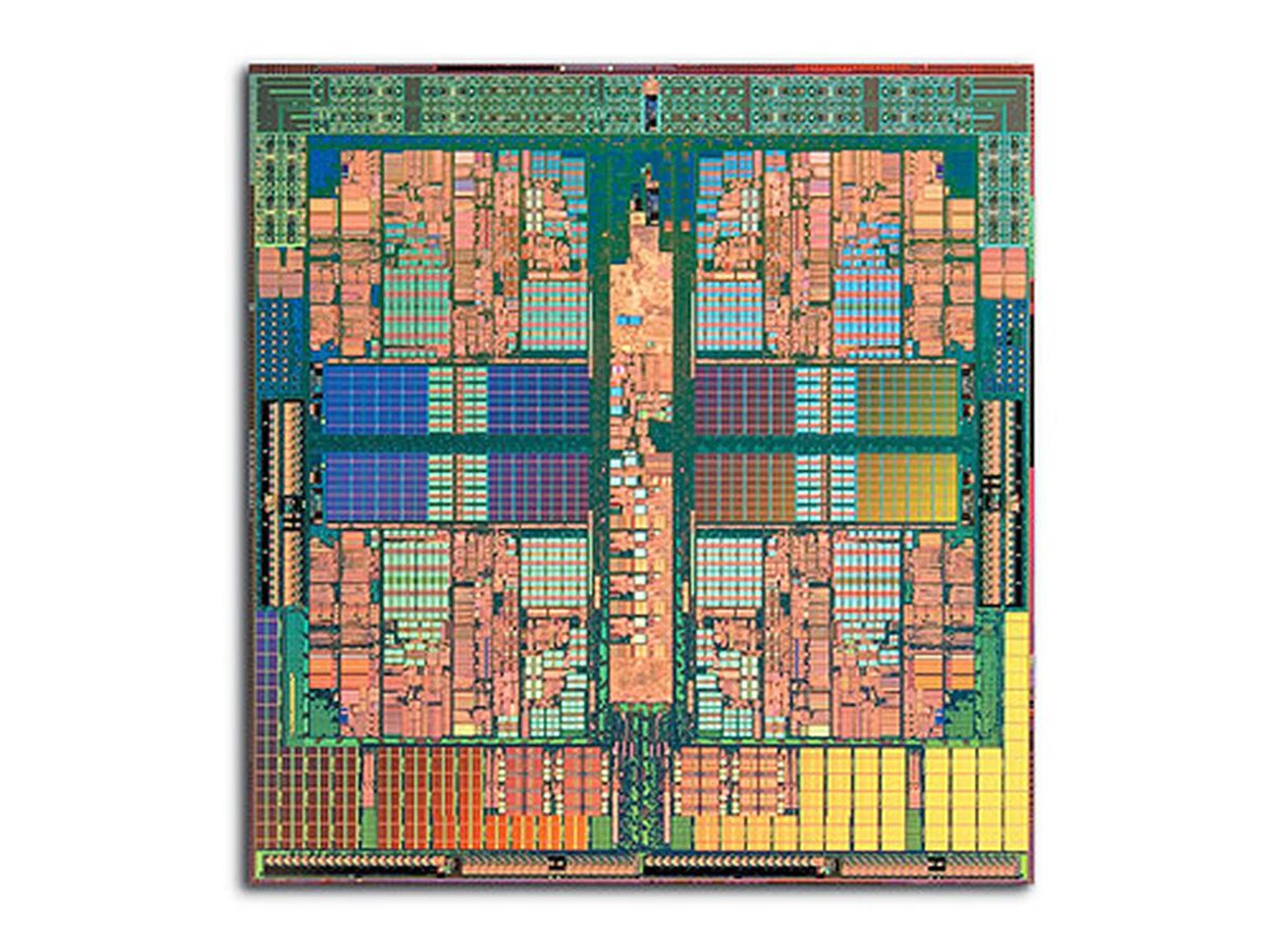
AMD's new Opteron quad-core processor is manufactured on a single silicon die.
Updates to the Processing Cores
The individual cores themselves are quite similar in structure to the existing second-generation Opteron processors, but Barcelona has a number of enhancements and tweaks to bring up to speed for current and future needs. After all, the Barcelona core design is supposed to carry AMD forward to the next two years and it should have sufficient capabilities built-in to cater to all needs till the next major redesign is available. One of the more significant changes is that the Barcelona can now execute 128-bit SSE operations in a single cycle as AMD has increased the floating-point pipeline width to 128 bits (up from just 64 bits on the previous generation, and is now equivalent to Intel's Core architecture). While making this change, AMD also doubled their instruction and data delivery mechanisms with a 32-byte/cycle instruction fetch, dual 128-bit load/cycle data cache load bandwidth, 128-bits/cycle pipes to the L2 and the built-in memory controller to bolster their more powerful processing units. On the virtualization front, the nested paging feature introduced in the second generation Opteron makes its way into the Barcelona as well, primarily to help accelerate the performance of virtualized environments.
Cache Structure
The processor's L1 and L2 cache hierarchy remains as it was in the previous Opteron processor design with 64KB of dedicated L1 cache for data and instructions per core, 512KB of dedicated L2 cache per core and to augment these, the Barcelona core now incorporates 2MB of shared L3 cache. With four processing cores on the die, you can expect significant traffic flow in and out of the processor, so the L3 shared cache design acts as a go-between to further supplement the various processing cores and store frequently used data closer to the cores rather than reaching out to the memory.
Increased Power Efficiency for the Barcelona
Processor power management has taken significant leap from the previous generation. The native quad-core design on the Barcelona has allowed AMD to adjust the processing clock domains independently on each core depending on the utilization level, but the running voltage is still dependent on the processing state of the highest utilized core. Still, this is a step forward in power savings as the previous dual-core design pegged clock speed and voltage to that of the highest utilized core. While this reduces power consumption by modulating the clock frequencies per core, AMD finally incorporated more advanced clock-gating mechanisms to dynamically switch off sections of the die that are not needed, which is performed by analyzing the processing tasks at hand. Dubbed as the AMD CoolCore Technology, it is a purely hardware logic design that does not require any drivers on the operating system to govern its operation. Two kinds of control options are present in the CoolCore Technology, Coarse Control which regulates turning on/off large working blocks of the die like FPU or read/write logic of the memory controller, while Fine Control works at the micro level analyzing specific transistor paths, smaller logic blocks and if they can be switched off when not required.
Additionally, AMD has split the power plane in the Barcelona processor to the CPU cores from that of the memory controller, allowing them to operate at differing voltages independently. This brings about better CPU power efficiency as the processor throttles voltages up or down as required in the processing cores and the memory controller in accordance with the task at hand, which could be either a highly memory intensive operation (leaving most of the cores idle) or vice versa. With independent power planes, the operating frequencies of both domains can also be controlled separately to boost processing capacity of any one side. The flipside to this split power plane design is that you'll require an updated motherboard to take advantage of this feature, which otherwise the processor will operate off a unified power plane and loses the benefits explained. To add on, depending on the processor variant, one will incur a penalty in the memory controller's operating frequency, thus system performance is affected as well.
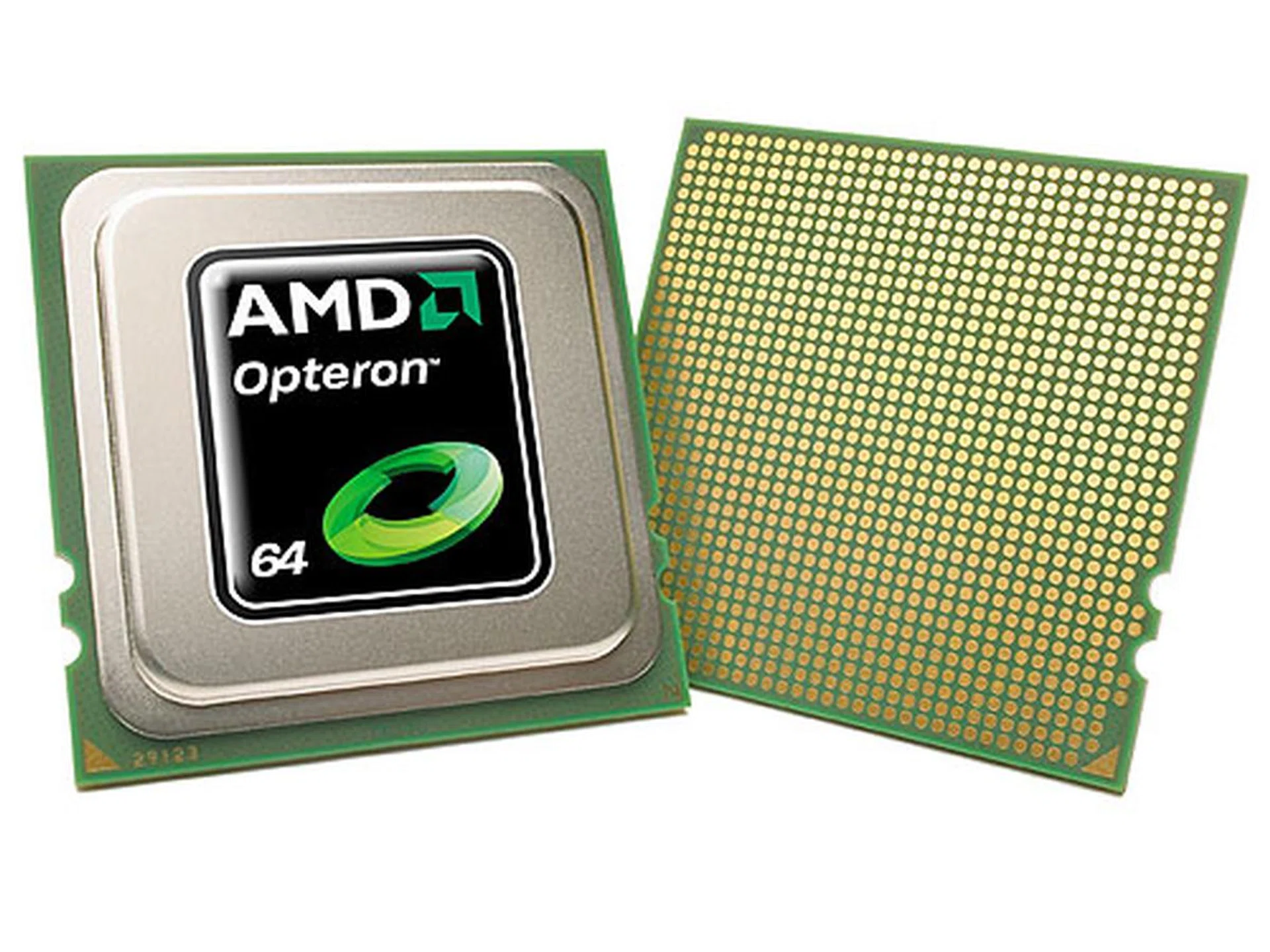
AMD's new Opteron codenamed Barcelona comes in the Socket-F form factor.
With the coming of a new processor design from AMD, they've also introduced a new form of power rating which they termed as ACP. TDP specs relate the absolute highest power draw possible because the processors are designed to operate within that rating. In reality, AMD found that it's not an accurate reflection to their customers who take the TDP specs to design and plan their data center / rack power needs. Average CPU Power (ACP) spec was conceived to solve this discrepancy which despite its name, the spec takes into account of the processor's real-world testing at high utilization levels in a handful of industry leading benchmarks under predefined conditions. You can read more about it in their whitepapers, but in short, the ACP specification does seem to drive a more moderate approach to measuring power considering what we normally observe in certain environments. Still, measuring processors through ACP may not be a true reflection of power consumption since it is dangerous to assume all environments are the same. Thus, the extent of manufacturers adopting AMD's new definition remains to be seen, while some considers this move by AMD to be rather desperate to make their processors look good in terms of power consumption.
With that said, here's how the various Barcelona core based processors stack up:-
Processor Model / ProcessorCharacteristics | Core Frequency | Northbridge Frequency | L2 Cache Size | L3 Cache Size | Max TDP (W) | HyperTransport Speed | Estimated Price (US$) |
Opteron 2350 | 2.0GHz | 1.8GHz | 512KB x 4 | 2MB | 95 | 1GHz (2000MT/s) | $389 |
Opteron 2347 | 1.9GHz | 1.6GHz | 512KB x 4 | 2MB | 95 | 1GHz (2000MT/s) | $316 |
Opteron 2347 HE | 1.9GHz | 1.6GHz | 512KB x 4 | 2MB | 68 | 1GHz (2000MT/s) | $377 |
Opteron 2346 HE | 1.8GHz | 1.6GHz | 512KB x 4 | 2MB | 68 | 1GHz (2000MT/s) | $255 |
Opteron 2344 HE | 1.7GHz | 1.4GHz | 512KB x 4 | 2MB | 68 | 1GHz (2000MT/s) | $209 |
Harpertown - Clovertown's new 45nm Successor
If we were to summarize Intel's Harpertown based Xeon processors in a few words, this section title captures that essence. However there are more to just the die shrink in Harpertown. Like its Clovertown predecessor, Harpertown will be made up of two new 45nm Penryn dies housing dual processing cores with 6MB of shared L2 cache mounted in a single LGA771 package. With a pair of these dies, Harpertown will be equipped with a total of 12MB of L2 cache. Other enhancements expected are detailed in our Core 2 Extreme QX9650 processor that uses a similar core to that of the Harpertown for the desktop (which is known as Yorkfield).
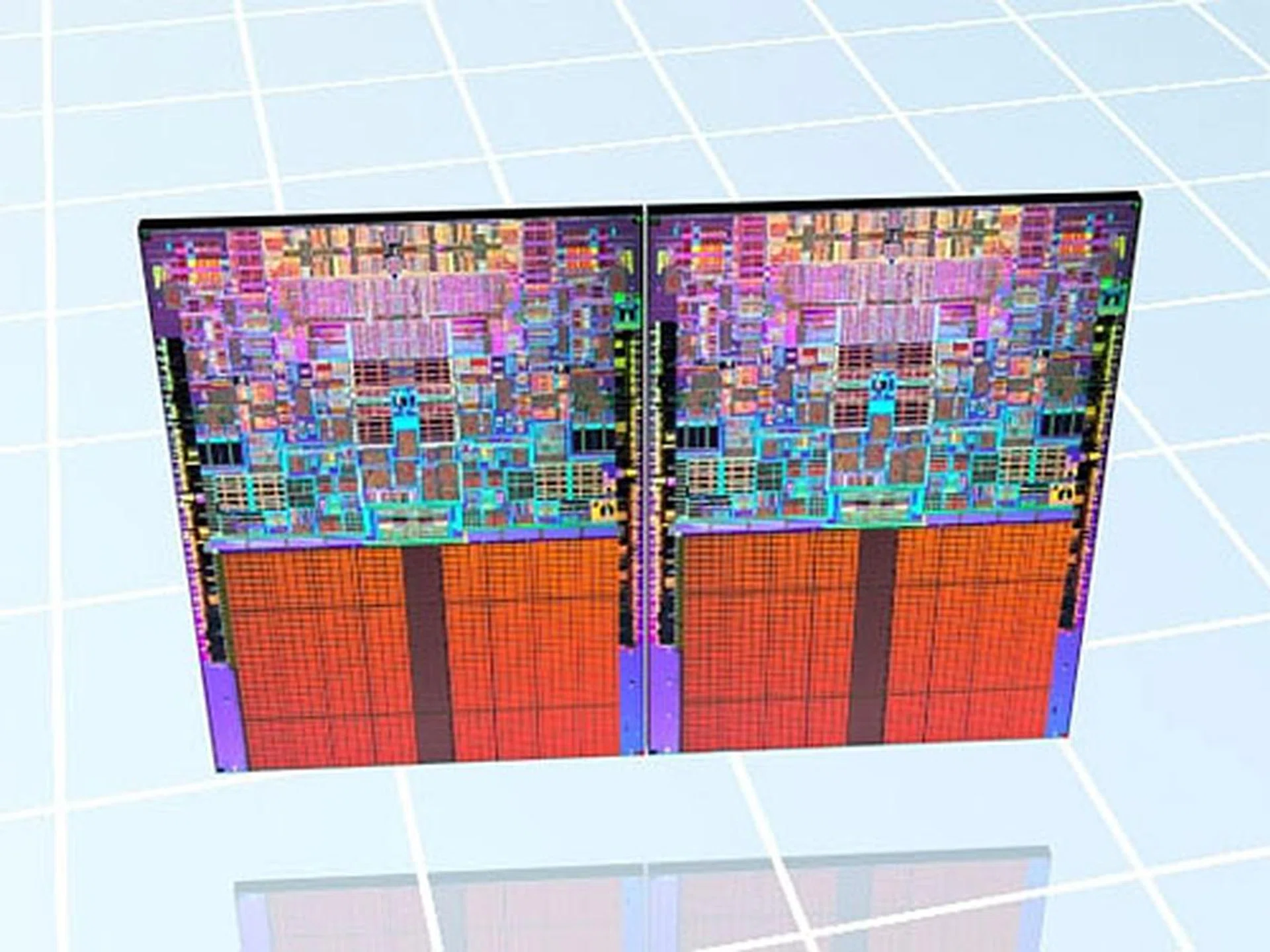
Intel's 45nm quad-core processor, codenamed Harpertown, is packaged by combining two dual-core dies together.
Harpertown Xeon processors are also part of a new high performance computing platform known as Stoakley. Besides the processor, the key ingredient in this platform is Intel's new Seaburg Northbridge based motherboard. Key highlights of the new chipset are as follows:-
- Supports a dual point-to-point FSB speed up to 1600MHz (in addition to 1333MHz and 1066MHz)
- A huge 24MB Snoop Filter (up from 16MB previously to better support the new generation quad-core processors with increased L2 cache size)
- Quad-channel FB-DIMM of speeds up to DDR2-800 (up from DDR2-667 previously)
- Able to address up to 128GB of system memory
- Integrated PCI-X
- Dual x16 PCIe Gen.2 lanes, as well as 44 PCIe first generation lanes
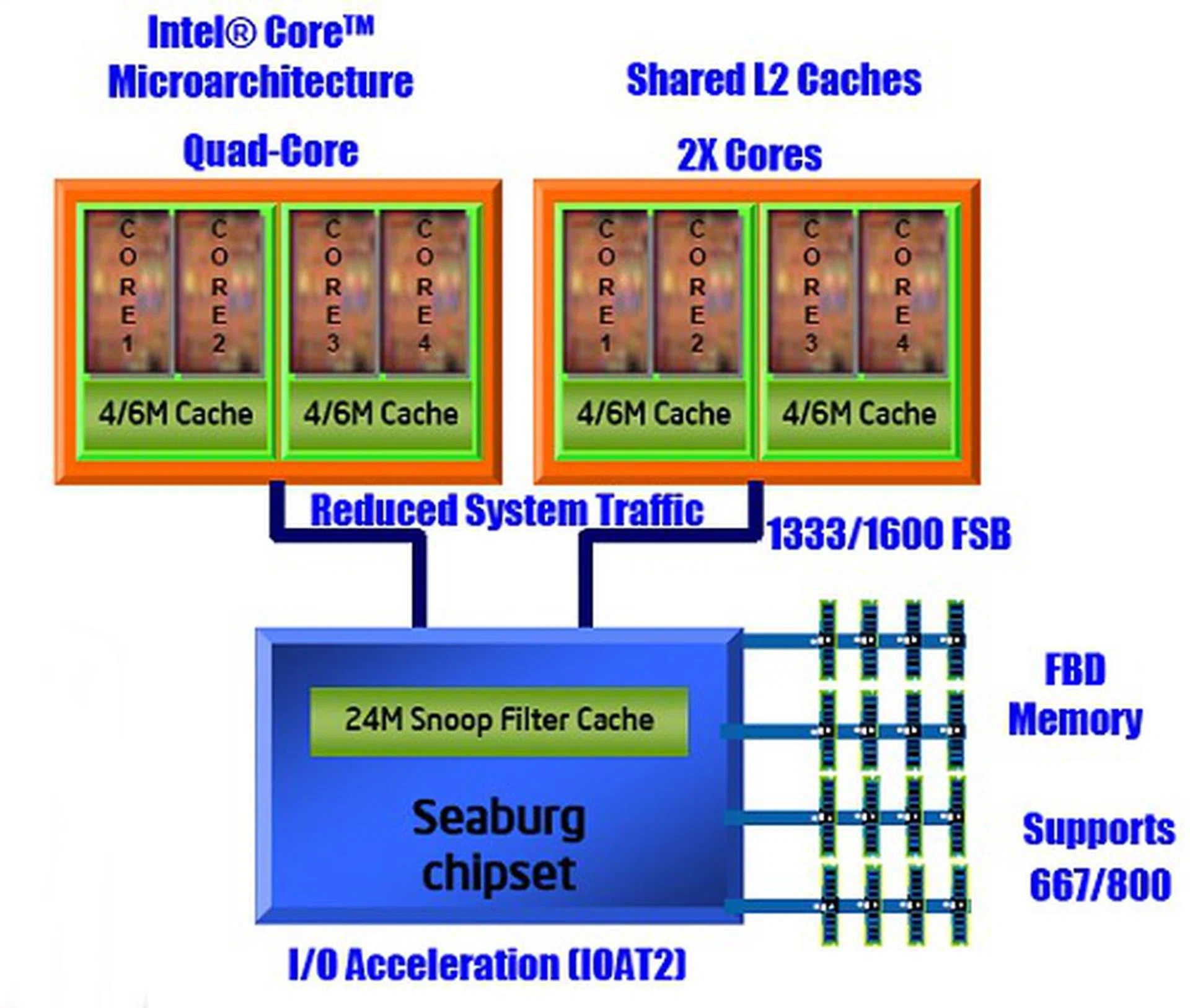
A diagramatic representation of the new Intel Stoakley platform.
Officially, Stoakley and Harpertown are not yet launched although information of these products have been lingering for long. As such, we are not quite certain of the exact model names expected in retail, let alone the pricing for the expected parts. However, what we can safely say is that the new Harpertown Xeon processors would go by the Xeon 54xx numbering scheme with the usual L, E, X designation before the numerals that signify the TDP rating/class of the processors. While 1600MHz FSB based Harpertown Xeons will work only on the newer Stoakley platform, the 1333MHz FSB versions would work fine on the existing Bensley platform as well as the newcomer.
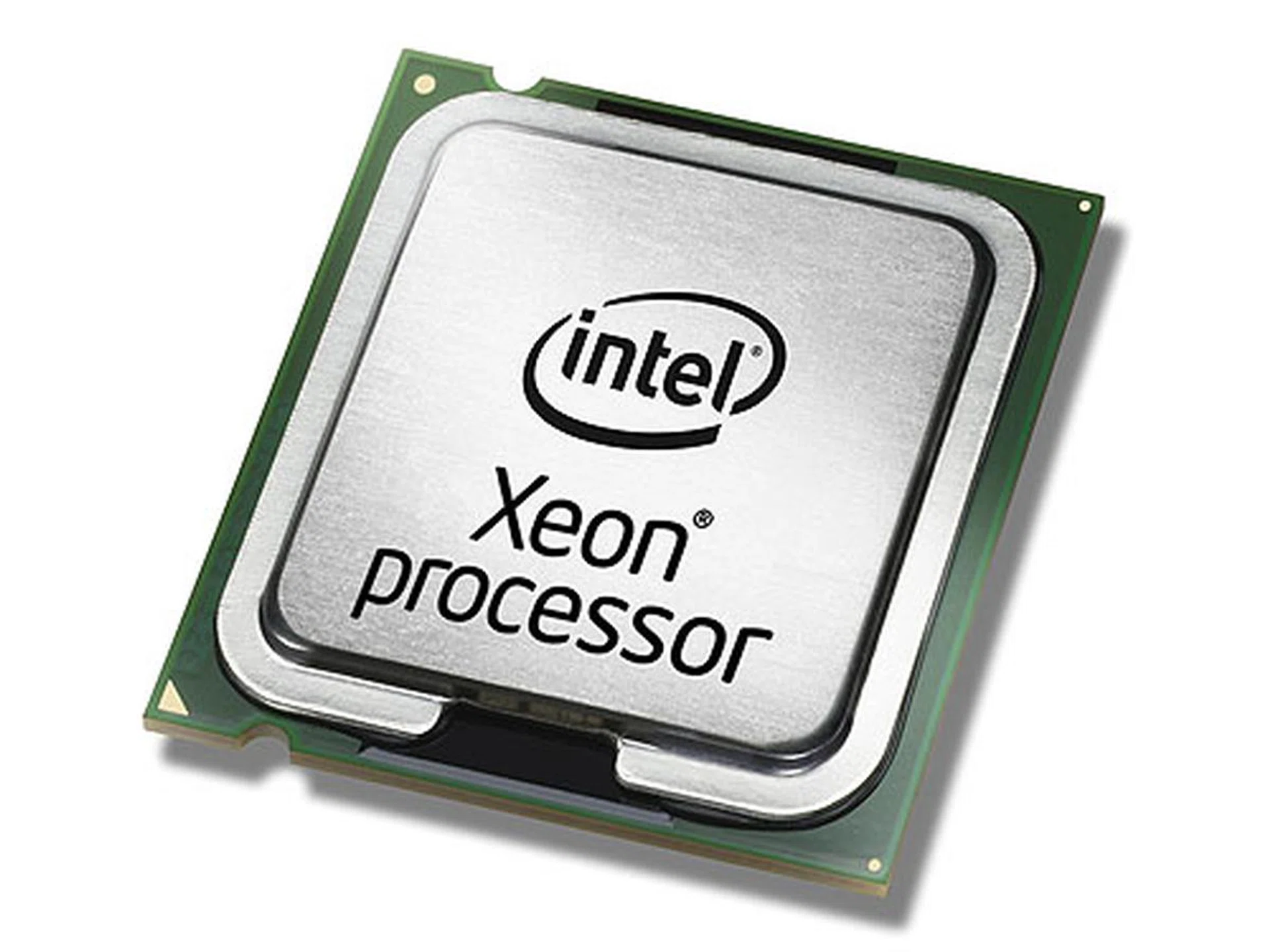
Intel's new Xeon processors comes in the familiar LGA771 package.
Workstation/Server Processors Compared
Processor Name | Opteron 23xx (quad-core) | Xeon 53xx (quad-core) | Xeon 54xx (quad-core) |
Processor Codename | Barcelona | Clovertown | Harpertown |
Processor Model | 2350, 2347, 2347 HE, 2346 HE, 2344 HE | X5365, X5355, E5345, E/L5335, E/L5320, E/L5310 | Various |
Processor Frequency | 1.7GHz - 2.0GHz | 1.6GHz - 3.0GHz | 2.0GHz - 3.2GHz |
No. of Cores | 4 | 4 | 4 |
Front Side Bus (MHz) | - | 1333 / 1066 | 1600 / 1333 |
HyperTransport Bus | 1GHz (2000MT/s) | - | - |
L1 Cache (data + instruction) | (64KB + 64KB) x 2 | (32KB + 32KB) x 4 | (32KB + 32KB) x 2 |
L2 Cache | 512KB x 4 | 4MB x 2 | 6MB x 2 |
L3 Cache | 2MB | N/A | N/A |
Memory Controller | Integrated Dual Channel (up to DDR2-667) | External, Dual/Quad Channel (FB-DIMM DDR2-533/667) | External, Dual/Quad Channel (FB-DIMM DDR2-533/667/800) |
TDP (W) | normal series: 95W, HE series: 68W | L series: 50W, E series: 80W, X series: 120W | L series: 50W, E series: 80W, X series: 120W |
Execute Disable Bit | Yes | Yes | Yes |
64-bit Computing | AMD64 | Intel 64 (Intel EM64T) | Intel 64 (Intel EM64T) |
Power Management Technology | AMD PowerNow! & AMD CoolCore Technology | Intel Intelligent Power Capability | Intel Intelligent Power Capability |
Virtualization Technology | Yes | Yes | Yes |
Packaging | Socket F (1207) | LGA771 | LGA771 |
Process Technology | 65nm SOI | 65nm | 45nm |
Die Size | 285mm² | 286mm² | 214mm² |
No. of Transistors | 463 million | 582 million | 820 million |
Test Setup & Benchmarks
First up, we'll detail the testbed details before bringing on the benchmark numbers. Since these are server level hardware, we received three different racks, each catering to a processor generation. AMD's Barcelona server rack came by the way of a Tyan motherboard in their Transport GT24 chassis. However, it's an unreleased version as it's based off a yet-to-be-announced Tyan S3993 server board using a yet-to-be launched Serverworks/Broadcom HT2100 chipset. Still, everything worked fine in our testing. Although we would have very much liked to get our hands on the AMD's current Barcelona at 2GHz, we had little choice but to benchmark the next best option at 1.9GHz.
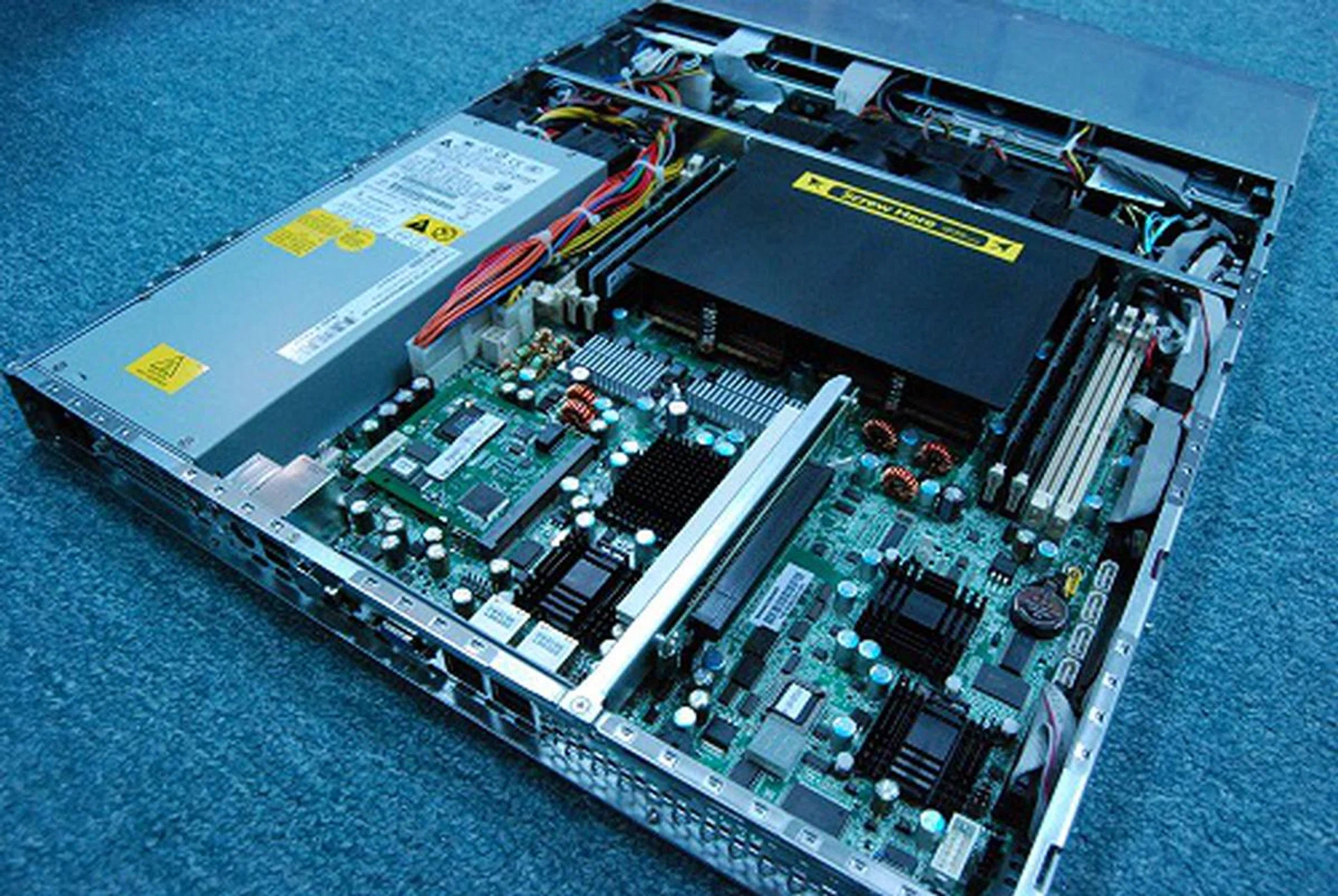
Our AMD Barcelona 2P server was from Tyan and to-date, but oddly this model has yet to be launched in retail.
Expectedly, Intel's Harpertown rack was also one of the evaluation models from Supermicro which was using a X7DWN+ motherboard (Stoakley). Since the platform and solution from Supermicro are at a pre-release stage, you should take the performance numbers in this article as a guide and not an absolute final. From the information we have to date, the Intel Harpertown Xeon on this system is the second fastest SKU at 3GHz (using a 1.6GHz FSB) and goes by the model name of the E5472 processor. The fastest Harpertown Xeon is a 3.2GHz part. The 3GHz Harpertown is perfect for our article since the equivalent comparison Clovertown we had was a 3GHz part as well.
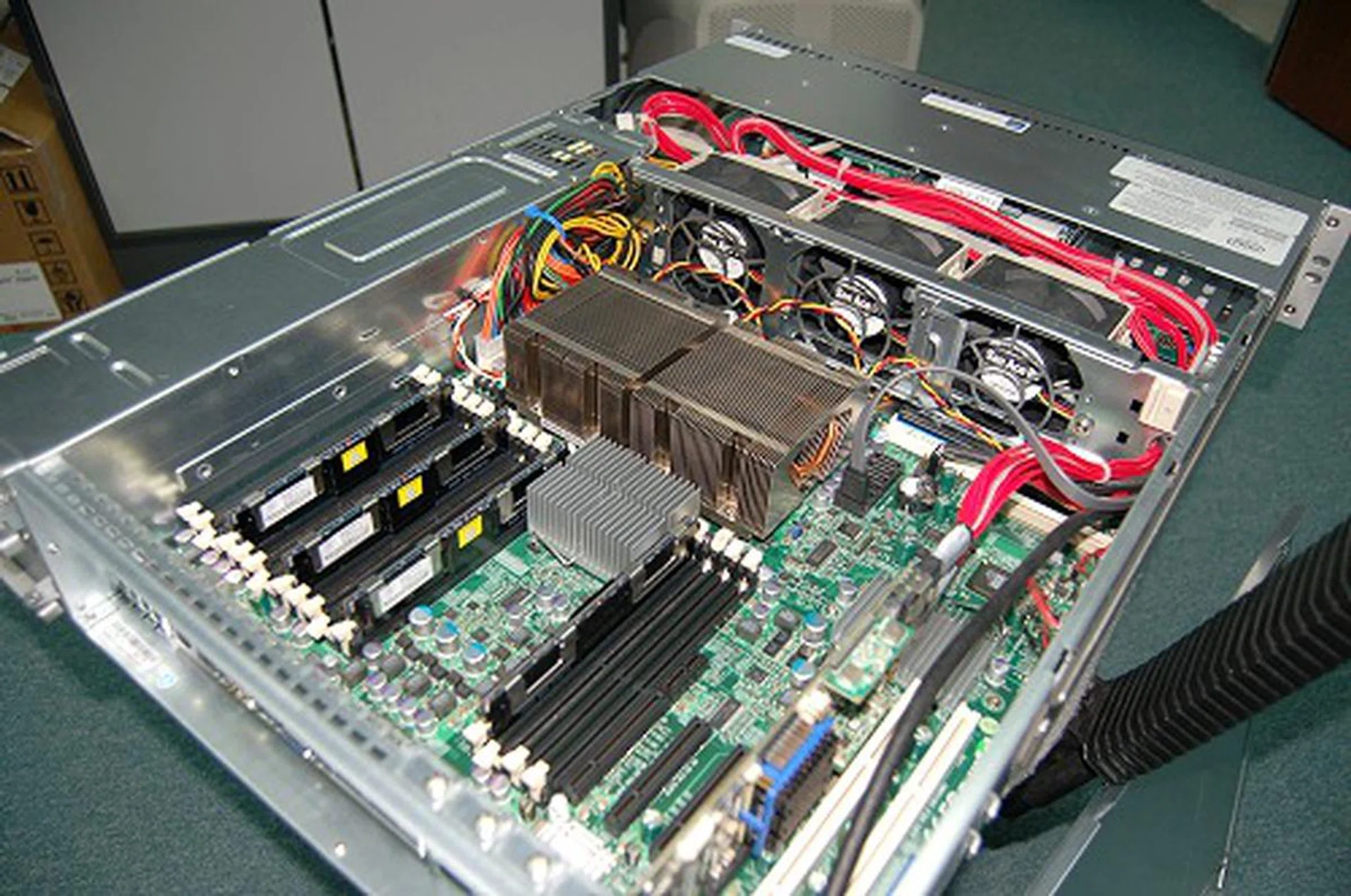
Intel's Harpertown evaluation unit was courtesy of Supermicro.
The Clovertown machine was based on a standard Bensley platform using the Intel 5000X (Greencreek) motherboard. Processors tested on this platform were the Xeon L5320 (1.86GHz, 1066MHz FSB, low-voltage), Xeon X5355 (2.66GHz, 1333MHz FSB) and the Xeon X5365 (3.0GHz, 1333MHz FSB). The Xeon L5320 at US$320 is equivalently priced to that of the AMD Opteron 2347 at US$316 and should serve as the focal point of our comparison in this article. The Xeon X5365 processor's results are shown as a point of comparison to relate the best of the Clovertown series in performance against both AMD's Barcelona (since it is just one step below the top SKU) and to contrast against the equivalently clocked Harpertown system.
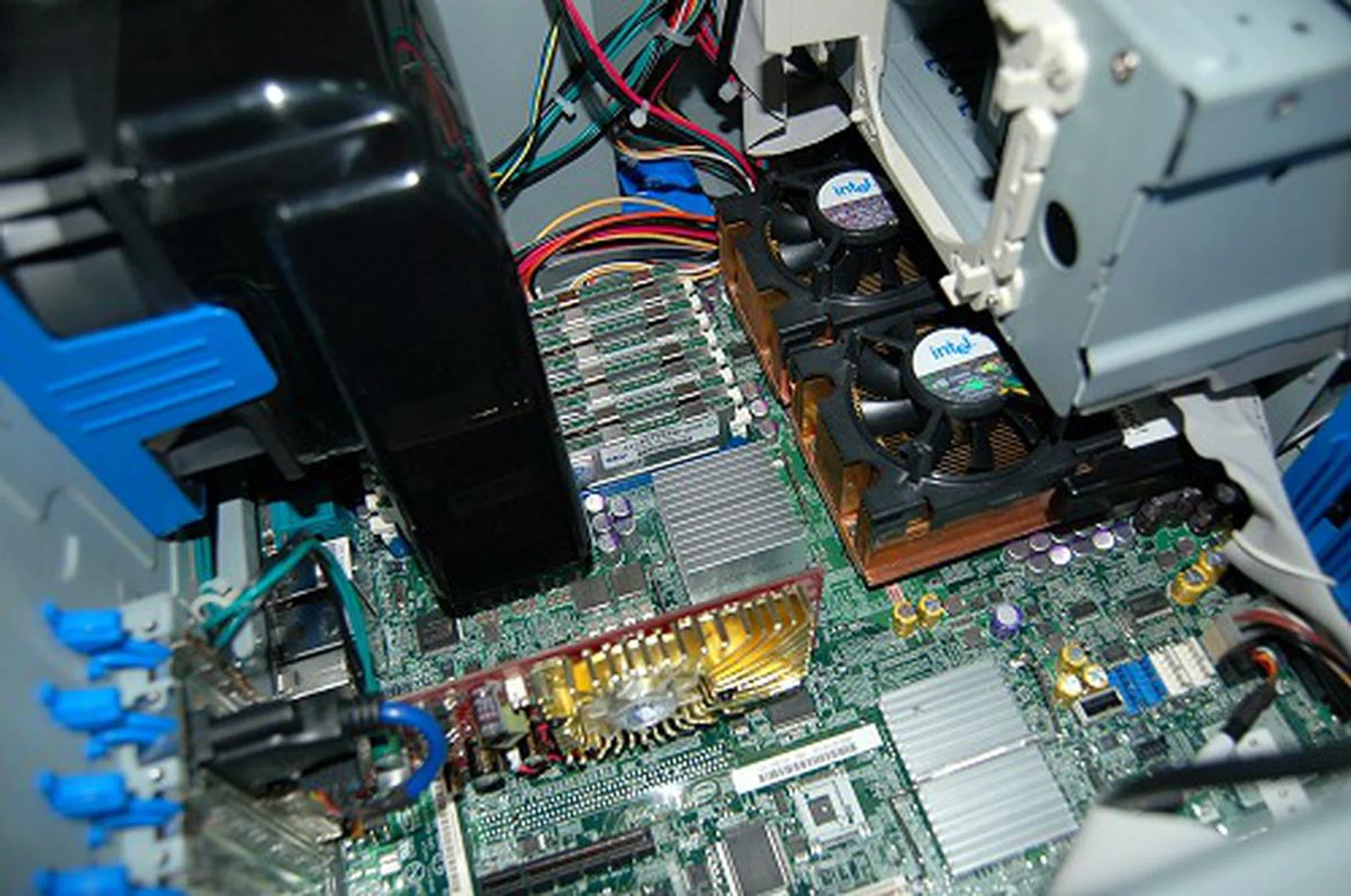
Intel's 5000X based workstation platform housed our Clovertown processor testbed.
All machines were equipped with dual physical processors and 8GB of total system memory. The operating system of our choice was Microsoft Windows Server 2003 Standard x64 R2 edition. Note that while the Barcelona and Harpertown systems came with ATI's ES1000 display controller embedded on the board, the Clovertown machine is of a workstation class with no on-board graphics. As such we've installed an MSI GeForce 8400 graphics card, which is one of the more 'basic' of the lot, but more importantly, it has very low power consumption and thermal envelope - though still not comparable with that of any on-board graphics.
AMD Opteron Barcelona Configuration
- Tyan S3993 motherboard (Serverworks/Broadcom HT2100 chipset)
- 2 x Opteron 2347 (1.9GHz) processors
- 4 x 2GB Micron Registered DDR2-667 memory modules
- Seagate Barracuda 7200.10 200GB SATA hard disk drive (one single NTFS partition)
- ATI ES1000 on-board graphics - ATI driver version 8.24.3.0
- Microsoft Windows 2003 Server Standard X64 R2
Intel Xeon Harpertown Configuration
- Supermicro X7DWN+motherboard
- 2 x Intel Xeon E5472 (3.0GHz) processors
- 4 x 2GB Nanya FB-DIMM DDR2-667 memory modules
- Seagate Barracuda 7200.10 200GB SATA hard disk drive (one single NTFS partition)
- ATI ES1000 on-board graphics - ATI driver version 8.24.3.0
- Microsoft Windows 2003 Server Standard X64 R2
Intel Xeon Clovertown Configuration
- Intel Enterprise Server S5000XVN (Intel 5000X chipset)
- 2 x Intel Xeon L5320 (1.86GHz), X5355 (2.67GHz), X5365 (3.0GHz) processors
- 8 x 1GB ATP FB-DIMM DDR2-533 memory modules
- Seagate Barracuda 7200.10 200GB SATA hard disk drive (one single NTFS partition)
- MSI GeForce 8400 GS 256MB Tubrocache - with NVIDIA Forceware 162.18 (64-bit edition)
- Microsoft Windows 2003 Server Standard X64 R2
The benchmarks used in this review include:-
- SPECCPU 2000 v1.3
- Lightwave 3D 9.0 (64-bit edition)
- Cinebench 9.5 (64-bit edition)
- Cinebench 10 (64-bit edition)
- SunGard Adaptive Analytics 3.5
- Black Scholes 3.5
- POV-Ray 3.7 Beta 22 (32-bit SSE2 optimized & 64-bit editions)
Results - SPEC CPU2000 v1.3
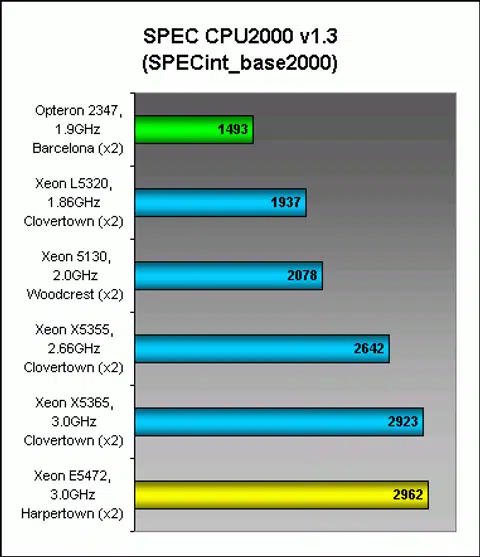
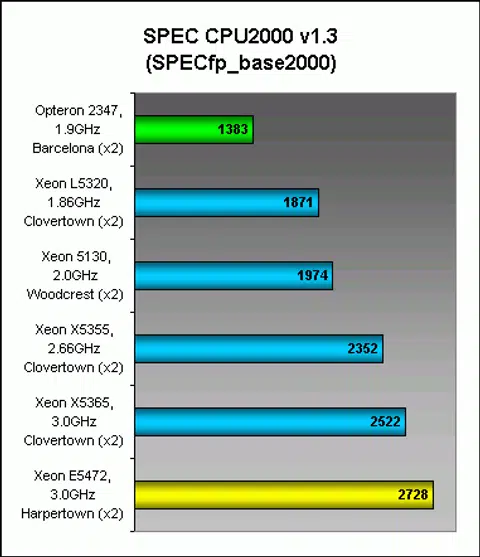
SPEC CPU2000 version 1.3 consists of two benchmark suites for measuring highly compute-intensive integer and floating point performance. Single threaded performance tests showed that the Clovertown at 1.86GHz was notably ahead of the Barcelona at 1.9GHz in both integer and floating point workloads. Expectedly, the 3GHz parts from the Clovertown and Harpertown series held the pole position in this test.
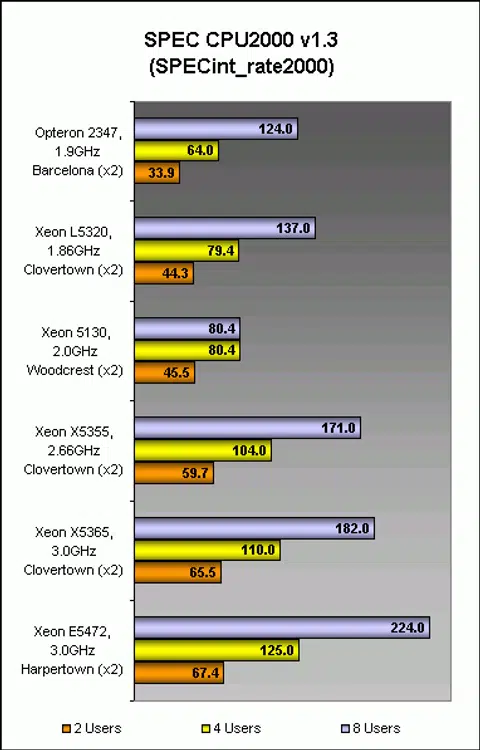
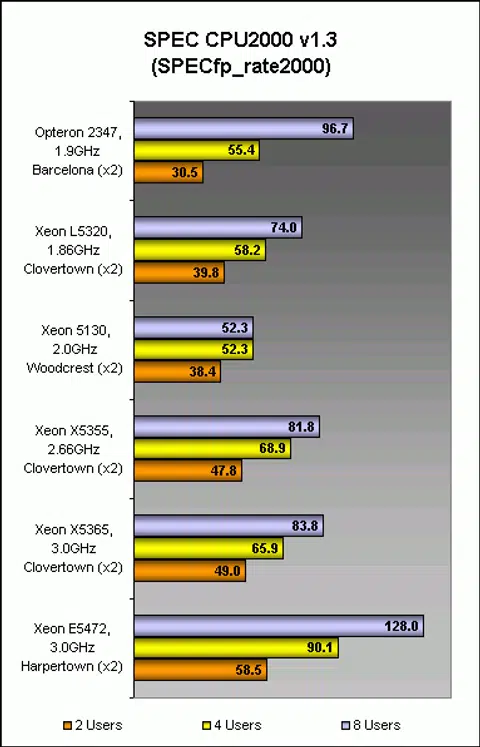
SPEC CPU's rate tests run multiple copies of the speed test to load all available processing cores. We configured the benchmark for two-user, four-user and eight-user workloads for the respective processors, and Intel once again kicks up the win effortlessly for the integer workloads. Floating point workloads were not exactly a walk in the park for Intel as we found AMD's Barcelona matching its competitor at the four-user workload, but at the eight-user workload, the Opteron 2347 posed a serious challenge to even Intel's top processor. However, the upcoming Harpertown Xeon processors managed to fend off the impressive showing of the Barcelona processor with its more updated core architecture and the better platform.
However, there's more to the floating point rate score if we systematically dissect the performance of various individual workloads. In the floating point workload set, we can see that scores for all the 14 individual floating point benchmarks were pretty divided. Some results highly favored Intel's processor while others bent over to AMD's side. We realized that benchmarks which were mostly memory intensive like the 171.swim workload (shallow water modeling) and the 179.art workload (image recognition, neural networks) benefited from AMD's built-in memory controller and direct connectivity to the physical memory. However when it comes to highly FPU compute intensive calculations which required less loading of the memory, Intel led the way in workloads like the 178.galgel (computational fluid mechanics) and 200.sixtrack (high energy nuclear physics accelerator design). Here's an extract of some of the results we have discussed above:-
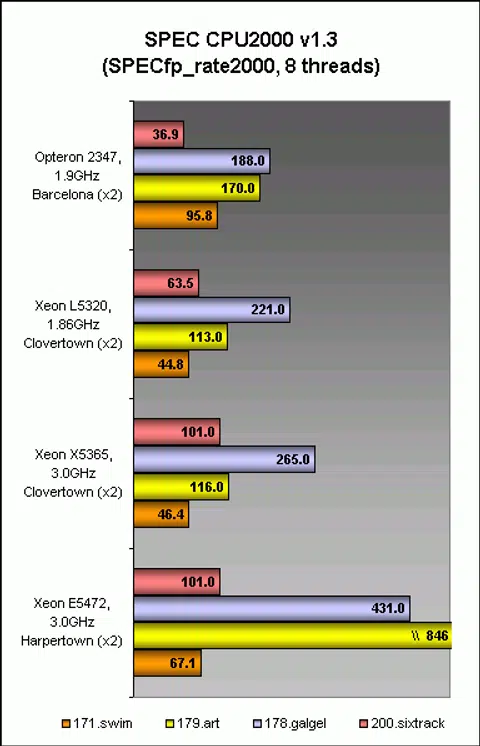
Pitting the AMD Opteron 2347 and the Intel Xeon L5320 processors, we can see that the compute intensive floating-point workloads like 178.galgel and 200.sixtrack are a fair bit faster on the Intel platform. For highly memory intensive workloads, AMD turned the tables with a more than 50% lead. So there doesn't seem to be one solution that fits all needs, since it really depends on the workloads fed to the processor to justify which is the better option. However, Intel's Harpertown Xeon processor's updated core and platform might just come close to being that 'dream' platform. Clock for clock when compared with the Clovertown counterpart, the new Xeon E5472 offered huge gains. Even on the memory intensive 179.art workload, Intel's scores were completely off the chart at a staggering 846 points! That puts it at around eight times faster than any of the Clovertowns' scores for the same test.
Results - Black Scholes 3.5
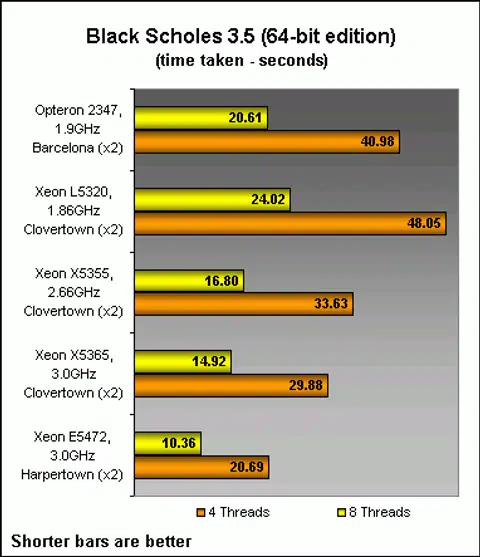
Black Scholes is a model used for financial engineering and risk management for pricing current and future stock options. It is a multi-threaded benchmark and thus scales well with the number of processing cores available. We configured the benchmark for both four and eight threads to check out the performance scaling of the server processors we have at hand and AMD's Barcelona completed the calculations 20% ahead of the time taken for the equivalently priced Intel Xeon L5320 pair. Meanwhile on the high-end, the new Harpertown 3GHz came out twice as fast as the Barcelona and was more than 40% speedier than the Clovertown at 3GHz. Again, the improvements made to the Core microarchitecture were quite tangible. It was unfortunate that AMD couldn't help us secure their previoius second generation Opterons for a proper core comparison against the newer Barcelona.
SunGard Adaptive Analytics, ver 3.5
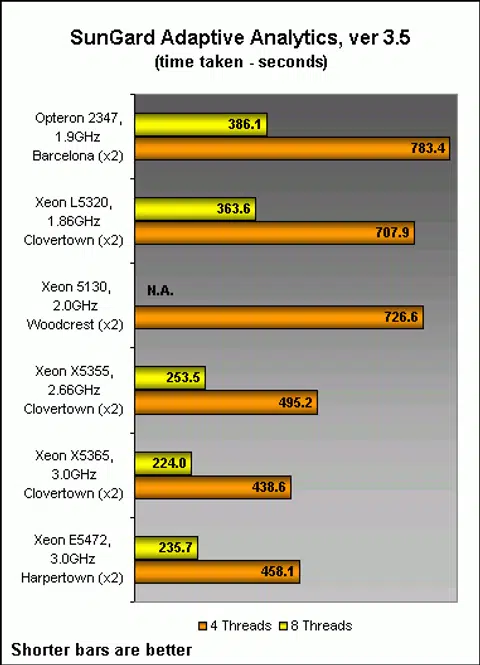
This is another multi-threaded financial analysis tool which performs risk analysis by using monte carlo simulation of financial futures. In this benchmark, Intel's Xeon L5320 pair performed better than the new AMD Opteron 2347 processor pair. On the other end, Harpertown didn't seem to make an impact here, but that's a given since it's not an entirely new architecture but just an enhanced version of the previous Core microarchitecture. However Harpertown, like the Opteron, has SSE4 instruction support, and when applications do come out to support these extensions, we can expect a notable performance boost against processors that can't support SSE4 extensions. Till that time arises, this is a hidden potential for both processors.
Results - Lightwave 3D 9.0 (64-bit edition)
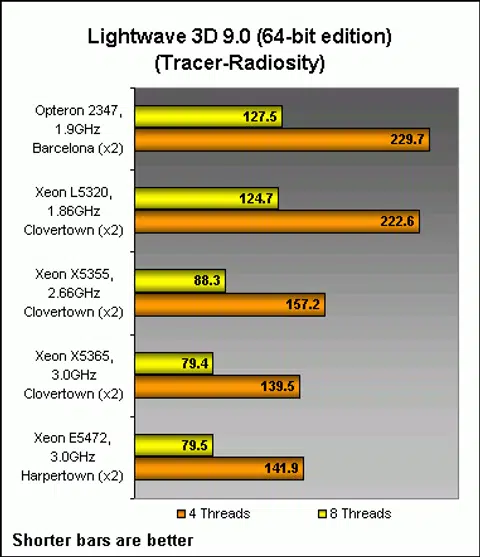
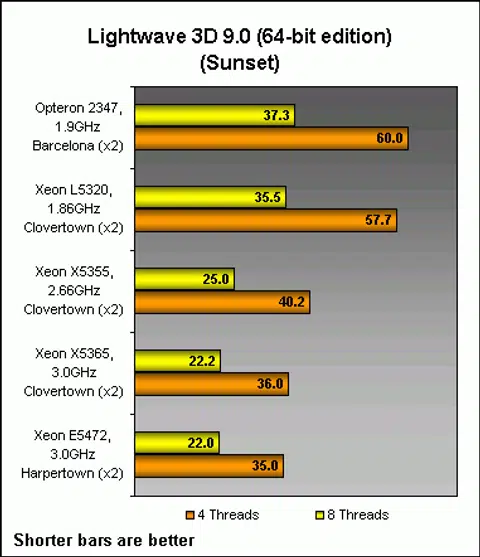
In Lightwave's 3D rendering application, we saw the Barcelona and the equivalent Intel Xeon closely tied, but Intel is still that tad bit faster in this test despite its slight clock speed disadvantage.
Results - POV-Ray 3.7 Beta 22
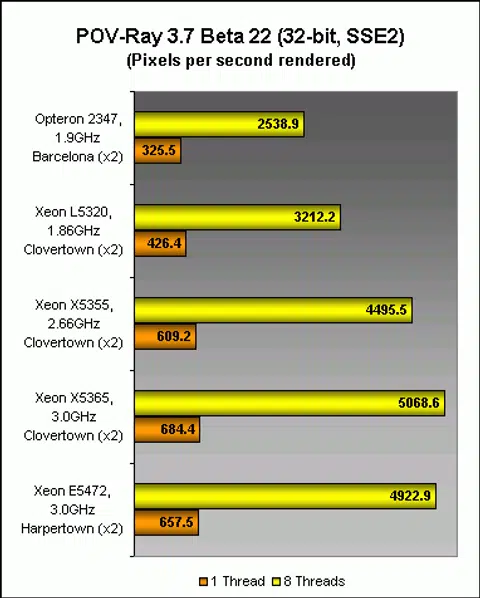
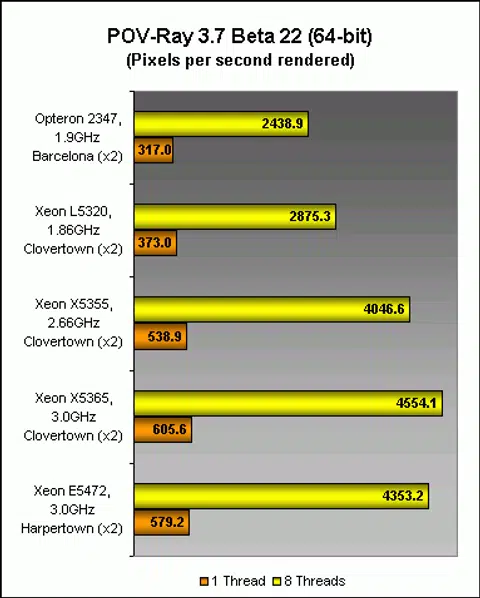
The free POV-Ray raytracing tool to create 3D graphics officially doesn't yet support SMP, but its many beta variants do and so we've used the latest version available at the time of testing. The application comes compiled in 32-bit and 64-bit versions. Logically speaking, the 64-bit edition should come out better in performance, but alas, the 32-bit version is more highly optimized and turned out to give better performance for all our testbeds. So much for 64-bit computing, but what's interesting from the results is that the Intel processors seem to have taken a bigger performance penalty on the 64-bit edition than the AMD platform. It's an interesting tidbit, but in all reality, it's too early to pass off any statements on these numbers as the 64-bit software platform is still far from being bug and trouble-free (at least comparatively speaking to the existing 32-bit operating systems). That aside, the results here show that the AMD Barcelona is yet again trailing the equivalently priced (and clocked) Intel Xeon processors.
Results - Cinebench ver. 9.5 and 10
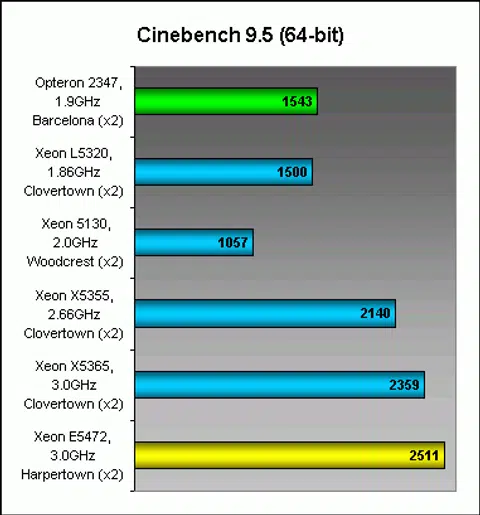
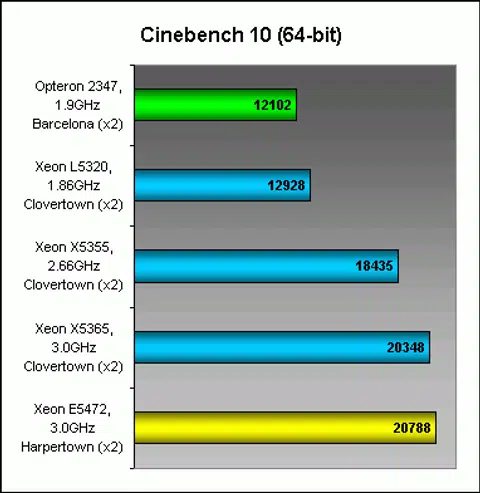
Cinebench is another popular render based benchmark that is highly threaded. The performance standings of this benchmark are quite similar to what we have seen in Lightwave. While AMD had a minor lead with the Cinebench 9.5, Intel had the upper hand in the more compute intensive version of the benchmark using the newer Cinebench 10 engine.
Results - Power Consumption
Having seen the performance results, we hooked up a power meter at the outlet to check out just how power efficient these systems were. Unlike desktop DIY components where we can acquire products to ensure that everything is closely matched as possible, you can't do so at the server level. Each of the rack systems has their own cooling ecosystem to fit the specific design needs, while the same applies to the specific component cooling like the CPU and others. Even the type of PSU used and their efficiency determines the total power draw of the system.
While that portion is out of our control, we did our best to control the other parameters like ensure the same single hard drive and optical drive is used as well as ensuring auxiliary peripheral cards were removed from the system. Even then, the Clovertown machine doesn't use on-board graphics like the Barcelona and Harpertown system, so we stuck a low-end GeForce 8400 GS to ensure low power draw from the card. Memory was another area where it was not quite 'fair' across the board. While all systems had 8GB of memory, the number of modules and the type used were different. The AMD platform naturally used registered DDR2 memory and there were four 2GB modules. The Harpertown system came with four pieces of 2GB FB-DIMM DDR2-667 memory, but the Clovertown machine was installed with eight pieces of 1GB FB-DIMM DDR2-533 memory. Now take note of these while deciphering the power readings below:-
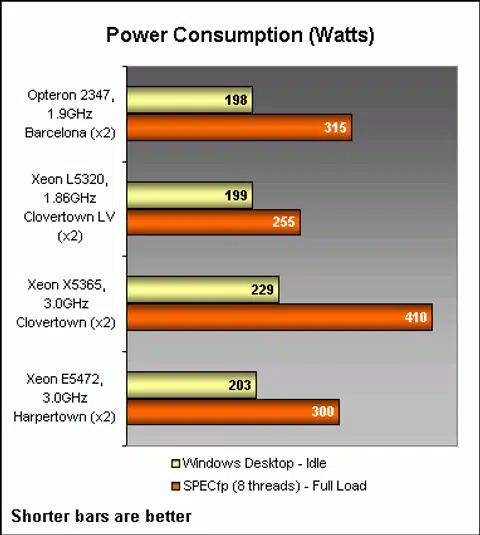
Focusing on the AMD Opteron 2347 (Barcelona) and the Intel Xeon L5320 processors, Intel has a clear win in this area. Now before remarking anything further, do note that the Opteron 2347 is priced similarly to the Xeon L5320 and that both have similar performance in some tests while there are others which Intel picks up the win. So from a price-performance perspective, there's really nothing to dispute here. In addition to that, you have to factor in that the Clovertown systems were a little disadvantaged with a discrete graphics card versus those with on board graphics. Also, remember the common complaint that the FB-DIMM runs hot and consumes more power? Well, again the Clovertown machine is at a further 'disadvantage' as it had eight pieces of FB-DIMM memory, twice the number of modules on the Barcelona. Even in terms of heat output, we didn't find it unusually warm. And on the CPU side, both operated at reasonably low temperatures. Intel actually operated much cooler, but this could also be due to the thermal removal solution on the rack in addition to the low voltage processors.
So despite the mentioned drawbacks, the Intel Xeon L5320 machine has proven itself to have better performance, value and power consumption. With all the work that AMD had put in the processor for aggressive power savings, it was sad and unfortunate that we did not really see much of those technologies matching Intel's solution.
Over on the high-end performance solutions, Harpertown's new 45nm process technology is paying off big time as you can see the huge difference in power savings from that of a Clovertown. In fact this upcoming 3GHz, near-top-of-the-line SKU from Intel has lower peak power consumption than the Barcelona's near-top-of-the-line SKU, while the performance of the Xeon E5472 is miles and miles ahead.
Conclusion
Barcelona was a much needed processor design for AMD to get back in the game to compete in the performance per watt segment. However, having tested the Barcelona here at Hardware Zone, we weren't as impressed given the hype surrounding it. When the very first Opteron was introduced, it was accurate to say it was a revolution at its time. When Intel's Core microarchitecture launched, that was a bigger revolution. Both brought about phenomenal gains in processing power, but what Intel did was to also bring down thermal and power specs to a whole new level. Both processing architectures dictated much of how the CPU industry should move ahead and have carved themselves a place in history.
The Barcelona however, is unfortunately not among those ranks. What it did was to bring itself forward to better compete with Intel. Unfortunately as the results showed, it wasn't quite as effective as we hoped it would be. Performance-wise, they were reasonably well clock-for-clock, but not in terms of performance per dollar. The Opteron 2347 (Barcelona 1.9GHz) was found to be trailing a bit behind the similarly priced and lower clocked Intel Xeon L5320 (1.86GHz) and that is despite the fact the Intel platform used slower FB-DIMM DDR2-533 memory. If you give it further thought, Intel's low-voltage processor is rivaling and bettering AMD's standard editions in terms of performance at the same price point and consuming far less power (mind you that the Intel system used a discrete graphics card too). If one wasn't picky about power consumption, Intel has a speedier 2GHz processor that operates on a faster 1333MHz FSB and is priced exactly at the same price point too. So inadvertently AMD already has a comfortable lead in technical specifications, but yet lags behind the equivalent Intel counterpart. Of course, total platform costs are not yet taken into consideration, but generally even if the overall Intel solution turns out to be a little more expensive, it would still be more power efficient.
However, a point to note on performance is that the AMD Barcelona still has its turf when applications and loads are very highly memory subsystem dependant. As shown in the breakdown of some of the floating point workloads, AMD fared very well in workloads that were mainly memory driven since its integrated memory controller and direct memory connectivity at lower latencies give it a big advantage. However, where compute intensive workloads are concerned, Intel has a clear lead in this area. Thus, there's no one processor that would satisfy everyone, and it really depends on what the system is expected to run.
With that said, moving towards high performance computational needs, Intel is clearly the leader still with the Clovertown based 3GHz parts and the upcoming Harpertown based processors which we've also tested in this article. AMD has mentioned time and time again that they'll be shipping higher frequency versions by end of the year, but Bacelona's availability in general is still low and having seen AMD struggle with Brisbane core desktop products, we're not certain how they'll pull off both performance and quantity aspects of their new Opteron line-up. In fact, not getting a 2GHz version for review in this article could be a tell-tale sign of limited availability again. AMD has hardly had a chance to parade its Barcelona based Opterons much, but already Intel is readying to launch their successor to Clovertown very shortly. The Harpertowns we've tested ranged from similar performance levels as the Clovertown in some workloads, while in some others, the new Xeons take an unprecedented leap thanks to its updated Core architecture and a faster Stoakley platform. In the areas of power consumption, the 45nm process technology of the Harpertown processors showed a dramatic 25% to 30% power savings when compared to its predecessor and this near-top-end performance SKU is already drawing lower power than the new AMD Barcelona whose performance is nowhere near.
Overall, AMD now has a decent lineup, but Intel still edges it out on overall competitiveness in several verticals.
 |  |
 |  |
| |
Our articles may contain affiliate links. If you buy through these links, we may earn a small commission.