
Netflix’s Altered Carbon asks what would happen if death were no longer real
Altered Carbon is Netflix's latest big-budget sci-fi series, and boy is it a visual treat.
Mild spoilers ahead!
How much of our humanity is tied up with our mortality? That’s the big question that Altered Carbon asks.
Set over 300 years into the future, Netflix’s latest prestige series may be its highest-profile science fiction story yet. It is based on Richard K. Morgan’s 2002 cyberpunk noir novel of the same name, where death has become a thing of the past and immortality the currency of the day.
Humans can now quite literally shrug off the mortal coil and take on another body, or “sleeve”, once the current one dies or becomes damaged. Consciousness is stored in a piece of metal called the “stack”, located at the base of the brain. As long as the stack remains intact, the person lives on, and can be transferred into a new sleeve as something Morgan calls DHF, or Digital Human Freight.
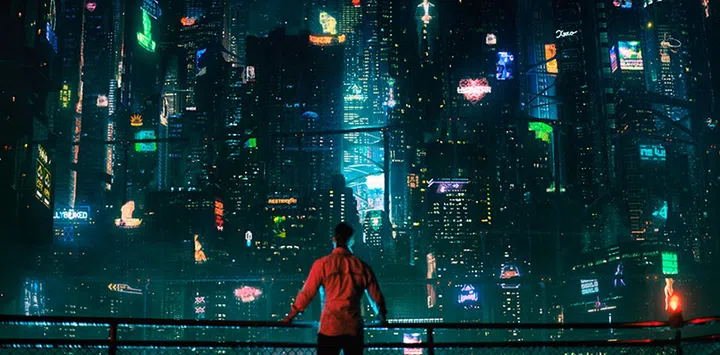
Altered Carbon is cyberpunk reified. (Image Source: Netflix)
This take on Cartesian duality dovetails with sci-fi’s aptitude for grappling with ideas of the posthuman. Altered Carbon puts forward a class of super-rich colloquially referred to as Meths (And all the days of Methuselah were nine hundred sixty and nine years), who are worshipped by some as actual gods and build their residences in towering structures that float above the clouds.
Unfortunately, the rest of the population isn’t so lucky, and they live in gritty urban centers and are too poor to afford a new sleeve for themselves when they die. Their stacks are put in storage, slumbering in oblivion as they await a new sleeve.
This disparity effectively solidifies the line between the haves and have-nots, where those who live on the ground are casually dismissed as “fireflies”, or a “tiny spark whose beauty lies in how quickly they’re extinguished”. But while seemingly cavalier, this line captures the point that Altered Carbon tries to drive home. Life is valued largely because it will end one day, and any scarce commodity turned infinite resource immediately sees its worth drop.
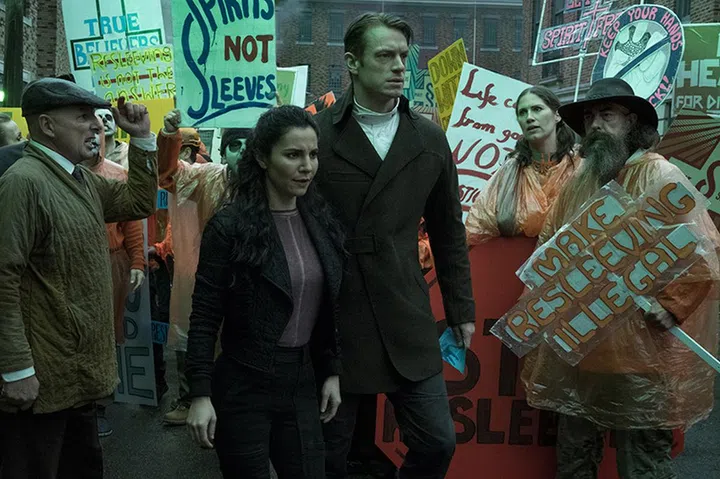
Joel Kinnaman and Martha Higareda as former Envoy Takeshi Kovacs and Lt. Kristin Ortega. (Image Source: Netflix)
Furthermore, death used to be the great equalizer, but its banishment has effectively created a class of demigods that consolidate their power over the centuries and wield terrible influence. They even have safeguards against the destruction of their stacks, with remote DHF backups via satellite. If the stack is destroyed, the backup is simply loaded into a waiting clone.
This raises more questions about authenticity and self. Is a copy of your mind truly you? And if one self is destroyed, and a backup is waiting to take its place, did that version of you experience death? One could argue that much of the value of the self rests in its inimitable essence – there is nothing ever quite like it, and there never will be. But when a mind can be copied, and even placed into another body to exist alongside the original in a process called double-sleeving, the value of each individual feels diminished.
This is exactly the genius of the show’s central conceit. In a world that has conquered death, there is more injustice and suffering than ever. Altered Carbon sounds like it should be a utopian ideal, with immortal beings that can “needlecast” to distant planets, wide-eyed explorers unbound by the limits of a single lifetime. (You'll need to watch the show to truly understand this.)
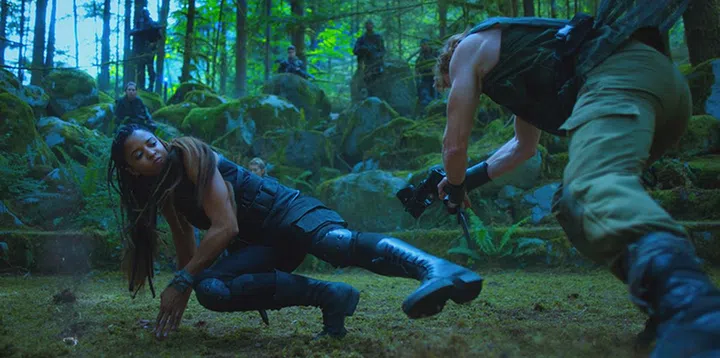
Altered Carbon doesn't disappoint with its action sequences.
Instead, it is a world rife with inequality, where the mind and body are subject to all sorts of degradations. Stacks are thrown together like lifeless cargo, and bodies are casually discarded, commodified (some of them have upgrades), and eminently interchangeable. Ironically, a solution that was supposed to elevate life above death has instead undermined the very meaning of life itself and what it means to be human.
As with most examples of dystopian fiction, Altered Carbon has piercing real-world applications. While we’re still a long way off from digitizing the human consciousness, projects like the US$6 billion Brain Initiative and 2045 Initiative are looking at mapping neuronal activity and uploading the mind (in the case of the latter).
It’s not completely rooted in fiction, so if you enjoy thinking about the implications of high technology, Altered Carbon will provide plenty for you to chew on. It’s not perfect, and it spends a lot of time on ponderous philosophizing, but the core idea is sound and a joy to pick apart and explore. For instance, while mind and body appear separate, Takeshi Kovacs also mentions something called “sleeve memory” to explain his attraction to Kristin Ortega, raising the possibility that flesh and consciousness are more intertwined than previously thought.
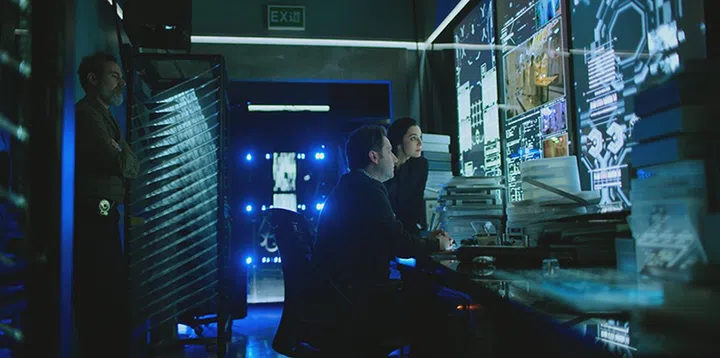
If you wanted a glimpse of a high-tech future world, Altered Carbon serves that up in spades.
Then there’s Altered Carbon’s unique position in the larger cyberpunk canon. As a fan of William Gibson’s Neuromancer, I also particularly enjoyed the similarities between the two. Altered Carbon draws heavy inspiration from Neuromancer and Gibson’s Sprawl trilogy, and the neon-drenched streets and seedy environs echo Gibson’s version of Chiba City.
However, what’s interesting is how Altered Carbon diverges from Gibson and traditional cyberpunk depictions of the divide between mind and body. While some choose to present the body as a prison for the mind, Morgan and showrunner Laeta Kalogridis paint a universe where the consciousness is even more vulnerable without a sleeve. In fact, stack technology was invented precisely to enable the renewal of the body, not to free the mind.

That pink backpack means serious business. (Image Source: Netflix)
All things considered, Altered Carbon makes for a thoroughly enjoyable watch, especially for those who enjoy sci-fi and action films. It is alternatingly funny, poignant, and bizarre, and the action sequences are slickly choreographed and leave you only wanting more. The world is gritty, fully realized, and every bit worthy of its big budget.
Yes, it’s violent and crude, but all that is punctuated by moments of levity, such as when Kovacs struts through a clinic littered with dead bodies carrying a tiny, pink unicorn backpack. Altered Carbon is flawed and won’t satisfy those looking for an airtight plot and pacing, but hey, it’s super fun and a great visual treat.
Our articles may contain affiliate links. If you buy through these links, we may earn a small commission.