
PC gaming is the lone bright spot holding up a PC market in decline
The PC gaming hardware segment continues to go from strength to strength, even breaking the US$30 billion mark for the first time in 2016. Growth in the Asia-Pacific region was particularly strong, partly thanks to an entrenched PC gaming culture.

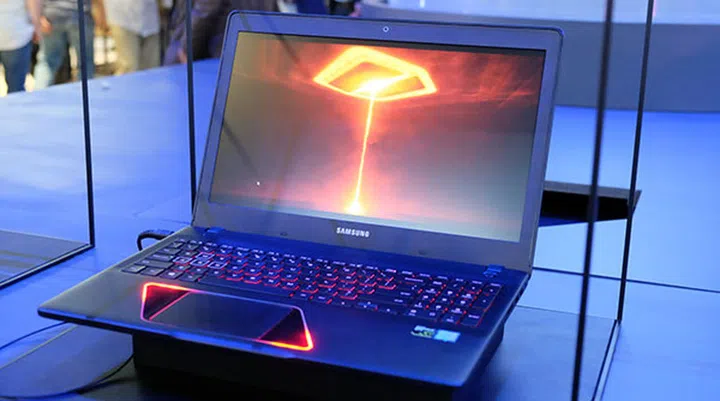
Samsung's Odyssey 15 is part of a new line of dedicated gaming laptops from the consumer electronics giant.
The PC market may be in the middle of its sixth straight year of decline, but gaming remains the brightest spot in an overall flagging market. The PC gaming hardware segment, which includes DIY PCs, gaming notebooks, components, and peripherals, continues to go from strength to strength, even breaking the US$30 billion mark for the first time in 2016.
A report by research and consulting firm Jon Peddie Research predicts a six per cent compound annual growth rate (CAGR) through 2019, with a particularly strong showing in the Asia-Pacific region. This was attributed to a number of factors, including the region’s large population, entrenched PC gaming culture, and the lack of a significant console tradition (combined with past restrictions on console sales in China).
That said, Asian markets apparently preferred low- to mid-range hardware, whereas demand for premium hardware was highest in Western markets like the US, Canada and Europe. Globally, high-end hardware accounted for the largest slice of the global PC gaming pie at 43 per cent, while entry-level and mid-range systems and products comprised 22 per cent and 35 per cent respectively.
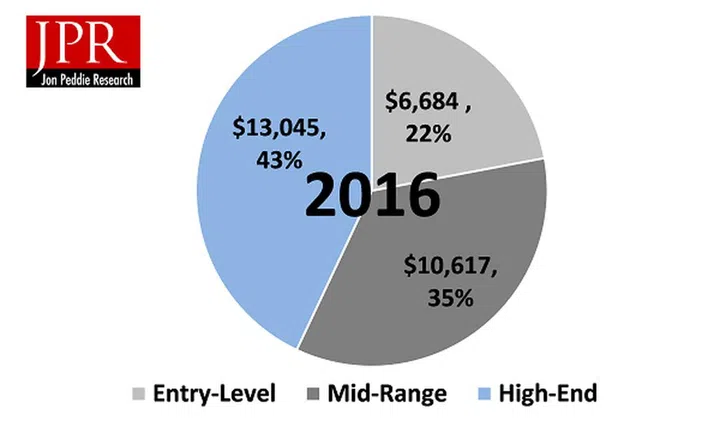
Figures shown here are in the billions. (Image Source: Jon Peddie Research)
Moving from 2015 to 2016, the largest jump was in mid-range gaming, which saw an impressive 39 per cent increase from US$7.64 billion to US$10.6 billion. High-end spending went up by 22 per cent, while expenditures on lower-end hardware inched up by a more modest 5.7 per cent.
The strong growth in the mid-range and up could be due to a combination of factors. For one, the minimum hardware required for a decent PC gaming experience with the latest games is quite high. Furthermore, basic tasks like sending email and word processing can be handled on ultrabooks or even phones, which reduces the incentive to get a low-end gaming system and carves out a space for more powerful systems to function as content creation machines or gaming systems for enthusiasts.
Additional drivers of high-end spending are coming over the horizon as well, in the form of AMD’s Ryzen CPUs and Vega GPUs.
Moving forward, it should come as no surprise that we’re seeing manufacturers focus more on gaming systems and hardware, with dedicated gaming lines like Lenovo’s Legion and Samsung’s Odyssey.
Source: Jon Peddie Research
Our articles may contain affiliate links. If you buy through these links, we may earn a small commission.