
NVIDIA VRWorks adds extra realism to VR games with PhysX support and better audio
NVIDIA's new GeForce GTX 1070 and 1080 serve up copious amounts of graphics performance, and the company wants to put it all to good use in powering more immersive VR experiences. It has added new features to VRWorks, including support for more realistic physics effects and enhanced audio.

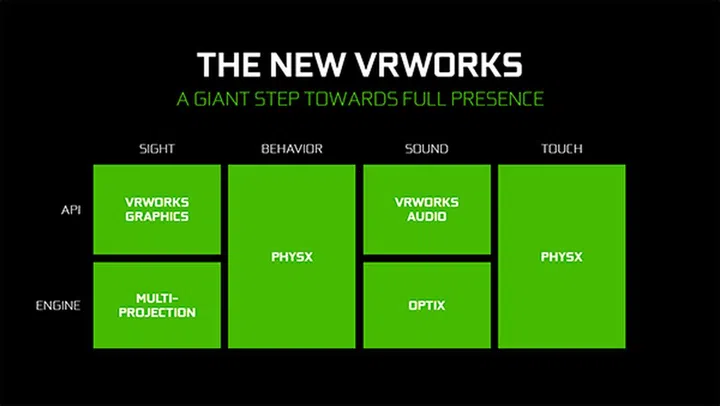
Image Source: NVIDIA
The big news coming out of NVIDIA this past weekend was the announcement of its long-awaited Pascal cards, the GeForce GTX 1080 and 1070. Not only do these cards outperform the Titan X, they also cost less and are more power efficient, which translates into a seriously attractive value proposition. Not surprisingly, NVIDIA wants to put this extra graphics horsepower to work in virtual reality applications, and the new Pascal GPUs now bring support for PhysX to VRWorks, in addition to more realistic audio with a new feature called VRWorks Audio.
This latest advancement finally brings VR games in line with traditional 3D games, which have long been able to take advantage of the ability of NVIDIA GPUs to calculate PhysX simulated physics. Thanks to the new Pascal GPUs, game objects and environments in VR games can now achieve realistic physical behavior, including things like realistic collision detection.
VR experiences revolve around immersion and true-to-life interaction with simulated surroundings, so more accurate physics effects, realistically modelled touch interactions, and environmental behavior could go a long way toward enhancing what the industry calls “presence”.
Audio also gets a boost with VRWorks Audio, which aims to simulate the real-world interactions between sound waves and the environment. While today’s VR applications already provide positional audio, realistic aural experiences are comprised of more than just the location of the audio source. Sound is a function of the physical environment, and is affected by things like the placement, structure and material of the surroundings and objects.

VRWorks Audio attempts to address this by using NVIDIA’s OptiX ray tracing engine, effectively tracing the path of sound in an environment in real-time (much in the same way it handles light rays), thus delivering audio that is an accurate product of the shape, size, and material properties of the virtual world.
In order to showcase these new technologies, NVIDIA created VR Funhouse, an upcoming VR game that comprises 10 mini-games. Each game highlights a different feature of VRWorks – for instance, a game called Crown Creeper utilizes VRWorks Audio and forces you to use your ears to navigate.
Source: NVIDIA
Our articles may contain affiliate links. If you buy through these links, we may earn a small commission.