
NVIDIA to label VR capable hardware to help consumers
We've all heard the term HD ready or HD compatible being thrown around the past few years, usually in regards to televisions. Now NVIDIA is hoping to do the same for VR capable PC systems.

Look for this label when you're shopping for a VR capable system.
With VR finally set to see the light of day in the next few months, NVIDIA has taken it upon itself to help out buyers who are upgrading their notebooks and desktops with a new labeling initiative called VR Ready.
To that end, the GPU manufacturer has signed up several big names in the PC hardware business such as Acer, ASUS, Gigabyte and Aorus (to name a few). Even retailers like Amazon and Newegg are being roped in to help out, all in the hopes of making sure that the consumer knows whether that machine they're eyeing will be able to run the upcoming VR headsets satisfactorily.
To get the VR Ready label, the machine has to meet certain criteria. The GPU has to be an NVIDA GeForce GTX 970 or higher for a desktop and an NVIDIA GeForce GTX 980 for notebooks. The machine also has to have an Intel Core i5-4950 processor or higher, at least 8GB RAM and with a minimum of two USB 3.0 and a HDMI 1.3 port as well as be running at least Windows 7 SP1.
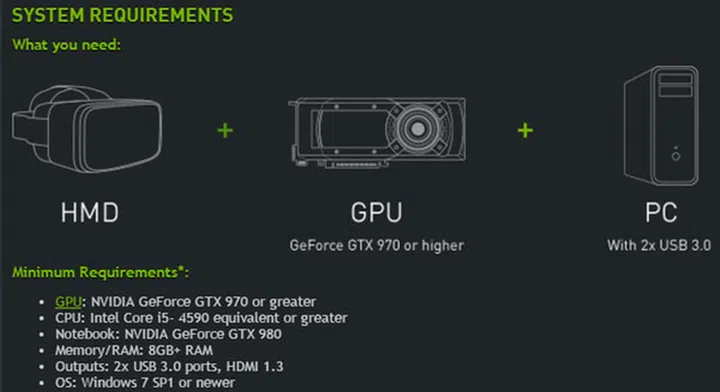
Here are the specs a system has to have as a minimum, to be labeled VR Ready.
With those specs, it's much easier to get a desktop VR Ready system than a notebook considering only a handful of manufacturers right now are producing gaming notebooks with the NVIDIA GeForce GTX 980 instead of the GeForce GTX 970M or 980M.
Whether VR will take off or not is another story, but at least if you're not tech savvy and just want to get in on the VR boat, you don't have to flounder around wondering what hardware you'll need to run VR games when the headsets hit in the next few months.
Source: NVIDIA blog
Our articles may contain affiliate links. If you buy through these links, we may earn a small commission.