
HTC Vive Focus Vision PC VR headset launches in Singapore
The HTC Vive Focus Vision uses a lossless DisplayPort mode, which allows it to connect directly to a PC’s graphics card to bring gaming content at 5K resolution and a 120Hz refresh rate. #htc #vr #gaming

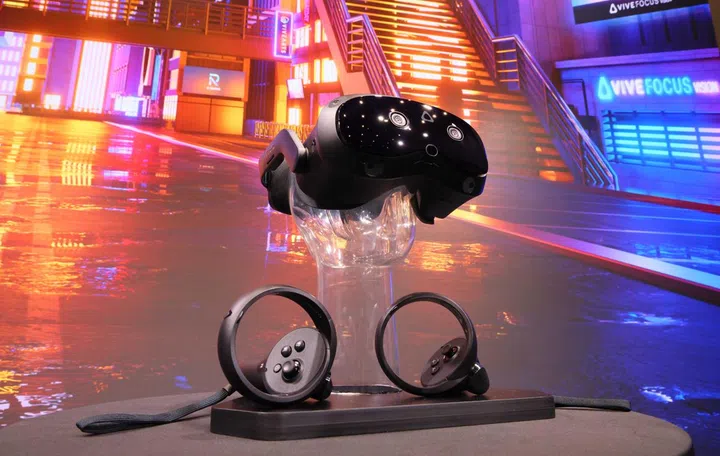
The Vivo Focus Vision XR/MR/VR headset for gaming, by HTC Vive. Photo: HTC Vive.
HTC Vive has finally announced its high-end virtual reality (VR) headset for PC gaming, and it’s coming to Singapore.
The Vive Focus Vision by HTC Vive is a standalone headset that powers extended reality (XR) and VR. It’s built to tackle VR gaming and various display-related features to create an unparalleled tracking and viewing experience for streamers and gamers.
Additionally, HTC Vive said it is committed to bringing these next-generation XR and VR innovations to Singapore, which is excellent news for local gamers.
HTC Vive Focus Vision
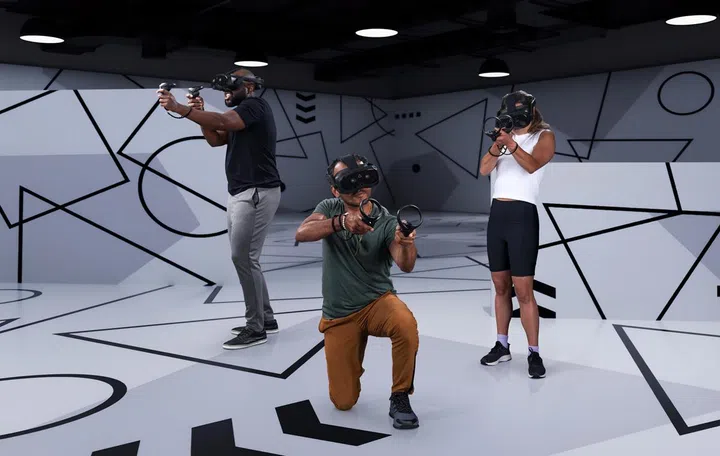
Three Vive Focus Vision users. Image: HTC Vive.
A large part of what makes XR and VR gaming appealing is high-quality playback with high definition, minimal lag, and other features for added comfort and uptime. Much of this is translated from having generous bandwidth for data transmission and technologies that offer depth correction, on top of having powerful components to support them all.
Vive Focus Vision has lossless DisplayPort mode for PC VR gaming, allowing it to connect directly to a PC graphics card to get 5K resolution, 120° FOV, and 120Hz refresh rate VR gaming (handy for gamers who use SteamVR). However, note that DisplayPort mode will only be available as an update in late 2024.
Interestingly, the double LCD panels have high resolution (2,448 x 2,448 pixels per eye), but only has a maximum 90Hz refresh rate.
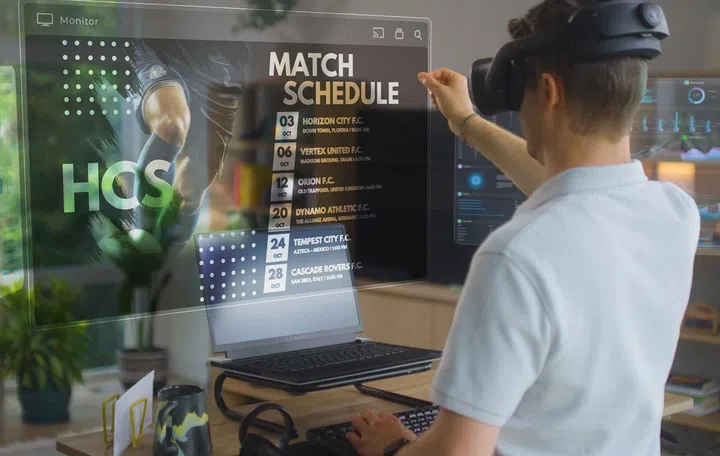
HTC Vive Focus Vision for productivity. Image: HTC Vive.
Another key feature is auto-IPD adjustment, where the VR headset has built-in eye tracking to adjust the distance between the user’s pupils. This makes it possible to share the HTC Vive Focus Vision with family, friends, and colleagues, while also making it suitable for venues with high turnovers (gaming cafés, exhibitions, staff welfare corners of offices, etc.).
The headset comes with dual front-facing 16MP colour cameras, enabling stereoscopic passthrough. A user in the middle of a VR session can still see their immediate surroundings with natural depth perception, and this also adds to the realism in mixed reality (MR) content.
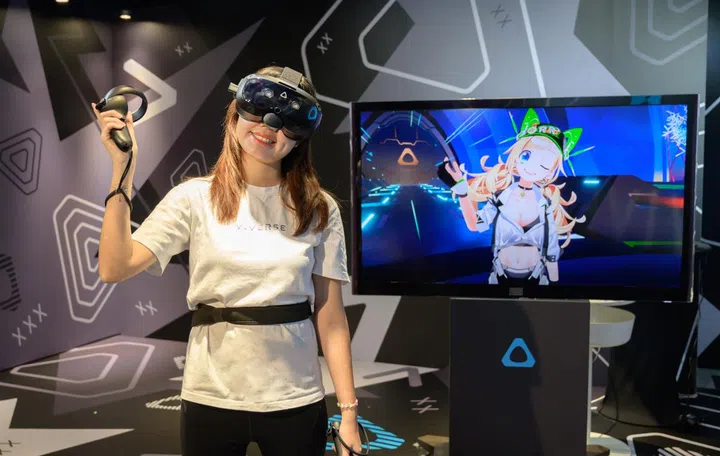
HTC Vive Focus Vision demo of its facial and gesture tracking. Photo: HTC Vive.
The headset also contains multiple tracking technologies, making it responsive even in low-light situations. HTC Vive said it has Vive Ultimate Tracker, Facial Tracker and built-in infrared sensors. Together, these trackers allows the user to convey emotions with 26 body joints and 38 blend shapes across the lips, jaw, cheeks, chin, and tongue. This also makes the headset a viable option for amateur and professional VTubers, who interact with users via digital avatar proxies.
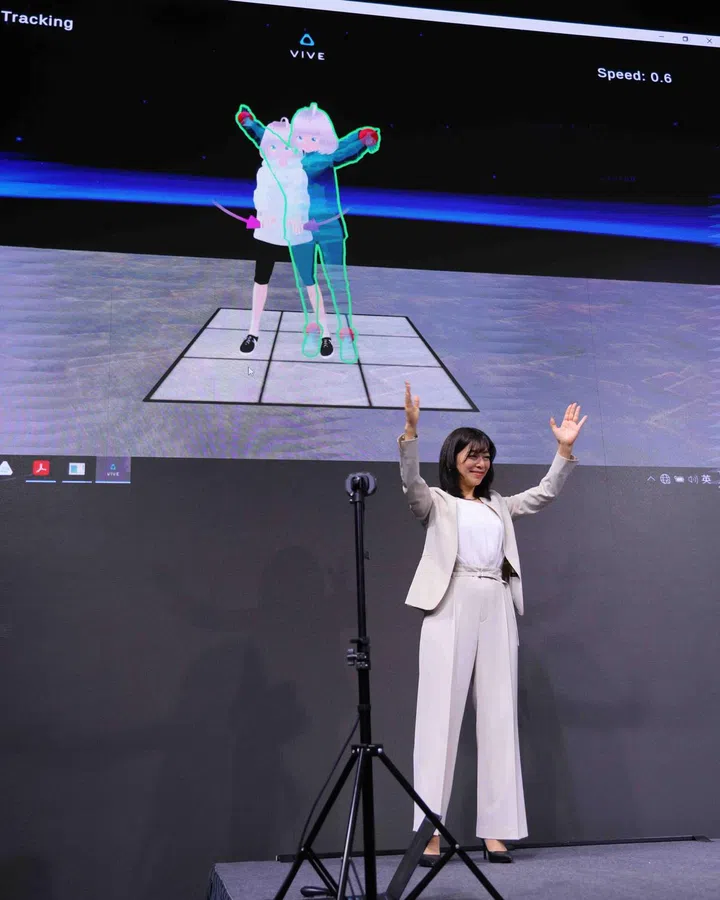
Demo of tracking capabilities. Photo: HTC Vive.
Much of comfortable VR gaming relies on its ergonomics and battery capabilities. HTC Vive said that Vive Focus Vision has a rear-position battery pack with optimised weight distribution, an upgraded cooling system designed for extended use, and hot-swappable auxiliary batteries (the headset can still run for 20 minutes when replacing batteries).
Key specifications of the HTC Vive Focus Vision:
Specification | Parameter |
Headset display | 2x LCD panels 2,448 x 2,448 pixels resolution per eye 90Hz refresh rate 120° FOV |
Processor, Memory, Storage | Qualcomm Snapdragon XR2 12GB RAM (LPDDR5) 128GB storage Up to 2TB expandable storage (MicroSD card) |
Connectivity | 1x USB 3.2 Gen 1 (Type-C) 1x USB 3.2 Gen 1 with DisplayPort support (Type-C) Bluetooth 5.2, BLE Wi-Fi 6 and 6E |
Audio | Dual microphones with noise and echo cancellation Dual drivers Privacy mode for sound leakage 3.5mm audio jack (output) |
Buttons | Headset buttons, volume buttons |
Sensors | 4x tracking cameras 2x eye-tracking cameras 2x full-colour passthrough cameras G-sensor, proximity sensor, depth sensor, infrared floodlight, gyroscope |
Eye-tracking | 120 Hz gaze data output frequency (binocular) 0.5° to 1.1° accuracy within 20° field of view 5-point calibration Automatic IPD adjustment |
Ergonomics | 150mm facial interface for eyeglasses support IPD between 57mm and 72mm Quick-release headstrap |
Battery | "Upto two hours" hot-swappablebattery 30W charging adapter included |
Pricing and availability
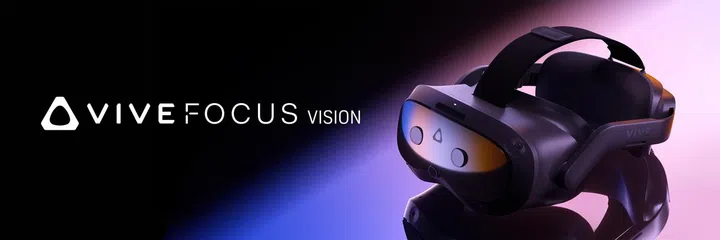
HTC Vive Focus Vision. Image: HTC Vive.
The HTC Vive Focus Vision will be available in Singapore starting in early December 2024. Currently, HTC Vive only lists one official retailer for the headset, which can be found here.
Currently, the Consumer Edition (CE) for each Vive Focus Vision bundle (S$1,699) includes one head-mounted display, two controllers, one headset battery, one charger, and accompanying charging cables.
For its launch promotion, Singapore gets a complimentary S$249 Vive Wired Streaming Kit (compatible with DisplayPort mode) and three VR games bundled, worth a total of S$509, while stocks last. This promotion is valid only until 1 January 2025.
Our articles may contain affiliate links. If you buy through these links, we may earn a small commission.