
Here are some preliminary benchmarks of the Sapphire Radeon R9 Fury X!
One HWZ member managed to get his hands on a Sapphire Radeon Fury X, complete with a couple of preliminary benchmarks!

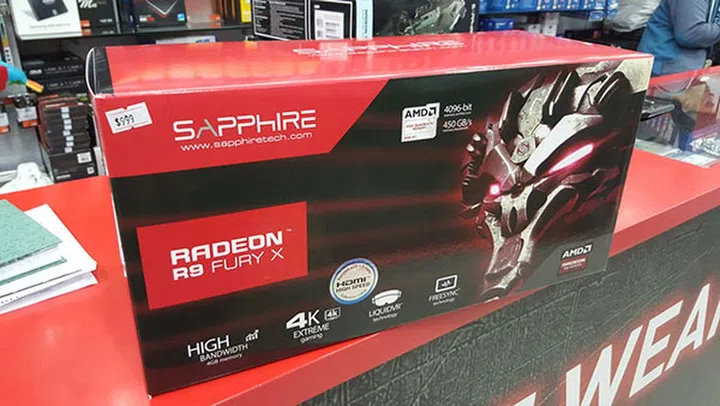
Image Source: royfrosty
We haven’t managed to get our hands on the Radeon R9 Fury X reference card from AMD yet, but it seems limited quantities of the card are now available from certain manufacturers! One of our members, royfrosty, managed to get his hands on the Sapphire Radeon R9 Fury X so we’re able to bring you the results of a few preliminary benchmarks that he ran (with his permission of course).
Here’s the liquid-cooled card, encased in a premium-looking shroud of die-cast black aluminium:
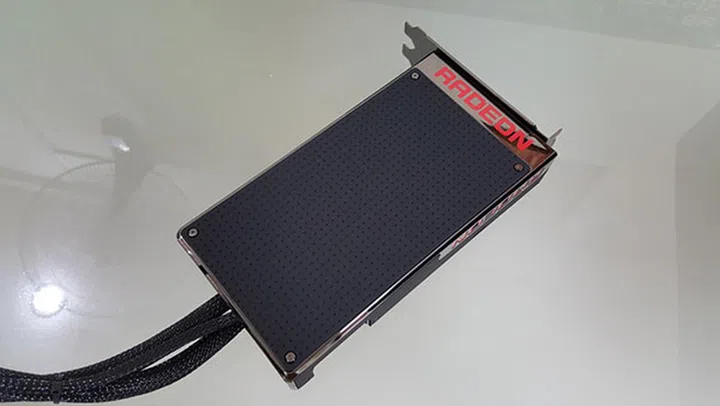
Image Source: royfrosty
Our member ran Middle-earth: Shadow of Mordor at Ultra settings with all the eye candy cranked to the maximum. The Sapphire Radeon Fury X posted an average fps of 84.94 at a 1440p resolution, quite an impressive result that beats that of the NVIDIA GeForce GTX 980 Ti, which managed 82.1fps in our own tests.

Benchmark scores at Ultra settings and 2560 x 1440 resolution. (Image Source: royfrosty)
At a resolution of 3840 x 2160, the Radeon Fury X put out 48.95fps. This again surpassed the GeForce GTX 980 Ti, which posted 45.9fps at the closest comparable resolution. With 4GB of High Bandwidth Memory and a 4096-bit memory bus, the Radeon R9 Fury X is supposedly in its element at 4K resolutions.

Benchmark results at Ultra settings and 3840 x 2160 resolution. (Image Source: royfrosty)
Do note that this isn’t the most clear cut comparison as our tests on the GeForce GTX 980 Ti were performed at a resolution of 2560 x 1600 and 3840 x 2400, instead of 1440p and 2160p respectively. The few frames of difference between the two could very well be attributed to the difference in resolution between the two tests.
Furthermore, we paired the GeForce GTX 980 Ti with an ASUS P9X79 Pro motherboard and Intel Core i7-3960X processor, whereas the Radeon Fury X was tested with an MSI Z97S SLI Plus board and Intel Core i7-4770K processor.
So while you could argue that the Radeon Fury X beat the GeForce GTX 980 Ti because the former card was tested at a slightly lower resolution, there’s no saying what additional performance you might squeeze out of it on an enthusiast-level X79 or X99 platform.
These will certainly be things we'll be looking into when we have a card available for a full review. But at any rate, these initial numbers from the Radeon Fury X look fairly promising. And at S$999, it does look like it might be a worthy alternative to the GeForce GTX 980 Ti (the Gigabyte version of the reference card retails for S$1080).
Our articles may contain affiliate links. If you buy through these links, we may earn a small commission.