
Custom AMD Radeon R9 390 and 390X cards are here!
Add-in card manufacturers like ASUS, Gigabyte and MSI have now announced their own versions of AMD's 300 series cards, which only means more choices for consumers and better cooling and performance over the reference designs.

After letting NVIDIA’s second-generation Maxwell cards go unanswered for the first half of the year, AMD is certainly wasting no time in working with add-in card manufacturers to get custom versions of the AMD Radeon 300 series cards out to the market.
Rounding out the top of the Radeon 300 series line-up is the Radeon R9 390 and 390X, which are essentially rebadges of the Hawaii GPU that was previously used in the Radeon R9 290 series, but with an impressive 8GB of GDDR5 memory.
We’ve compiled a list of cards from custom card manufacturers, complete with triple-fan coolers, aggressive designs, and factory overclocks.
ASUS
The ASUS Strix R9 390 and 390X come decked out in ASUS’ latest DirectCU III cooler, complete with two thick 10mm heatpipes that are in direct contact with the GPU. ASUS is claiming up to 30% cooler temperatures over the reference design. We wouldn’t be surprised if this is indeed the case, seeing as the DirectCU III cooler also features three “wing-blade” fans that have been designed to increase airflow for better cooling.
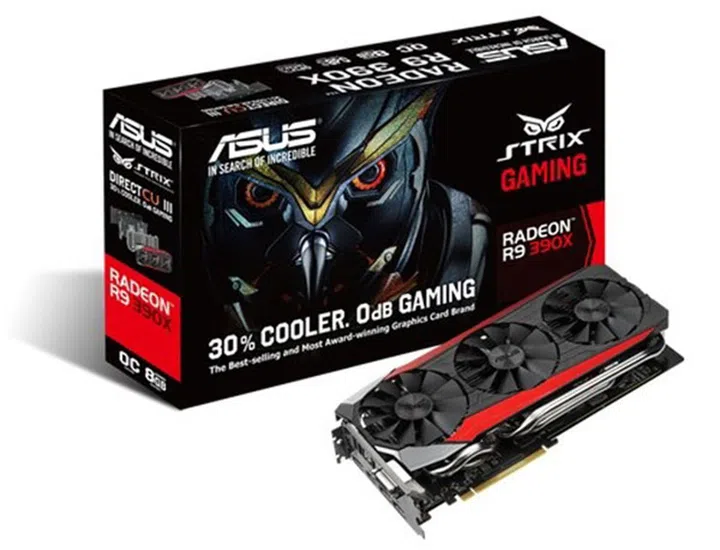
ASUS Strix R9 390X. The ASUS Strix R9 390 features the same cooler and design. (Image Source: ASUS)
Furthermore, the fans utilize something ASUS calls 0dB fan technology, which means that they stop spinning completely under low loads or a pre-set thermal threshold. This ensures that gamers will not be bothered by unnecessary noise when the extra cooling isn’t needed.
The Strix R9 390 and 390X are also manufactured using ASUS’ Auto-Extreme technology. According to ASUS, this is the industry’s first completely automated manufacturing process that removes the element of human fallibility from the production line. This supposedly helps to ensure a more consistent level of quality and reliability across all cards that come off the production line.
Both cards also come equipped with a solid metal backplate that reinforces the structural integrity of the card and prevents the PCB from flexing.

Both cards come equipped with a metal backplate for extra rigidity. (Image Source: ASUS)
The ASUS Strix R9 390 DirectCU III OC comes with an out-of-the-box overclock of a 1050MHz core clock, while the Strix R9 390X DirectCU III OC is clocked higher at 1070MHz. We don’t have details on exact pricing or availability yet, although ASUS did say that they will be coming soon.
However, if you can’t wait to snatch up one of AMD’s latest cards from ASUS, both cards are also available with the older DirectCU II cooler. The Radeon R9 390 DirectCU II retails for S$559, while the Radeon R9 390X DirectCU II can be had for S$739.
Club 3D
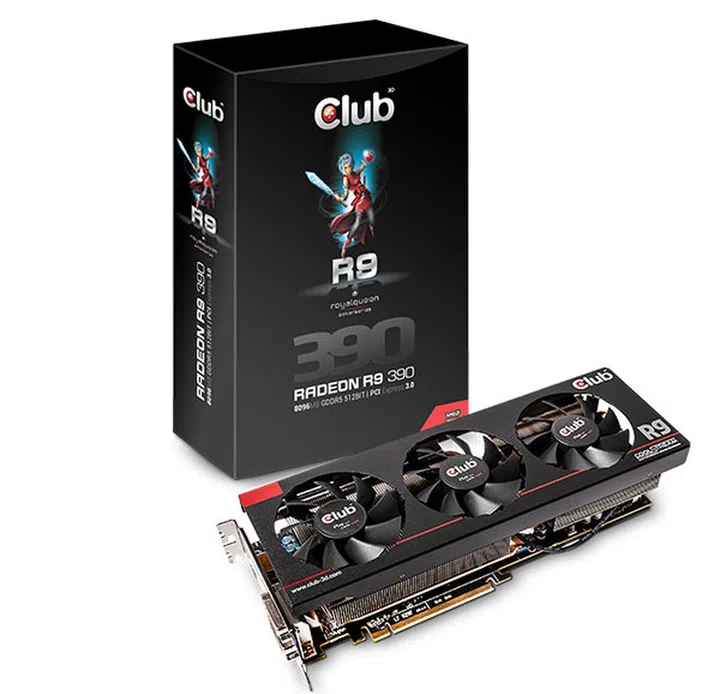
Club 3D Radeon R9 390 royalQueen. (Image Source: Club 3D)
The Club 3D Radeon R9 390 and R9 390X royalQueen feature a triple-fan CoolStream cooler that includes five nickel-plated heatpipes for maximum heat dissipation.
The Radeon R9 390 royalQueen comes with a slight factory overclock of 1010MHz, while the Radeon R9 390X royalQueen ships with a core clock of 1060MHz.
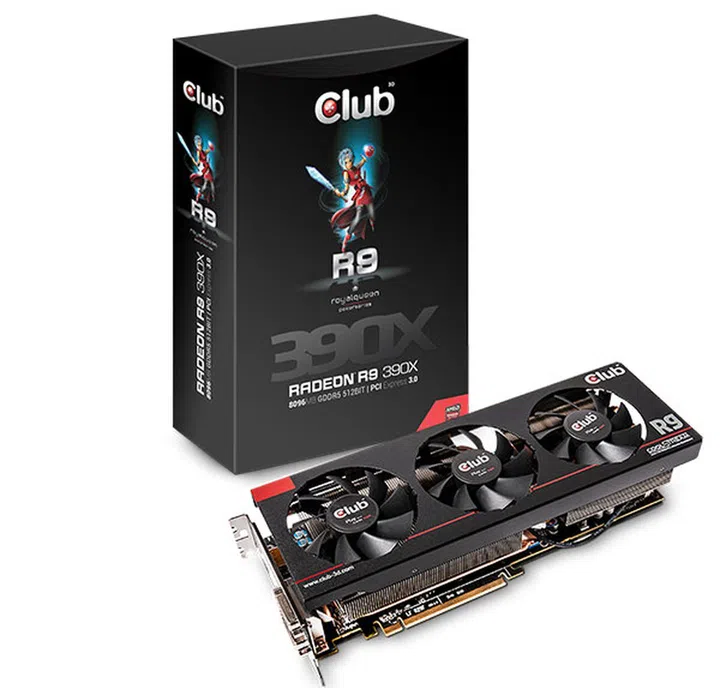
Club 3D Radeon R9 390X. (Image Source: Club 3D)
Both cards are actually triple-slot cards, so that’s one thing to take note of if you intend to run them in CrossFire mode. At 305mm long, these are also one of the longer cards of the lot so you would do well to ensure that your case can accommodate one of these.
Club 3D has also included a metal backplate on both cards, which is probably a good idea given how long and thick the cards are.
Gigabyte
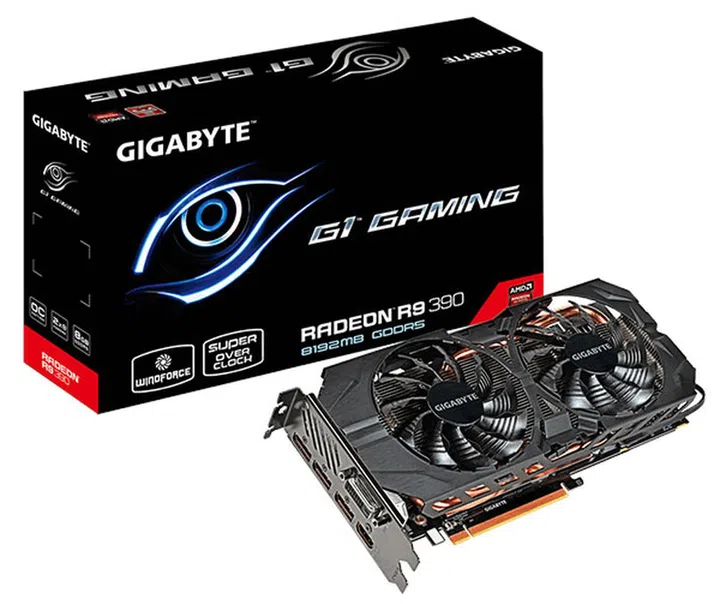
Gigabyte Radeon R9 390 G1 Gaming. The Gigabyte Radeon R9 390X G1 Gaming looks identical. (Image Source: Gigabyte)
The Gigabyte R9 390 and R9 390X G1 Gaming cards boast Gigabyte’s signature dual-fan WindForce cooler and pure copper heatpipes. The R9 390 G1 Gaming ships with a factory overclock of 1025MHz, while the R9 390X G1 Gaming runs at 1060MHz.
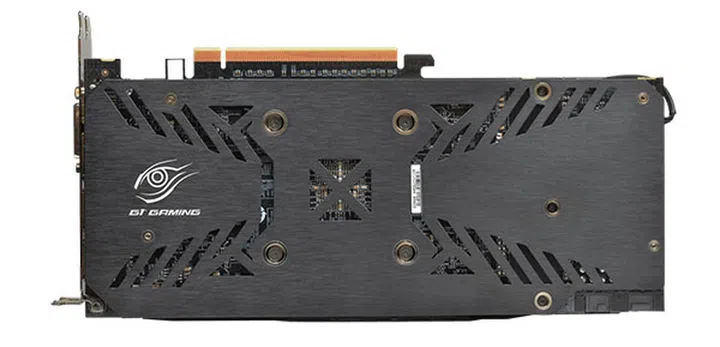
Both cards feature a similar brushed metal backplate for added support. (Image Source: Gigabyte)
Both cards feature dual semi-passive 90mm fans that are capable powering off entirely under low loads for as quiet an experience as possible. LED indicators on the card itself also helpfully indicate whether the fans are spinning or not. Furthermore, the fans sport a 3D stripe curve design that aims to guide the airflow through the fan to improve cooling performance.
There’s also a brushed metal backplate that adds rigidity to the card and prevents flexing.
The Gigabyte R9 390 G1 Gaming is retailing locally for S$559, while the R9 390X G1 Gaming is going at S$675.
MSI
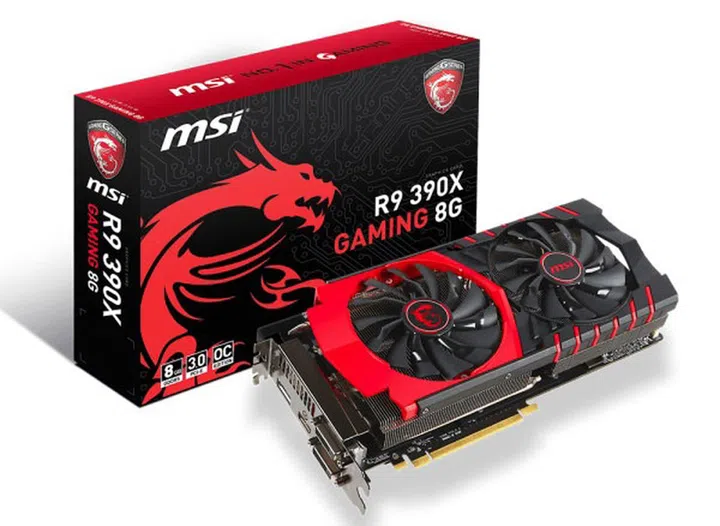
MSI R9 390X Gaming 8G. The MSI R9 390 Gaming 8G sports the same design and cooling shroud. (Image Source: MSI)
The MSI R9 390 and R9 390X Gaming 8G come equipped with MSI’s Twin Frozr V cooler and Zero Frozr semi-passive fan technology that allows the fans to stop spinning under light gaming loads. The dual Torx fans can also work independently of one another, which means you won’t have to put up with the noise of two fans if just one will suffice for cooling. And like ASUS and Gigabyte, MSI has also designed these Torx fans to maximize airflow and direct air toward the heat sink.
The cooling shroud also features an LED-illuminated MSI Gaming Dragon insignia with five lighting modes that can be set through the MSI Gaming App. Gamers can also choose whether they want to run the card in OC Mode, Gaming Mode, or Silent Mode via the application.
Both cards boast a solid metal backplate for extra rigidity and support.
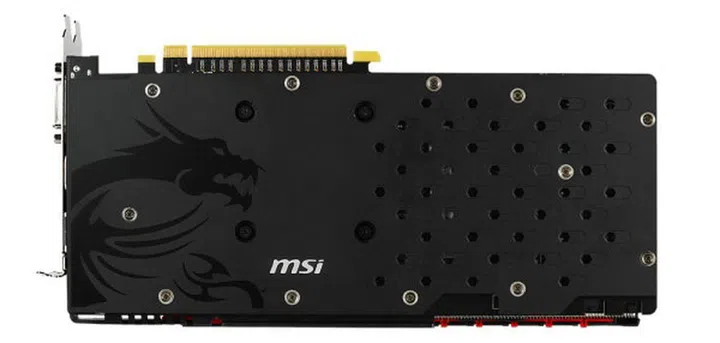
The MSI R9 390 and 390X Gaming 8G feature a solid metal backplate with the MSI dragon insignia. (Image Source: MSI)
The MSI R9 390 Gaming 8G comes with a factory overclock of 1060MHz core clock and 6100MHz memory clock in OC Mode, while the faster R9 390X Gaming 8G goes as high as 1100MHz in OC Mode, with the same 6100MHz memory overclock.
The MSI R9 390 Gaming 8G is retailing at S$559, while the MSI R9 390X Gaming 8G is going for S$749.
PowerColor
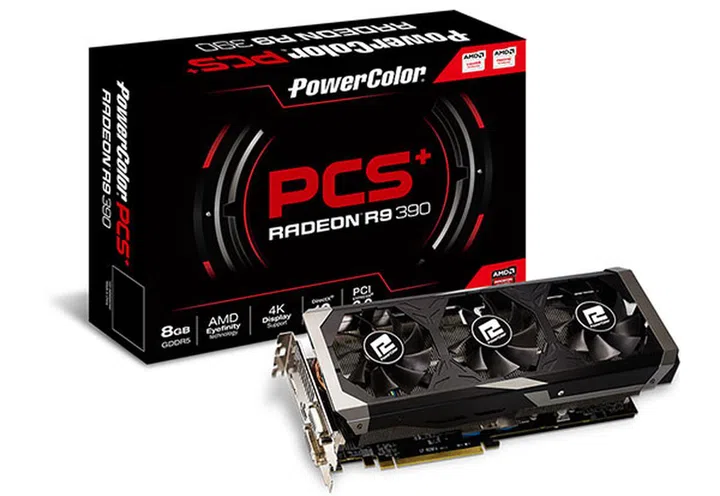
PowerColor PCS+ R9 390X. (Image Source: PowerColor)
The PowerColor PCS+ R9 390 and R9 390X ship are equipped with a slight factory overclock of 1010MHz and 1060MHz respectively. However, the memory clocks remain at reference speeds at 6000MHz for both cards.
The cards utilize an eight-phase (6 + 1 + 1) board design for smoother power delivery and better overclocking. And of course, there’s PowerColor’s own implementation of a semi-passive fan technology called Mute Fan Technology that allows the trio of fans to power down when the GPU is handling light workloads.
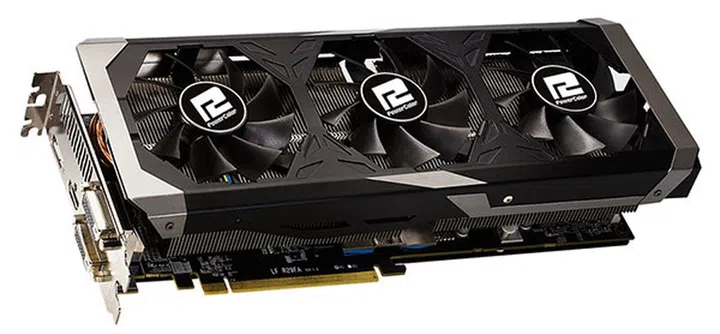
Both the PowerColor PCS+ R9 390 and R9 390X feature a triple-fan cooling shroud with semi-passive fans. (Image Source: PowerColor)
The triple-fan cooler means that the cards are also fairly long at 305mm. They are also even thicker than the Club 3D cards at 55mm, so they are likely also triple-slot offerings.
In addition, the hefty custom cooler features a pure copper GPU block, three 6mm-thick heatpipes, and one 8mm-thick heatpipe to help channel heat to the nickel-plated aluminium heatsink. A metal backplate completes the cooling apparatus by tacking on additional support and passive cooling.
Sapphire
The Sapphire Nitro R9 390 features Sapphire’s Tri-X cooler that comes with triple dual ball-bearing fans and 10mm-thick heatpipes. As expected of all modern graphics cards, the fans are also able to turn off entirely under low loads using Sapphire’s Intelligent Fan Control (IFC-II) technology.
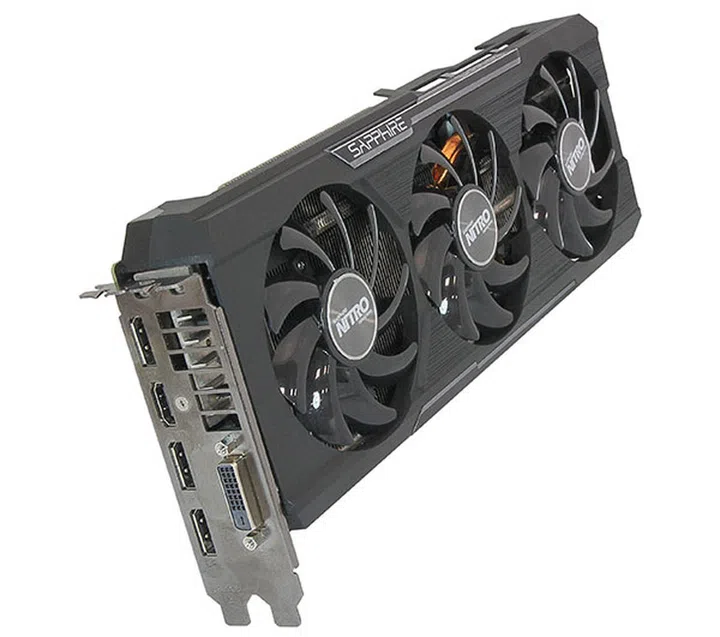
Sapphire Nitro R9 390. (Image Source: Sapphire)
The cooling shroud itself is a fairly utilitarian affair with a black gunmetal finish that should blend in well with most builds. It comes with a very slight overclock of 1010MHz and requires quite a bit of space at 308mm long. According to Sapphire, it takes up just over two expansion slots.
The Sapphire Tri-X R9 390X also features the Tri-X cooler, but with a more eye-catching orange accent down its side this time. It features the same IFC-II technology on the Nitro R9 390 for quiet operation, 10mm heatpipes and triple dual ball-bearing fans.
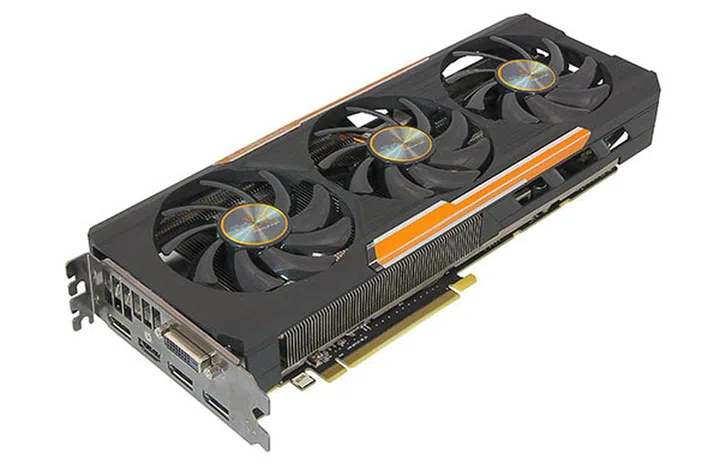
Sapphire Tri-X R9 390X. (Image Source: Sapphire)
The card also comes with a very slight overclock of 1055MHz, up from 1050MHz on the reference card.
XFX
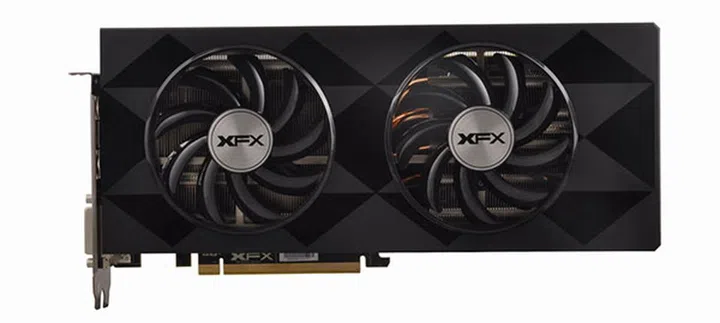
XFX Radeon R9 390X Core Edition. (Image Source: XFX)
XFX has equipped custom versions of the Radeon R9 390 and R9 390X with its dual-fan Double Dissipation cooler. In addition, each card also comes in Black Edition or Core Edition variants, where the Black Edition is the higher clocked of the two.
The XFX Radeon R9 390 Double Dissipation Core Edition ships with a factory overclock of 1015MHz, while the Black Edition is clocked slightly higher at 1050MHz.
On the other hand, the XFX Radeon R9 390X Double Dissipation Core Edition ships with the reference core clock of 1050MHz, while the Black Edition is overclocked to 1090MHz. In addition, all XFX Radeon R9 390 series cards come with a solid metal backplate for extra support.
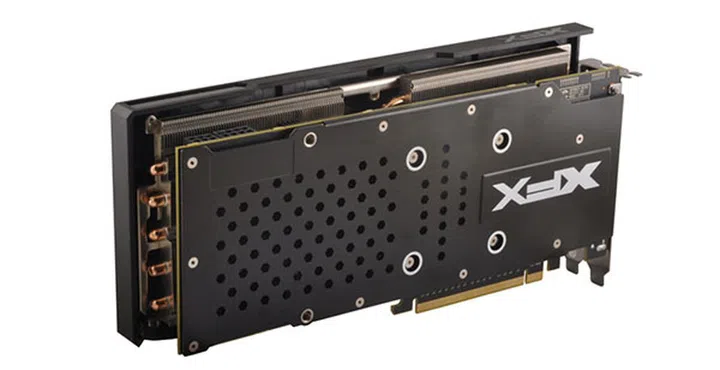
All XFX Radeon R9 390 series cards come with a solid metal backplate. (Image Source: XFX)
The dual-fan Double Dissipation cooler is a staid black shroud that sports a tessellated pattern of triangles that adds a dash of style to an otherwise plain design. In addition, XFX utilizes a six-phase digital voltage control design on all its R9 390 series cards that it says will help with overclocking.
Source: ASUS, Club 3D, Gigabyte, MSI, PowerColor, Sapphire (1), (2), XFX
Our articles may contain affiliate links. If you buy through these links, we may earn a small commission.