
AMD's RDNA 4-based RX 9070 and RX 9060 series will compete with NVIDIA's mainstream offerings
AMD has officially exited the ultra-enthusiast gaming GPU market.
#amd #radeon #gaming

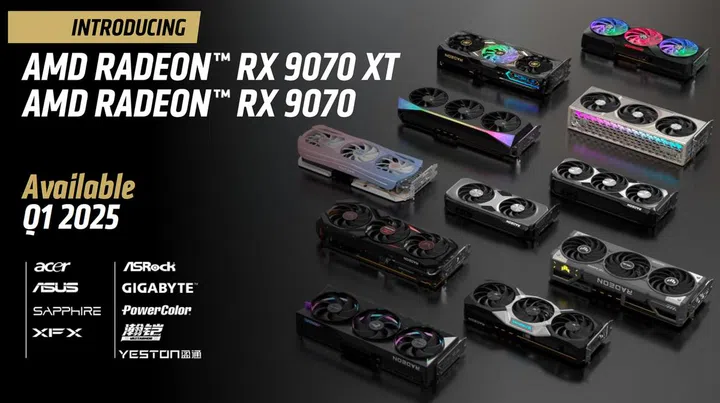
Image: AMD
AMD has unveiled its much-anticipated follow-up to the Radeon 7000 series, the Radeon 9000 series GPUs. Based on the RDNA 4 architecture, AMD has made a clear pivot with the new Radeon 9000 serkes, moving away from the high-end enthusiast segment and opting instead to challenge the main mainstream products from both NVIDIA and Intel with new and improved AI capabilities, ray tracing, and media encoding quality.
The new RDNA 4 architecture brings with it an optimised compute unit design, supercharged AI processing, and enhanced ray tracing performance. These advancements are thanks to second-generation AI accelerators and third-generation ray tracing hardware, paired with a fresh 4nm manufacturing process that replaces the 5nm and 6nm technologies used in the RDNA 3 chips. This smaller process node, alongside a shift to a monolithic die instead of the previous multi-chip module (MCM) design, should deliver higher efficiency and improved performance than previous generations of Radeon GPUs.
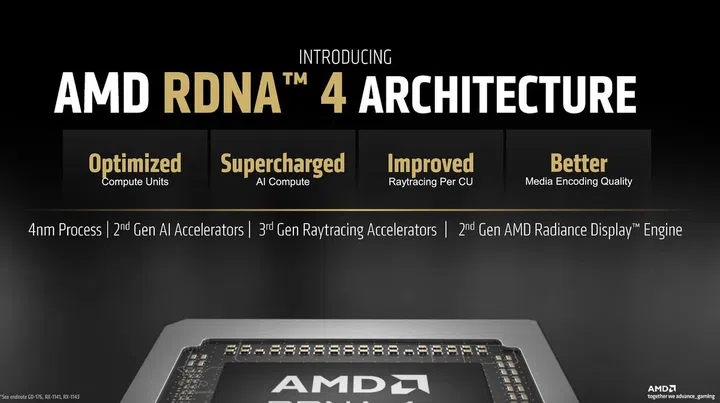
Image: AMD
At launch, AMD is introducing the Radeon RX 9070 and RX 9060 series, choosing to skip the ‘8000’ number in its naming scheme and streamlined to align with AMD’s Ryzen 9000 series CPUs. The company is going one step further, going with the ‘70’ and ‘80’ designations that correspond to NVIDIA’s models in the same price and performance brackets. The RX 9070 XT, for instance, will go head-to-head with NVIDIA’s RTX 4070 Ti, while the non-XT RX 9070 targets the RTX 4070. Meanwhile, the RX 9060 series takes on NVIDIA’s RTX 4060.
The RX 9070 XT and RX 9070 will each come with up to 16GB of video memory and will be available from a wide range of AIB partners, including ASUS, Gigabyte, XFX, and Sapphire. Unsurprisingly, the XT variants are positioned as the more premium option, offering higher performance, while the non-XT versions are designed to provide a more budget-friendly alternative.
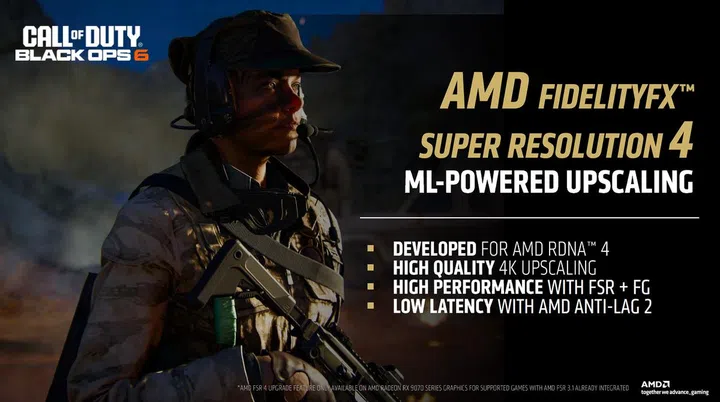
Image: AMD
A standout feature of the RDNA 4 architecture is the new FSR 4 (FidelityFX Super Resolution) technology. RDNA, if you don’t know by now, is AMD’s answer to NVIDIA’s DLSS and Intel’s XeSS. FSR 4 leverages the GPUs' AI accelerators to provide high-quality 4K upscaling, enhanced by AMD’s Frame-Gen technology and reduced latency thanks to Anti-Lag 2. A major advantage of FSR 4 is its compatibility with all games that already support FSR 3.1, so games will be able to take advantage of this new feature straight away – such as Call of Duty: Black Ops 6.
In addition to the hardware improvements, AMD has introduced a new AI-driven feature within its Adrenalin software suite called Adrenalin AI. This utility brings image generation, document summarisation, and a new AI question-and-answer function, which will complement AMD’s existing software tools. Similar to NVIDIA’s ChatRTX and Intel’s AI PlayGround, Adrenalin AI aims to bring a personalised and locally driven AI experience to AMD Radeon card owners.
It will be interesting to see how the new Radeon cards stack up not only against NVIDIA’s current-gen RTX 40 series, but also its upcoming RTX 50 series. Watch this space.
Our articles may contain affiliate links. If you buy through these links, we may earn a small commission.