
AMD Radeon HD 7970 & HD 7950 - Heading to Southern Islands with Tahiti
AMD goes over 7000 with its new flagship GPU built on a 28nm process. The new GPU architecture is called Graphics Core Next (GCN) which supports HDMI 1.4a as well as DisplayPort 1.2 HBR2. We pit the new Radeon HD 7970 and 7950 models to see how far they've progressed from its predecessors. Can it unseat the GeForce GTX 580 from its throne on all accounts?
AMD Radeon HD 7000 - Departure from the Northern Islands
On 9th January this year, AMD officially launched its next generation family of graphics cards, the Radeon HD 7900 series. The successor and flagship offering from this series is the Radeon HD 7970. This graphics card has been touted as the successor and heir to the Radeon HD 6970 who hails from the 'Northern Islands' Radeon HD 6900 series.
The Radeon HD 7000 series of GPUs mark a departure from the architecture of the Northern Island family. AMD has introduced their next generation GPU architecture, Graphics Core Next (GCN). Its latest generation of graphics cards, based on 28nm GPUs built with GCN architecture, will hail from the Southern Island series.
The two major chip manufacturers, AMD and NVIDIA are consistently revising their GPU architectures; hence, the introduction of a new one can be considered a momentous event and AMD is first off the blocks this time round to unveil GCN.
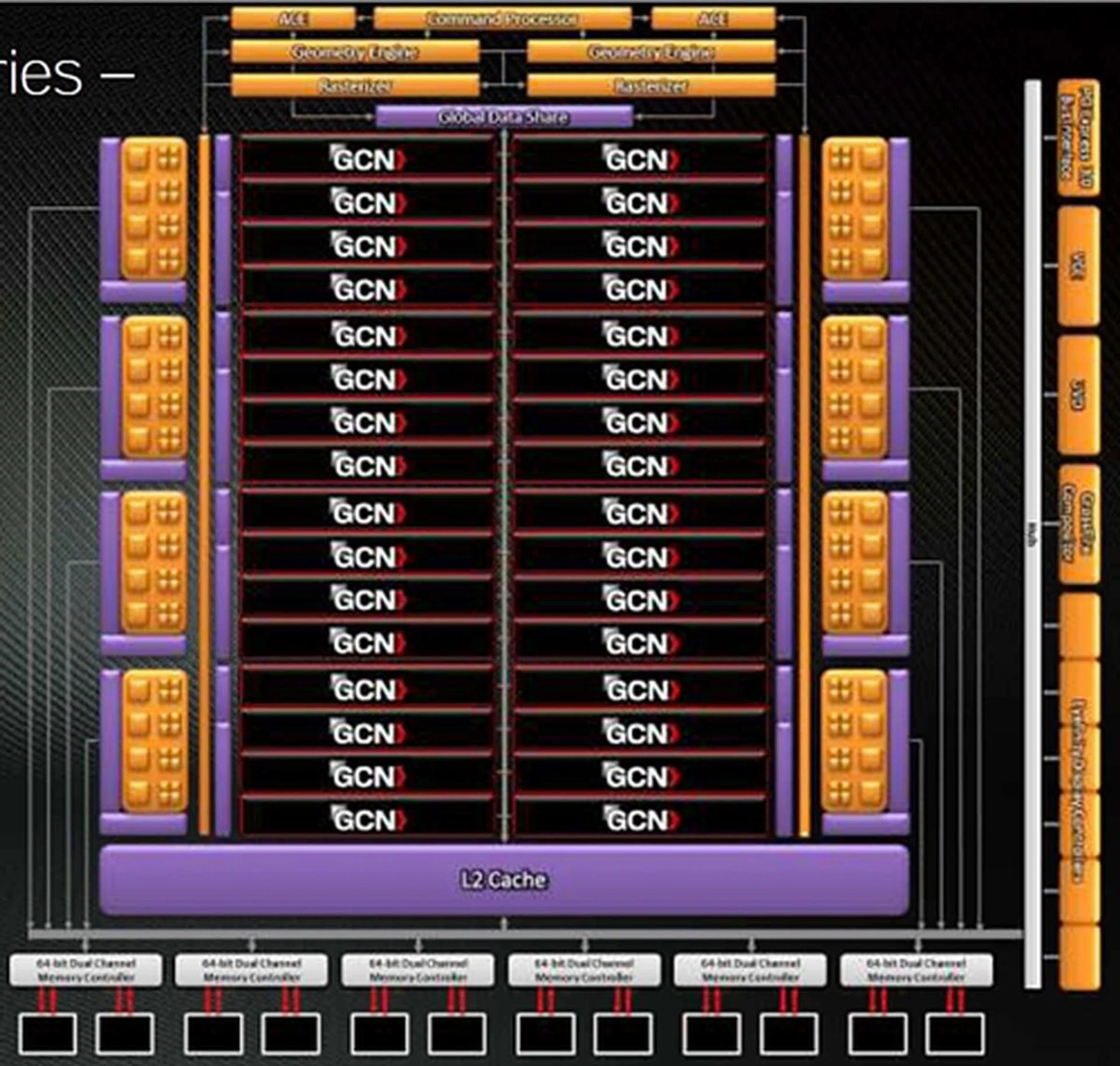
The block diagram of the 'Taihiti' GPU based on AMD's next generation GCN architecture. Take note of the number of GCN Compute Units which can number as many as 32 on a single GPU.
What is GCN?
From the diagram above, we can picture a GPU, built with AMD's GCN architecture, to be made up of basic building blocks called GCN Compute Units.
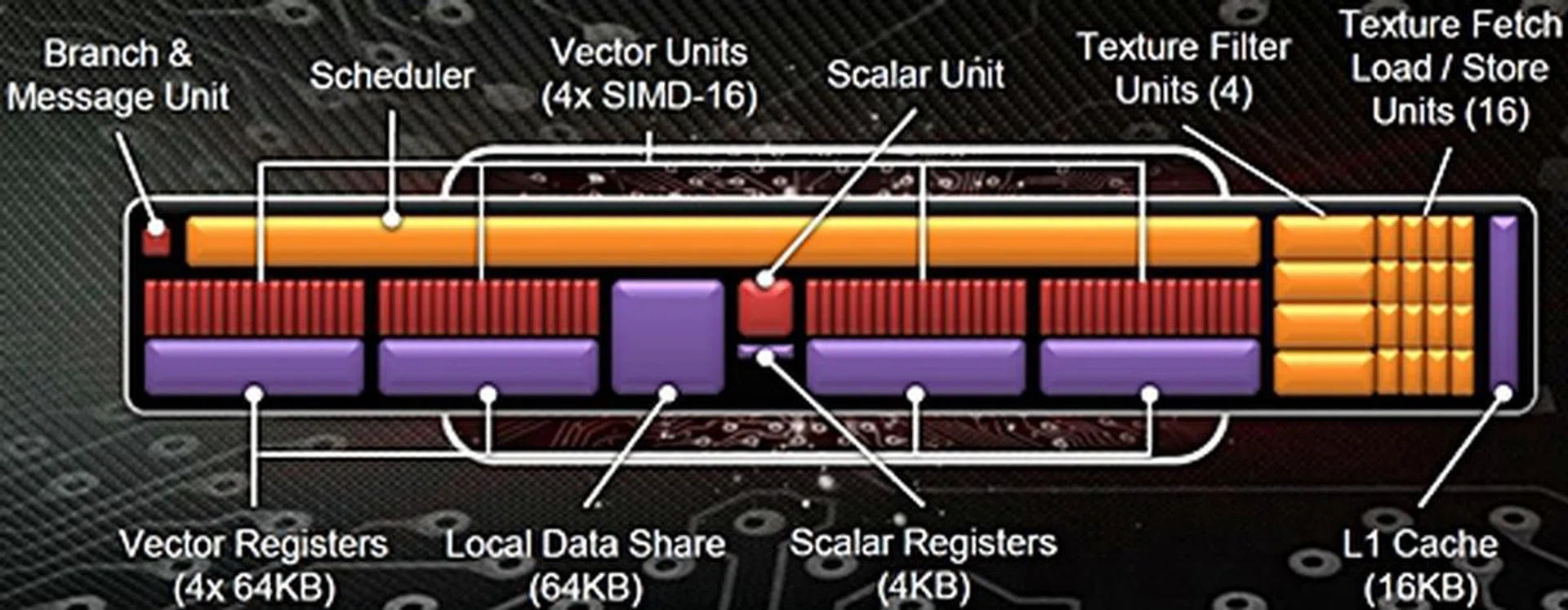
A block diagram of a GCN Compute Unit (CU). According to AMD, it features four 16-wide SIMD engines which allows it to process four different instruction sets in simultaneously.
Each GCN Compute Unit (CU) can be described as a processor with a scalar and four vector units (each of which has 16 processing element) that are built on a non-VLIW (Very Long Instruction Word) instruction-set architecture. According to AMD, the GCN CU is able to execute instructions with dependencies efficiently as its own hardware scheduler is able to assign instructions according to the various available computation units within the CU to avoid dependency bottlenecks. This allows the GPU as a whole to handle more instruction-sets per clock cycle.
In contrast, the Northern Island GPUs have its basic building blocks (VLIW4) based on VLIW instruction-set architecture. In return, these GPUs were not able to process instructions that have dependencies efficiently. This results in the graphics processors using up more clock cycles until the dependency issues were resolved. The VLIW architecture was suited for 3D processing; however, it could not handle the scalar processing requirements of generic computing applications efficiently.
AMD's departure from the Northern Island architecture can be seen as its efforts to introduce GPUs that strike a balance between 3D graphics and general purpose computing. AMD's GCN architecture is expected to handle a wider spectrum of compute workloads as AMD expands its GPU repertoire to target both graphics and professional computing requirements. Another important feature of the GCN architecture is its support for PCIe 3.0 x16 bus interface, making the AMD Radeon HD 7900 graphics cards one of the first PC components launched that is compliant with this new standard.
Meet the Radeon HD 7900 Series
In keeping with tradition, the AMD Radeon HD 7900 series was launched with two SKUs - the Radeon HD 7970 and Radeon HD 7950. These two entities share the same Tahiti GPU core; however, the latter features less active GCN compute units that number 28. The more premium Radeon HD 7970 GPU sports a full complement of 32 active GCN compute units as supported by the Tahiti core.
Considering each GCN CU has quad 16-processing element vector units, that brings a total of 64 stream processors per GCU block. This means the number of stream processors on the GPU of Radeon HD 7970 is 2,048 while Radeon HD 7950's GPU features 1,792 of such stream processors. To accompany them, the number of texture mapping units (TMU) have been pegged to 128 for the Radeon HD 7970, while the the lesser equipped Radeon HD 7950 sports 112 TMUs. Compared with the Radeon HD 6970 and 6950 respectively, the new Tahiti core based Radeon HD 7900 series are looking favorably better - from a specs perspective.
Other basic differences for the 7970 and the 7950 are GPU and memory clock speeds. The AMD Radeon HD 7970 has its GPU core clock rated at 925MHz (marginally better than the 6970 it superceded) and its memory clock speed is 5500MHz. Its younger brother, the 7950 has its GPU core clock rated at 800MHz and its memory clock speed is lowered to 5000MHz (which sort of match the clock speeds of a default Radeon HD 6950).
The Radeon HD 7900 series also sport a much wider local memory bus at 384 bits wide - applicable for both the Radeon HD 7970 and the 7950 SKUs. This should bring significant performance gains from the previous 256 bits wide bus. This brings the Radeon HD 7970's total memory bandwidth to 264GB/s while Radeon HD 7950's memory bandwidth is expectedly lower at 240GB/s considering clock speed diifferences.
In the end, these changes between the two Radeon HD 7900 SKUs aren't drastic and are the usual level of differentiation applied for getting out a slightly different SKU (or in other words, maximizing the produced GPU cores that probably can't meet the requirements to pass off as the 7970). For a casual observer looking over the reference card, the AMD Radeon HD 7950 looks almost the same as its elder brother. More on that on the following pages, but here's how the new AMD Radeon HD 7900 series stack up against its closest competitors.
Model | AMDRadeon HD 7970 | AMDRadeon HD 7950 | AMDRadeon HD6970 | ATI Radeon HD 6870 | NVIDIA GeForce GTX 580 | NVIDIAGeForce GTX 570 |
Core Code | Tahiti XT | Tahiti Pro | Cayman XT | Barts XT | GF110 | GF110 |
Transistor Count | 4300 million | 4300 million | 2640 million | 1700 million | 3000 million | 3000 million |
Manufacturing Process | 28nm | 28nm | 40nm | 40nm | 40nm | 40nm |
Core Clock | 925MHz | 800MHz | 880MHz | 900MHz | 772MHz | 732MHz |
Stream Processors | 2048 Stream processing units | 1792 Stream processing units | 1536 Stream processing units | 1120 Stream processing units | 512 Stream processing units | 480 Stream Processors |
Stream Processor Clock | 925MHz | 880MHz | 880MHz | 900MHz | 1544MHz | 1464MHz |
Texture Mapping Units (TMU) or Texture Filtering (TF) units | 128 | 112 | 96 | 56 | 64 | 60 |
Raster Operator units (ROP) | 32 | 32 | 32 | 32 | 48 | 40 |
Memory Clock | 5500MHz GDDR5 | 5000MHz GDDR5 | 5500MHz GDDR5 | 4200MHz GDDR5 | 4000MHz GDDR5 | 3800MHz GDDR5 |
DDR Memory Bus | 384-bit | 384-bit | 256-bit | 256-bit | 384-bit | 320-bit |
Memory Bandwidth | 264GB/s | 240GB/s | 176GB/s | 134.4GB/s | 192.4GB/s | 152GB/s |
PCI Express Interface | PCIe ver 3.0 x16 | PCIe ver 3.0 x16 | PCIe ver 2.0 x16 | PCIe ver 2.0 x16 | PCIe ver 2.0 x16 | PCIe ver 2.0 x16 |
Molex Power Connectors | 1 x 6-pin, 1 x 8-pin | 1 x 6-pin, 1 x 6-pin | 1 x 6-pin, 1 x 8-pin | 2 x 6-pin | 1 x 6-pin, 1 x 8-pin | 2 x 6-pin |
Multi GPU Technology | CrossFireX | CrossFireX | CrossFireX | CrossFireX | SLI | SLI |
DVI Output Support | 1 x Dual-Link | 1 x Dual-Link | 2 x Dual-Link | 1 x Dual-Link, 1 x Single-Link | 2 x Dual-Link | 2 x Dual-Link |
HDMI | 1 | 1 | 1 | 1 | 1 (mini-HDMI) | 1 (mini-HDMI) |
DisplayPort | 2 (version 1.2 HBR2) | 2 (version 1.2 HBR2) | 2 (version 1.2) | 2 (version 1.2) | None | None |
HDCP Output Support | Yes | Yes | Yes | Yes | Yes | Yes |
Street Price | Launch Price:US$549 | ~US$449 | ~US$349 | ~US$238 | ~US$509 | ~US$349 |
Setting Foot on the Southern Islands
AMD has named their new GPU series the Southern Islands and its product line comprises the following GPU cores:-
- Tahiti (featured in the Radeon HD 7900 series)
- Pitcairn (unannounced future Radeon HD 7800 series)
- Cape Verde (featured in the Radeon HD 7700 series)
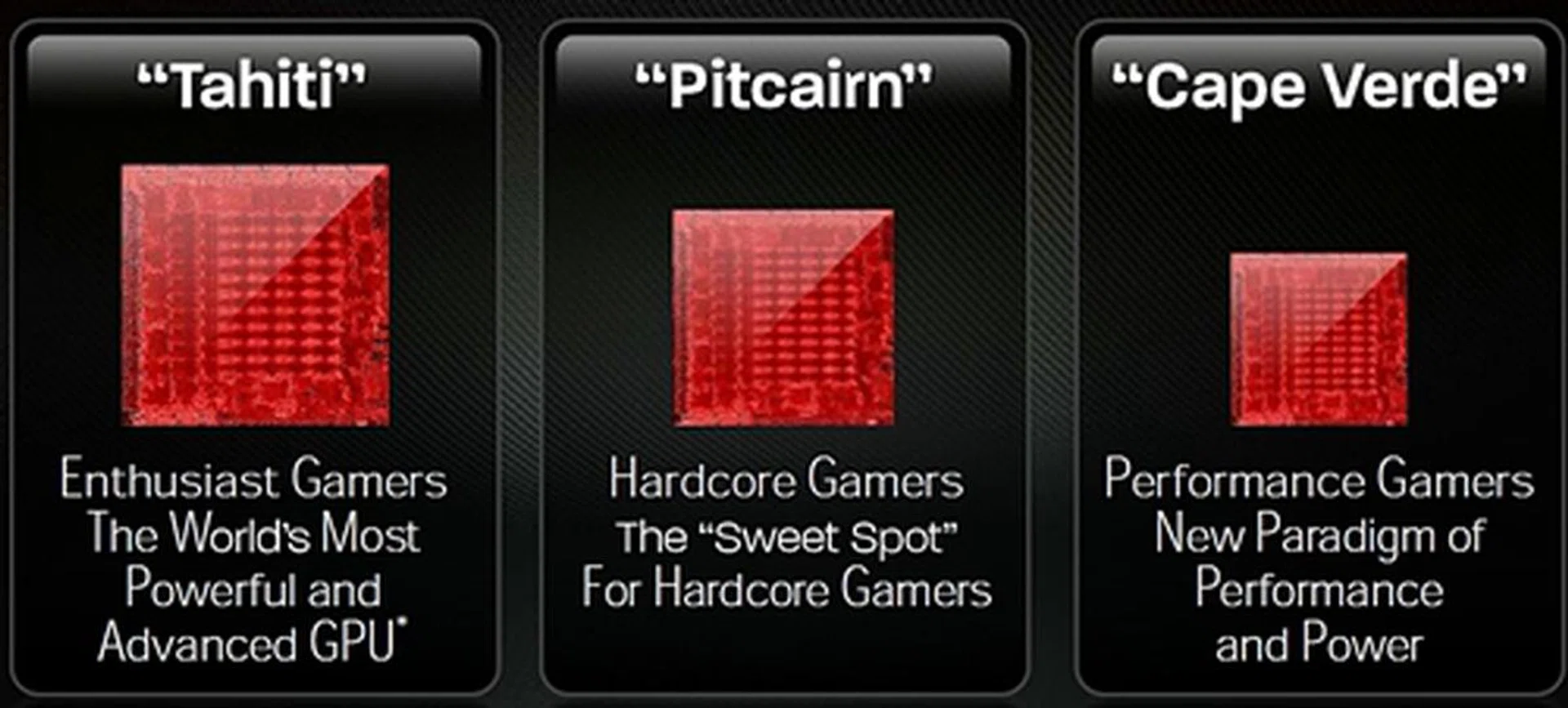
The Southern Islands product line has three categories targeted at gamers with different needs. The previous generation Northern Island GPUs had five distinct product lines.
AMD has not announced the launch date of the Pitcairn, which is the SKU that should excite most users because of its sweetspot for performance and price for the upgrading folks. However, Capre Verde that's aimed as the new mainstream performance GPU will be launched next on the 15th of February. It will consist of the Radeon HD 7770 and Radeon HD 7750 models which are also using the GCN architecture of the Southern Islands series.
Tahiti - Offering More Memory Bandwidth
The Tahiti core is AMD's first GPU to be manufactured on TSMC 28nm fabrication process and the architecture allows it to pack in up to a total of 32 GCN Compute Units. As a result, it has a total of 2,048 stream processing units; the largest total when Tahiti is compared to the other GPUs. Its 768KB L2 cache is relatively generous and it has a total of six 64-bit memory controllers, providing its memory bus interface with bandwidth of up to 264GB/s. This is an improvement of approximately 100GB/s over the Radeon HD 6970.
We understand that the Tahiti GPU block diagram is a logical representation of the GPU; however, we cannot help but notice the absence of the pair of ultra-threaded dispatch processors found on the GPUs from the previous generation Northern Island GPUs. Apparently, its absence is one of the major architectural difference between the Northern and Southern Islands.
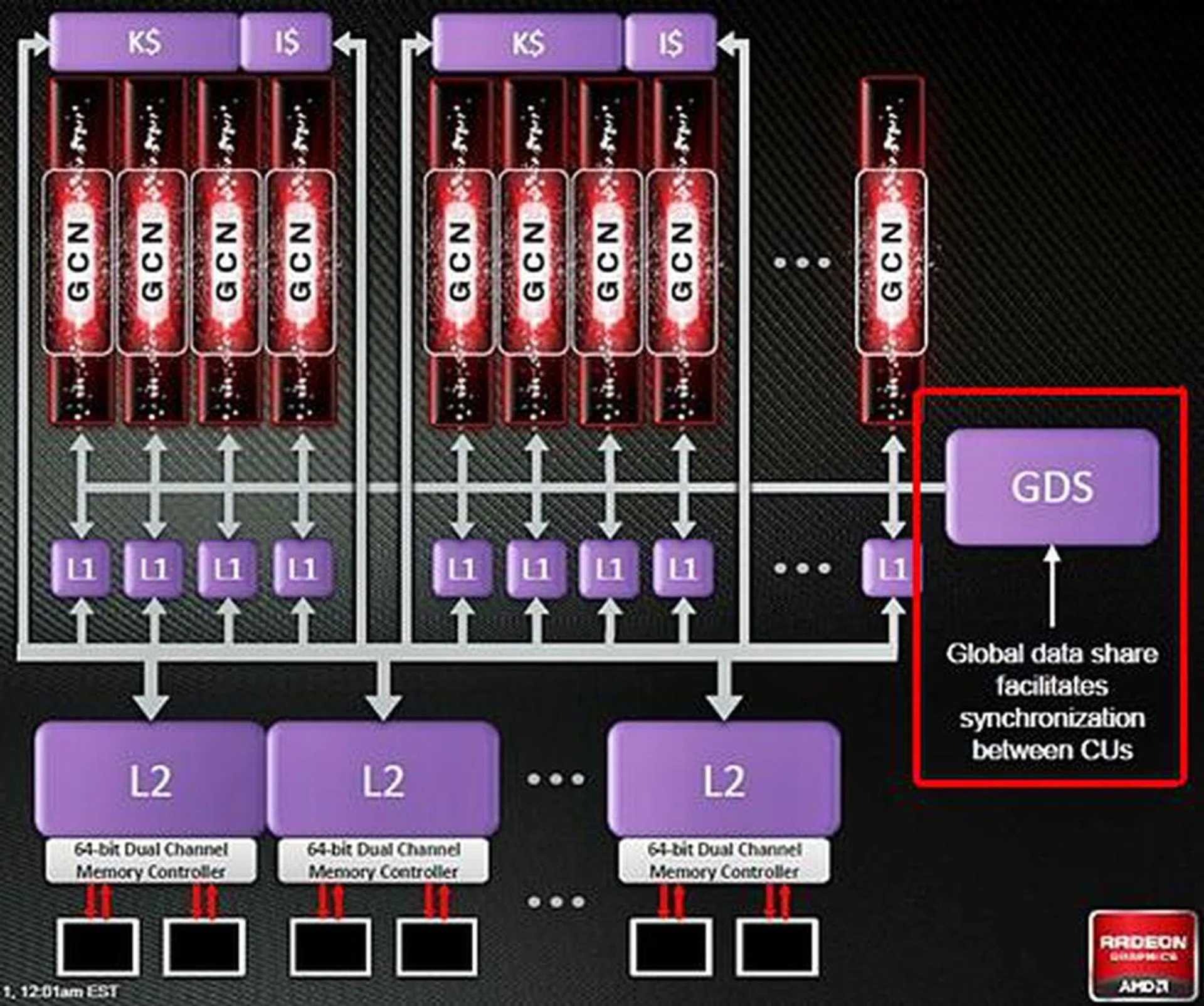
With the absence of the ultra-threaded dispatch processors, the Global Data Share (GDS) is responsible for synchronization between GCN Compute Units.
Tessellation Engine Overhaul
There are two geometry engines on the Tahiti GPU and each engine sports a new ninth-generation tesellator. According to AMD, the tesellation engine has been revised to increase vertex re-use and claims that an improvement in throughput of up to 4 times when compared to the previous generation tessellation units of Radeon HD 6900.
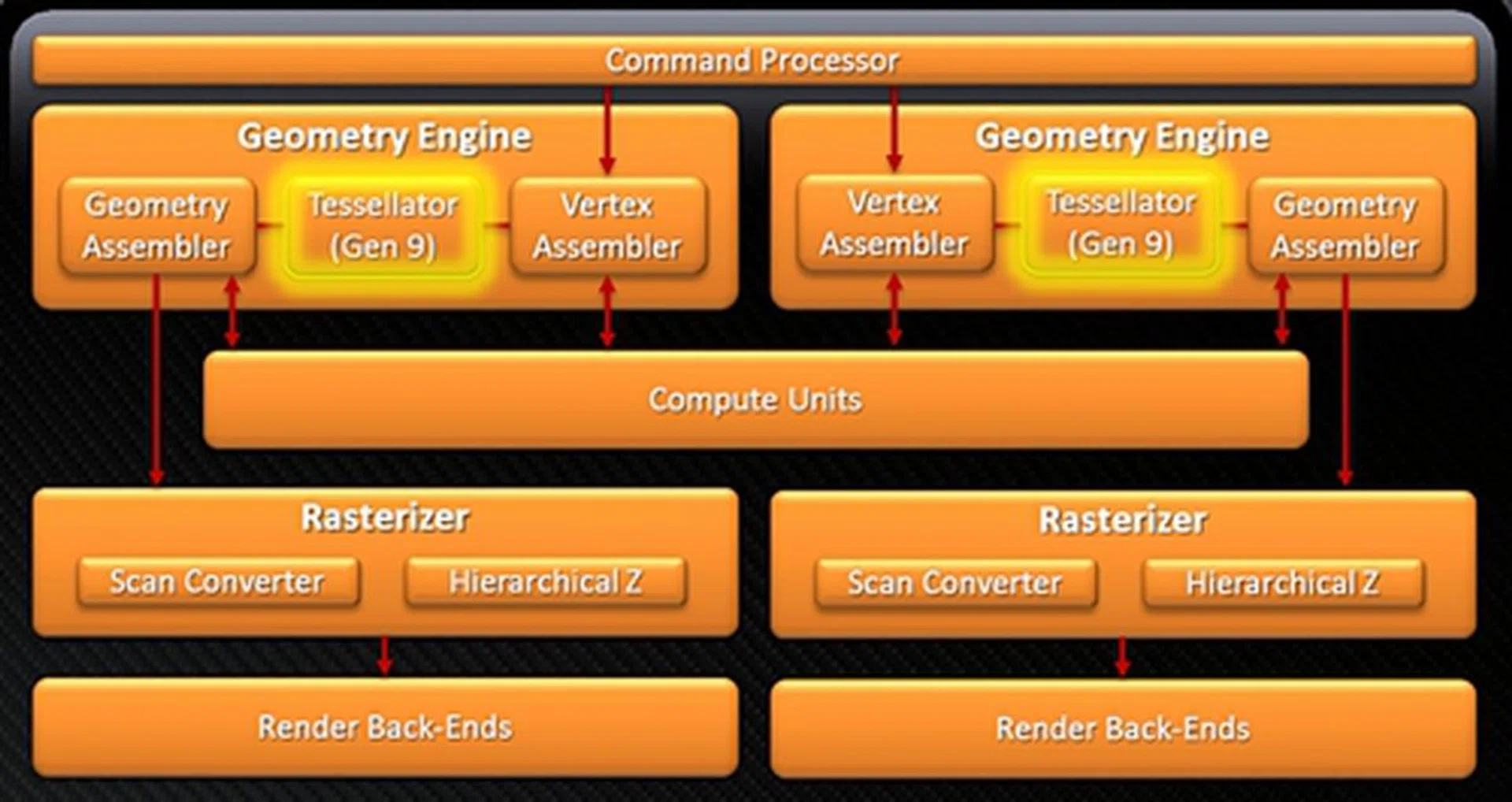
The pair of geometry engines and each of them sports a new tesellator unit that has been revised for vertex re-use.
Power Management AMD ZeroCore Style
In terms of power management, the Tahiti GPU features the existing AMD Powertune technology. Its new feature is called the AMD Zerocore and AMD claims that it shuts down idle GPUs in a multi-GPU setup when they are not in use. It's mentioned that even the cooling fan of the graphics card is turn off to save power and reduce the noise emission from the computing rig. This is definiltey useful when using the system in a non-gaming mode for example.
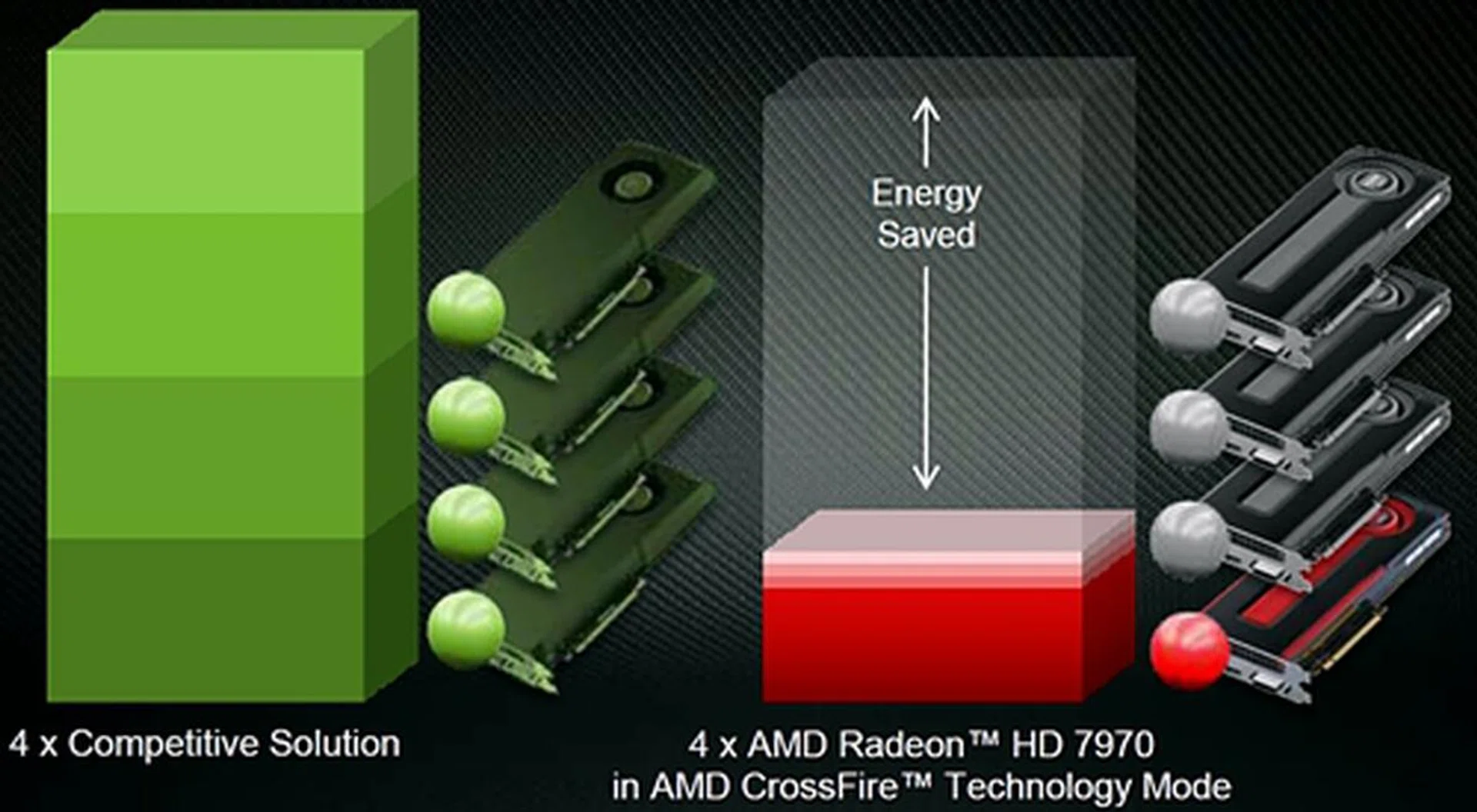
The AMD Zerocore technology is able to turn off the second, third and fourth GPUs in a CrossFire setup to save energy.
Users of CrossFire technology will be glad to know that the ZeroCore technology touted by AMD can help them save on their utility bills by turning off un-used GPUs in a multi-GPU environment.
DirectX 11.1, OpenCL 1.2 and DirectCompute 11.1
Besides being first consumer GPU to be fabricated from the 28nm process technology, another feather in AMD's hat is Tahiti being the first GPU to support DirectX 11.1, OpenCL 1.2, and DirectCompute 11.1. Take note that Windows 8 is slated to have support for DirectX 11.1.
Partially Resident Textures (PRT)
In order to take advantage of Tahiti's local hardware memory, AMD has implemented Partially Resident Textures (PRT) that treats the local memory as a texture storing cache. With this technology, texture information in upcoming video or graphic frames are pre-fetched from the CPU and HDD and stored locally on the GPU. Hence, such texture information can be streamed smoothly from the local cache to reduce stutter that is normally associated with scene loading in a typical game environment.
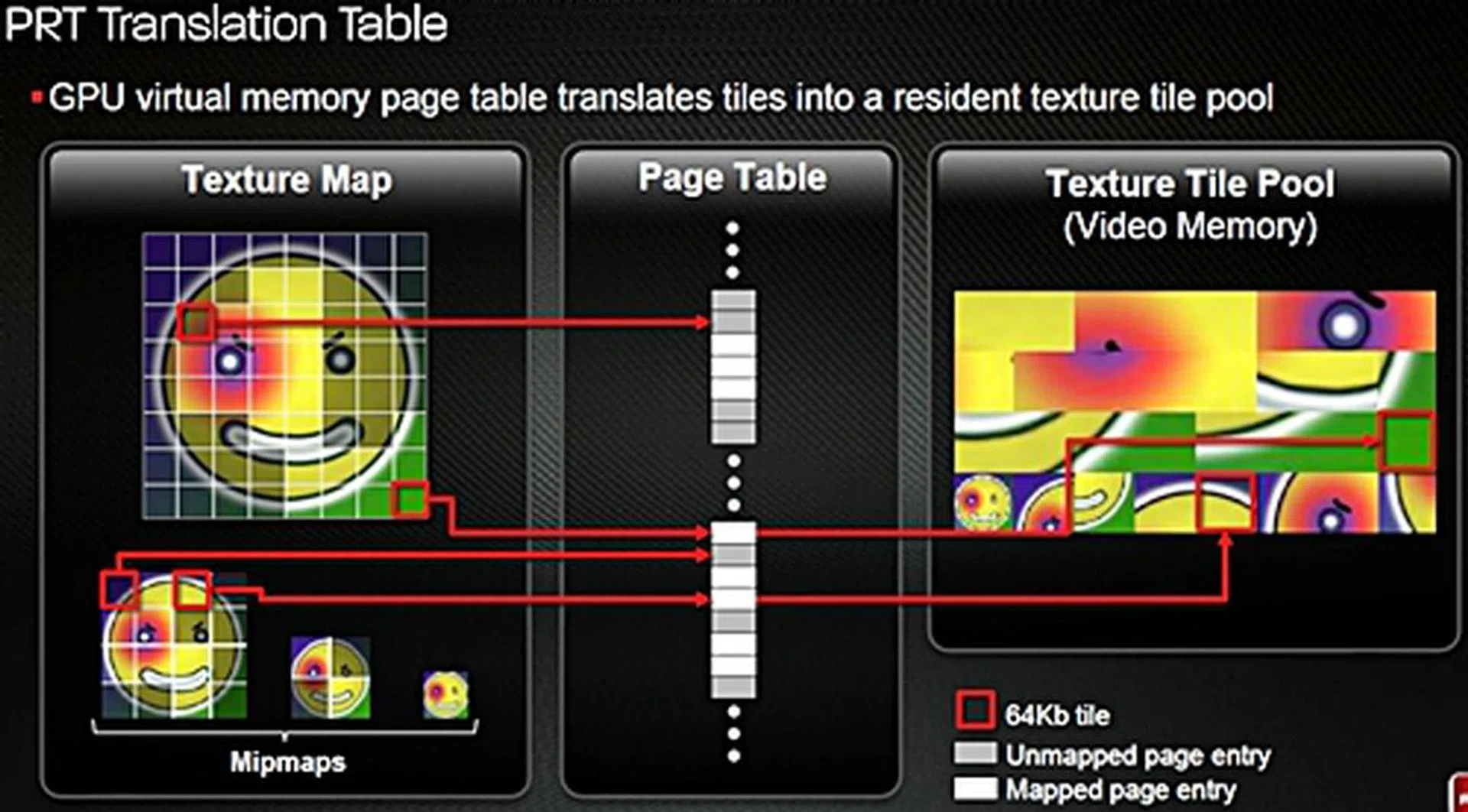
According to AMD, PRT technology needs to be implemented at the game engine level before it can be utilized. We believe that developers of game engines will need to implement program routines in the APIs of their engines to flush the page table of orphaned page entries.
Another advantage offered by PRT technology is its ability to dynamically load selected textures based on when they will be needed. In turn, the GPU can display a low-resolution texture before the higher-resolution version is loaded to further reduce stuttering.
AMD EyeFinity 2.0
Besides featuring new technology, AMD has also updated its existing ones like AMD EyeFinity that was first introduced with Northern Island GPUs (Radeon HD 6800 and 6900 series). Now updated to Eyefinity 2.0, this version on the Souther Island GPUs support 5 x 1 potrait and landscape setups. It also supports flexible bezel compensation that allows the user to mix displays of different screen sizes.
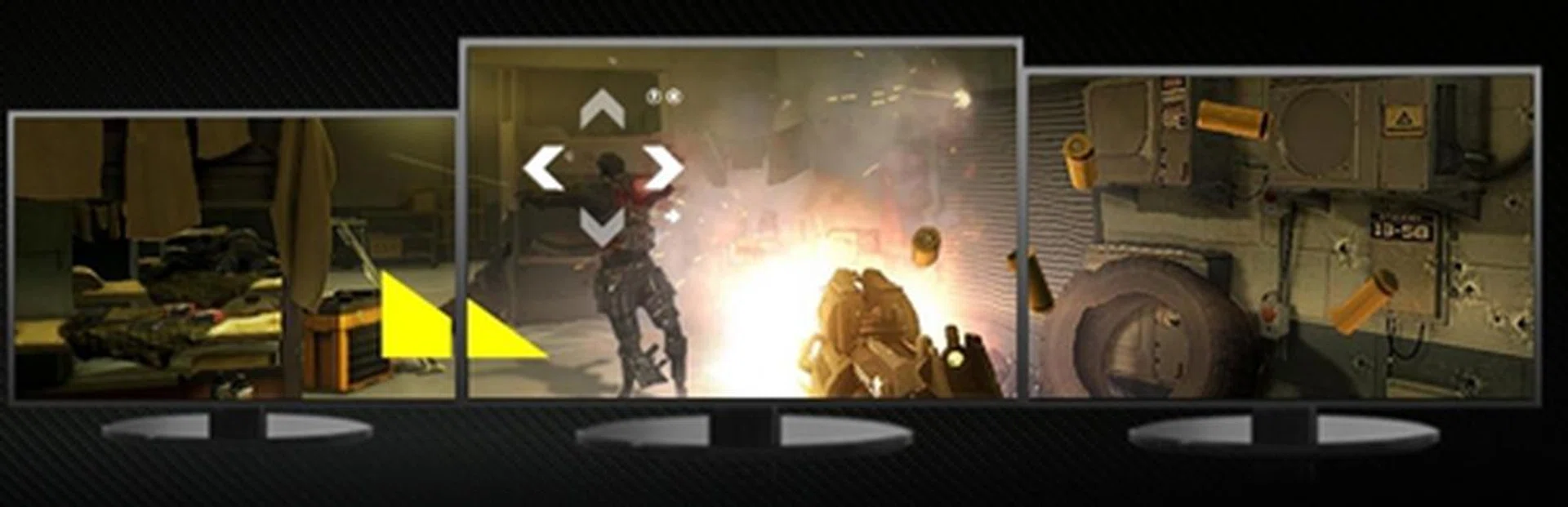
AMD EyeFinity 2.0 has a new flexible bezel support feature that allows users to mix displays of different screen sizes in a multi-display environment.
Discrete Digital Multi-Point Audio (DDMA)
AMD claims that the Tahiti GPU is first in its ability to deliver multiple simultaneous independent output streams. This means that each attached display can output its own unique audio signal.
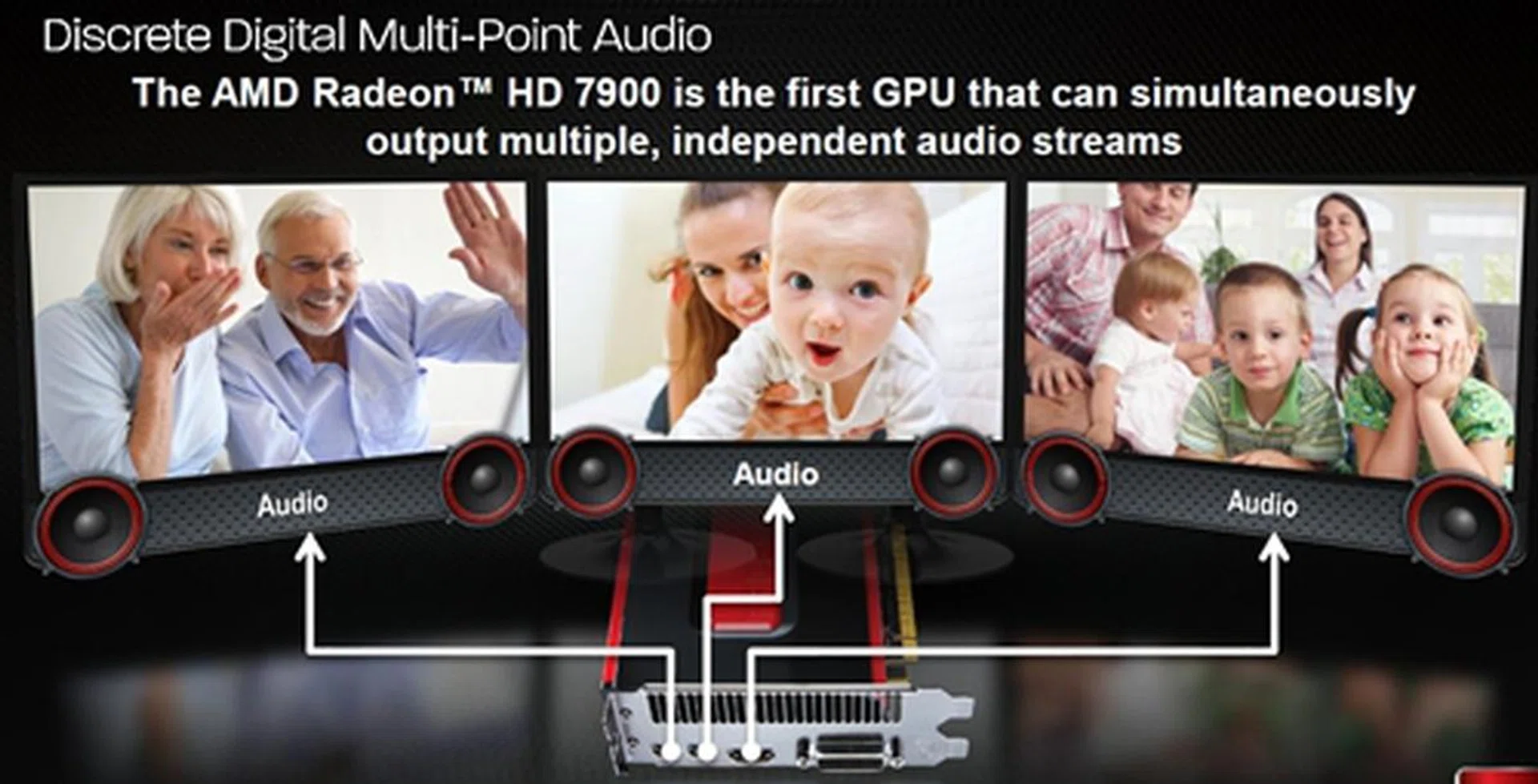
DDMA allows independent audio streams to be directed at each display in a multiple-display environment. We question the practical application of this feature except if there is a situation when different users of the same PC need to view their videos at the same time.
Big Brother, Little Brother
To the casual observer, there is little difference between the AMD Radeon HD 7970 and AMD Radeon HD 7950 refernce cards. As we have highlighted earlier, AMD Radeon HD 7950 features the same Tahiti GPU, but with a slightly lower number of 28 GCN CU versus the 7970's 32 GCN CU units while the number of TMU units also differ at 112 and 128 respectively. Additionally, memory clock speed has been clocked down to 5000MHz instead of 5500MHz on the top model. Such seemingly miniscule differences are typical of SKU differentiation for graphic cards.
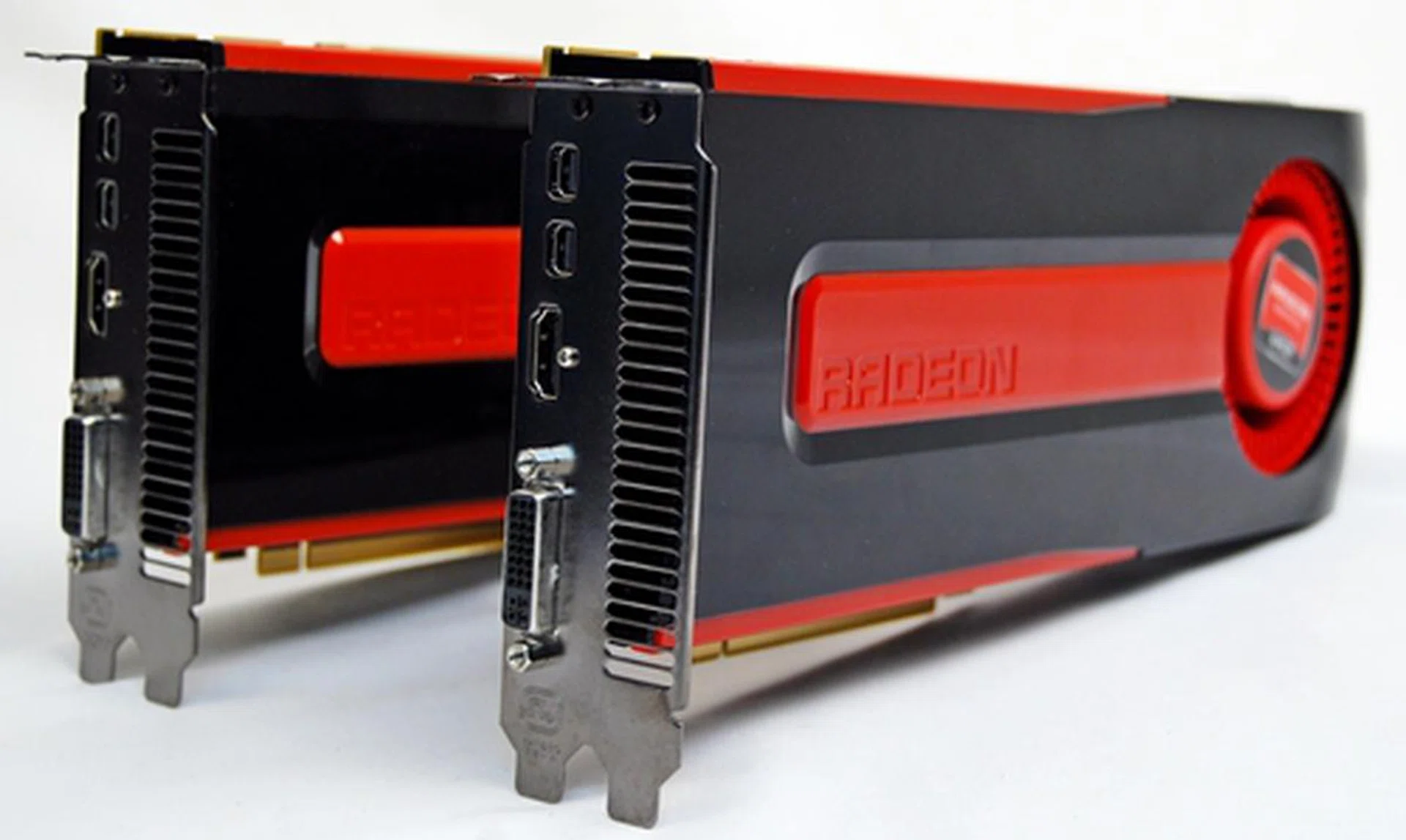
As the big brother, AMD Radeon HD 7970 is in the foreground while its little brother AMD Radeon HD 7950 takes a backseat in this family portrait.
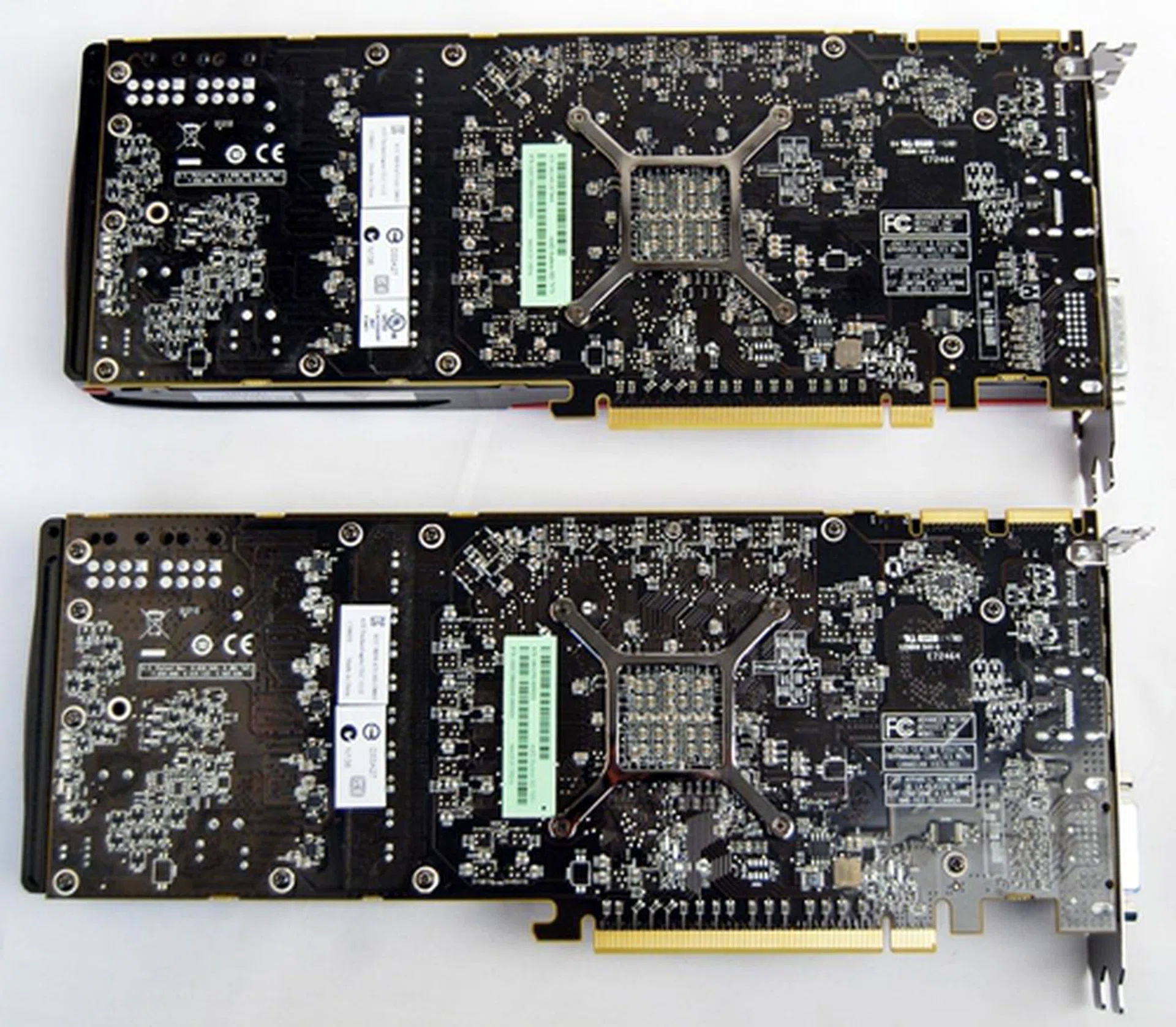
From the back view, they are almost impossible to differentiate except for their tell-tale SKU labels (pale lime green in color). The card on top features the Radeon HD 7970 while the bottom one features the Radeon HD 7950.
In terms of size, both cards occupy two full expansion slots and are as long as their Radeon HD 6900 predecessors at 10.5 inches long or about 27cm.
Power and Molex Connectors Configuration
Big brother Radeon HD 7970 is rated at 250W for its maximum power draw of its circuit board while the Radeon HD 7950 is rated at 200W. That said, for a simple and straightforward gaming rig, you probably won't require anything more than a well-built 550W PSU to get these GPUs going.
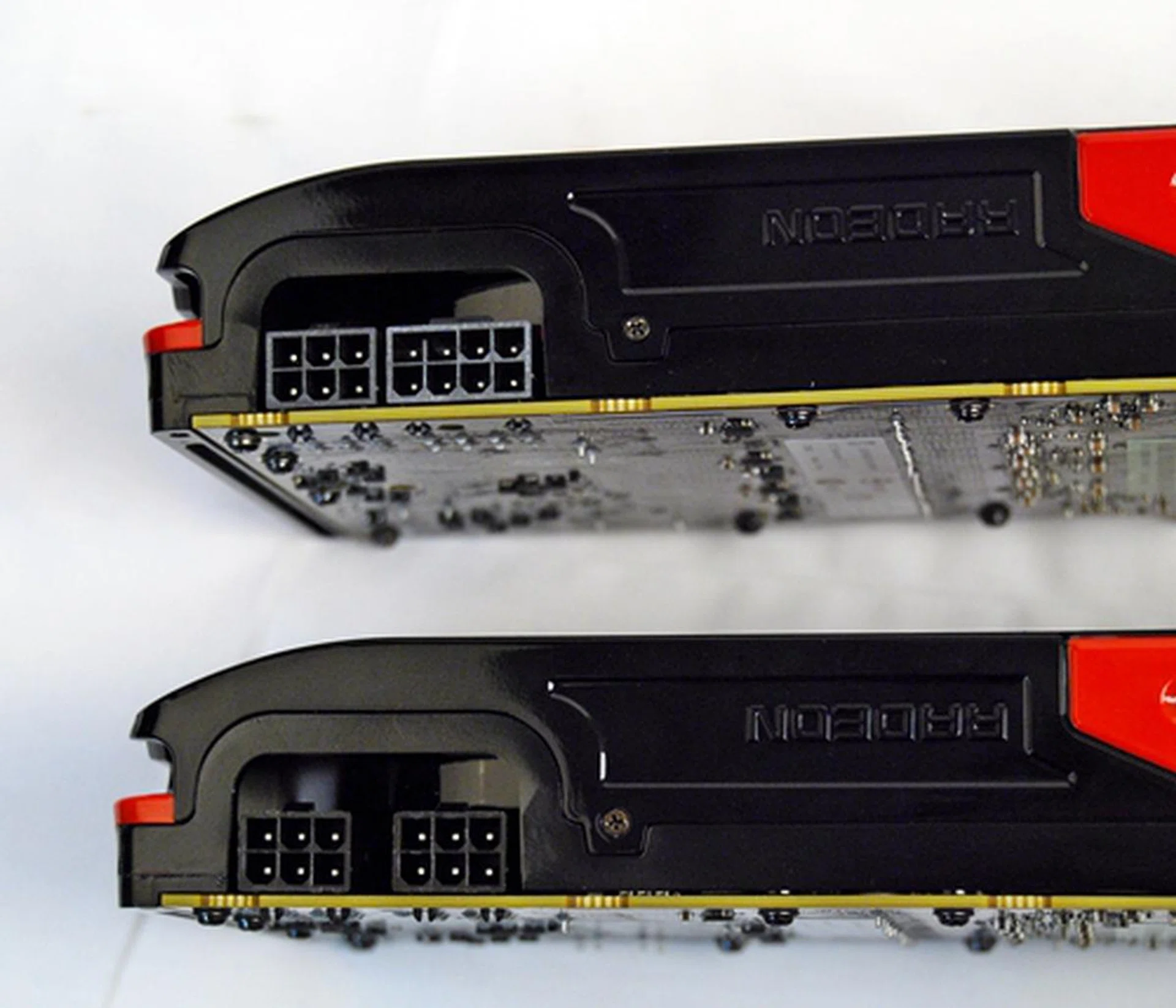
At the top, Radeon HD 7970 has one 6-pin PCIe power connector and an 8-pin one. Its younger brother, Radeon HD 7950, has a pair of 6-pin PCIe power connectors.
Test Setup
We welcome the South Islanders to our trusty setup which comprises the following key components. The version of the AMD Catalyst used for testing the AMD Radeon HD 7970 and 7950 is 11.11.
- Intel Core i7-975 (3.33GHz)
- Gigabyte GA-EX58-UD4P motherboard
- 3 x 1GB DDR3-1333 G.Skill memory in triple channel mode
- Seagate 7200.10 200GB SATA hard drive
- Windows 7 Ultimate 64-bit
For comparison, we have pitted the Southern Islanders against cards from the Northern Islands as well as worthy top competitors from NVIDIA. Note that we've also included dual-GPU varieties to see how the new flagship from AMD stands against these behemoths.
The list of card tested and driver versions used:
- AMD Radeon HD 7970 3GB GDDR5 (AMD Catalyst 11.11)
- AMD Radeon HD 7950 3GB GDDR5 (AMD Catalyst 11.11)
- AMD Radeon HD 6990 4GB GDDR5 (AMD Catalyst 11.11)
- AMD Radeon HD 6970 2GB GDDR5 (AMD Catalyst 11.11)
- NVIDIA GeForce GTX 590 3GB GDDR5 (ForceWare 285.62)
- NVIDIA GeForce GTX 580 1560MB GDDR5 (ForceWare 280.26)
In moving with the times, we have updated our benchmarking software to include three other gaming titles to the mix - Crysis 2, Batman: Arkam City and Dirt 3.
The full list of benchmarks used:
- Futuremark 3DMark 11
- Futuremark 3DMark Vantage
- Crysis Warhead
- Far Cry 2
- "Heaven" from Unigine v2.1
- S.T.A.L.K.E.R.: Call of Pripyat
- Batman: Arkham City
- Crysis 2
- Dirt 3
3DMark 11 and 3DMark Vantage Results
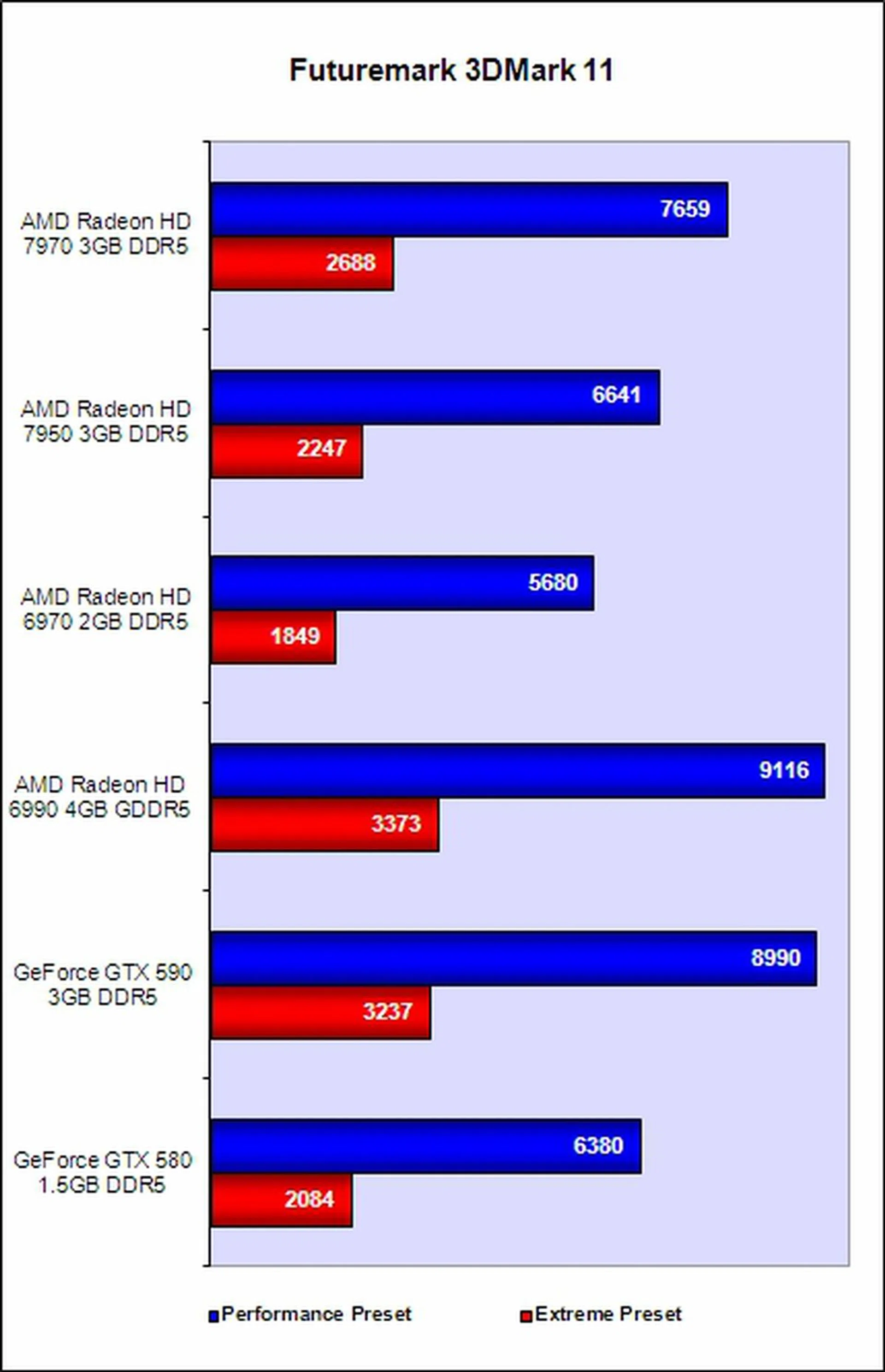
The 3DMark 11 benchmarking utility makes use of the various DirectX 11 functions such as tessellation and DirectCompute to put the GPUs through their paces. Both the cards from the Southern Islands pulled ahead of their Northern Island brethen by quite a margin. The Radeon HD 7970 for example, was about 45% speedier than the Radeon HD 6970 in this synthetic benchmark. Up against the the previous fastest single-GPU card, the NVIDIA GeForce GTX 580, it was close to 30% ahead.
The Radeon HD 7950 however, wasn't as pronounced in its wins as it garnered a lead of about 20% and 7% in the respective comparisons against the HD 6970 and the GTX 580. Both the newercomers were only outclassed by the dual-GPU cards from both AMD and NVIDIA, i.e., Radeon HD 6990 and GeForce GTX 590 which still held a 25% speed advantage.
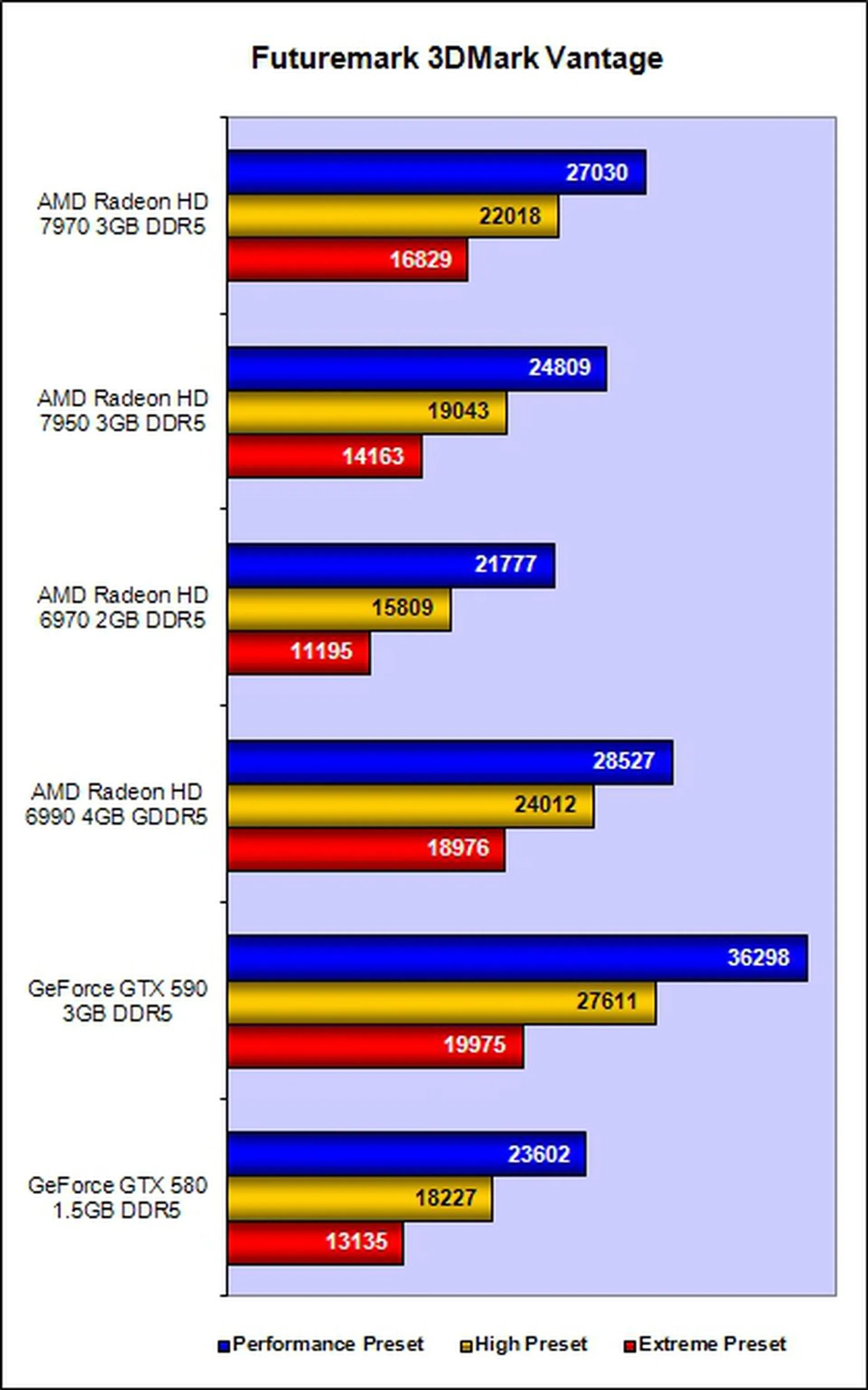
For 3DMark Vantage, Radeon HD 7970 and 7950 prove their mettle again; only to be bested by those hardcore dual-GPU monster cards! In terms of hard numbers, the Radeon HD 7970 bested its predecessor HD 6970 by over 50% and about 28% when contrasted with the GTX 580. The dual-GPU monster cards from AMD and NVIDIA still held an upper hand of 12% and 18% respectively over the Radeon HD 7970 in the most extreme settings. It doesn't sound like a big advantage for the dual-GPU cards anymore, but we'll find out later if this holds in the game tests.
As for the Radeon HD 7950, it manages to stay ahead of the HD 6970 by up 27%, but it's hardly more than 7% better than the GTX 580. These figures are in-line with 3D Mark 11 standings above too.
Crysis Warhead
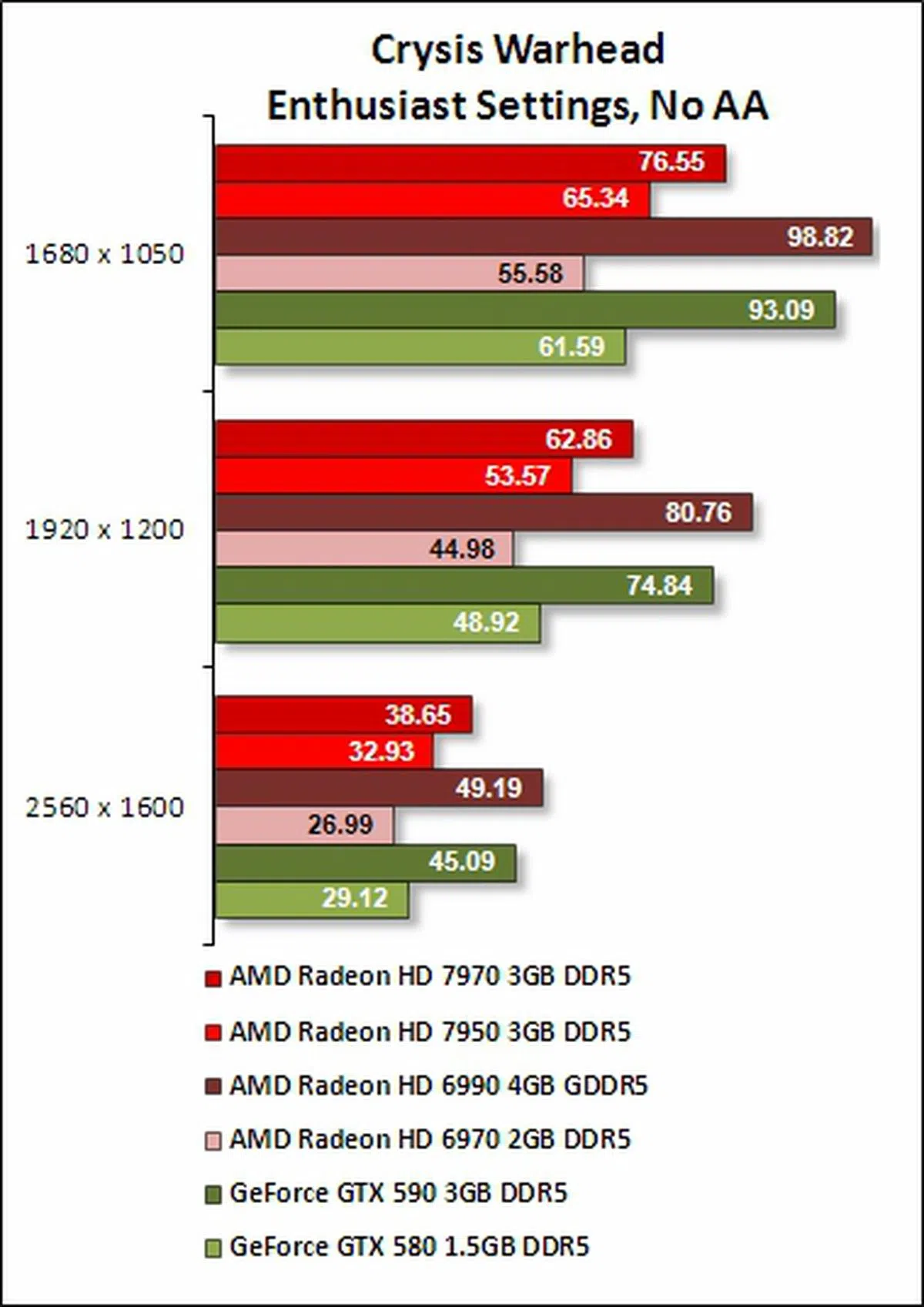
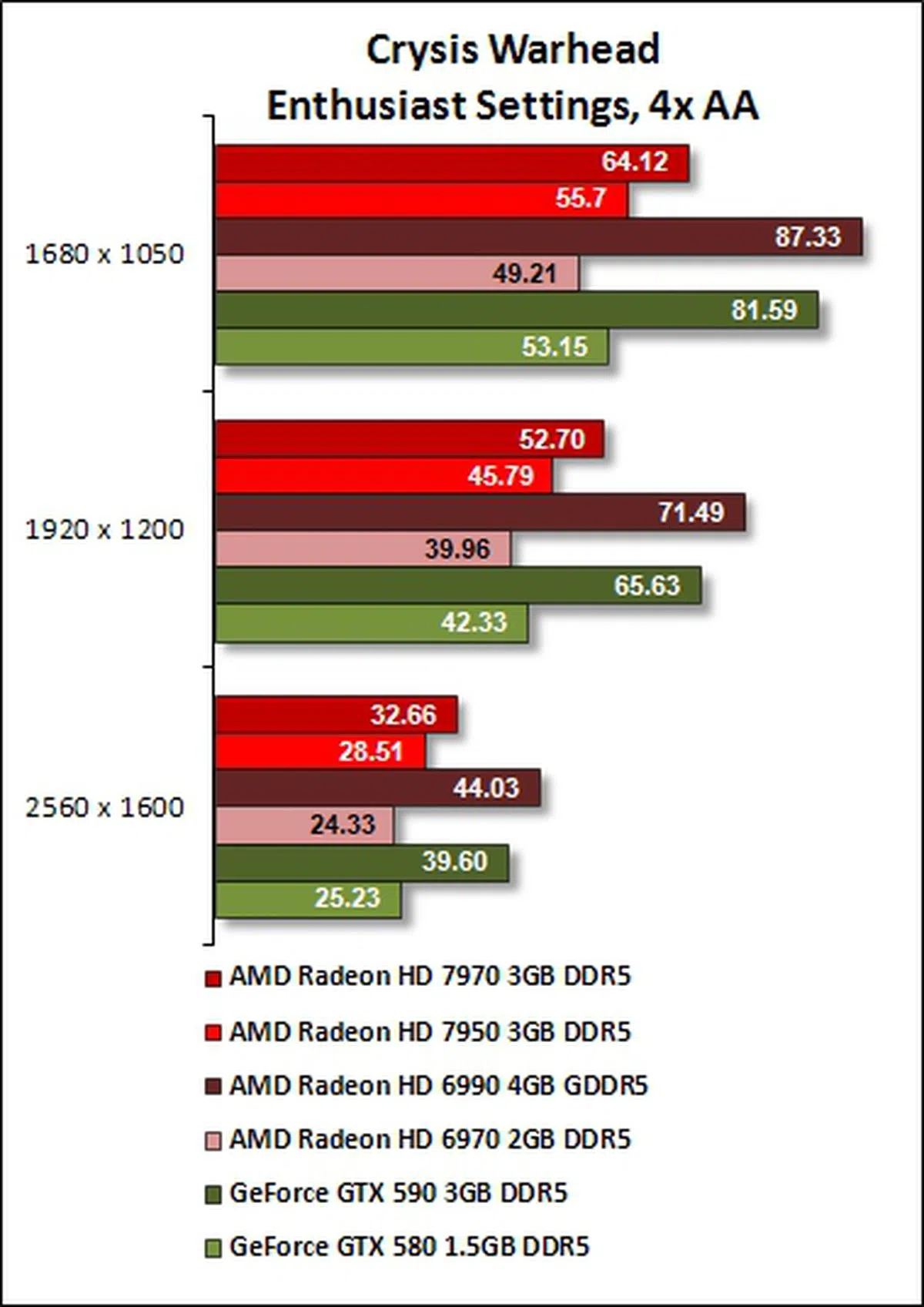
For the Crysis Warhead at Enthusiast Settings with anti-aliasing at 4x setting, Radeon HD 7950 was unable to generate more than 30fps at the highest resolution of 2560 x 1600 pixels. At lower resolutions, the cards from the 7900 series performed consistently better against their competitors; at the resolution of 1920 x 1200, the cards performed at least 7 to 24% better than GeForce GTX 580. At the highest resolution, the cards' performance improved to approximately 12% with the HD 7950 and 30% with the HD 7970, regardless of the anti-aliasing settings.
Against the dual-GPU cards, the top-end HD 7970 is a distant 30 to 40% off their performance results.
 |  |
Far Cry 2
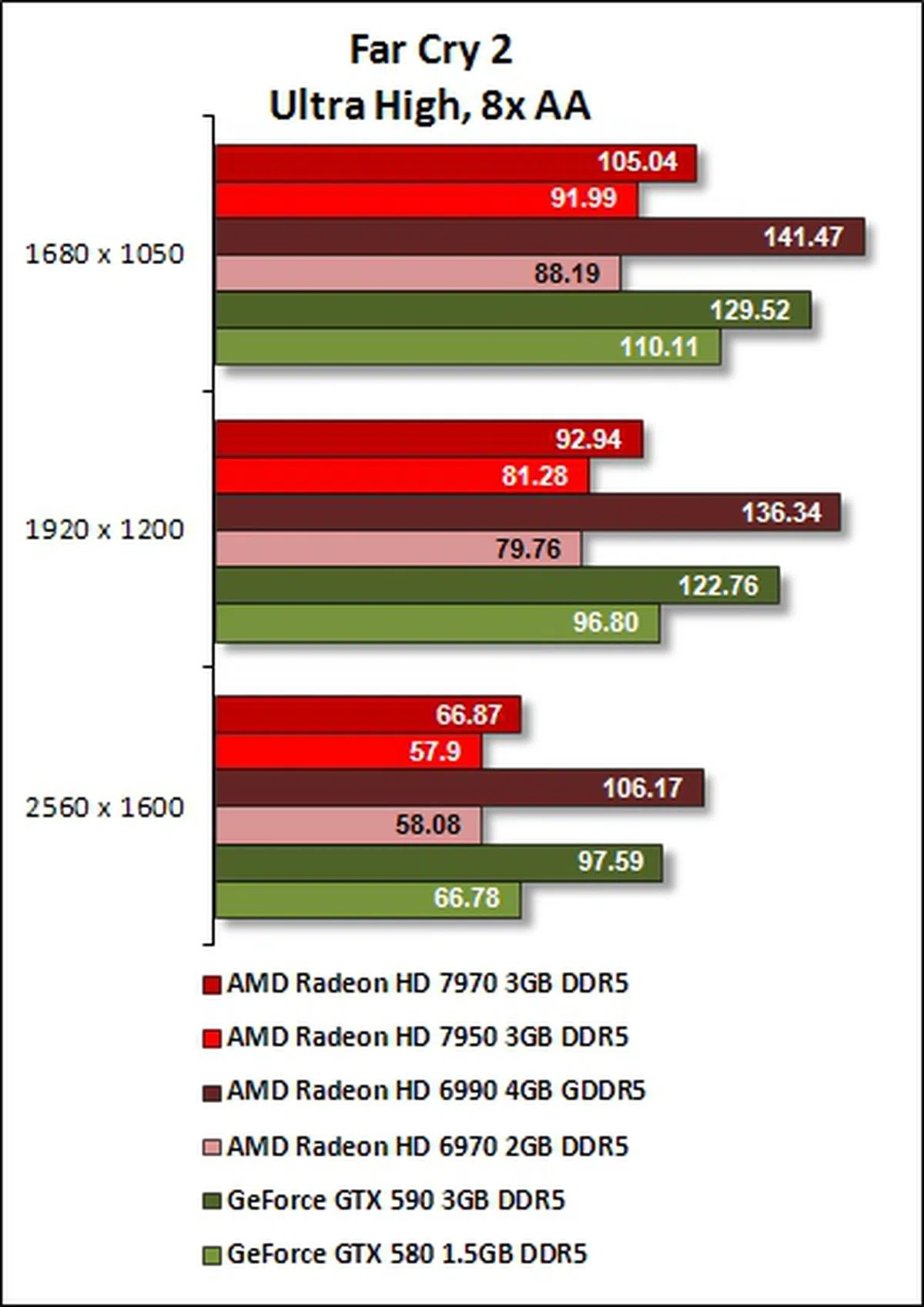
NVIDIA GeForce cards usually do well on Far Cry 2 and at 2560 x 1600 resolution, Radeon HD 7970 only managed to pulled ahead from GeForce GTX 580 by a razor-thin margin of slightly more than 0.1 per cent. With the benchmark's anti-aliasing set at 4x, only the Radeon HD 7970 managed to pull ahead of GeForce GTX 580 at all three resolution settings. The younger brother from Southern Islands, Radeon HD 7950, was clearly outclassed in this situation.
 |  |
Battlefield Bad Company 2 Results
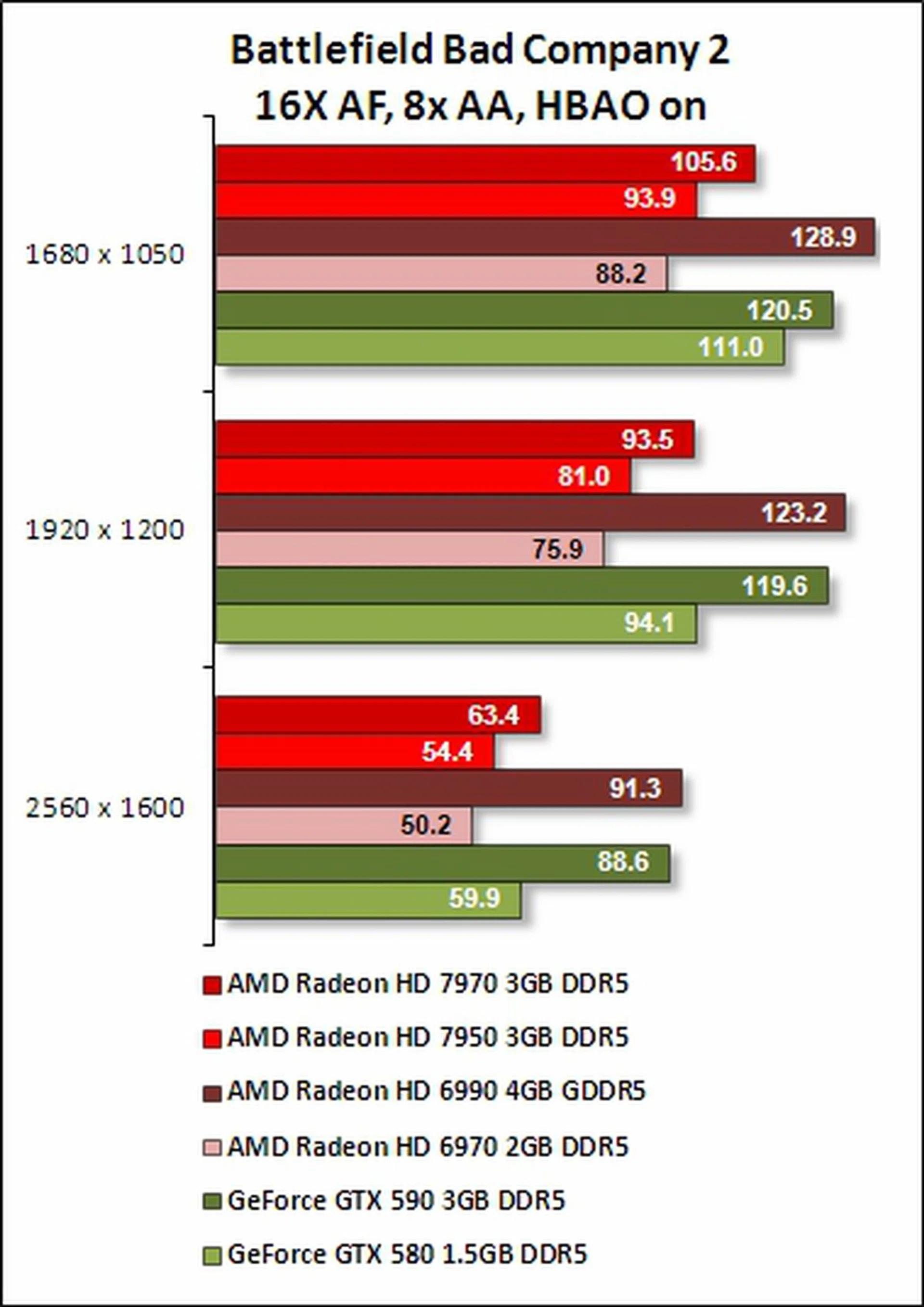
Battlefield Bad Company 2 makes use of tessellation which is an area where the cards from the Radeon HD 7900 series seem to be weak at. Their benchmark scores have improved over that of the Radeon HD 6970 GPU and they managed frame rates per second of above 50 at the highest resolution. They were however, hardly any better than the old GeForce GTX 580 with half the video memory.
Unigine "Heaven" 2.1
DirectX 11 Results
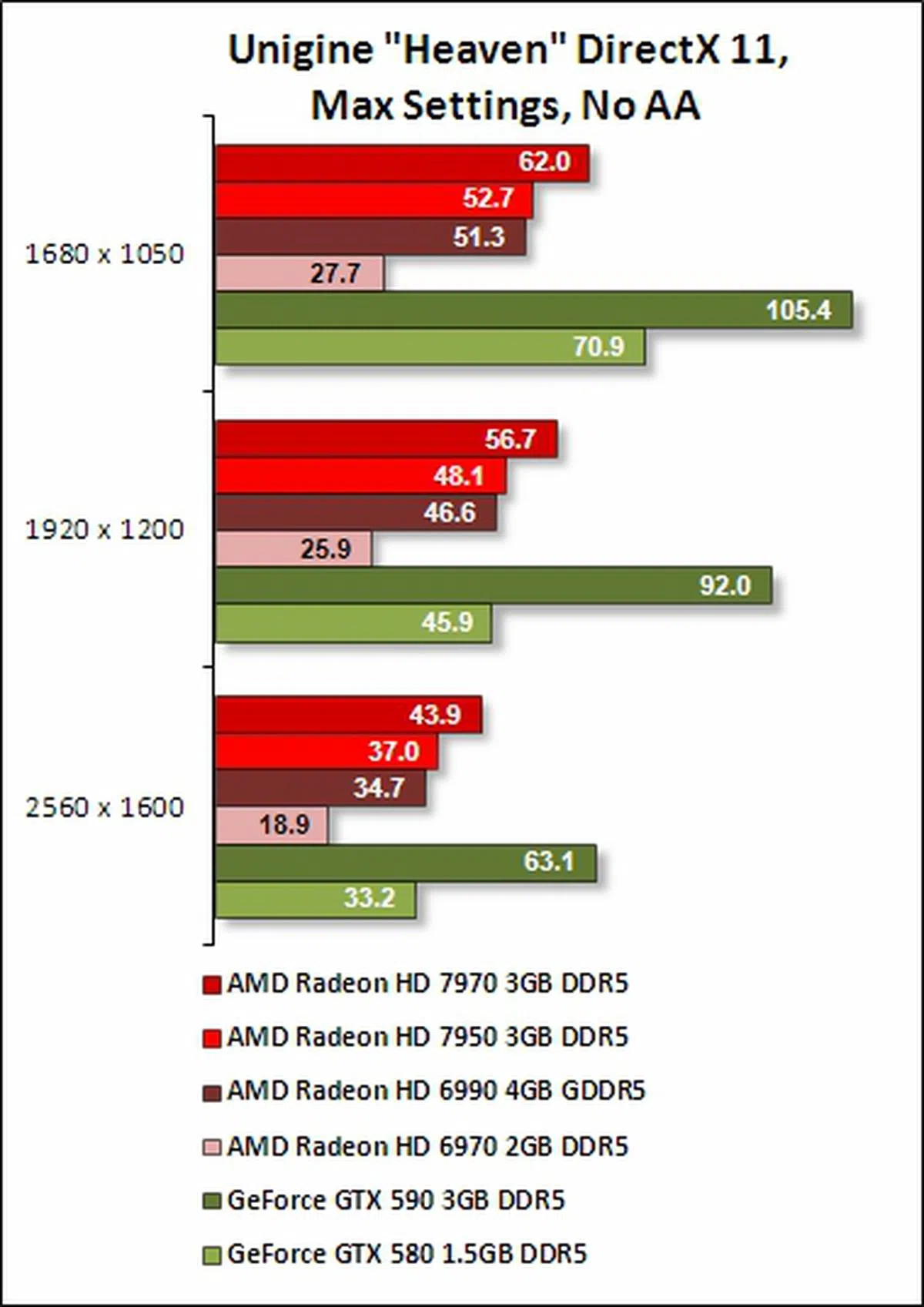
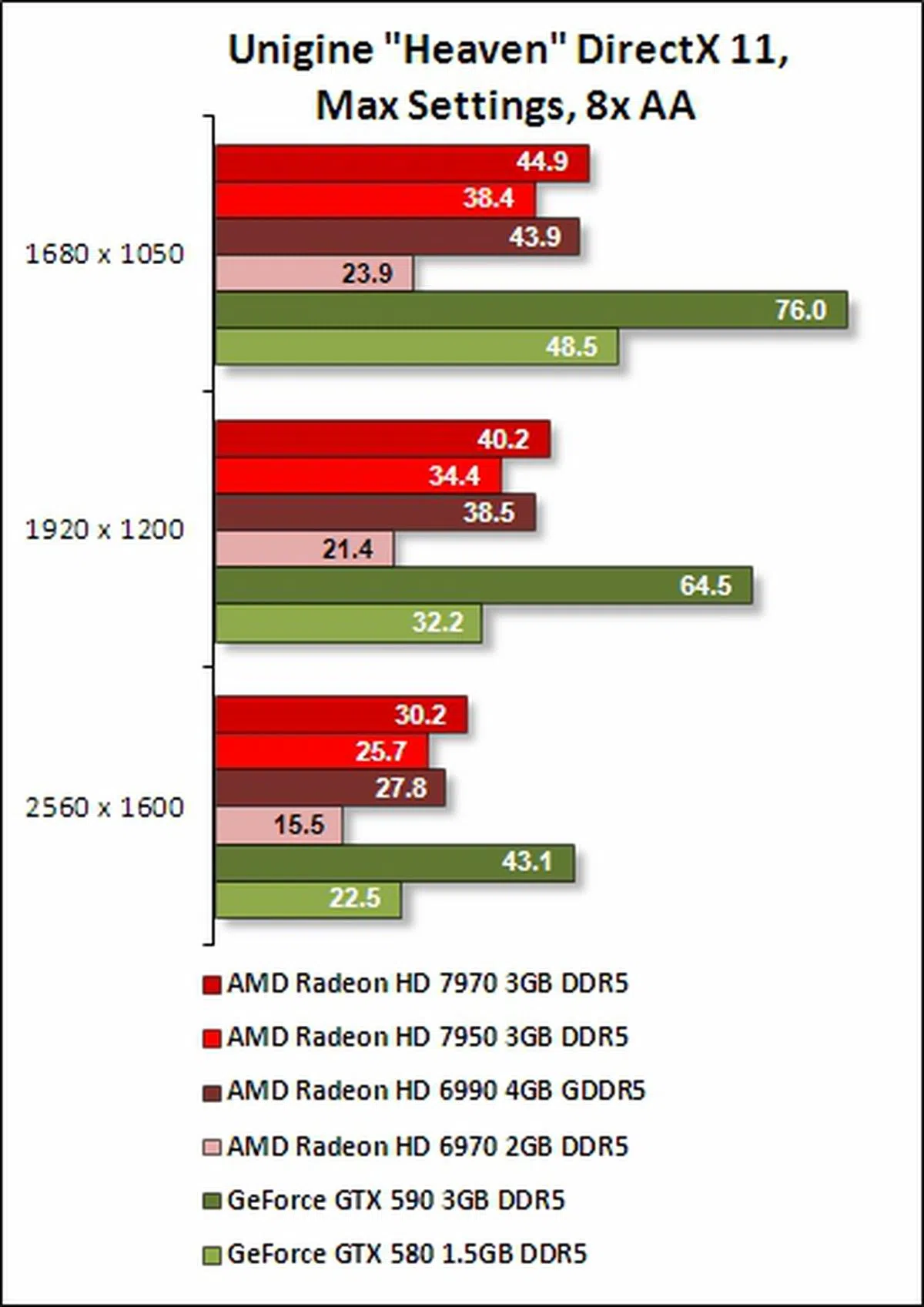
Tesellation performance is heavily emphasized on the Unigine benchmark and we can see that with the new GCN architecture, the new Radeon HD 7970 and 7950 handle tessellation operations better than Radeon HD 6990, their dual-GPU relative from the previous generation of Northern Island cards. The Radeon HD 7950 is almost on par with the Radeon HD 6990 while the Radeon HD 7970 outperforms its predecessor on the DirectX 11 front. Judging from the numbers here, it seems that AMD has greatly improved the tessellation performance of their newest cards.
 |  |
DirectX 10 Results
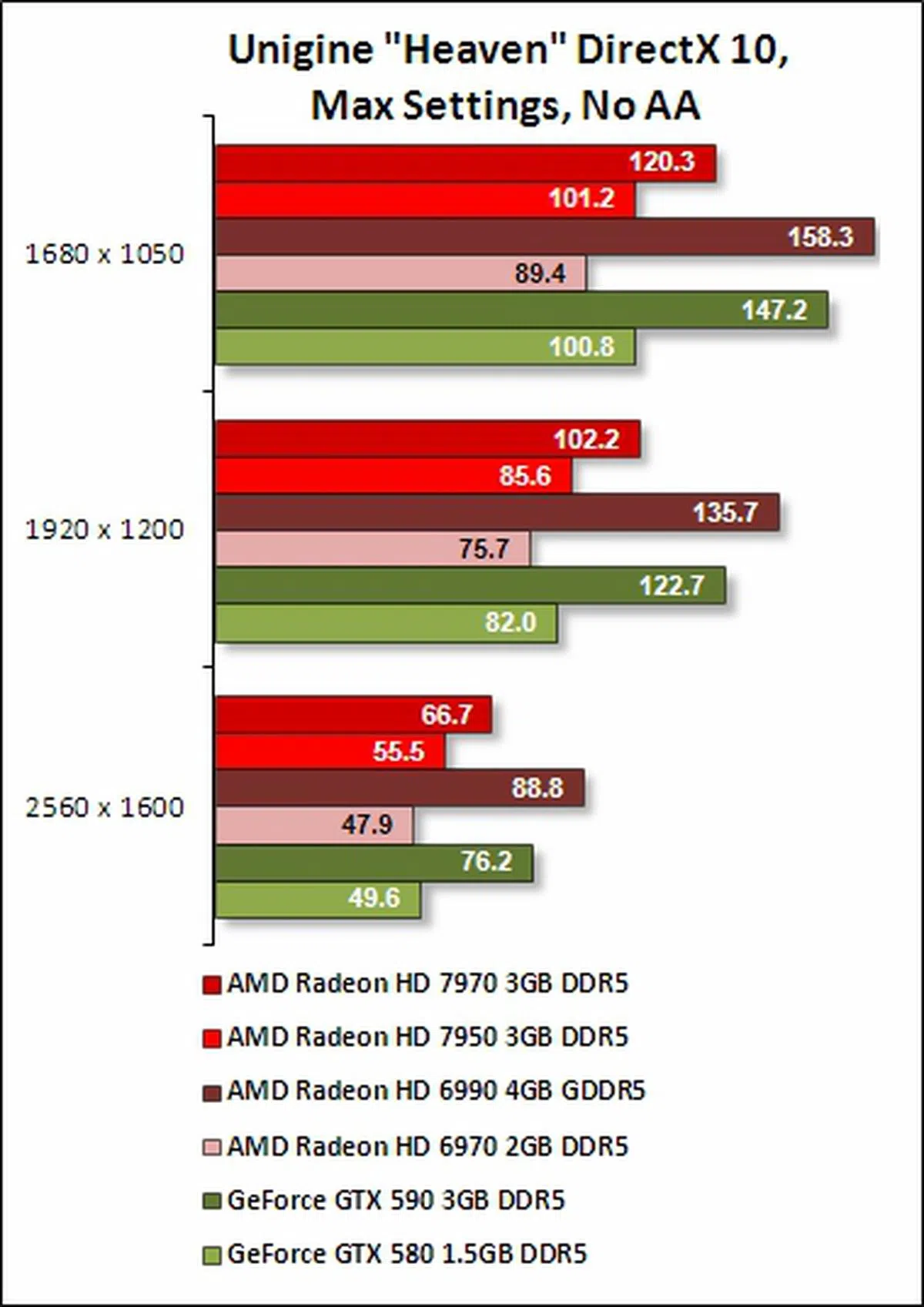
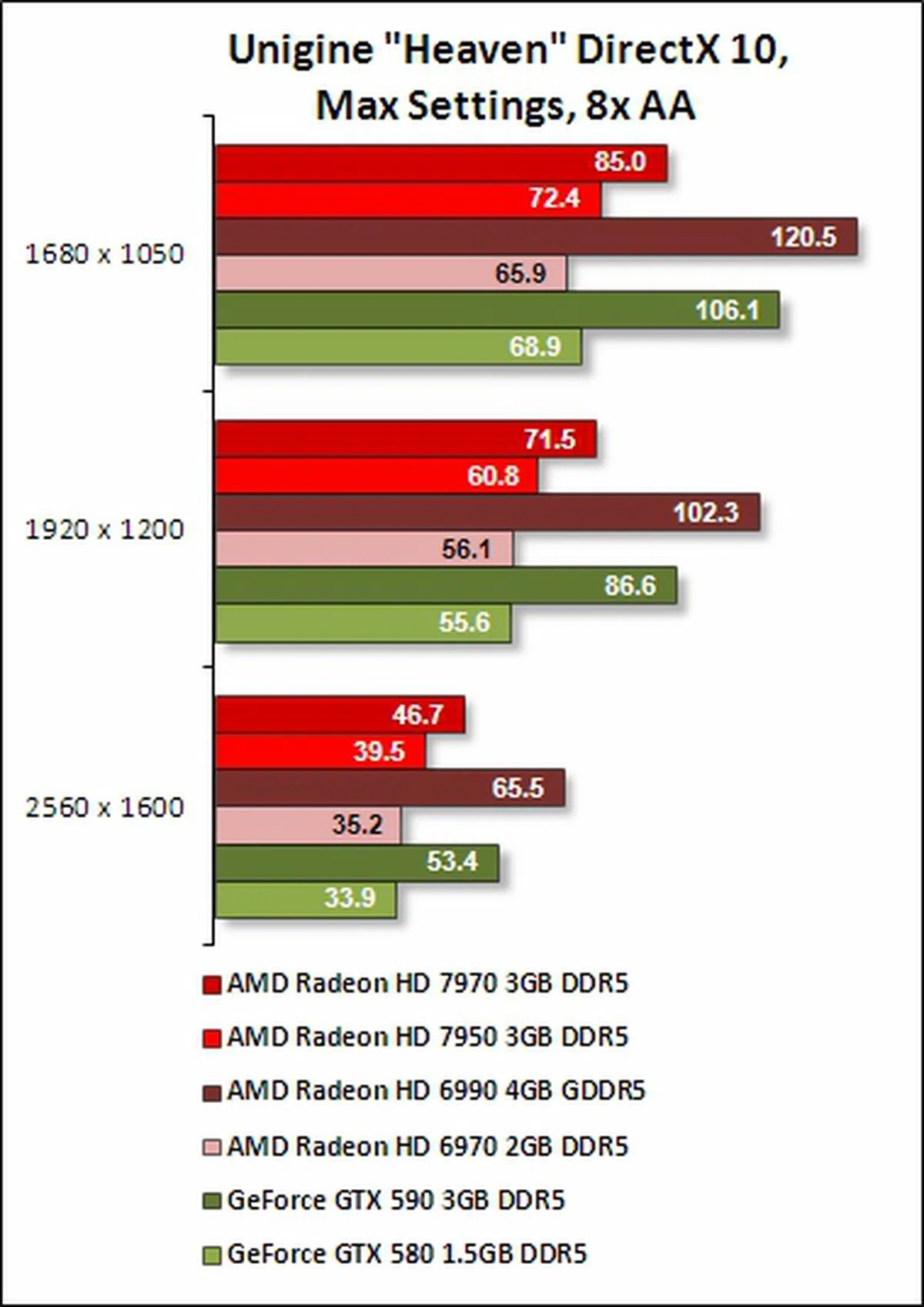
DirectX 10 performance on AMD cards have generally been good and the results from the Radeon HD 7900 series carry this legacy further. However, DX10 performance matters are probably no longer as important as they were before. Several titles this year will be DX11 ready, thus DX10 performance will steadily take a back seat in the coming months ahead.
 |  |
S.T.A.L.K.E.R.: Call of Pripyat Results
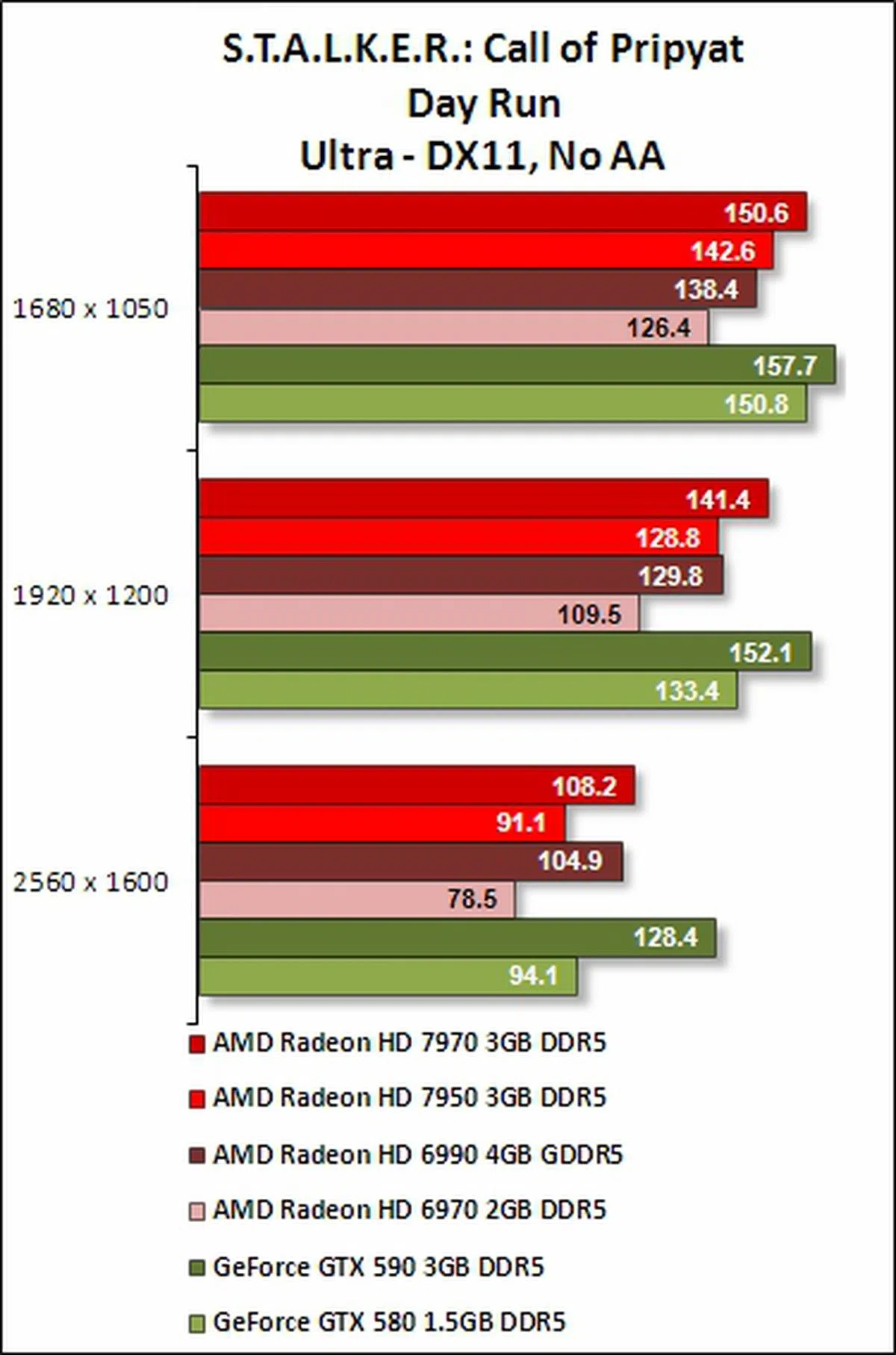
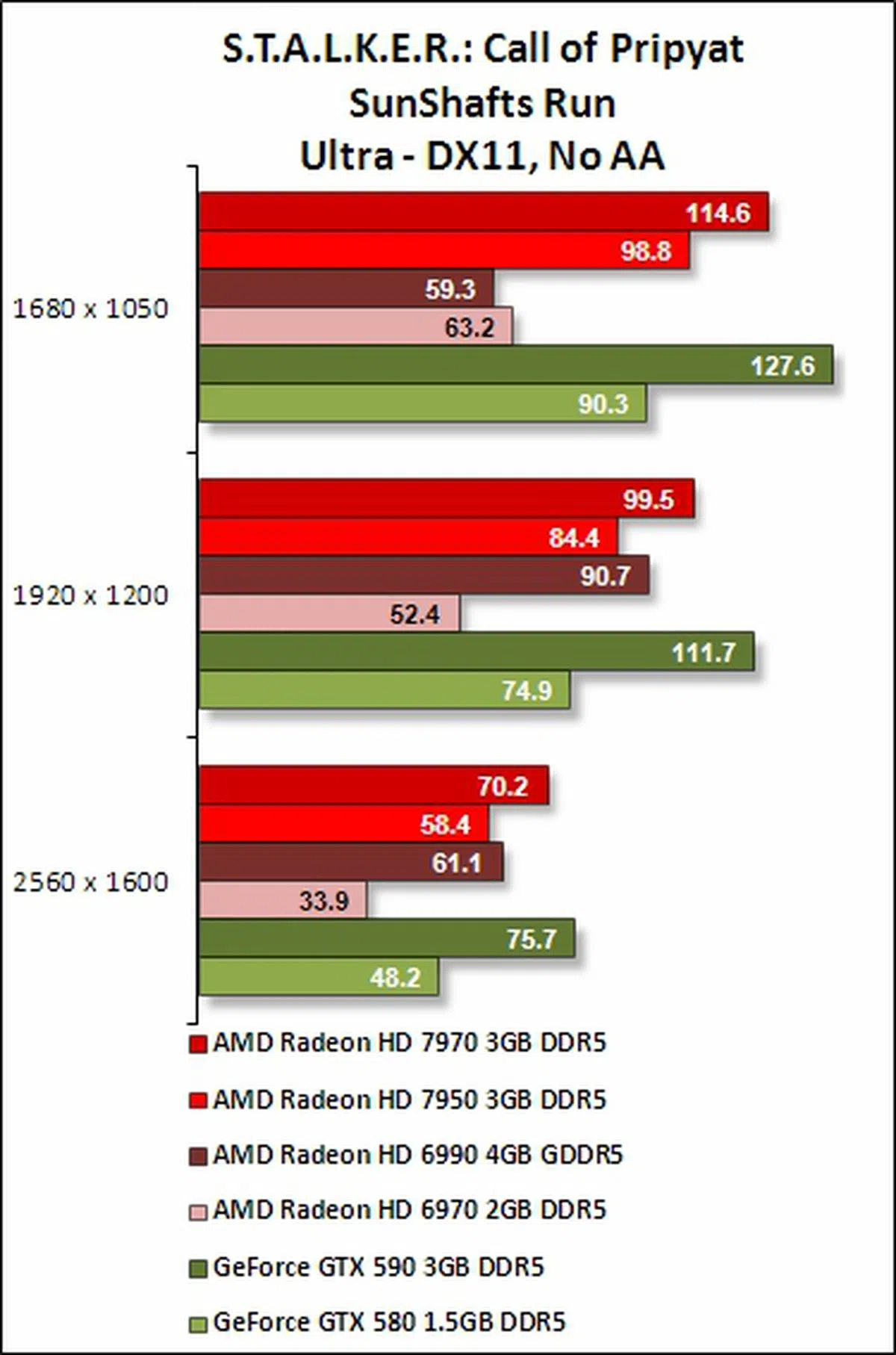
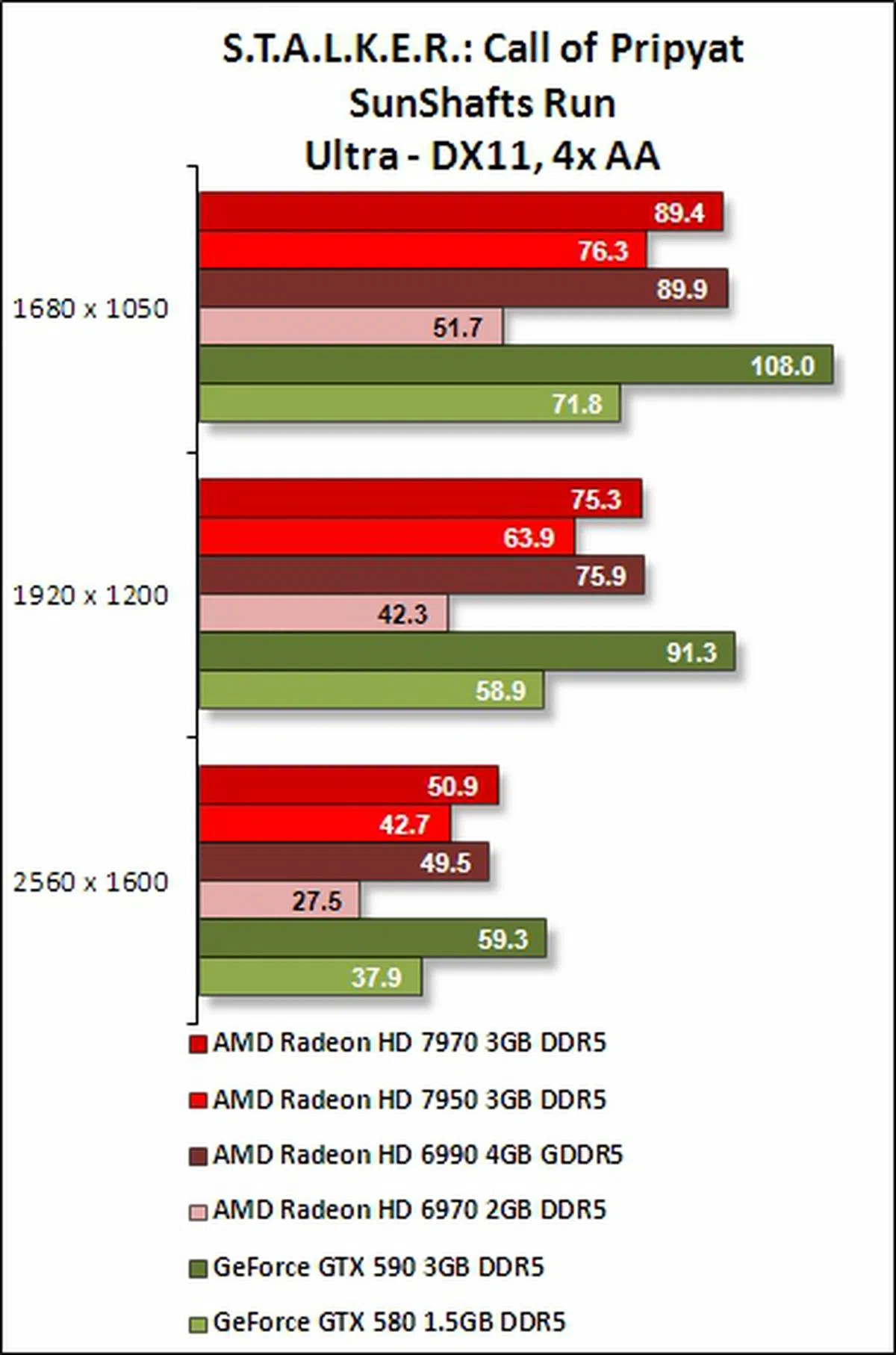
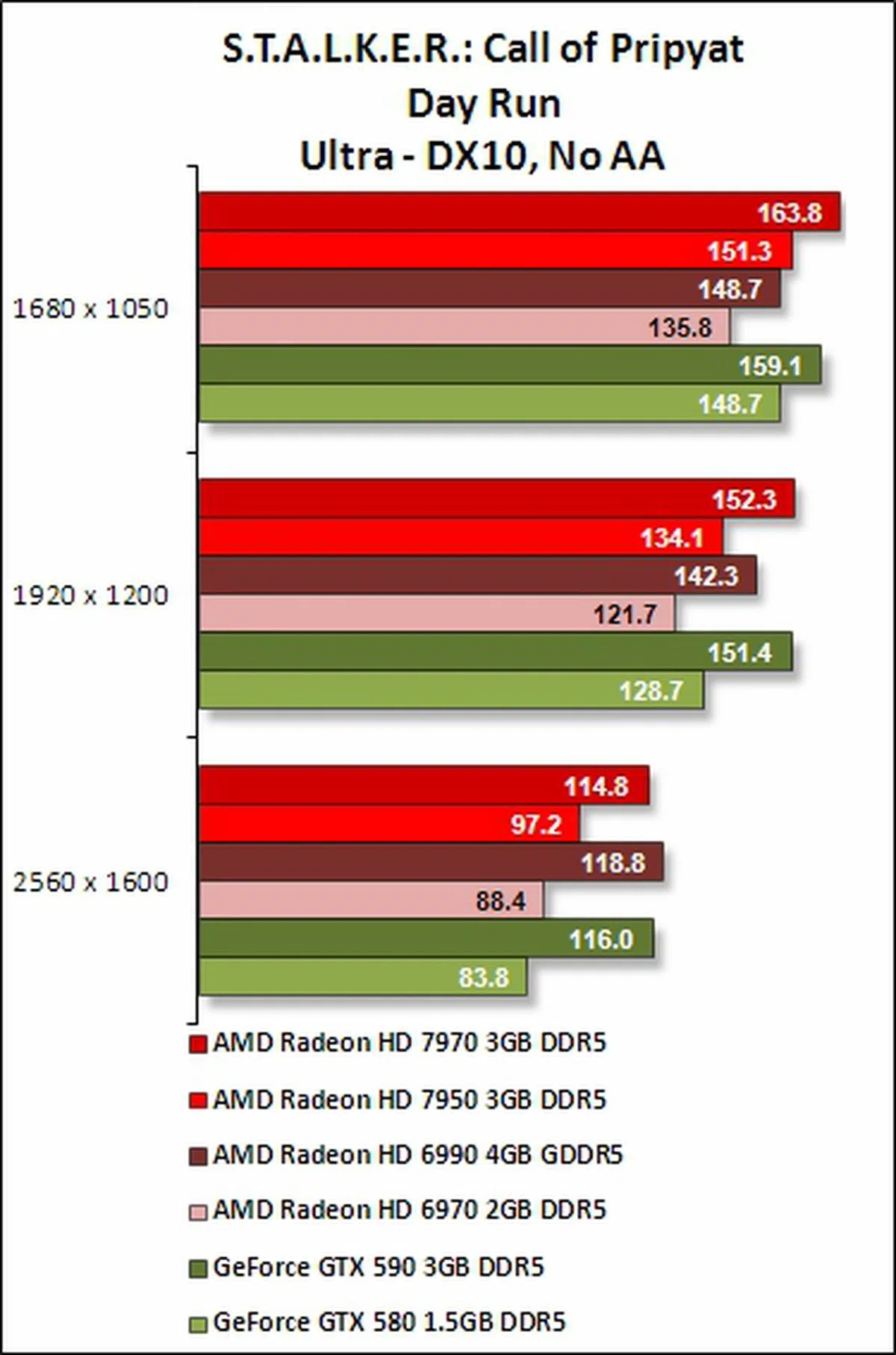
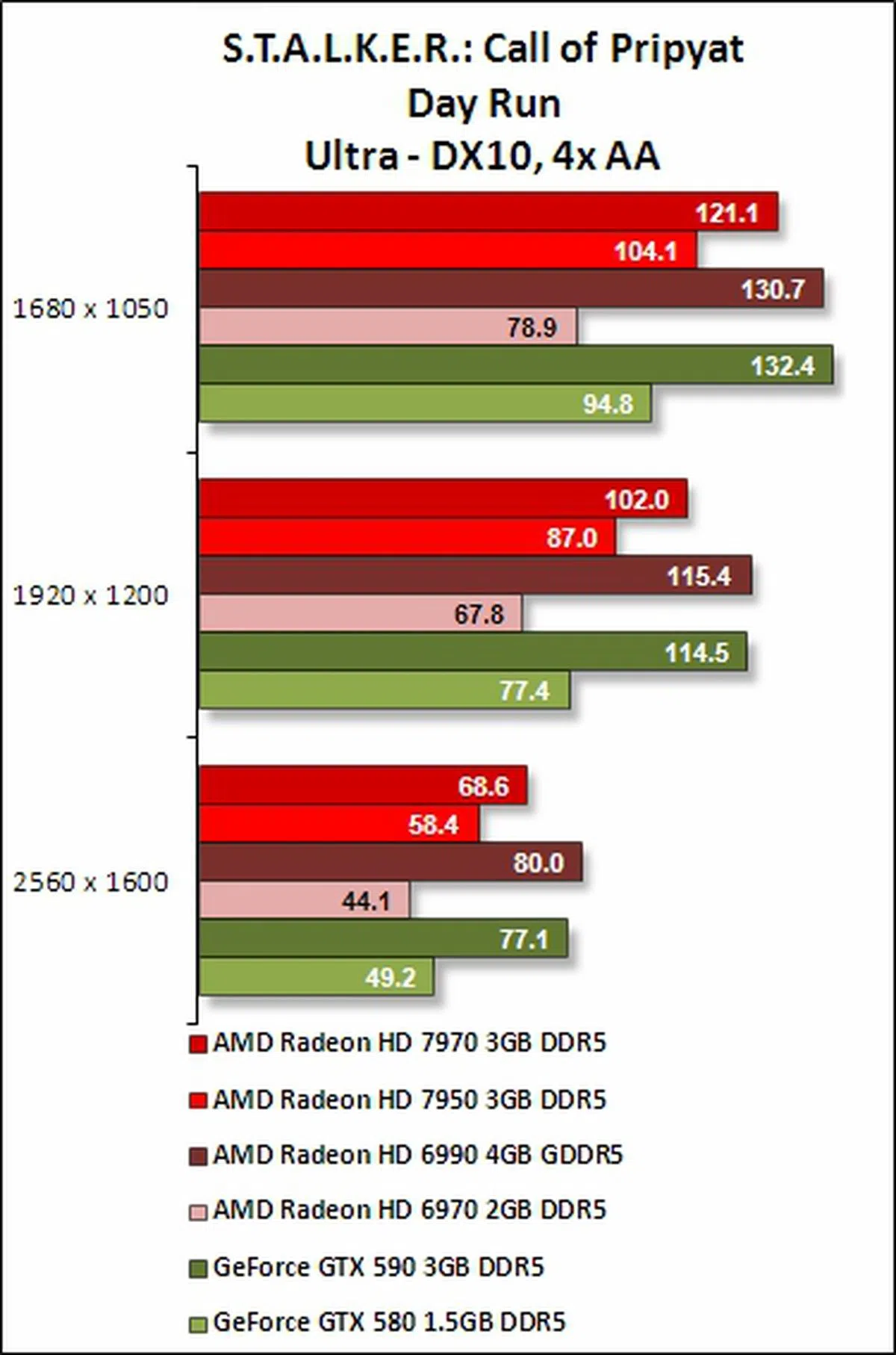
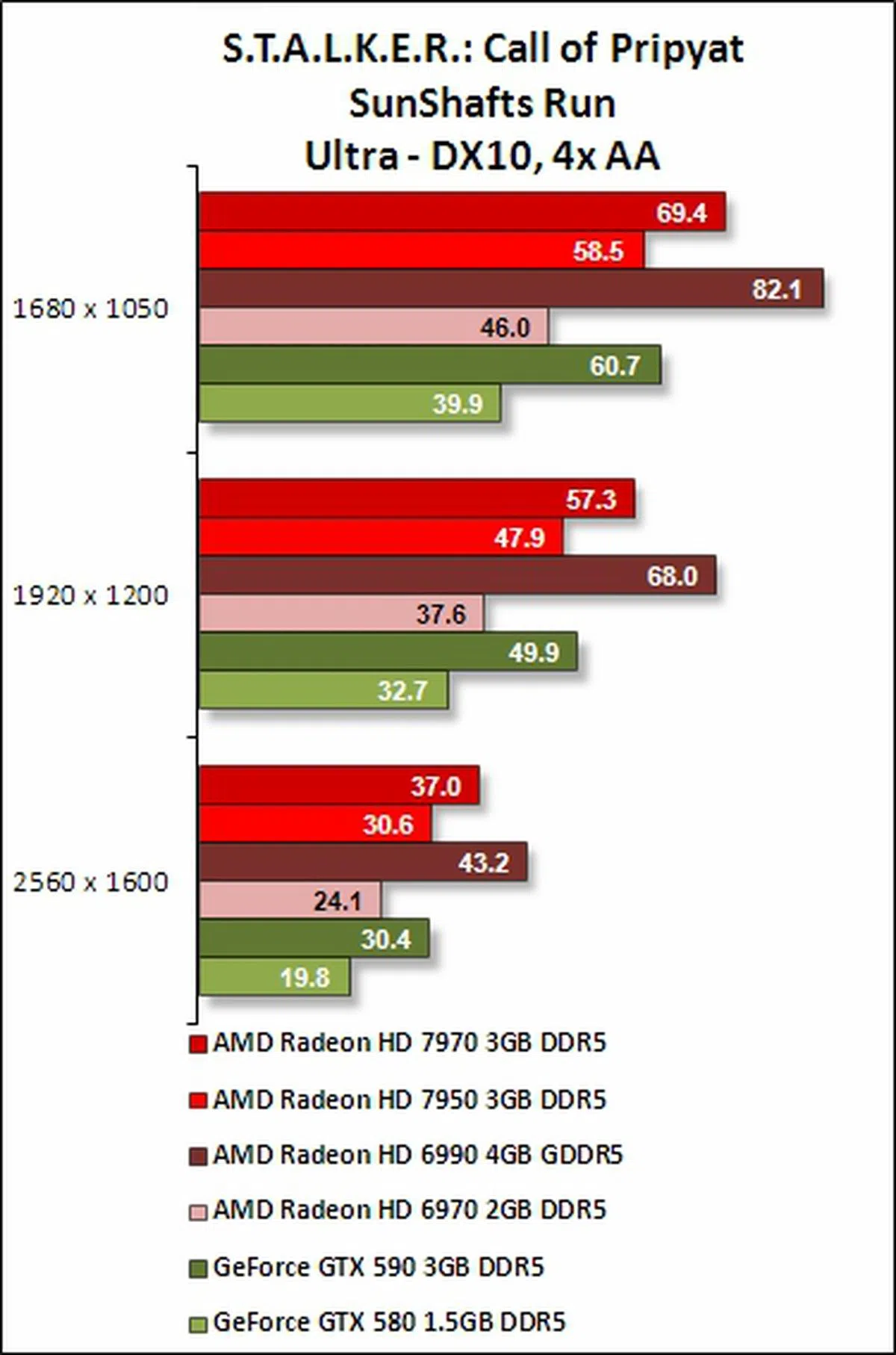
On DirectX 11 , the Radeon HD 7970 and 7950 performed almost on par with Radeon HD 6990 on the more intensive SunShaft Runs benchmarks, They were clearly beaten by GeForce GTX 590 by about 34% (the widest losing margin on the Day Run benchmark, at the highest resolution, with anti-aliasing at 4x setting); however, they narrowed the losing gap with their main NVIDIA competitor, with the DirectX 10 drivers enabled, to at least approximately 8%. As such, the overall standings in this benchmark somewhat micmik the findings from Unigine benchmark where the DX 11 performance is pretty strong for the 7900 series and much improved from the predecessor, while further building on its good DX10 performance legacy.
DirectX 11 Results
 |  |
 |  |
DirectX 10 Results
 |  |
 |  |
Crysis 2 Results
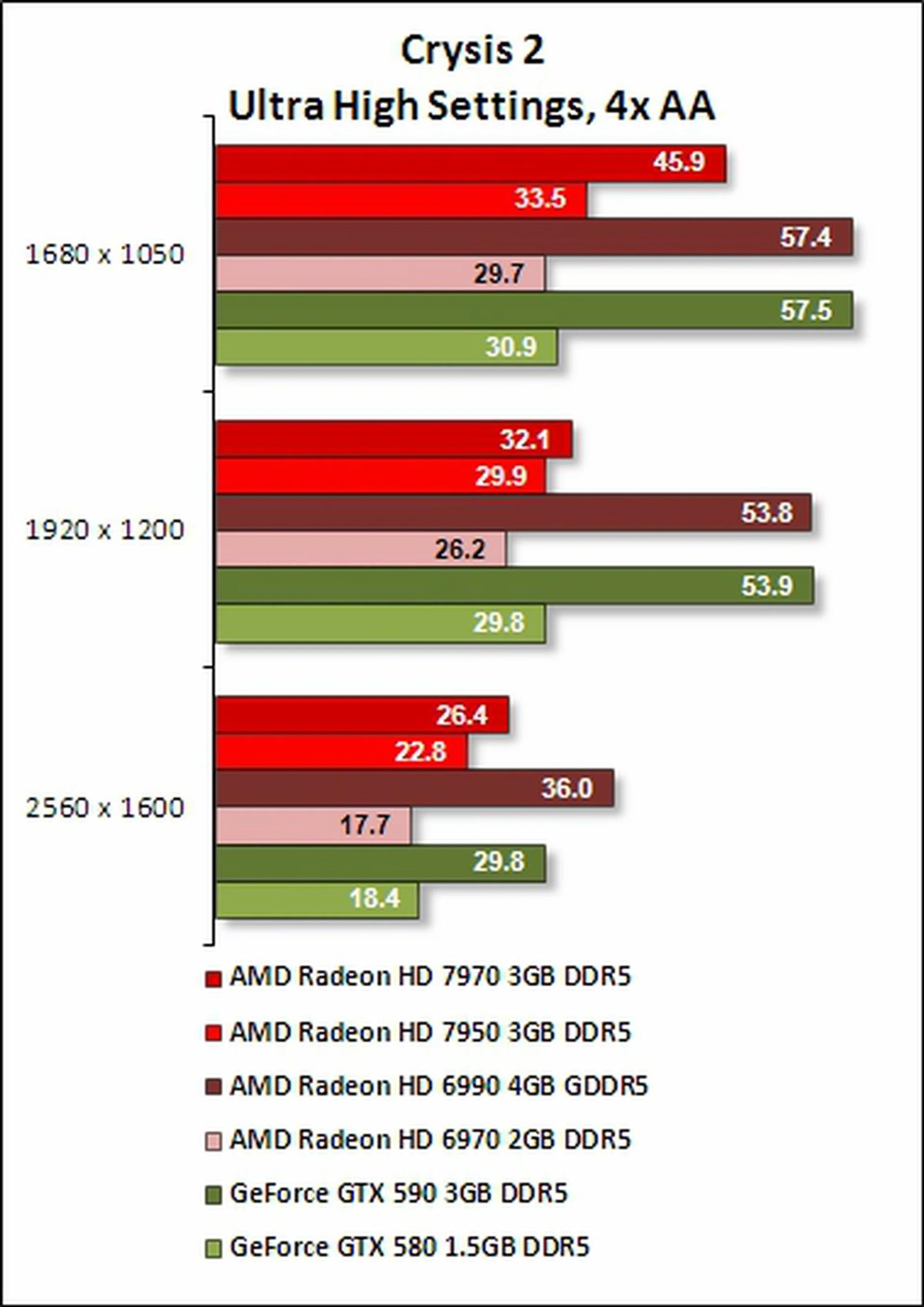
The Radeon HD 7950 managed to stay ahead marginally of the GeForce GTX 580, whereas the the lead Radeon HD 7970 actually managed over 40% performance gain (apart from the 1920 x 1200 pixels resolution). And at the highrest resolution, it wasn't much behind the GeForce GTX 590. However, frame rates at that resolution dipped below the 30fps mark, leaving only the Radeon HD 6990 as capable of handling the Crysis 2 benchmark at the highest settings.
Batman: Arkham City Results
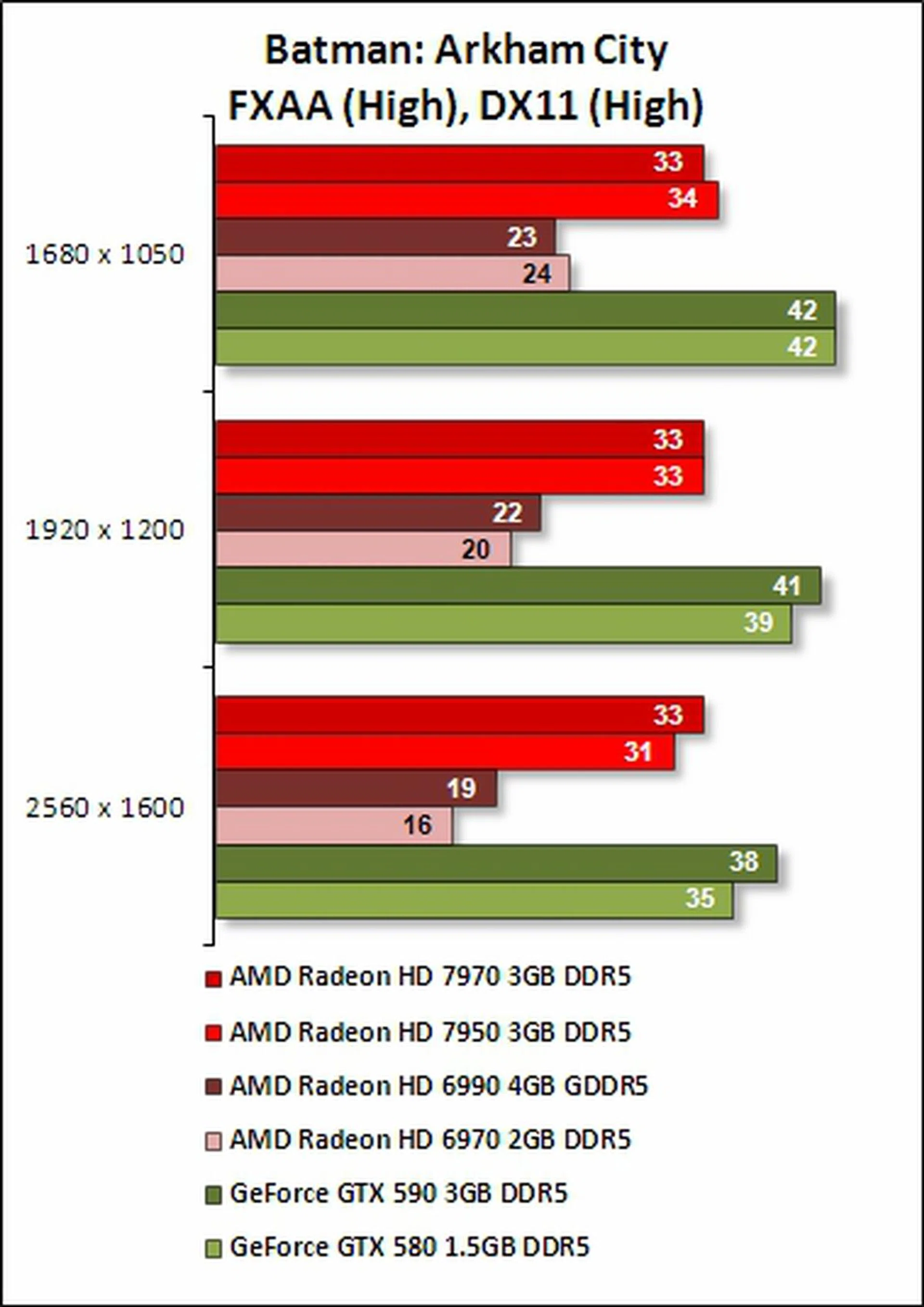
The performance scores of both Radeon HD 7970 and 7950 were consistent regardless of the resolution settings, which we found quite odd. Whatever the case, while the newcomers improve their standings by a fair bit, they are still outrun by the GeForce cards which so far have had a track record at tackling DX 11 games better.
Dirt3
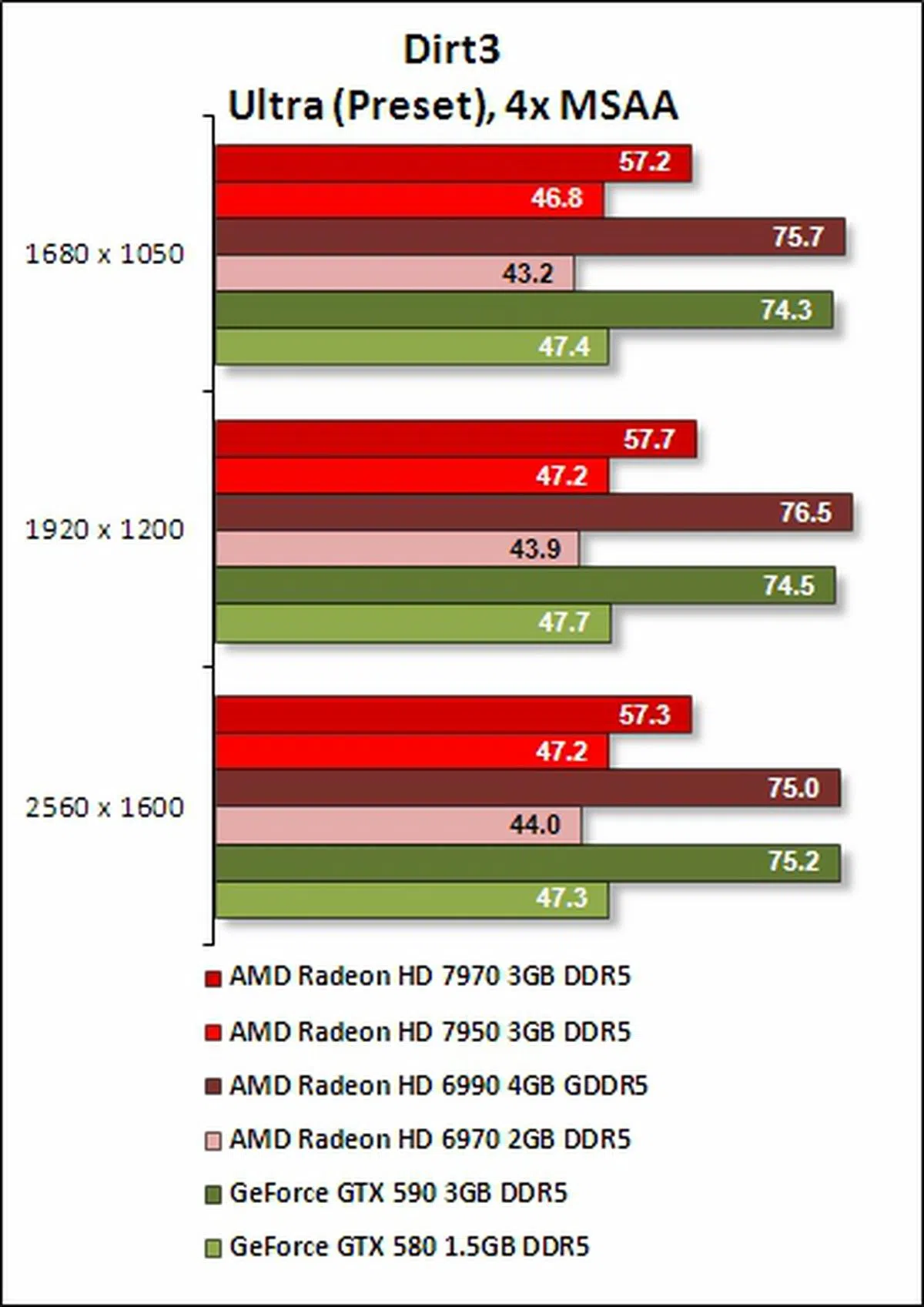
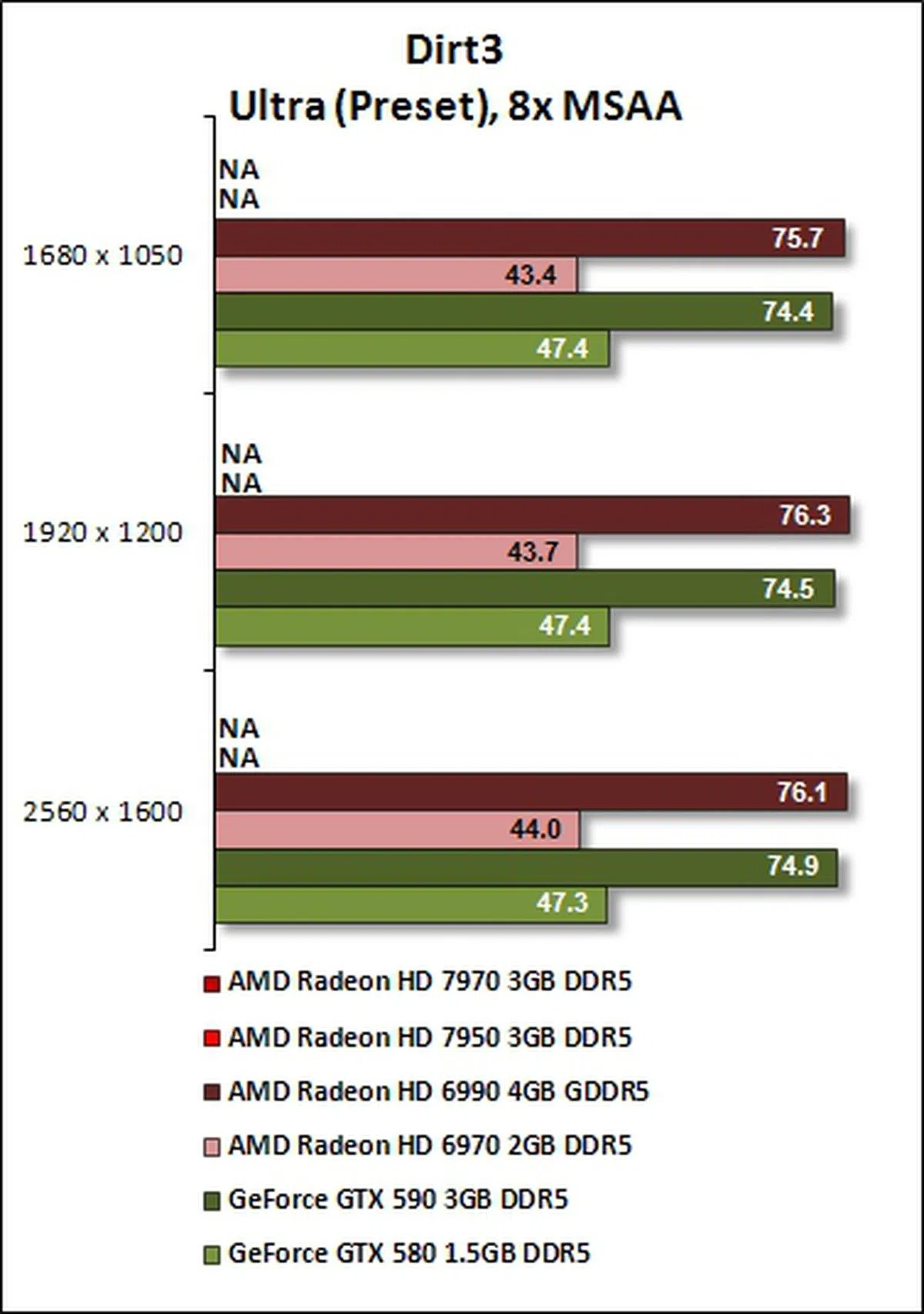
The Southern Island cards failed to run the Dirt3 benchmark at 8x MSAA setting; however, at 4x MSAA, their scores are rather consistent regardless of resolution and we suspect they are hampered by the system's overall throughput. Even if it's the case, the results have been scaling well with regards to the different graphics cards.
 |  |
Temperature
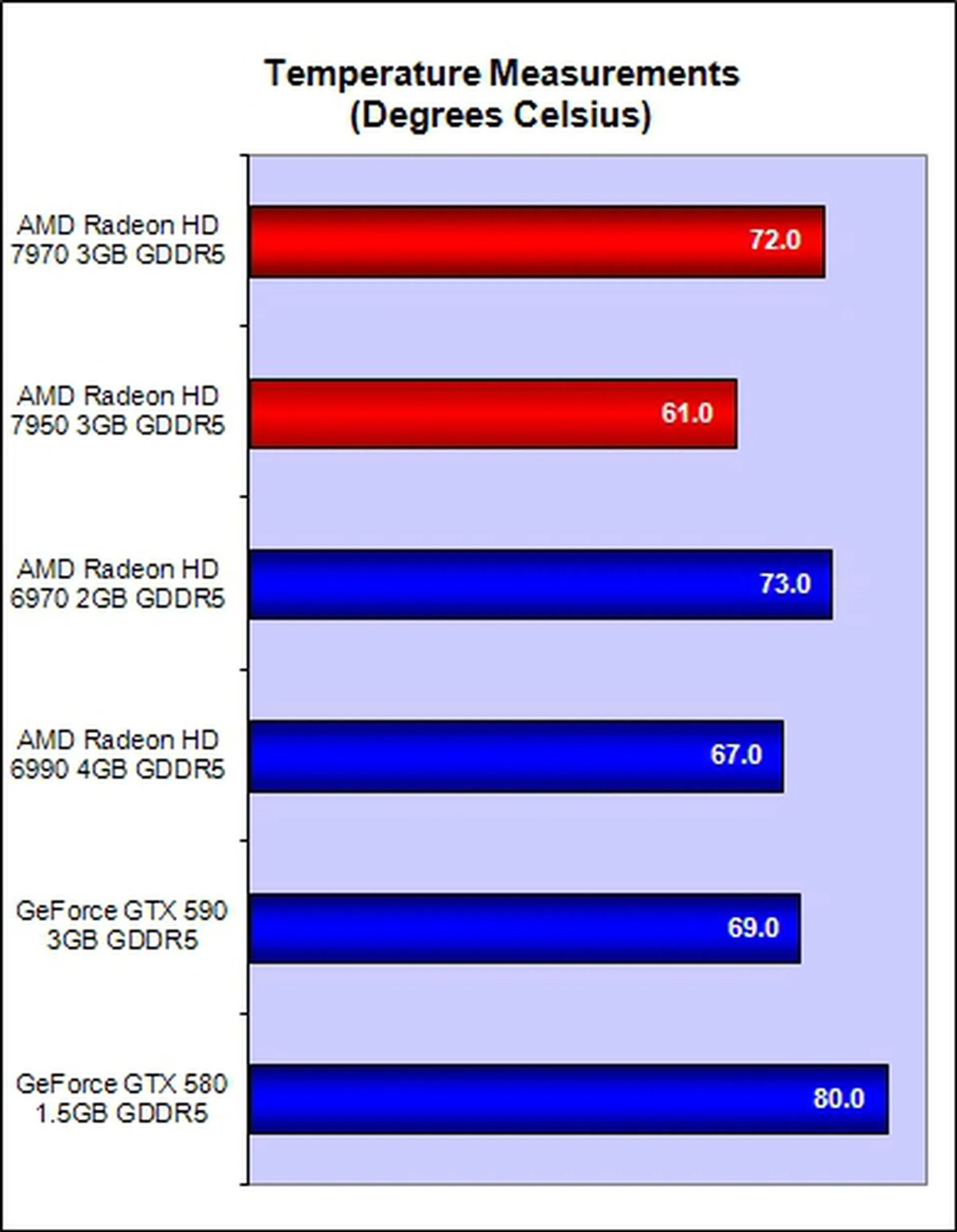
The Radeon HD 7970 runs at the second highest temperature of 72.0°C while its younger brother runs cooler at 61.0°C. Measurements were taken while benchmarking. Also, do bear in mind that all the cards tested have stock cooling options, we should see their operating temperatures heading south as manufacturers roll out cards with their own specialized coolers.
Power Consumption
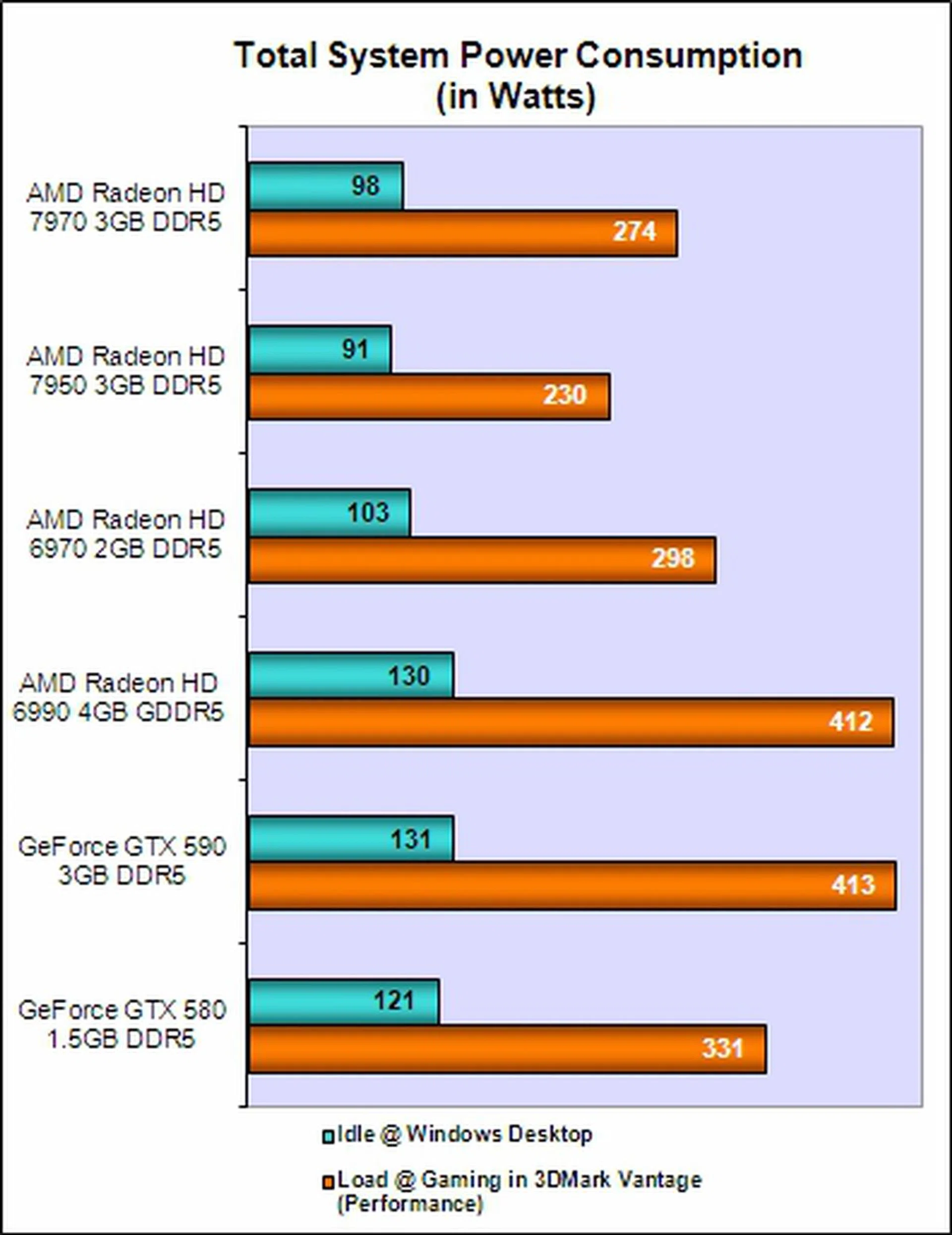
The power consumption of the new cards are the lowest compared to the rest of the cards, regardless whether they were measured when the cards were idle or on load. The dual-GPU monsters are power hungry entities while the energy efficiency of the new GCN architecture shines through in this test when you factor in that they are probably just 30 to 40% slower than the tested dual-GPU models. It's also much more power efficient than the HD 6970 and the GTX 580.
Overclocking
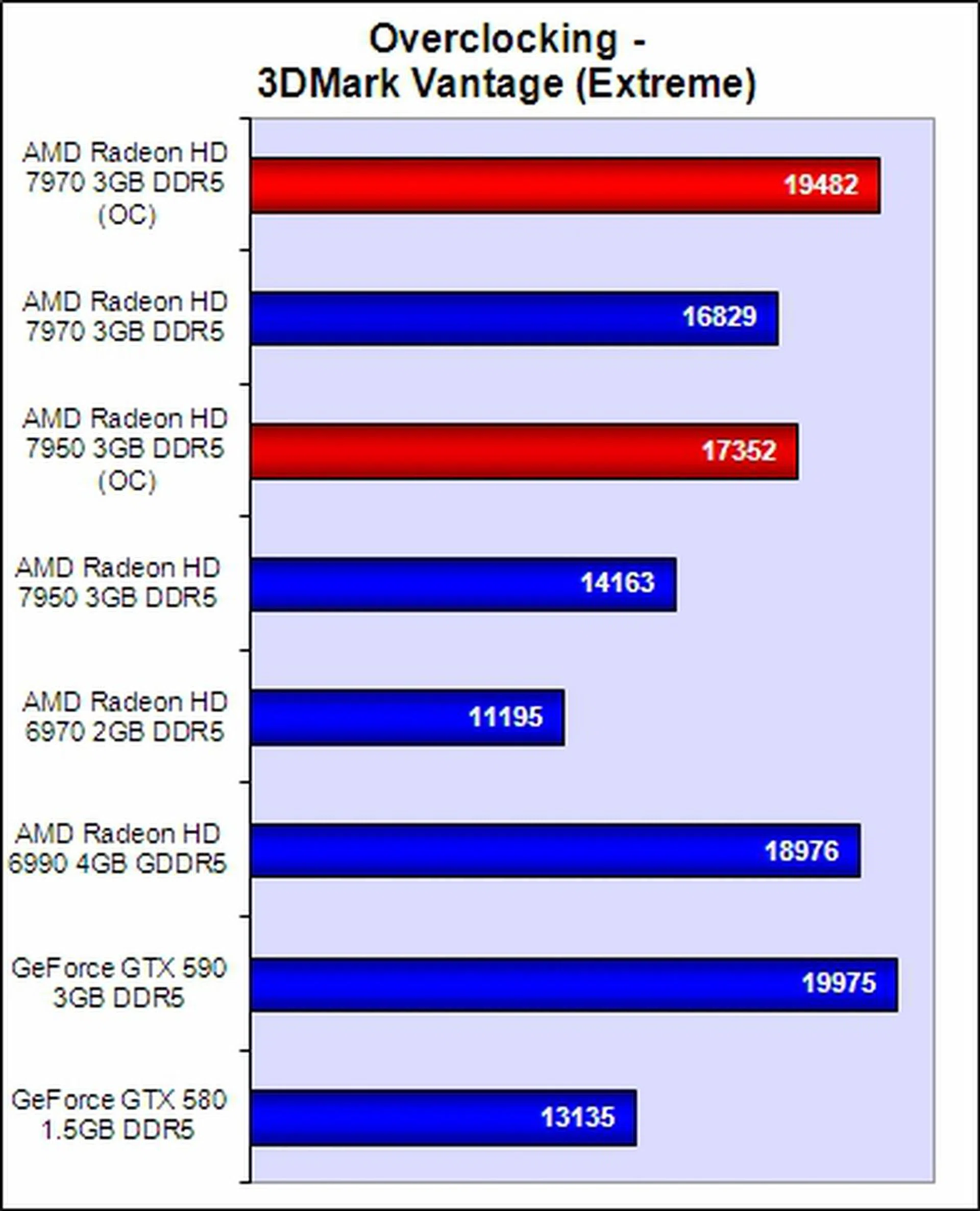
For Radeon HD 7970, its performance improved by almost 16% when it was overclocked, its GPU Core was pushed to its maximum limit of 1125MHz (925MHz was its default clock speed) while its memory clock was pushed to its limit of 6300MHz from its default value of 5500MHz. The Radeon HD 7950 was overclocked to 1100MHz from its default clock speed of 800MHz for its GPU Core clock speed while its memory clock speed was pushed to its maximum of 6300MHz (default value of 5000MHz). Its performance improved by approximately 22.5%. So far, the numbers look rather favorable for overclocking but as usual always apply caution when embarking on extreme overclocking, which we feel these cards can manage when carefully tackled.
Southern Islands Offer Great Potential
It would seem like we've committed a treasonous act by not updating our testbed to a motherboard that has support for PCIe Gen 3.0. However, in order to maintain the integrity of the data we have painstakingly accrued over time, we have decided to withhold the graphics testbed upgrade until Intel is official in its chipset support for PCIe Gen 3.0. In any case, our decade-old history of testing graphics cards have revealed little to no gain when new graphics cards are first to support a brand new interface version, be it PCI, AGP or PCIe. As such, we can safely say that's probably the least of our concerns at this point of time. What needs to be tackled is the price point for these new cards which we'll soon touch upon.
With the dissection of the inner workings and features of the Radeon HD 7900 cards, it's easy to tell that AMD is targeting NVIDIA's top GeForce GTX 580 single GPU offering with the Radeon HD 7950. From our benchmarks, the Radeon HD 7950 had its fair share of wins and losses against its NVIDIA counterpart in terms of benchmarking performance, but it was generally favorable. As we take a closer look at the other measurements in terms of its power consumption and operating temperature, it seems that we have a clear winner as Radeon HD 7950 takes the lead from GeForce GTX 580. Even the higher rated Radeon HD 7970 easily outperformed the NVIDIA camp in this lineup and sometimes it wasn't very far off from some of the dual-GPU graphics cards. Overall, we are impressed with the performance of Radeon HD 7970 as it consistently scored well, ahead of the GeForce GTX 580, but not as speedy as the last generation dual-GPU graphics cards.
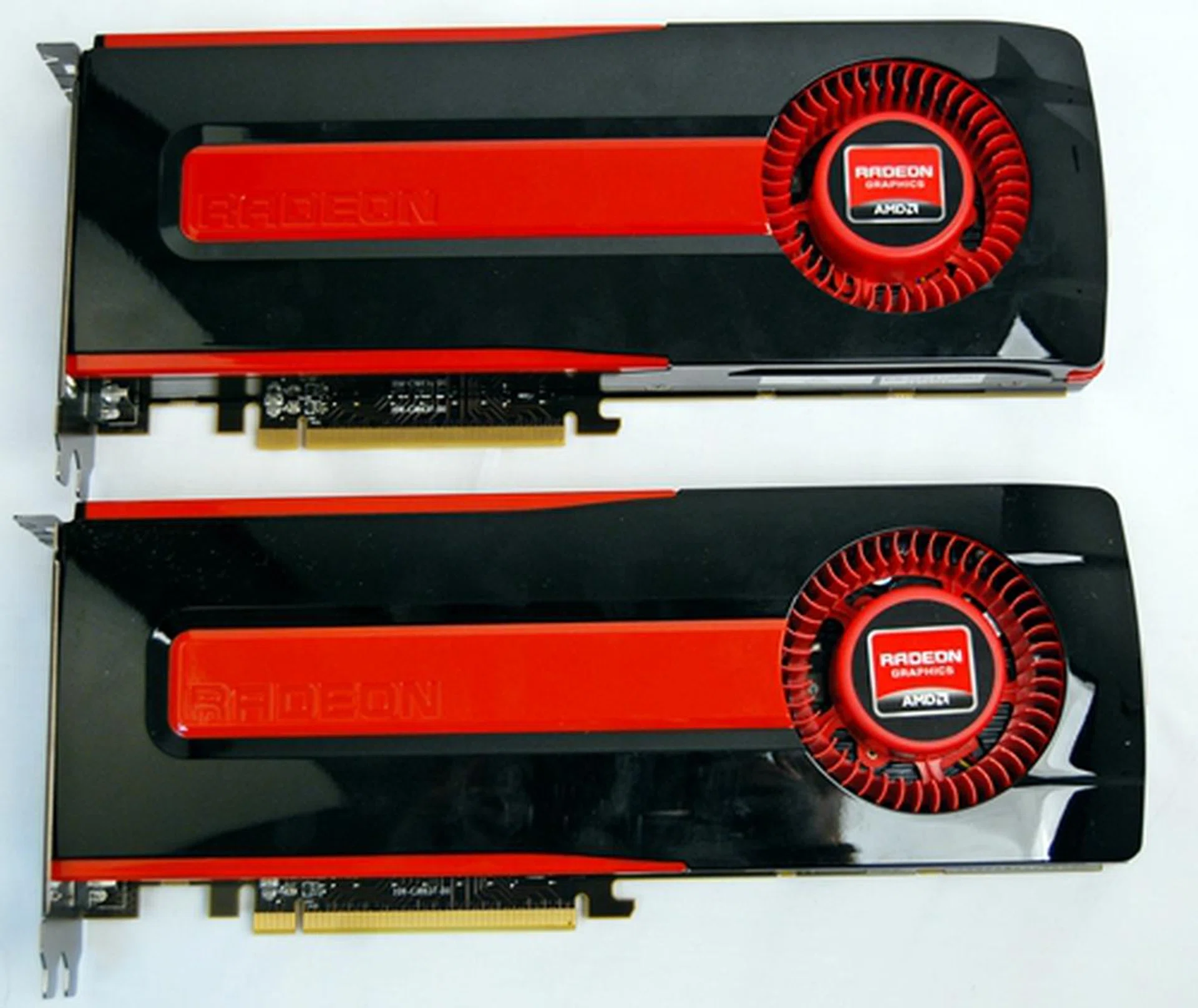
They may look identical (7970 is on top) but their differences are skin-deep. AMD has beaten NVIDIA to launch their first 28nm GPUs and garner another first-of-sorts by introducing components that are PCIe Gen 3.0 compliant.
The overclocking potential of the Southern Island cards are also commendable as we were able to push the cards to the limit with Radeon HD 7950, with its overclocked GPU core rated at 1100MHz, just 25MHz short of the maximum rate of 1125MHz. From our time with the reference cards, we believe that there is more overclocking potential for them as we see slowly begin to see further variants with customized coolers as well as tweaking software to assist in over-volting these cards and push them further.
In terms of the pricing of the card, AMD has aimed the Radeon HD 7950 squarely at the fastest single-GPU offering from NVIDIA, i.e., GeForce GTX 580. This NVIDIA part currently retails at about ~S$750 which makes the Radeon HD 7950 competitively priced as it retails at a similar price point or less. Factor in multi-monitor gaming possible via EyeFinity 2.0 on just a single GPU (unlike the GTX 580) and it seems like the deal is sealed if you're looking for a top-tier GPU. What's not to like? Probably the lack of a full 3D solution such as the NVIDIA 3D Vision kit. If you really dig that option, regardless of the fact that AMD can support 3D gaming, the problem is getting the glasses and middleware for them. This is where NVIDIA still retains the lead in this niche market.
Its elder brother retails at about S$850 which makes it ideal for bragging rights as it is the first 28nm GPU with a spanking new AMD GCN graphics architecture. It's however hardly 'affordable' even for those with deep pockets because for S$950 to S$1000, you can grab the very best the market has to offer such as the GeForce GTX 590 or the Radeon HD 6990 dual-GPU graphics cards. This is the reason why many are making a din in the online space of AMD's steep pricing, but let's face it - AMD has to charge a premium when it can afford to do so. In this case, it has a reason to charge premium given its performance and pole-position for a single GPU graphics card. If not for its price, we feel that the Radeon HD 7970 is a good product on its own and in time to come, it will be more competitively priced. Check out the retail pricing of these graphics cards updated weekly by our team.
Currently, it seems that AMD has the upper hand but with the impending launch of NVIDIA's first 28nm GPU, the GK107 in April, it remains to be seen if AMD will lose its first-to-market advantage in the graphics arena.
|  |

Our articles may contain affiliate links. If you buy through these links, we may earn a small commission.