
Sony and AMD teases new GPU tech in PS6
We also get the first crumbs of when the Sony’s new console could release, apparently in “a few years time.”
Note: This feature was first published on 14 October 2025.
In a recent video published by PlayStation, the PlayStation 5’s lead architect, Mark Cerny, had a chat with AMD’s Jack Huynh, senior vice president and general manager of the Computing and Graphics Group, about the results of a Sony-AMD partnership called Project Amethyst, and how they could be implemented in next-generation consoles.
In the process, Cerny threw a bone to those waiting for news of a potential PlayStation 6, noting that the upcoming technologies talked about in the video could appear in a future Sony console “in a few years time.”

The first of these technologies Cerny and Huynh talked about were Neural Arrays, which aim to tackle the intense load that upscaling features like AMD’s FSR and Sony’s PSSR places on the GPU. Instead of subdividing problems for individual compute units in the GPU to handle, Neural Arrays aim to connect each CU within the shader engine to “share data and process things together,” with the ability to “process a large chunk of the screen in one go.”
Another technology highlighted was the Radiance Core, a new hardware block which handles ray tracing and path tracing in real time, building off of AMD’s Neural Radiance Cache that it unveiled in Computex. The Radiance Core will be fully responsible for ray traversal, or locating the intersections between the rays of light and geometry, giving the GPU more resources for shading (GPUs currently handle both when it comes to ray tracing).
The final technology showcased was Universal Compression, which is designed to tackle current memory bandwidth limitations on GPUs that would hinder the implementation of these next-gen rendering technologies. The idea behind Universal Compression is fairly simple, in that it evaluates all data headed to memory and compresses it.
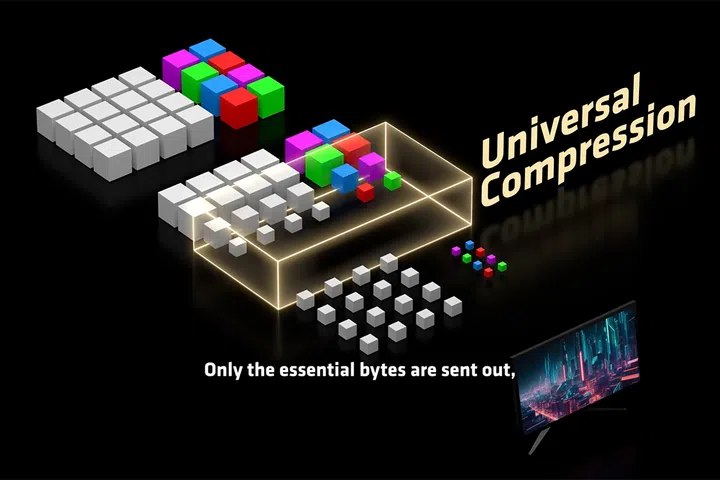
Universal Compression deals with limited GPU bandwidth by compressing all data heading towards memory.
It’s also similar in concept to Delta Color Compression, which, in its PS5 and PS5 Pro implementation, compresses data for visual elements such as textures and render targets.
While these new developments do sound promising, we’re still far away from seeing them in practice; as Cerny noted in the video, these technologies are in their infancy, existing only “in simulation” for now.
We’re also still quite a long ways away from the next PlayStation. Since it began in 2020, we’ve only reached the halfway point of the ninth generation of consoles, perhaps exacerbated by the PS4 and Xbox One having a relatively large install base even now, thanks in part to their successors’ rocky launch amidst a global chip shortage.
But this video gives us a brief look into what improvements a PS6 could have over current-gen consoles, and it looks like a large part of it is efficiency and performance boosts to the GPU, particularly for ray tracing and upscaling. We’ll find out the fruits of Sony and AMD’s co-engineering when “in a few years” rolls around.