
Samsung SSD 950 Pro: A high-end drive for Skylake system builders
Samsung recently unveiled their latest and fastest ever consumer drive - the SSD 950 Pro. It supports both PCIe 3.0 (x4) and NVMe protocol and offers performance that’s three times that of conventional SATA SSDs. We put it through its paces to find out just how fast it is.

A new flagship SSD
For the past four years, Samsung has made important new SSD announcements at its annual SSD Global Summit. In 2012, it announced the SSD 840 and SSD 840 Pro. A year later it was the SSD 840 Evo. And last year, we saw the SSD 850 Pro - the world’s first consumer SSD to use 3D V-NAND.
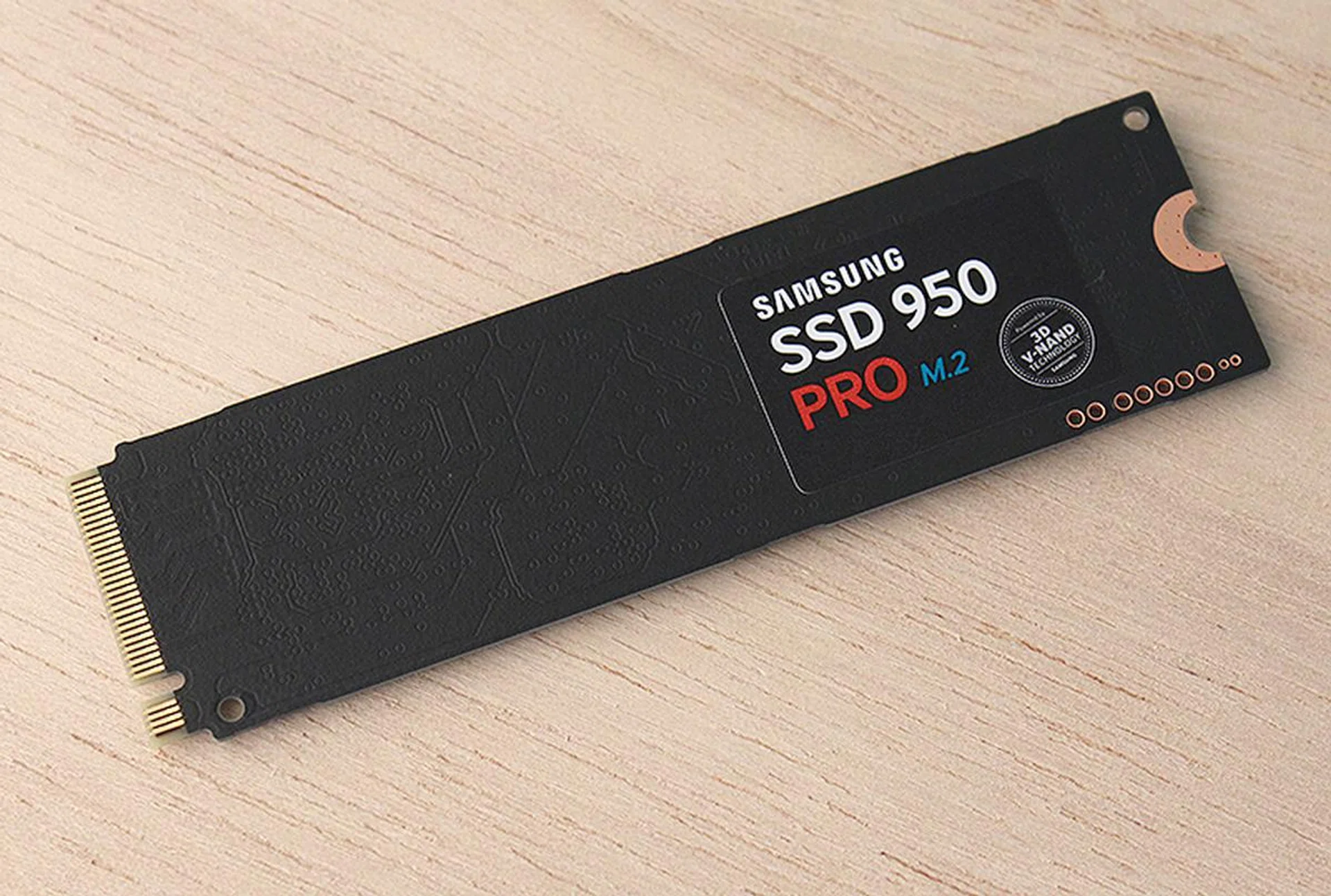
Behold ladies and gentlemen, I present Samsung's fastest consumer SSD.
This was a big deal and if you are still unfamiliar with 3D V-NAND, we suggest you read this and this first (go ahead, we'll wait for you). Speaking of 3D V-NAND, Samsung is rebranding it to just simply V-NAND (Vertical NAND). It’s a small change, but one that we suspect will make more sense to consumers, or at least make it easier to understand. 3D V-NAND probably sounds a little intimidating to some.
This year, Samsung is building upon the momentum with the SSD 950 Pro - Samsung's new flagship consumer SSD and also their first M.2 SSD to use the PCIe interface and also support the new NVMe protocol.
The SSD 950 Pro
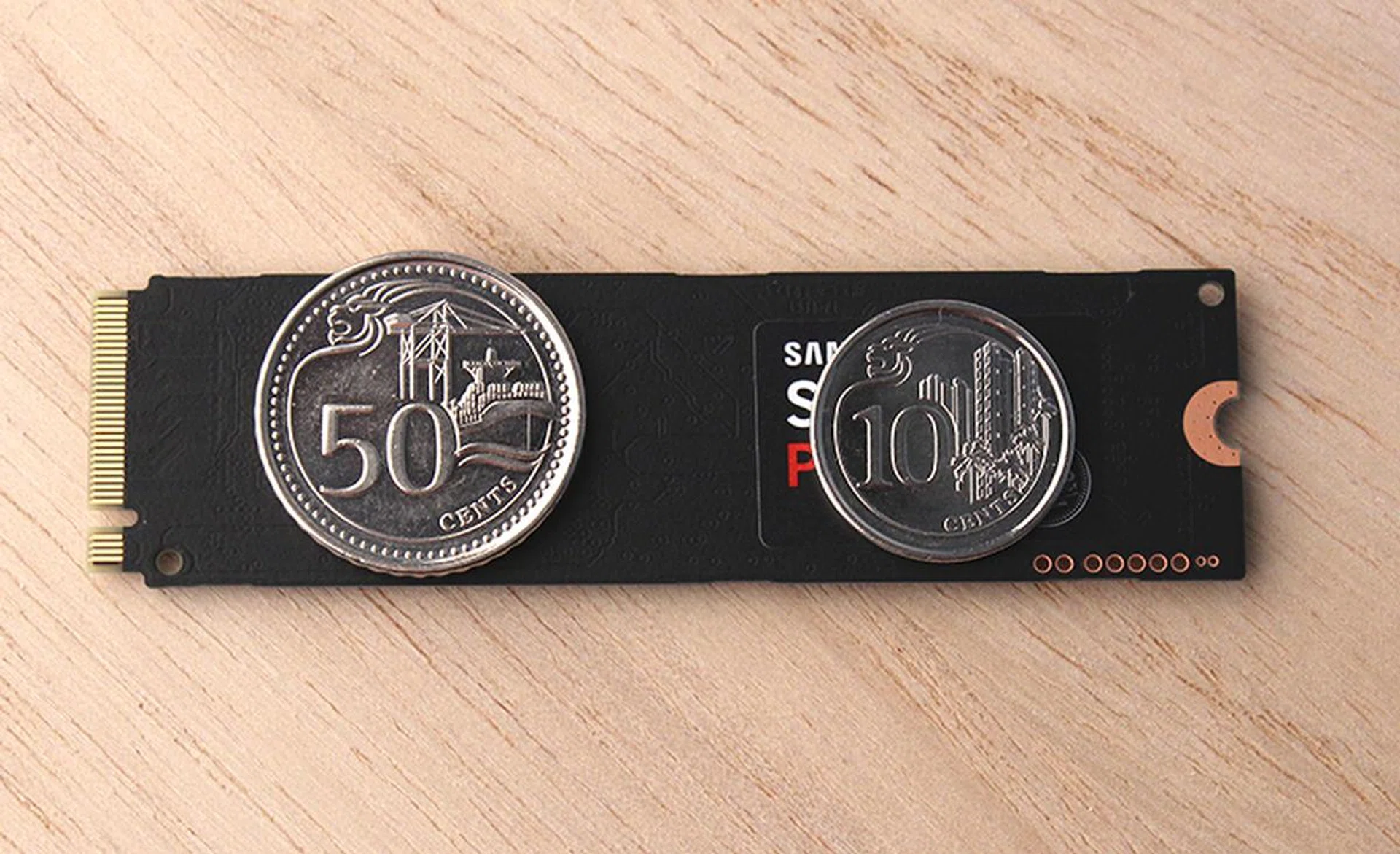
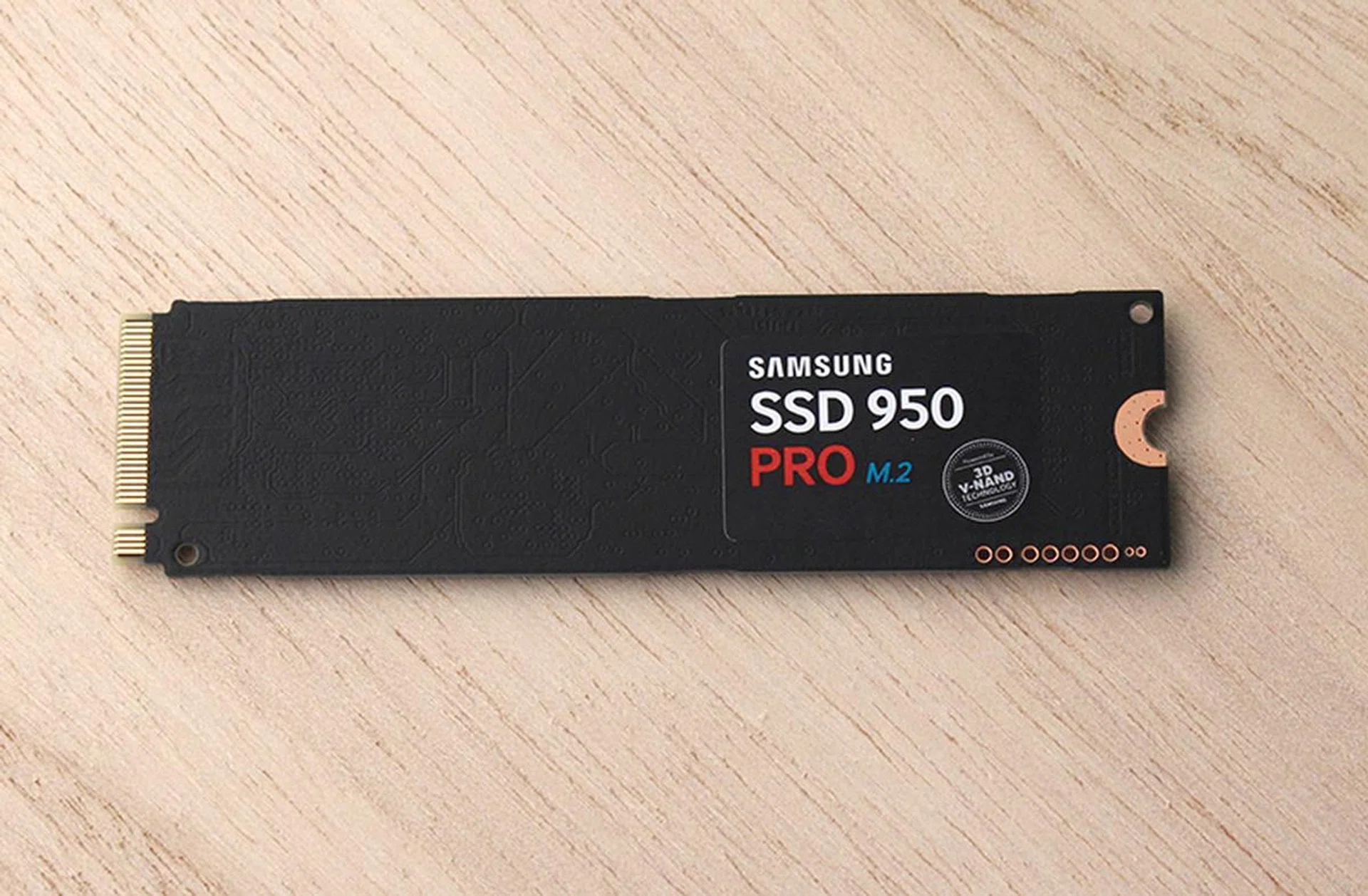
The SSD 950 Pro is really small.
This year we expected something special, and we weren’t disappointed. For so long, SSDs have been hampered by the aging SATA interface and arcane AHCI protocol, and Samsung addressed these shortcomings in one fell sweep with the new SSD 950 Pro. It’s notable for a few reasons:
- It uses V-NAND
- It uses the M.2 form factor and PCIe 3.0 (x4) interface
- It supports the latest NVMe protocol.
What this means is that the SSD 950 Pro will be able to offer sequential read and write speeds well in excess of 1GB/s - yes, 1000MB/s. The SSD 950 Pro will be offered only in 256GB and 512GB capacities for now, and the faster half-terabyte model can offer sequential read and write speeds of up to 2500MB/s and 1500MB/s respectively, while the slower 256GB model that we have here is rated at 2200MB/s read and 900MB/s write. That means it’s around two to three times faster than conventional SATA SSDs. But note that these speeds can only be achieved with the correct hardware. We'll address this in the conclusion of our review.
Like the Samsung SSD 850 Pro from last year, the SSD 950 Pro uses MLC V-NAND. There are still 32 stacked layers, but Samsung has managed to increase memory density to 128Gbit - crucial because there’s precious little real estate on an M.2 stick. Even so, the SSD 950 Pro currently tops out at 512GB, but there are plans to offer 1TB versions in the near future as V-NAND technology matures and memory density increases. Incidentally, it's worth noting at this point that the SSD 950 Pro uses the M.2 2280 form factor, meaning it's about 22mm wide and 80mm long.
The biggest highlight of the SSD 950 Pro is arguably its support the new NVMe protocol. NVMe or Non-Volatile Memory Express was developed expressly for PCIe-based SSDs, and supersedes the old AHCI protocol, with the goal to improve storage performance. In a nutshell, NVMe allows for more commands per queue and also more queues, to take advantage of the extremely low latency of flash-based storage.
And to support NVMe required a new controller, so you will find the UBX controller within the SSD 950 Pro. For those of you follow SSD developments closely, you’ll know that the UBX controller is not new and currently sees action in Samsung’s OEM-only SM951 SSD. The UBX controller features three cores running at around 500MHz and also communicates to the NAND packages through eight NAND channels.
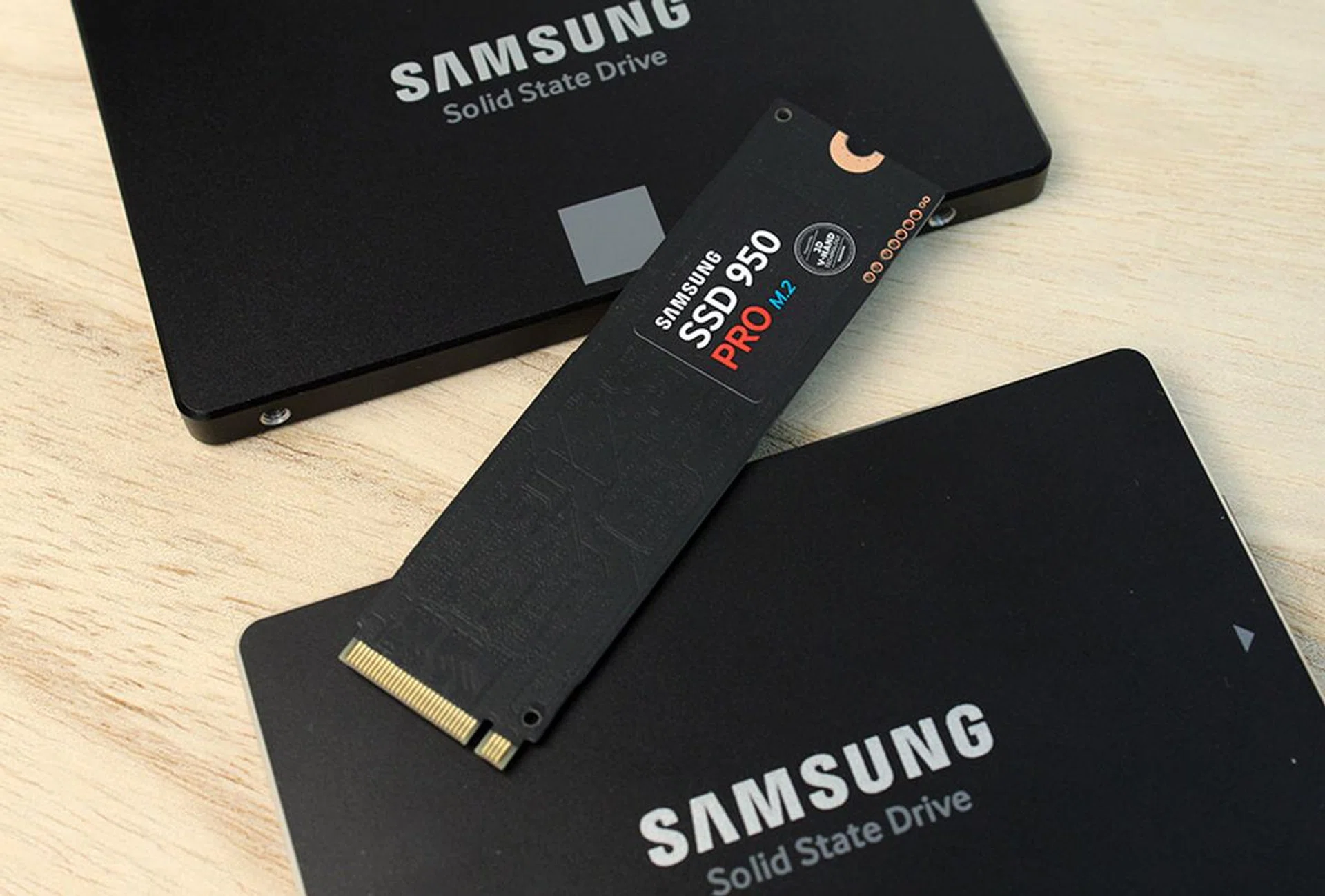
Samsung has strangely decided to offer only 5-year long warranties on the SSD 950 Pro. It's still plenty, but last year's SSD 850 Pro had 10-year long warranties.
Endurance is a hallmark of V-NAND and the 256GB SSD 950 Pro is rated for up to 200TBW, while the 512GB variant is good for 400TBW. Compared to the SSD 850 Pro of similar capacities, this is over 100TB more. Yet despite the higher endurance, Samsung is cutting back warranty on the new SSD 950 Pro to 5 years. This is a bit of a disappointment because the SSD 850 Pro offered 10-year long warranties. We'll discuss this in greater depth in our conclusion.
And like all other Samsung drives, the SSD 950 Pro works with Samsung’s excellent Magician utility. Magician is Samsung’s drive management utility and it lets users easily optimize their drives, monitor the drive’s status, update the firmware, clone and migrate data, and more. Even if more brands are following suit and offering their own drive management utilities along with their drives, Samsung's Magician remains to be one of the best drive management utilities available.
Test Setup
The Samsung SSD 950 Pro will be tested on our brand new storage testbed which has the following specifications:
- Intel Core i7-4770K (3.5GHz)
- ASUS Z97-Deluxe/USB 3.1 (Intel Z97 chipset)
- 2 x 4GB DDR3-1600 memory
- MSI GeForce 8600 GTS
- Windows 10 Pro
We have also revised our benchmarks with the latest software which includes PCMark 8. The list of benchmarks used are as follows:
- AS-SSD benchmark 1.8.5636.36856
- CrystalDiskMark 5.0.2
- PCMark 10 (Storage suite)
- Atto Disk Benchmark 3.0.5
- Iometer (version 2006.07.27)
Astute readers familiar with Z97 motherboards will probably notice that the Z97 motherboard that we are using only has a M.2 slot that supports up to PCIe 2.0 x2, in others words up to 10Gbps, which means it may not be maximizing the performance potential of the Samsung SSD 950 Pro, which actually uses the PCIe 3.0 x4 interface. However, considering the lack of Z97 motherboards that actually support PCIe 3.0 x4 over M.2, we feel that our setup is a good representation of the majority of users today and will be a good indication of what kind of performance you can get from Samsung's latest and greatest if you are using a typical Z97 setup.
We will be pitting the Samsung SSD 950 Pro against the fastest SATA-based SSDs in the market today which includes drives like Samsung's own SSD 850 Pro as well as Plextor's M6 Pro, SanDisk's Extreme Pro and OCZ's Vector 180. Granted, it's not an entirely fair match, but there aren't many PCIe-based M.2 SSDs in the market right now, plus we think it will be interesting to see how Samsung's latest matches up against the quickest SATA-based SSDs in the market today.
Here is the list of drives tested:
- Samsung SSD 950 Pro
- Samsung SSD 850 Pro
- OCZ Vector 180
- Plextor M6 Pro
- SanDisk Extreme Pro
PCMark 8
PCMark 8 is the latest benchmarking software from benchmarking specialists Futuremark. It was designed for Windows 8 machines and the storage suite test puts drives through a collection of 10 different real life workloads involving applications such as Photoshop, Illustrator, InDesign, Word, Excel and even games like Battlefield 3 and World of Warcraft.
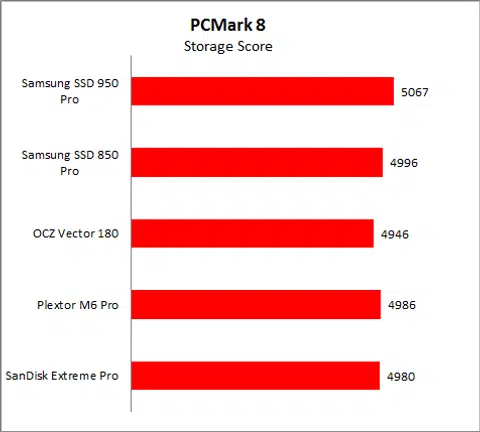
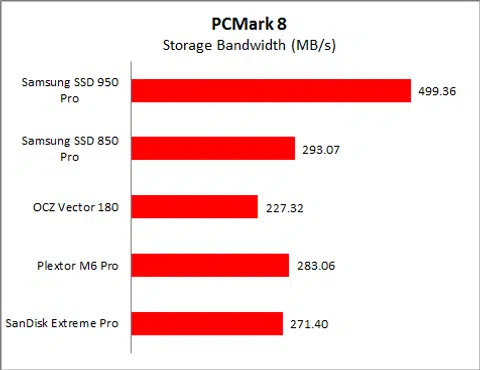
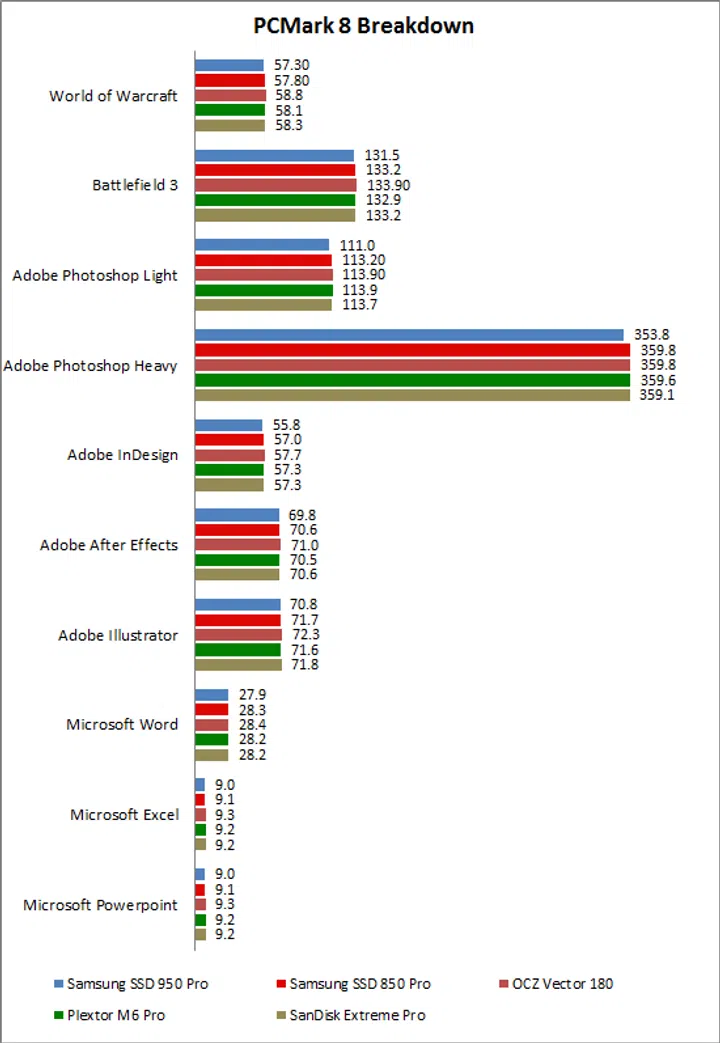
Unsurprisingly, the new Samsung SSD 950 Pro was the top performer after racking up a score of 5067 points. Though it was a scarce 71 points or 1% more than the second-placed Samsung SSD 850 Pro, the storage bandwidth results reveal a different story. With an average speed of 499.36MB/s, the SSD 950 Pro was actually a whopping 70% quicker than the SSD 850 Pro and other comparable high-end enthusiast SATA-based SSDs. Finally, moving on to the breakdown of the individual workloads, we can see that the SSD 950 Pro was consistently the quickest drive.
CrystalDiskMark 5.0.2 Results
CrystalDiskMark is an easy-to-run and quick utility to use to gauge a drive’s performance. It measures sequential read and write performance and random read and write speeds of random 4KB and 4KB (queue depth 32) data.
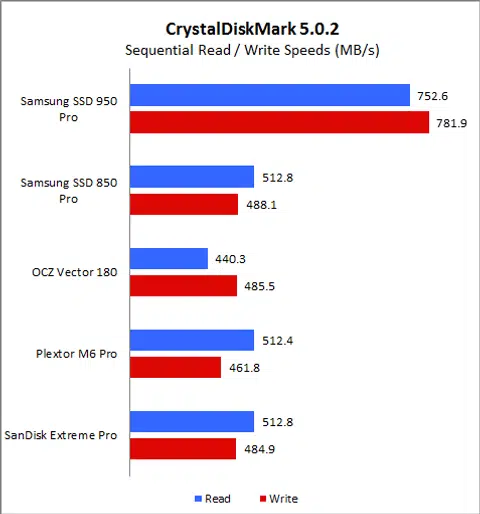
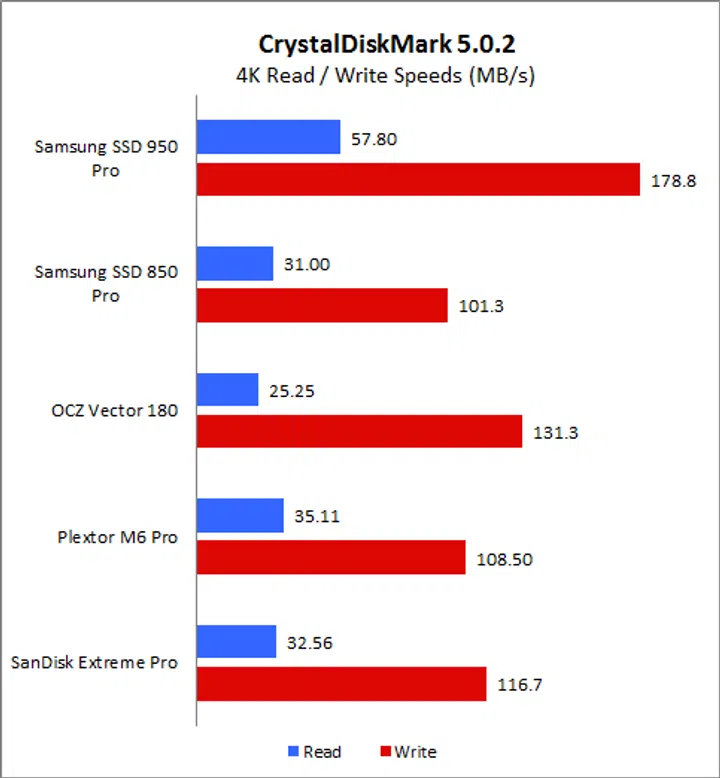
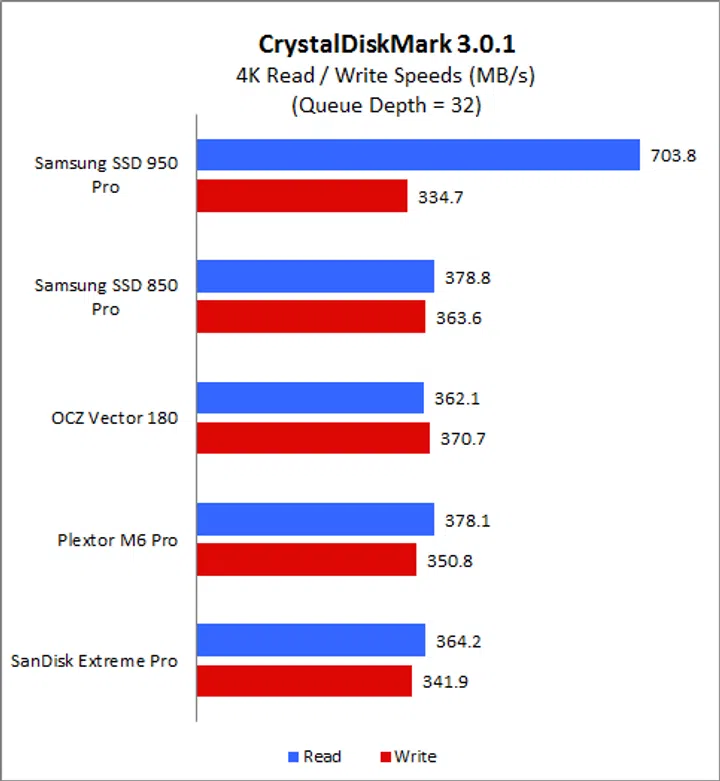
Thanks to the higher bandwidth offered by the PCIe M.2 interface, the Samsung SSD 950 Pro’s sequential performance was unmatched by any SATA-based drive. Overall, the SSD 950 Pro’s sequential read and write speeds were over 50% faster than the fastest SATA-based SSDs in the market today. The SSD 950 Pro was adept at handling smaller 4K data blocks too, read speeds were at least 60% than the second-placed Plextor M6 Pro, while write speeds were 35% quicker than the second-placed OCZ Vector. Finally, while performance on the intensive 4K, 32 queue depth workload was generally good - read speeds were over 85% faster - it suffered from poor write speeds. Here, the SSD 950 Pro managed just 334.7MB/s, over 10% slower than the leader, the OCZ Vector 180. Considering its stellar performances thus far, we believe this could be an NVMe driver issue that would hopefully be rectified soon as the protocol technology matures.
AS SSD 1.8.5636.36856 Results
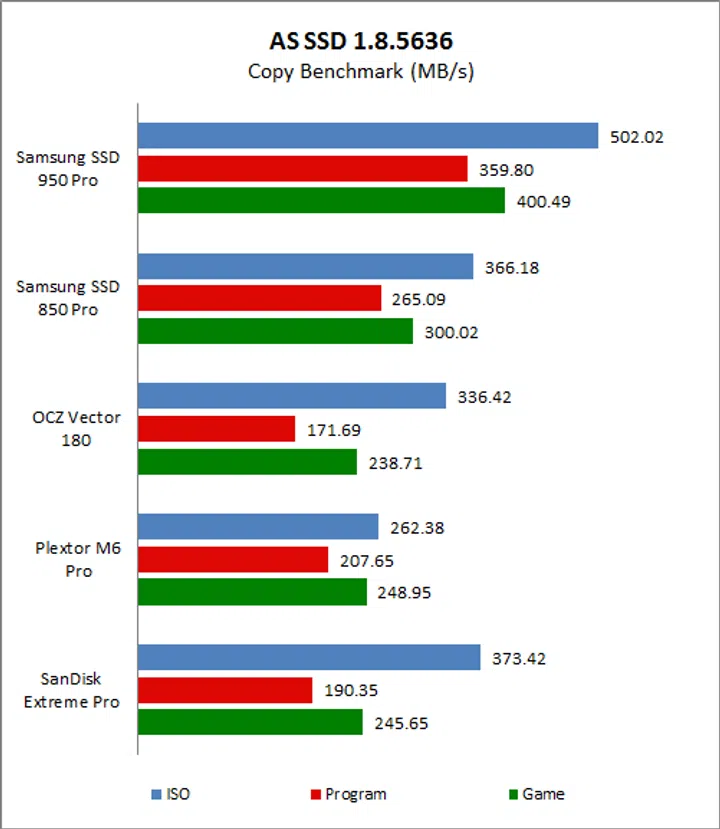
AS SSD is a benchmark that uses non-compressible and completely random data. This benchmark is useful because some controllers, like the once popular but now defunct SandForce SF-2281, compress data first before moving them around. However, with non-compressible and random data, controllers cannot compress the data first, which forces them to deal with data as they are. Therefore, this is a useful benchmark to prevent drivers using controllers like the SF-2281 controller or similar from gaining an upper hand.
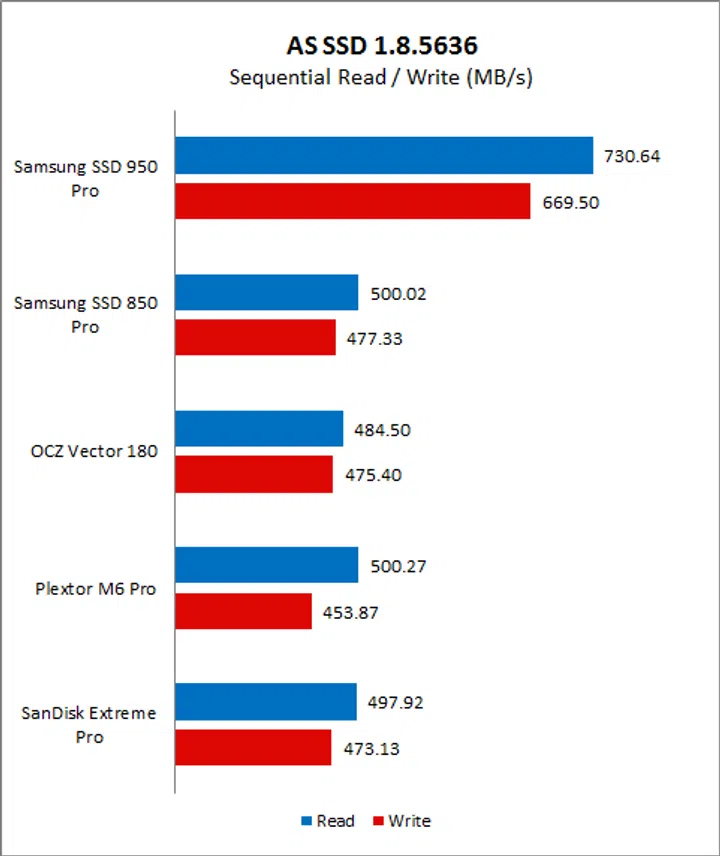
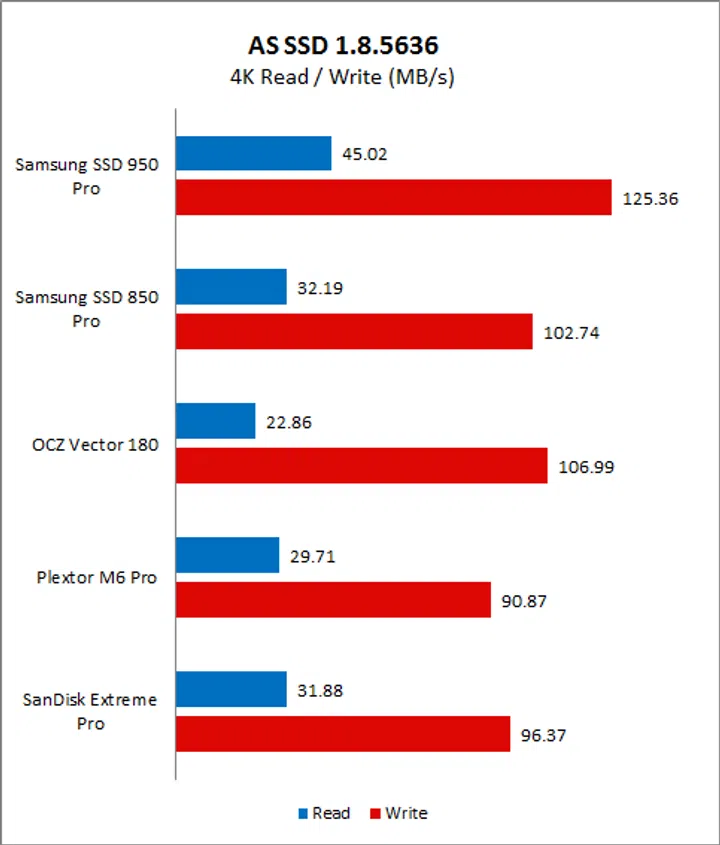
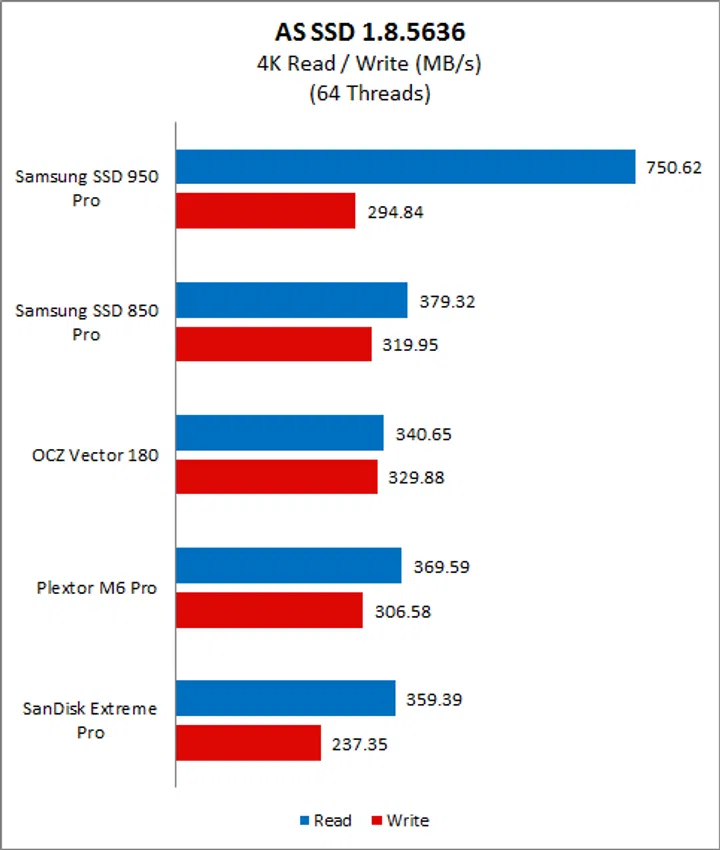
Beginning with the Copy Benchmark which simulates copy workloads of different types of files, the Samsung SSD 950 Pro was again the comfortable leader. Overall, it was about 35% quicker than all the other SATA-based drives here, which is certainly significant. Moving on, its sequential read and write speeds were predictably impressive and were about 43% quicker overall than the fastest SATA-based drives in the market today. However, we noticed that its write performance in the 4K, 64 queue depth workload was underwhelming and not in line with our expectations. Clearly, write performance in high queue depth scenarios is proving to be problematic for this drive and needs to be addressed.
ATTO Disk Benchmark 3.0.2 Results
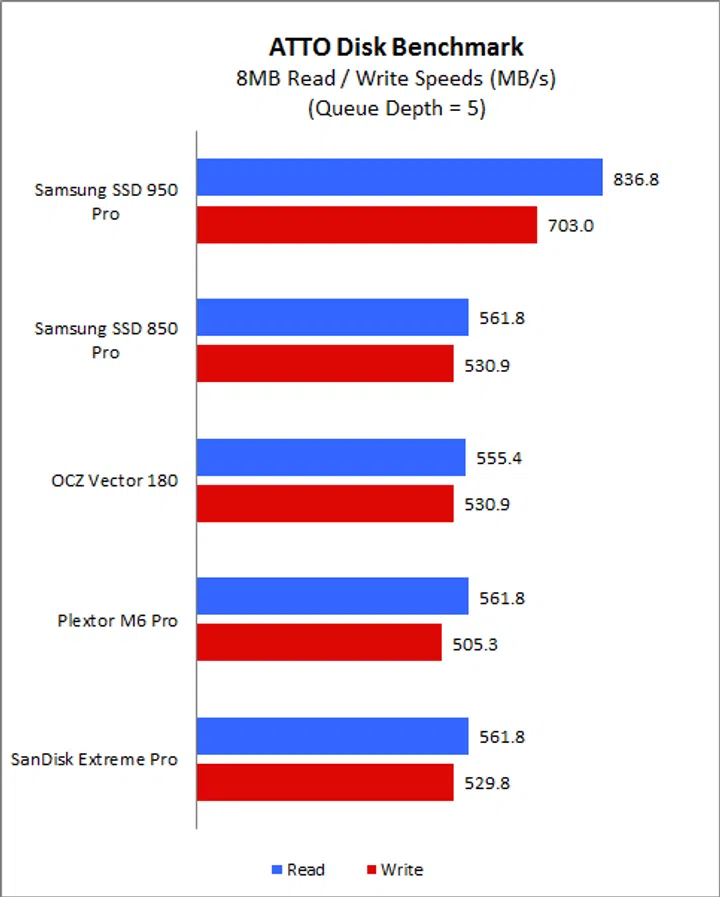
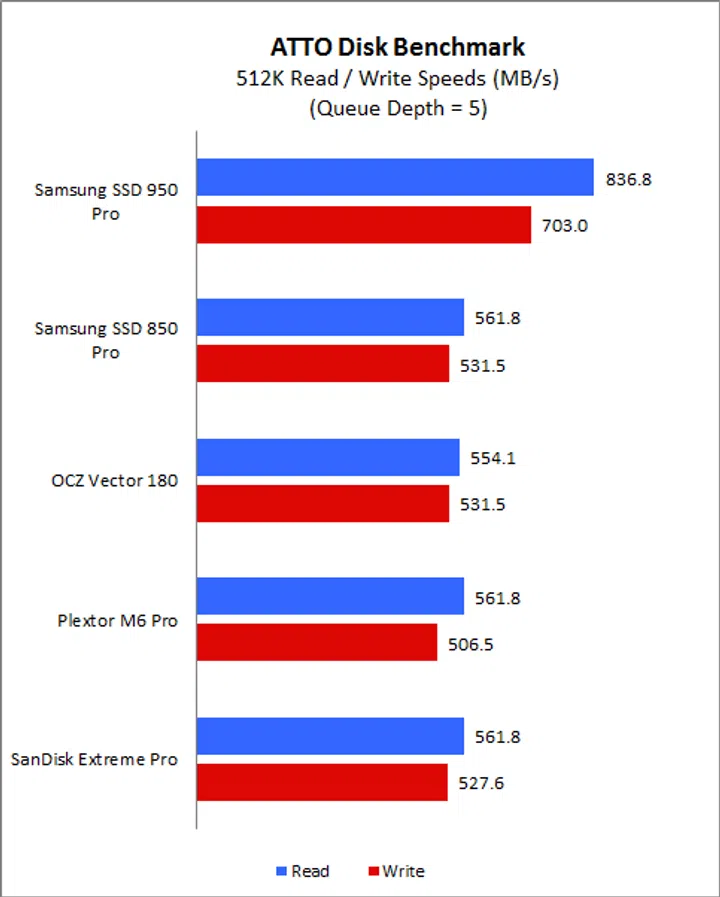
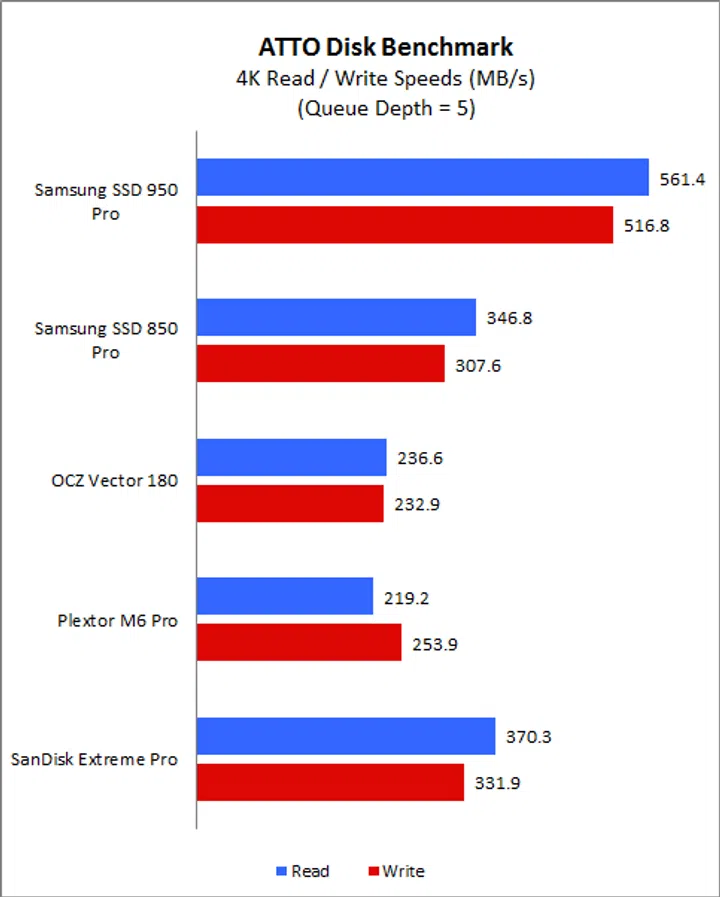
ATTO is one of the oldest benchmarks around, but it’s still a useful tool to gauge a drive’s adeptness at managing compressible data. It’s also useful for seeing how a drive performs across a variety of different transfer block sizes. Unsurprisingly, the Samsung SSD 950 Pro was the quickest drive, across all data block sizes. Over larger 512K and 8MB data blocks, the Samsung SSD 950 Pro’s read speeds were close to 50% faster than the fastest SATA-based SSD, whereas write speeds were a more modest 32% or so quicker. But it’s on smaller 4K data blocks that the SSD 950 Pro really showed its prowess, its read and write speeds were both over 50% faster.
Iometer Results (Part 1)
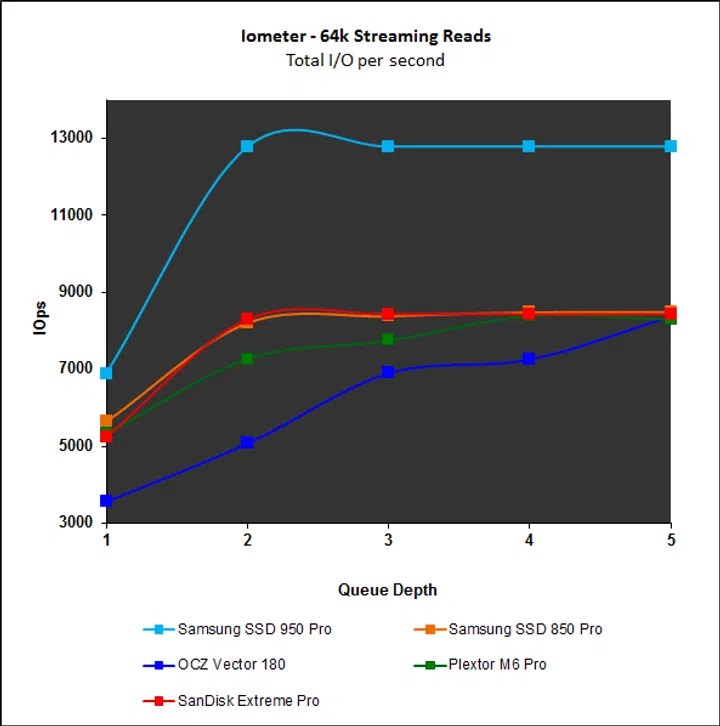
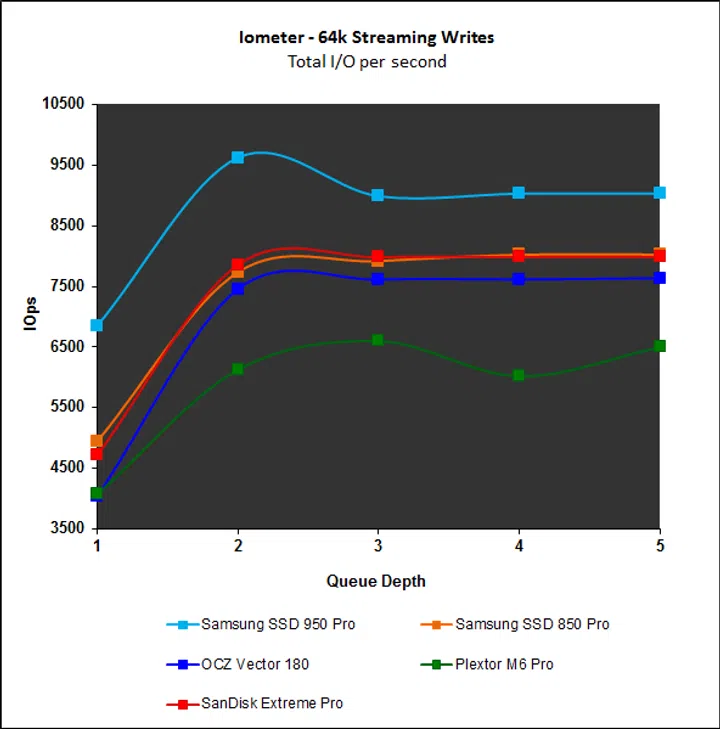
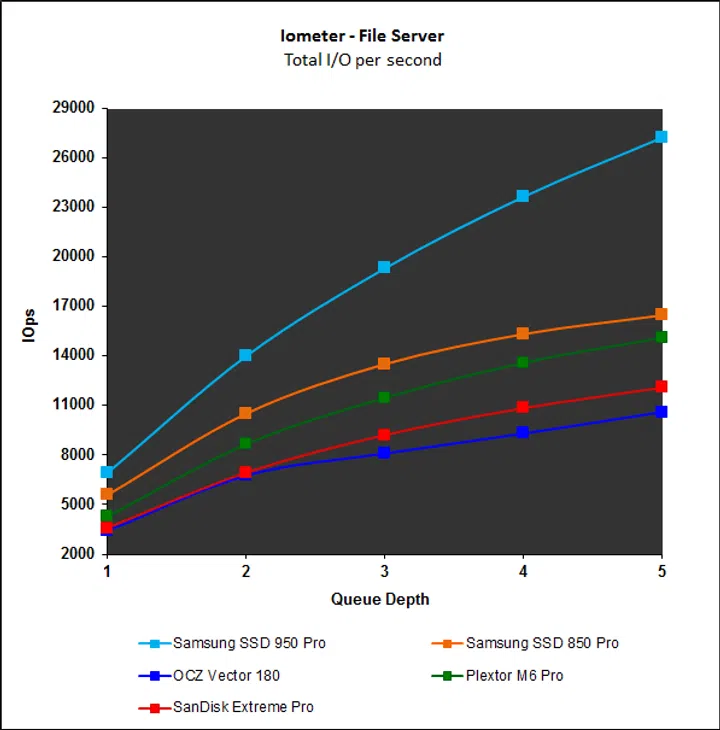
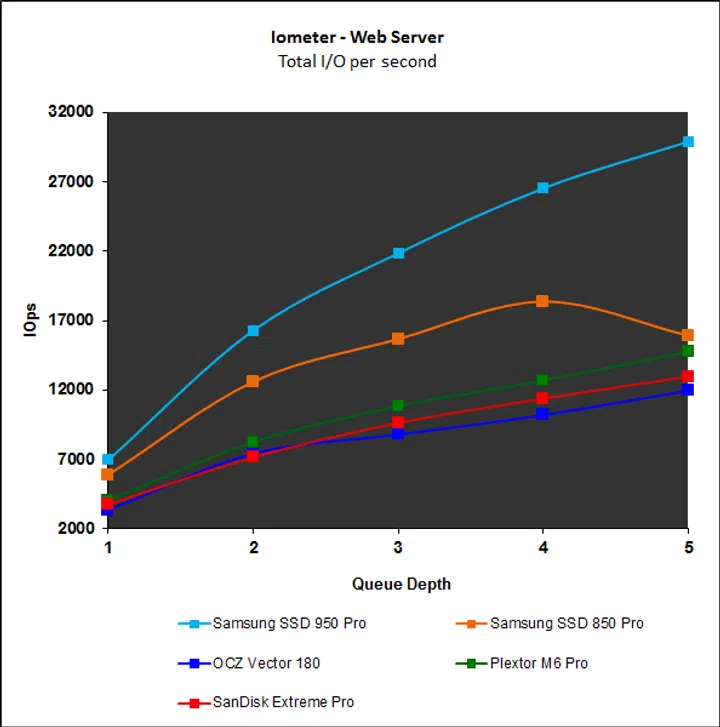
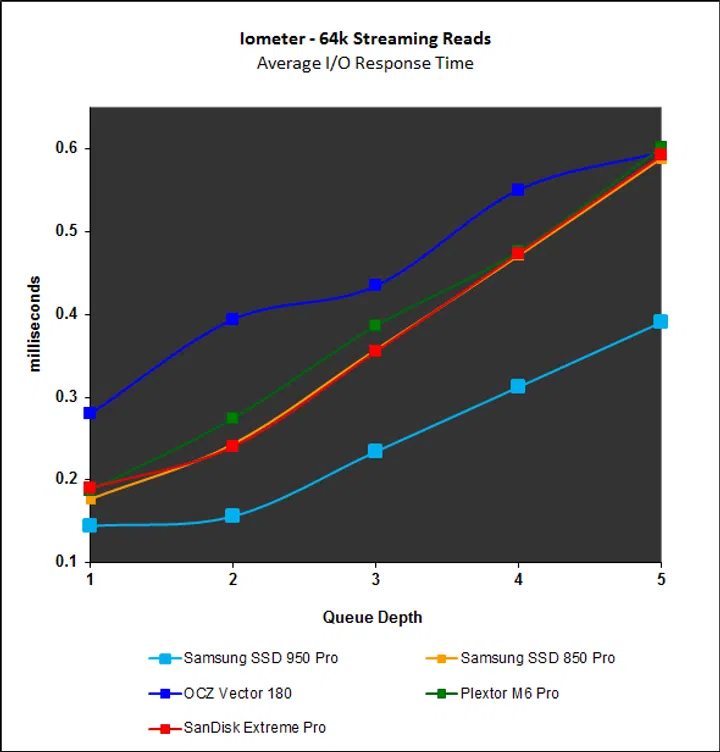
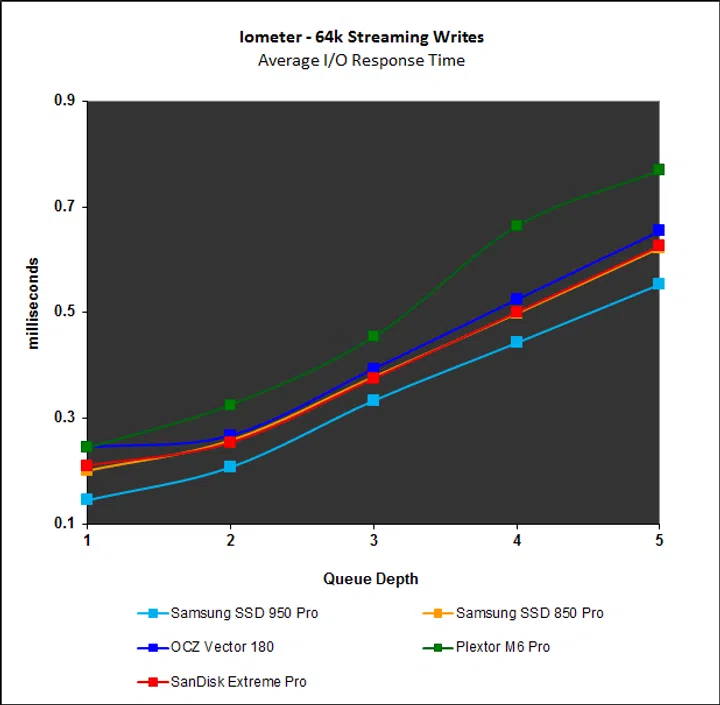
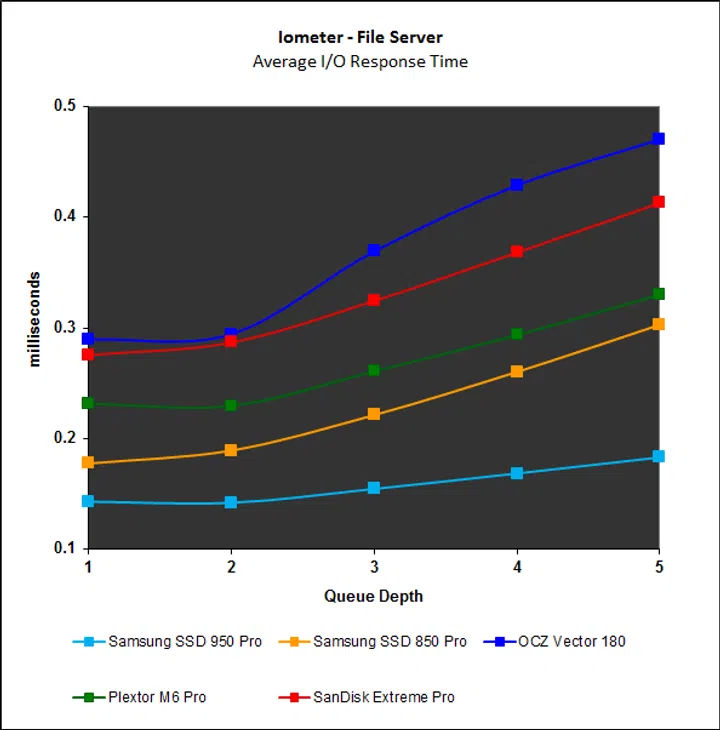
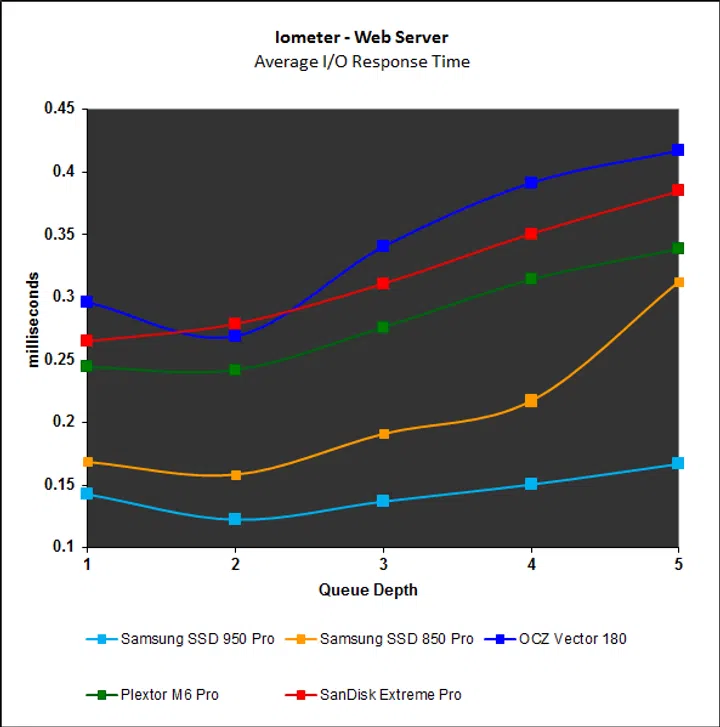
Lastly, we put the drives through the rigorous grind of Iometer, with different workloads and I/O queue depths. We have chosen to show results from a queue depth of 1 to 5 as this better represents the workloads a typical consumer might face. On Iometer, the Samsung SSD 950 Pro showed that it was clearly a lot faster than the current crop of top SATA-based SSDs. It recorded nearly double the number of IOPs on the 64K streaming reads workload and was around 10% to 15% quicker on the 64K streaming writes workloads. Its performance on the intensive File and Server workloads blew the other drives out of the water as queue depth increased.
Iometer Results (Part 2)
Finally, we look at the I/O response times for the workloads reported on the previous page. Finally, we look at the I/O response times for the workloads reported on the previous page. Unsurprisingly, considering the performance we saw on the earlier page, the Samsung SSD 950 Pro recorded the quickest response times amongst all the drives here. On the File and Web server workloads, we can see that its response times were nearly half that of the other drives, which explains its stellar performance on these workloads on the previous page.
An elite drive for elite users
The new SSD 950 Pro Samsung’s latest flagship consumer SSD and it is absolutely cutting-edge in terms of the technology that’s on show and the features it offers. First and foremost, it uses Samsung’s new V-NAND technology which offers improved performance and endurance over existing 2D planar NAND. Secondly, it uses the very latest M.2 form factor and PCIe 3.0 x4 interface, which gives it maximum bandwidth to strut its stuff. And finally, it supports the latest NVMe protocol, which was developed specially for PCIe-based SSDs to reduce latency and improve performance.
Performance is, as you would expect, absolutely stunning when compared to SATA-based SSDs. Overall, in our tests, we found that the SSD 950 Pro was around 30% to 50% faster depending on the work load involved. And as we mentioned, it could probably have been faster if not for our motherboard’s limited M.2 bandwidth.
Speaking of which, this is a potential problem for users looking to upgrade to the SSD 950 Pro. Beware, nerd talk ahead. As we have detailed, the SSD 950 Pro supports up to PCIe 3.0 x4, whereas most Z97 motherboards today have M.2 slots that only support PCIe 2.0 x2. If you do the math, the difference in bandwidth is quite great. PCIe 3.0 x4 carries up to 8GT/s which translates to around 32Gbps or 4GB/s, whereas PCIe 2.0 x2 carries 5GT/s but because of less efficient coding, effective transfer rates are really in the region of around 8Gbps or 1GB/s.
To take full advantage of the SSD 950 Pro requires a suitably high-end system.
What this really means for users looking to upgrade to the SSD 950 Pro is that to maximize this uber SSD, you would either need one of the latest Z170 motherboards (check out our shootout here) or a Z97 motherboard that has M.2 slots that support PCIe 3.0 x4. The latter is really quite hard to find. To the best of our knowledge, only the ASRock Z97 Extreme6 and Extreme9 have M.2 slots that support PCIe 3.0 x4. There could be others, but prepared to spend lots of time eyeballing specifications to verify if they do. The last option is to get a PCIe 3.0 x4 to M.2 adapter, but we are guessing purists won't like the idea of an extra component acting as an intermediary.
Another potential issue is the lack of mature NVMe drivers. As we mentioned in our test setup, we opted to use Samsung’s NVMe drivers for the test because the native Windows 10 NVMe drivers weren’t quite up to the task - we consistently recorded write performance that were poorer than even SATA-based SSDs. And while Samsung’s driver’s did improve performance, there are issues that need to be ironed out, especially with regards to write performance at high queue depths where performance was much lower than expected.
One of the most curious aspect of the SSD 950 Pro is the shorter 5-year warranty. When quizzed, Samsung’s response was that the higher endurance ratings of the new SSD 950 Pro would make up for the shorter warranty periods. But if it’s has better rated endurance, why not just keep the warranty at 10-years then? We could speculate on the various reasons behind this move, but while the shortened warranty (as compared to the SSD 850 Pro) is surely disappointing, 5 years is still plenty - probably enough to last you until your next upgrade. Even so, it’s fair to say that most of us will feel shortchanged.
Model | Capacity | Price | Cost per Gigabyte |
SSD 950 Pro | 512GB | S$599 | S$1.17 |
SSD 950 Pro | 256GB | S$369 | S$1.44 |
SSD 850 Pro | 512GB | S$394 | S$0.77 |
SSD 850 Pro | 256GB | S$217 | S$0.85 |
Finally, let’s talk about pricing. Samsung has been very aggressive with its pricing strategy and the 256GB variant of the SSD 950 Pro will have a recommended retail price of S$369. Should you require more storage, the 512GB variant is S$599. Looking at the cost per gigabyte figures, the larger 512GB drive is obviously more cost effective.
Obviously, this means that the SSD 950 Pro is much more expensive than the top SATA-based SSDs. Even prices of Samsung’s last flagship, the SSD 850 Pro, has come under the magic a dollar a gigabyte mark - the 256GB variant can be had for around S$217. Comparable drives like the Plextor M6 Pro and SanDisk Extreme Pro are all going for around the same amount too. This means that the SSD 950 Pro costs around S$150 or 70% more. That’s quite a huge premium.
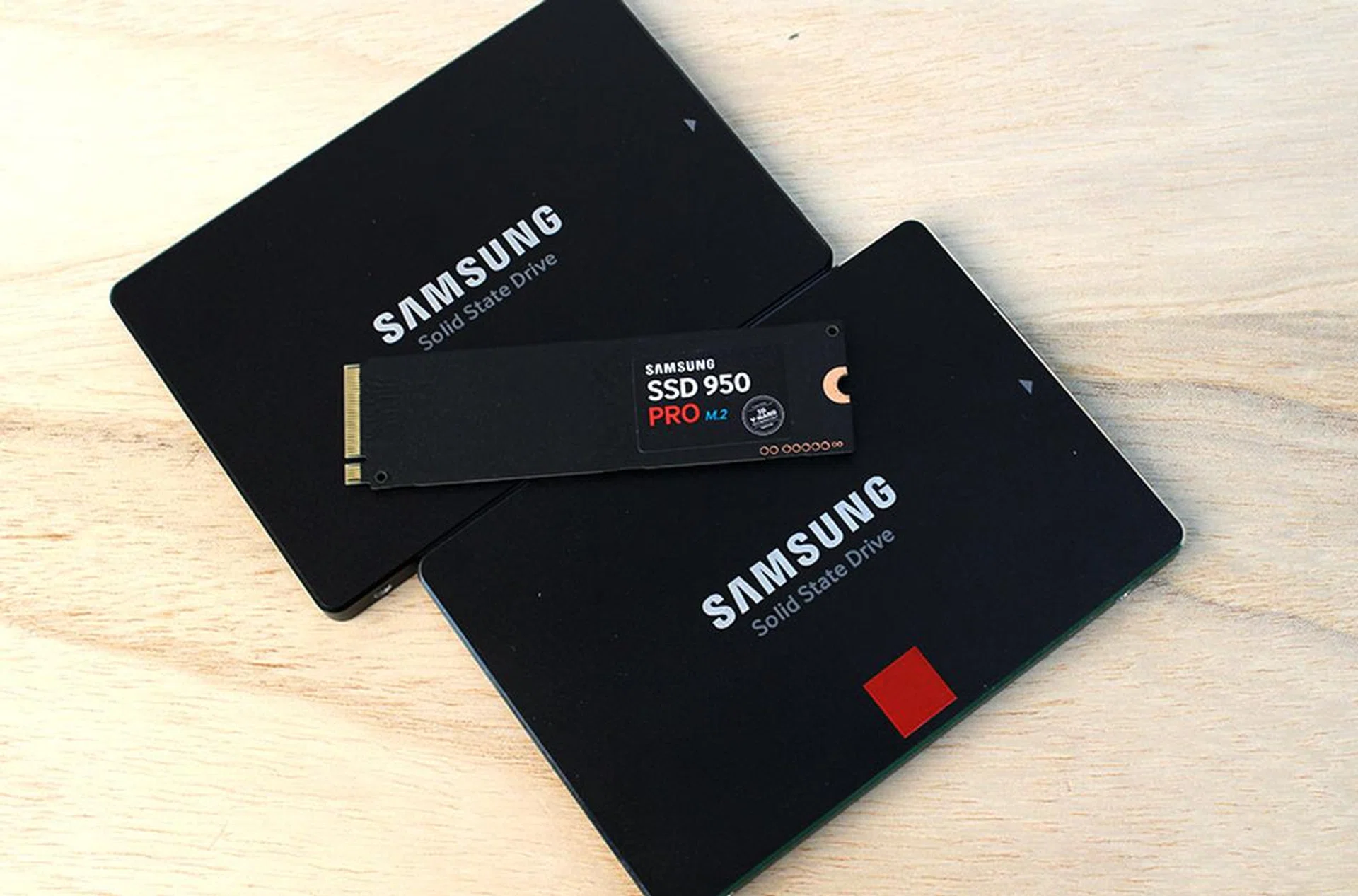
The new SSD 950 Pro costs substantially more than its SATA-based predecessor, but then it also offers loads more performance.
But look at it from another way. There’s a lack of PCIe-based M.2. drives at the moment, much less one that supports the new NVMe protocol, and the same goes for PCIe SSDs. And if you were to look at the prices of these drives, you would find that the Samsung SSD 950 Pro is actually competitively priced. The M.2 variant of the Plextor M6e, for instance, retails for around S$319 - S$50 less - but only supports PCIe 2.0 x2 and does not offer support for NVMe. The closest competitor is probably Intel's new SSD 750 Series, which supports PCIe 3.0 x4 and NVMe, but it's considerably pricier. To sum up, the premium can be justified, but only if you have a rig with a M.2 slot that supports PCIe 3.0 x4 and NVMe or don't mind using a PCIe 3.0 x4 to M.2 adapter, which would then let you get the most out of your investment. If you are currently in the midst or planning to upgrade to a Skylake system, the SSD 950 Pro would be an ideal companion drive. Otherwise, Samsung's older SSD 850 Pro is definitely no slouch.
To sum up, the Samsung SSD 950 Pro is a cutting-edge drive that befits Samsung’s status as one of the leaders in the consumer SSD space. It’s blazing fast and comes with a good warranty package and high endurance rating. However, to get the most out of it would require users to have a highly spec'ed or very modern rig. Also, NVMe drivers today still need some work as performance is still not quite consistent. But if these minor issues do not bother you, then this is easily one of the best drives you can get.
Our articles may contain affiliate links. If you buy through these links, we may earn a small commission.