
Leadtek WinFast A7600 GT TDH (GeForce 7600 GT 256MB, AGP)
Christmas has come early for those still hanging on to their AGP systems, for the GeForce 7600 GT is the latest GPU to spawn an official AGP variant. Featuring the same core and memory clock speeds as the PCIe version, the Leadtek WinFast A7600 GT TDH promises much, but can it deliver? Read on.

AGP Still Alive and Kicking
If hardware manufacturers had their way, we would all be using PCI Express motherboards and graphics cards by now. After all, the previous generation of graphics cards was supposed to be the start of the PCI Express era. Those graphics processors were already on PCI Express natively and the odds of AGP surviving that transition seemed quite remote. Of course, the chipmakers had miscalculated the inertia of the general populace. There was still demand for AGP variants and subsequently, ATI and NVIDIA both implicitly acknowledged this by introducing AGP versions through their Rialto and High Speed Interconnect (HSI) bridge chips respectively.
Fast forward to the present generation, where we have all seen a jump in graphics performance and growth in dual graphics cards configurations like SLI and CrossFire. Practically all the new motherboards in the market use the PCI Express interface only. One would think that AGP would finally be gone with all these new developments but it seems that there are still users clinging on to their aging systems. So, it is perhaps inevitable that the AGP interface was soon popping up for the latest graphics chipsets, especially for the lower end and mainstream. The latest chipset to undergo this AGP makeover is none other than the respectably mid-range GeForce 7600 GT.
Unlike the low profile GeForce 7800 GS, which was a diluted GeForce 7800 GT, there have been no compromises for the AGP version of the GeForce 7600 GT. The number of pipelines remains the same, along with identical clock speeds for both core and memory. So the only difference is the presence of the High Speed Interconnect chip and hence, the AGP compatibility. Here's a look at the first such AGP GeForce 7600 GT that we have received, the Leadtek WinFast A7600 GT TDH:
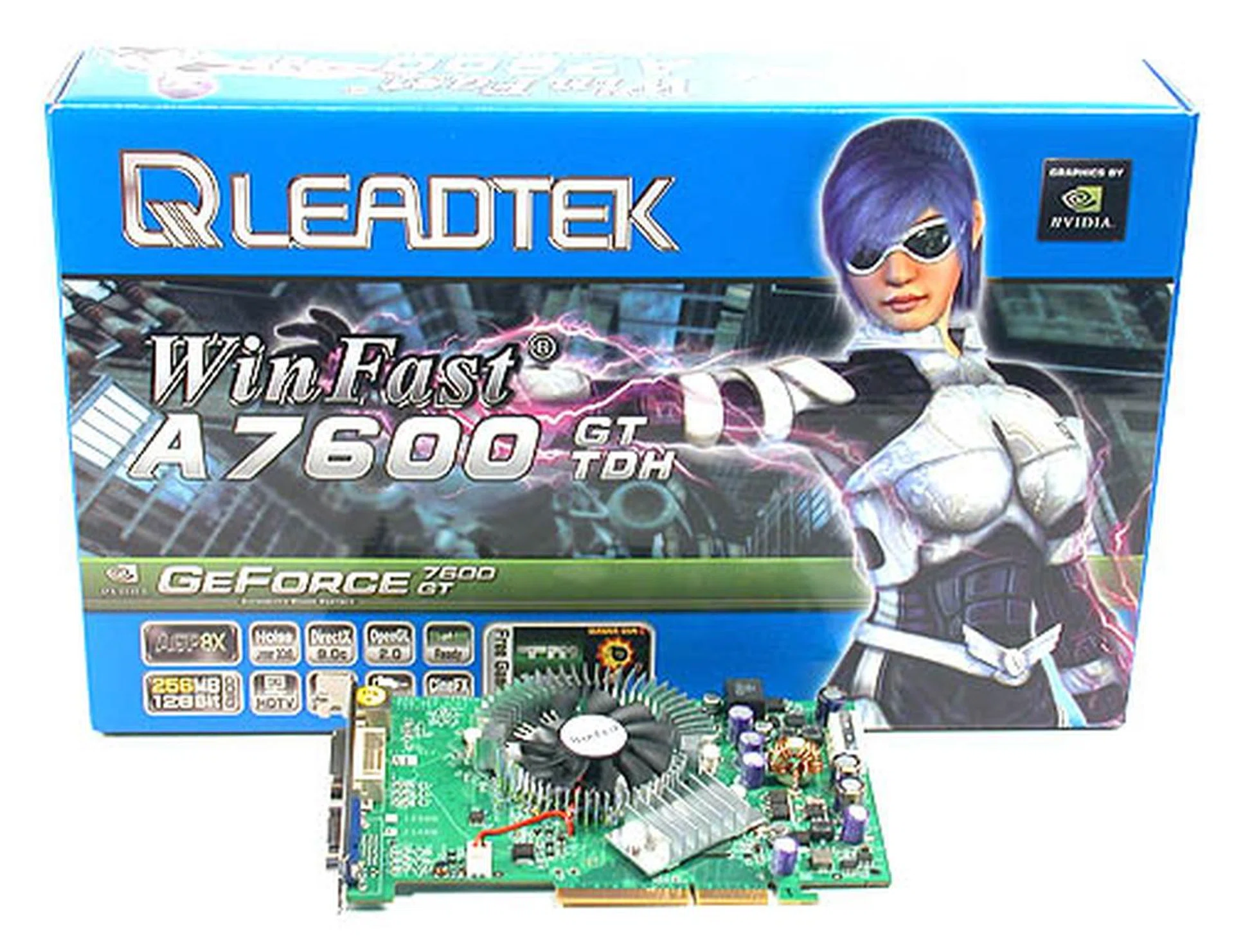
There's hope for those who can't bear to ditch their AGP systems but still hankering after the latest games.
The Leadtek WinFast A7600 GT TDH
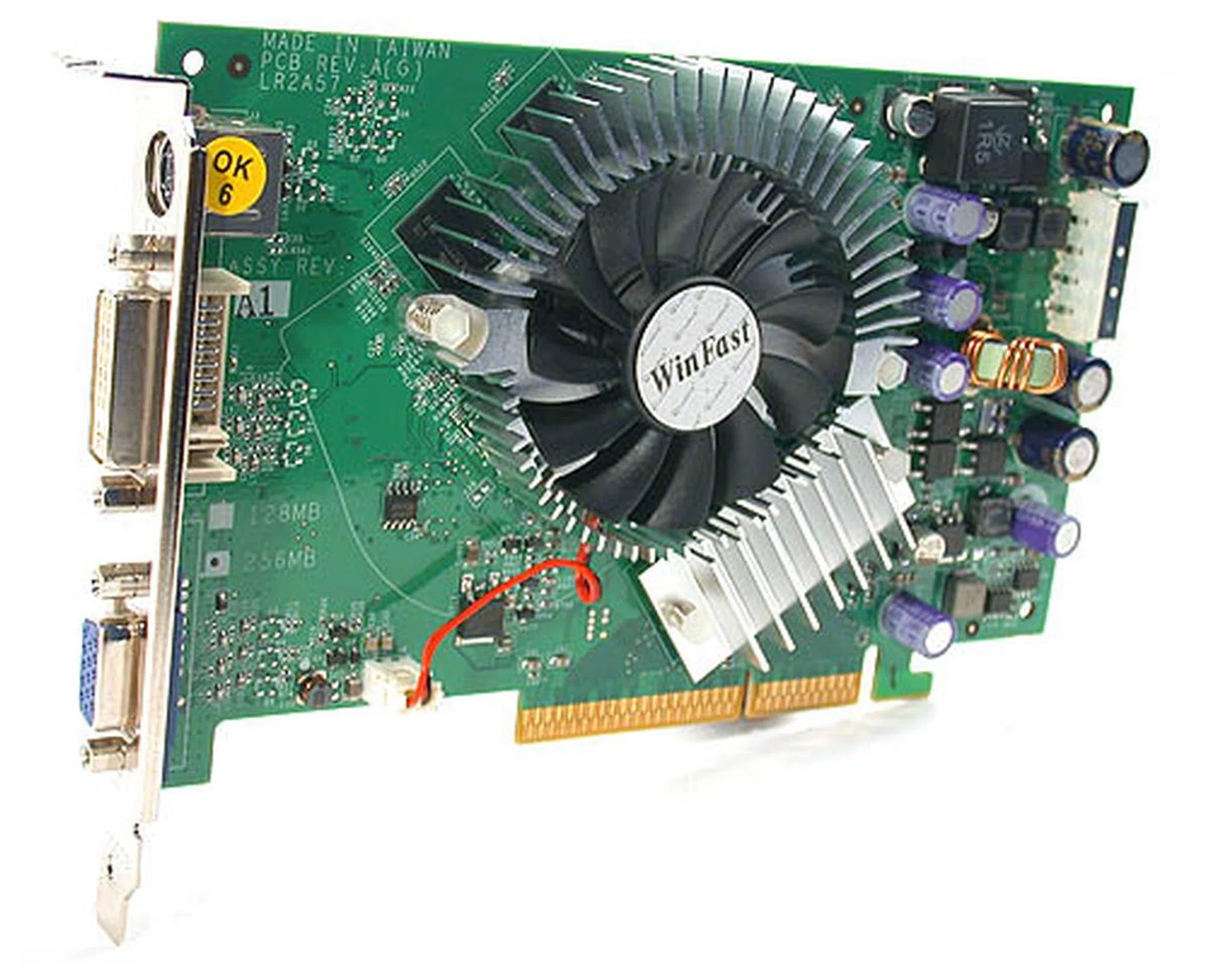
As you may notice from the nomenclature of this product, the 'A' in A7600 GT TDH model means that this is the AGP variant. But we won't blame you if you mistook this GeForce 7600 GT for Leadtek's own classic GeForce 6600 GT card. The usual Leadtek choice of a classic green PCB is complemented by a modest circular cooler design that looks exactly like the one on its GeForce 6600 GT. Due to its open design, the fan does not spin particularly fast so this card is relatively silent. The retro feel is strengthened by the presence of the power connector, which is required due to the power demands of the core and the 'weak' AGP interface that no longer can supply the power required by the new generation of cards. Even older AGP cards like the GeForce 6600 GT and 6800 GT required extra power directly from the power supply unit.
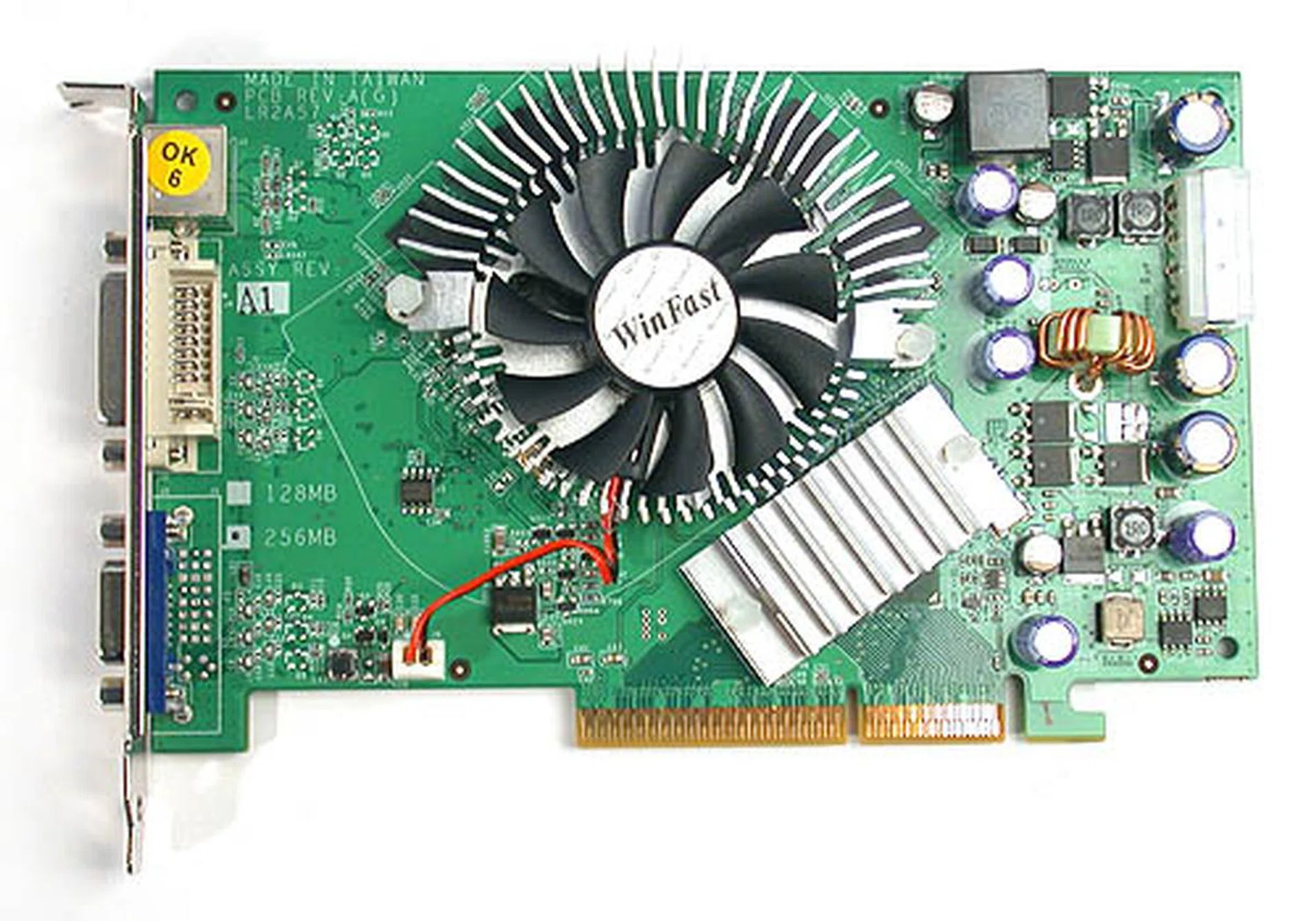
The Leadtek WinFast A7600 GT TDH has a certain retro charm about its classic green PCB and similarities with Leadtek's own GeForce 6600 GT.
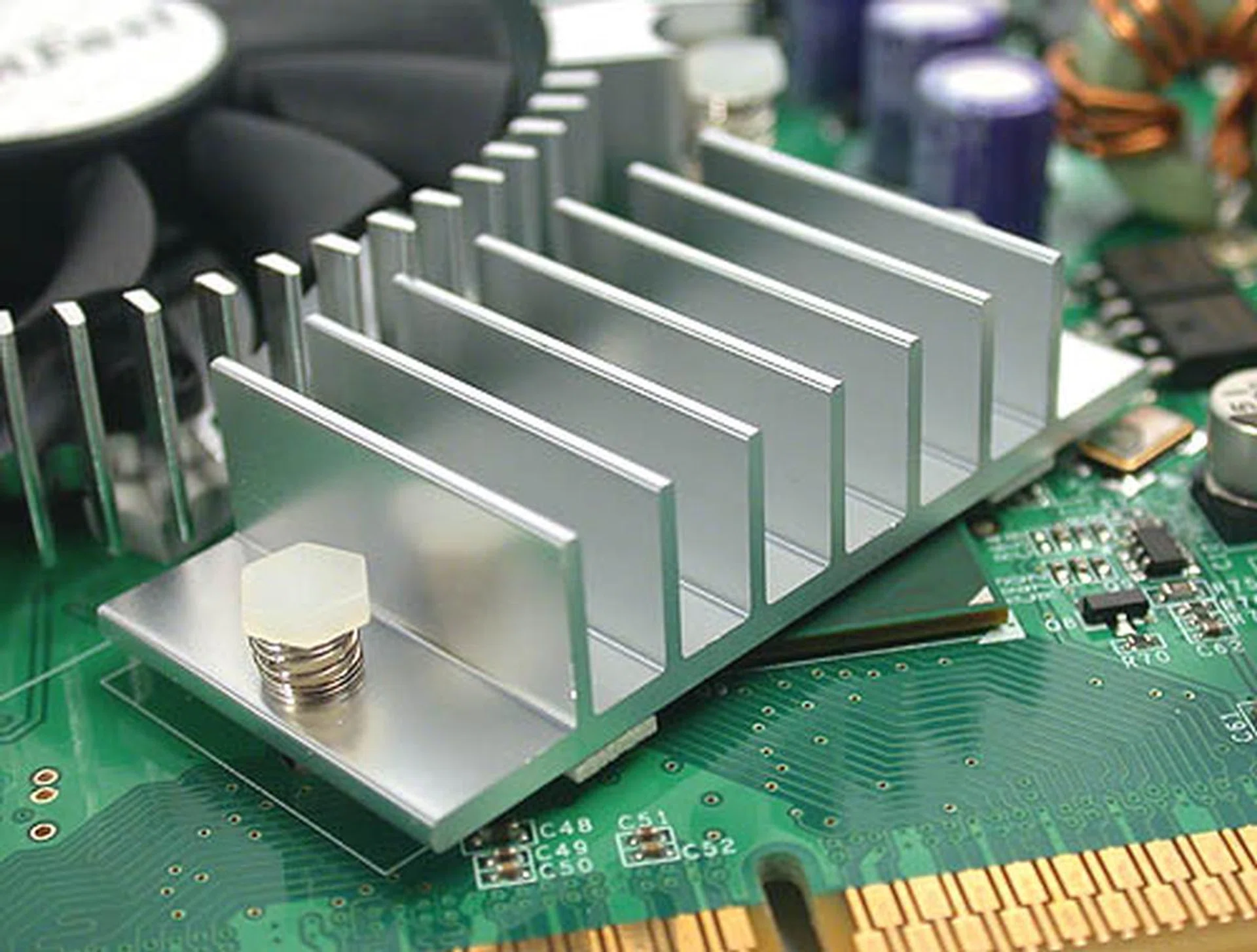
Beneath this heatsink is the bridge chip that makes it all possible, the High Speed Interconnect that allows the native PCIe GPU to 'talk' through the AGP interface.
The standard clock speeds for a GeForce 7600 GT is followed, meaning that the G73 core runs at 560MHz. The 1.4ns rated DDR3 RAM also runs at the reference 1400MHz DDR. In short, this looks like a faithful port of the GeForce 7600 GT to the AGP interface and one should get more or less the same performance as the original. One of the differences from a reference GeForce 7600 GT is the replacement of one of the DVI outputs on the Leadtek with an analog VGA output. This is understandable given that if you're still using an old AGP system, chances are that you lack a display that accepts DVI input.
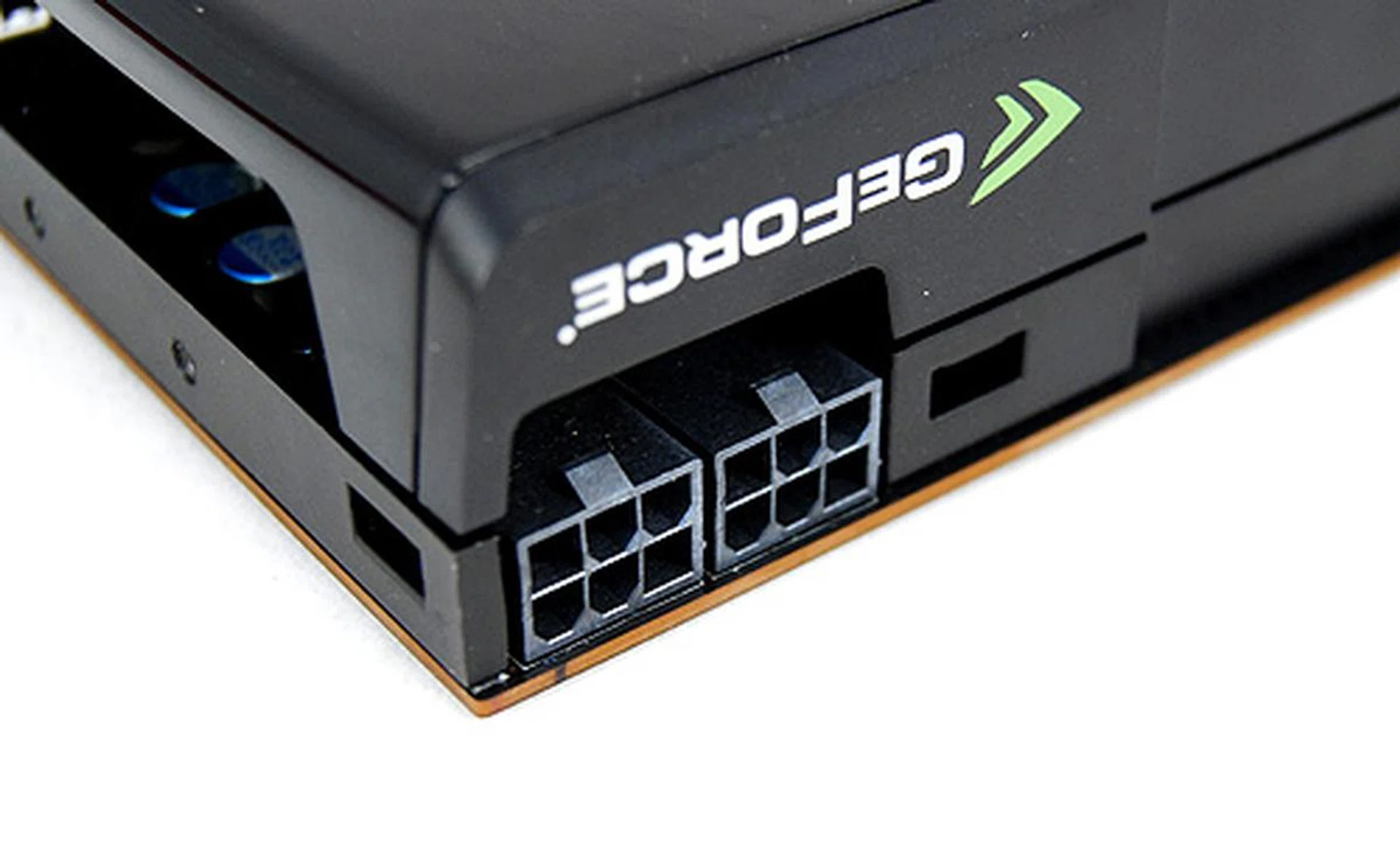
Since the AGP slot cannot provide enough power for this chipset, there is an external power connector and it too looks rather old-school.

One of the differences between the AGP and PCIe version - there is only one dual-link DVI output for the AGP compared to the full set of two on the original.
Leadtek has provided a rather comprehensive bundle for a mid-range product. Besides the usual accessories like a 9-pin mini-DIN to Component and S-Video dongle and a DVI-to-VGA adapter, we found a few gems among the software along with more obscure offerings. For example, CyberLink's Power DVD is almost a staple for DVD playback, MuVee 3 is available for video editing needs (though this card does not have video capture abilities), while Serious Sam II is a fun sequel to a popular first person shooter. However, there is also the less heralded game, Trackmania Nations. The items below sum up what you can expect from the package:
- 1 x DVI-to-VGA adapter
- 9-pin mini-DIN to S-Video/Component dongle
- User Manual
- Driver CD
- CyberLink Power DVD 6.0
- MuVee 3
- Trackmania Nations (full game)
- Serious Sam II (full game)
Test Setup
Brushing off the dust from our AGP testbed, we put it back into action for this unexpected GeForce 7600 GT entrant. This system consisted of an Intel Pentium 4 3.0GHz (800MHz PSB) processor on a reference Intel D875PBZ board and was equipped with two sticks of 512MB DDR400 RAM from Corsair in dual channel mode. An Excelstor 60GB HDD was used and installed with Windows XP Professional and updated to Service Pack 1 and DirectX 9.0c to remain compatible with our earlier tested graphics cards. Though the system configuration is old, it is certainly valid to depict this user group who may have systems of this performance caliber and are contemplating a better graphics card subsystem to cope with more taxing games of these days.
Since the AGP GeForce 7600 GT fell within the mid-range category, we dug out our results from the last mid-range AGP card that we reviewed, the slower clocked MSI GeForce 7800 GS (375/1200MHz DDR). Along with this, we've also got scores from other older cards like the GeForce 6800 GS, GeForce 6800 GT and an ATI X850 XT Platinum Edition for comparison.
The new AGP variant of the GeForce 7600 GT came with ForceWare 91.32, which seemed to be a minor update to the latest 91.31 drivers to add support for this card. The results from the rest of the NVIDIA contingent were tested with ForceWare 81.89, which though dated, does give a rough ballpark figure of where they stand. Meanwhile, the ATI X850 XT was last run with Catalyst 6.1. The newer drivers haven't really improved performance by leaps and bounds and thus the results we have gathered are still valid comparisons. The following benchmarks were used to test the new GeForce 7600 GT AGP:
- Futuremark 3DMark05 Pro (version 120)
- Futuremark 3DMark06 Pro (version 102)
- Tom Clancy's Splinter Cell 3: Chaos Theory (version 1.3)
- Chronicles of Riddick: Escape from Butcher Bay (version 1.1)
- Quake 4
Results - 3DMark05 & 3DMark06
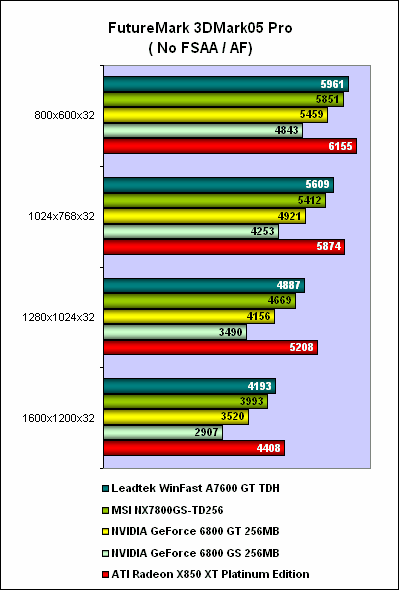
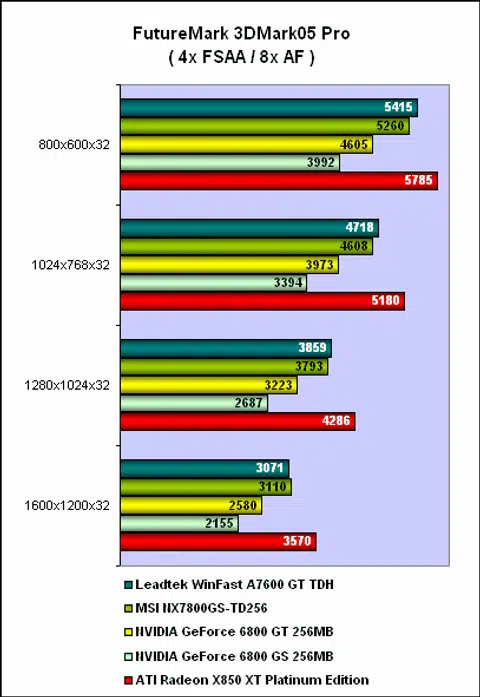
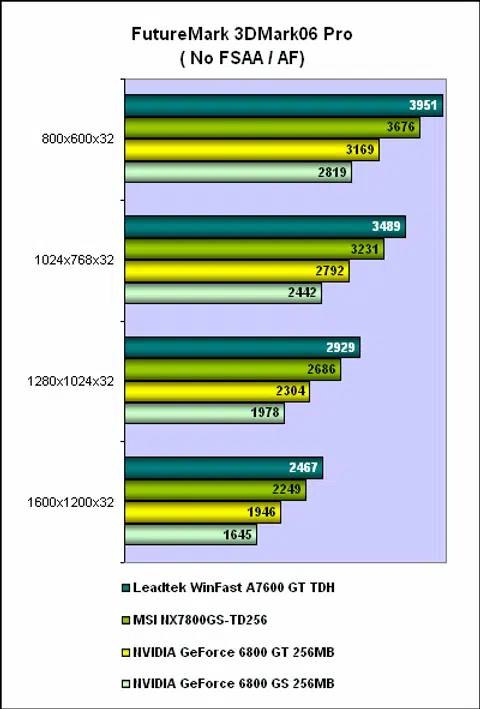
The Leadtek turned out to be faster than the GeForce 7800 GS for almost all settings and resolutions in these two synthetic benchmarks. A difference of 3% to 4% in 3DMark05 is quite significant though some of that may be attributed to the older drivers used for the GeForce 7800 GS. In 3DMark06, this difference widened to between 7 and 9% so it does seem that the faster clock speeds on the GeForce 7600 GT can make up for its lesser pipelines. Also, ATI's former champion, the Radeon X850 XT Platinum Edition showed why it used to rule the roost by winning 3DMark05 convincingly over the Leadtek, though we did not have results for 3DMark06 at the time.
Results - Splinter Cell: Chaos Theory (DirectX 9 Benchmark)
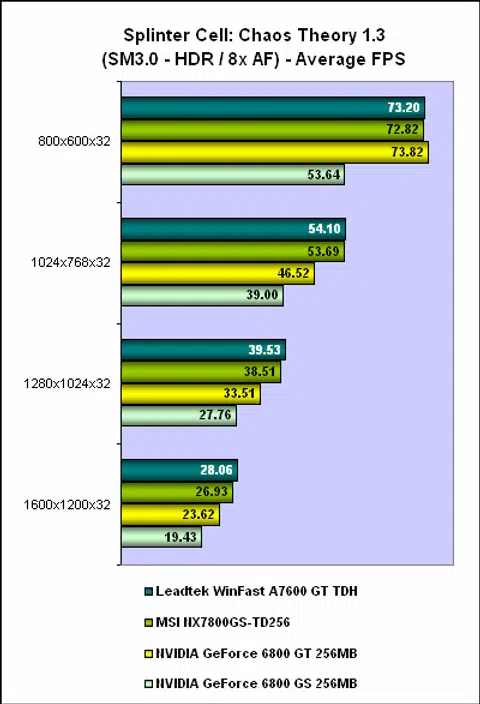
The scores between the Leadtek GeForce 7600 GT and the GeForce 7800 GS were very close in Splinter Cell. The Leadtek did seem to gather steam and take a minor lead as the resolutions went up but the margins were such that they probably won't matter too much to the gamer. If you keep to modest resolutions like 1024 x 768, the Leadtek should be able to provide an excellent gaming experience in this game with eye candy enabled.
Results - Chronicles of Riddick: EFBB (OpenGL SM2.0+ Benchmark)
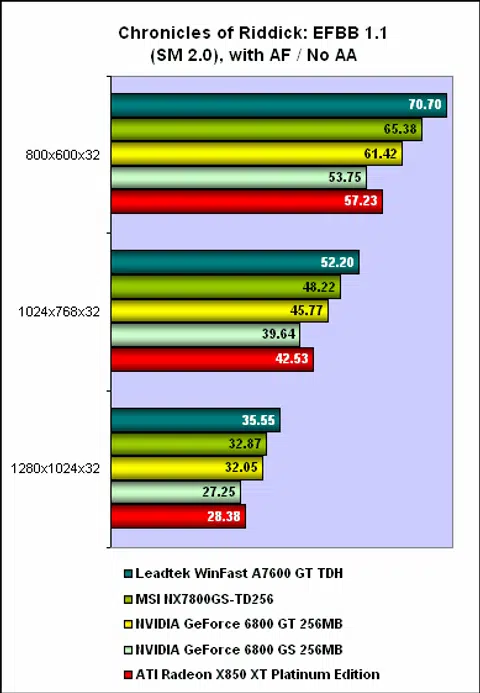
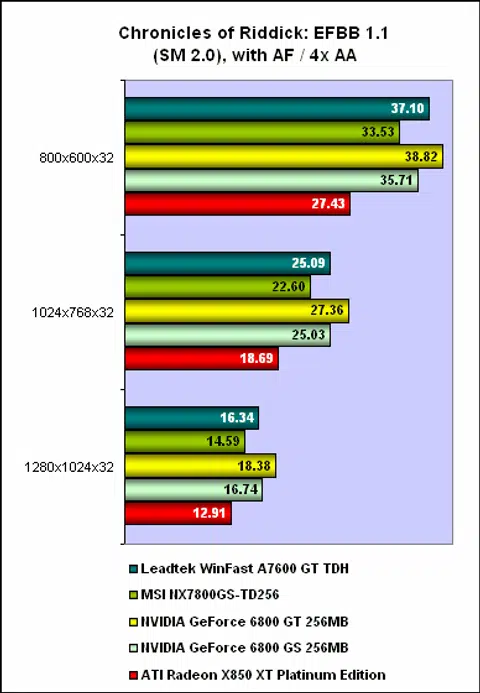
The scenario with and without anti-aliasing differed significantly in Chronicles of Riddick. While the Leadtek and the GeForce 7800 GS were the leaders without anti-aliasing, a similar lacking in raster operator units allowed the older GeForce 6800 GT and 6800 GS cards to prove quite a competitive threat when AA was turned on. Chronicles of Riddick again proved to be rather tough on these mid-range cards and keeping to 1024 x 768 is probably the best idea.
Results - Quake 4 (OpenGL SM2.0+ Benchmark)
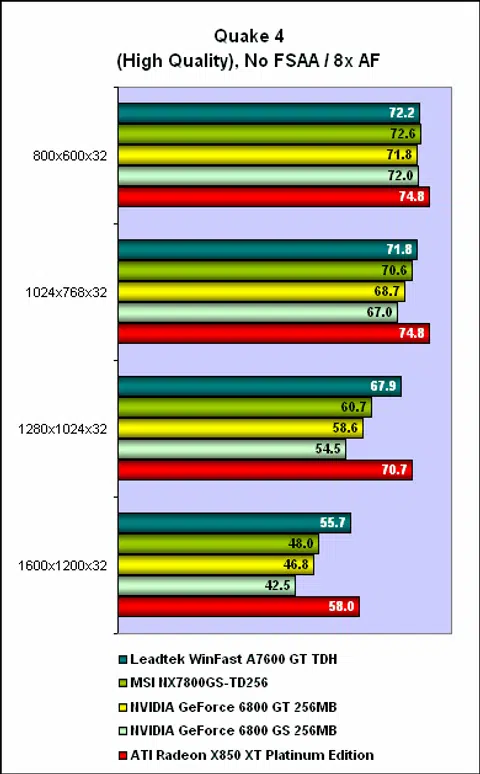
Quake 4 is constrained to 60 frames per second during gaming so anything more is superfluous and won't affect your game. For our results, you can be assured that the GeForce 7600 GT is good to go even at 1600 x 1200 with anti-aliasing enabled. The performance of most of the cards were rather similar at less intensive settings, but by 1600 x 1200, they had distinguished themselves such that the Leadtek was in the lead, though challenged strongly by the Radeon X850 XT Platinum Edition.

Temperature Testing
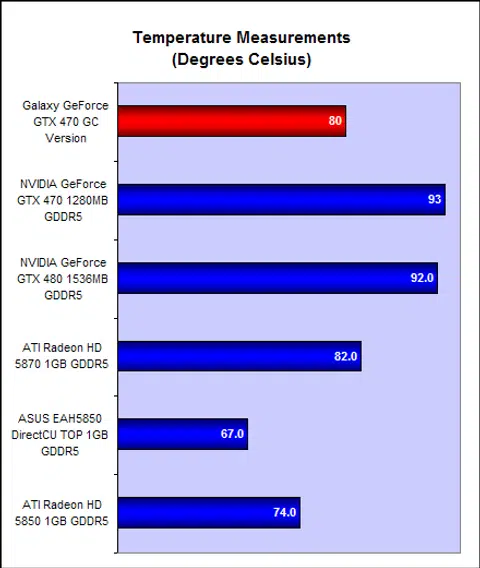
One of the improvements seen on NVIDIA's GeForce 7 series has been a streamlined architecture that has led to lower operating temperatures. The Leadtek WinFast A7600 GT TDH with its modest cooler seemed to be the best performer in this situation, with all its components averaging below 50 degrees Celsius, even much cooler than the MSI GeForce 7800 GS. The HSI bridge chip was also not overly warm and we could leave our fingers comfortably on its heatsink.
Overclocking
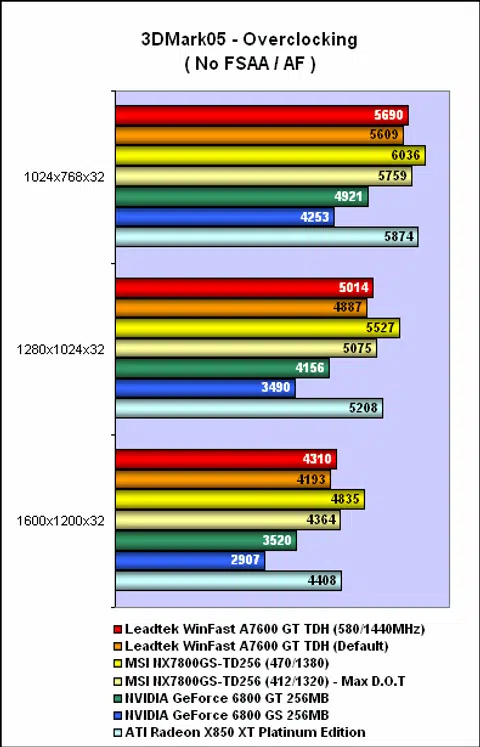
The Leadtek did not fare too well for overclocking, as we only managed a minor boost of 20MHz for both its core and memory frequencies. Compared to the PCIe versions that we have seen, this Leadtek AGP card had the worst tolerance for overclocking. It is difficult to assess where the bottleneck lies since this AGP card is paired with a bridge chip, which directly affects overclocking if it cannot handle the increase in clock speeds. Hopefully, this won't be symptomatic of all such AGP bridged cards as its stock performance lead over the 7800 GS is quickly lost through poor overclocking bandwidth. This slight overclocking would also not provide sufficient gain in frame rates to make a difference for the gamers.
Conclusion
For all the studies and research done on the subject of technology adoption rates, there are no certainties. After all, the PCI Express interface seemingly had solid and extensive support from the entire industry when it first appeared. The whole supply chain of processors to motherboards to graphics cards made the shift to the new interface almost at the same time. While the supply was ready, the same could not be said for demand.
For sure, the usual early adopters were quick to change their entire systems but despite the noise from chipmakers that they will be dropping AGP, the public and OEM businesses still put enough pressure that the graphics vendors relented and the bridge chips were introduced. This shows that many users are reluctant to change, especially when their present systems are still powerful enough to work with most popular applications with the rare exception of those cutting edge PC games. Of course, budget concerns come into play as well in these scenarios. Graphics card vendors also realized that the AGP platform group still constitutes a far larger slice of the pie than the PCIe platform, despite the latter being around for nearly two years. It only made dollars and sense to capitalize this segment and so they did.
Besides the novelty of having an AGP version of the GeForce 7600 GT, we doubt that there is any major performance difference between this and the average PCI Express based GeForce 7600 GT. Both variants, AGP or PCIe have the same core, same memory bandwidth and same clock speeds. There are some minor physical differences, from the addition of the HSI chip and its heatsink, along with an analog VGA output taking the place of a DVI output to the required power connector. We've also long established that the inclusion of the HSI bridge chip only incurred a very minor performance deficit, thus the general performance of a similarly spec'd AGP of PCIe card should strike a similar performance level. When compared against the GeForce 7800 GS, the only other compatible fresh offering this year, the GeForce 7600 GT AGP edition is a far more convincing option in all areas concerned - performance, price, thermal output and power consumption. Perhaps this could be the end of the GeForce 7800 GS, but we wouldn't miss it when the AGP edition of the GeForce 7600 GT is around as a more cost effective option for both manufactures and consumers.
At S$299, it's comparable to the PCI Express version and looks like one of the better cards you can get for your AGP system now.
As for the Leadtek WinFast A7600 GT TDH, the open design of its cooler allows decent airflow over the core. Together with its relatively slow fan rotation speed, it is one of the quieter coolers for the GeForce 7600 GT. Unfortunately, this was not translated to the overclocking arena. There may probably be higher pre-overclocked GeForce 7600 GT cards in the market than the best that we attempted on the Leadtek but of course, the chances of finding such a version for the AGP bus is unlikely. As discussed in the review, the presence of the HSI bridge chip is probably one of the factors for the limited overclocking capability and the actual tolerance would probably vary from one batch to another. That aside, with a cool and quiet card operating at decent performance levels, these are probably the most important reasons why consumers would be interested in this product.
Expected to retail at S$299 locally (US$189), it should cost slightly more than the average PCIe version. In fact, one could get Leadtek's own PCIe GeForce 7600 GT for S$30 less. However, this extra cost probably accounts for the HSI chip, along with the limited quantities produced. If you are still hanging on an AGP system, there are not that many modern choices anyway and the Leadtek WinFast A7600 GT TDH will allow you to continue playing the latest games (at reasonable settings) and extend the life of your AGP system for another year or two.
Our articles may contain affiliate links. If you buy through these links, we may earn a small commission.