
Intel Core i5-3470 Performance Analysis
Intel has just released a slew of new mainstream Core i5 class Ivy Bridge processors and we take a look at the very promising quad-core Core i5-3470.

Introducing the Core i5-3470 and New Processors
Intel’s third generation Core processors are finally here and selling in volume in the retail channels. Codenamed “Ivy Bridge”, these new processors represent the “tick” in Intel’s “tick-tock” strategy, where every “tick” is a shrink in manufacturing process technology used and every “tock” is a completely new microarchitecture. As such, Ivy Bridge is manufactured using the latest 22nm process technology and also boasts a number of other incremental upgrades.
The Ivy Bridge CPUs that were available at launch were all pretty high-end quad-core SKUs such as the Core i7-3770K that we reviewed earlier. Now, Intel is buffing up the Ivy Bridge lineup with six more Core i5 SKUs that are targeted at mainstream users.
Intel has just announced a handful of new Core i5 SKUs that will appeal to more mainstream users.
The one that we are testing today is the quad-core Core i5-3470. The chip has a base clock speed of 3.2GHz, a maximum turbo frequency of 3.4GHz and comes with a fairly generous 6MB of L3 cache. TDP of the new chip is 77W and price comes in at around US$184. However, the integrated GPU part is the weaker HD Graphics 2500 engine, which differs from the HD Graphics 4000 model with just six execution units instead of 16. In the interest of time, we'll be analyzing the graphics capabilities in a forthcoming article.
Judging from the specifications, the new Core i5-3470 is mostly comparable to the previous generation Core i5-2500 and i5-2400. The new Core i5-3470 has comparable clock speeds to the i5-2500 and i5-2400 and same 6MB L3 cache, but it has an appreciably lower TDP of 77W as opposed to the two Sandy Bridge processors’ 95W. This is achieved thanks to the power optimization features and process technology advancements on Ivy Bridge.
Here's a quick look at the new desktop processors that are launched today:
Processor Model | Core i5-3570 | Core i5-3570S | Core i5-3475S | Core i5-3470 | Core i5-3470T | Core i5-3470S |
Cores / Threads | 4 / 4 | 4 / 4 | 4 / 4 | 4 / 4 | 2 / 4 | 4 / 4 |
Frequency (Base) | 3.4GHz | 3.1GHz | 2.9GHz | 3.2GHz | 2.9GHz | 2.9GHz |
Turbo Frequency (GHz) | 3.8GHz | 3.8GHz | 3.6GHz | 3.6GHz | 3.5GHz | 3.6GHz |
DDR3 (MHz) | 1600MHz | 1600MHz | 1600MHz | 1600MHz | 1600MHz | 1600MHz |
L3 Cache | 6MB | 6MB | 6MB | 6MB | 3MB | 3MB |
Integrated GPU | HD 2500 | HD 2500 | HD4000 | HD 2500 | HD 2500 | HD2500 |
GPUClock (Base / Turbo) | 650MHz / 1150MHz | 650MHz / 1150MHz | 650MHz / 1100MHz | 650MHz / 1100MHz | 650MHz / 1050MHz | 650MHz / 1100MHz |
PCIe 3.0 Support | Yes | Yes | Yes | Yes | Yes | Yes |
TDP | 77W | 65W | 65W | 77W | 35W | 65W |
Price | US$205 | US$205 | US$201 | US$184 | US$184 | US$184 |
These six new processors are part of a larger group of 14 new processors that are being launched today - in case you are wondering, the other eight processors are mobile variants. You can find out more about the new mobile processors in our updated mobile Ivy Bridge article here.That said, while notebooks will finally be seeing dual-core Ivy Bridge processors, out of the six new desktop processors launched today, only one is dual-core processor. This means that it’ll be a little while longer before we see truly mainstream dual-core Ivy Bridge processors for desktop systems. Lastly, for those not familiar with Intel's naming scheme, the 'S' suffix denotes that the chip is a performance-optimized version, with TDP limited to 65W, while the 'T' suffix indicates that the chip is a power-optimized version, with TDP limited to 35-45W.
Test Setup
The new Core i5-3470 was tested using Intel’s reference Z77 motherboard - the DZ77GA-70K. The new Ivy Bridge processors have improved official memory support for up to DDR3-1600MHz. And since we have already established the minor performance gains going from DDR3-1333MHz to DDR3-1600MHz, the Core i5-3470 will only be tested at DDR3-1600MHz memory speeds.
For comparison, we’ll be pitting the Core i5-3470 against the the Core i5-2500 and Core i5-2400. These two Sandy Bridge CPUs have the closest clock speeds to the Core i5-3470. With a base frequency of 3.2GHz, the Core i5-3470 comes in right between in the Core i5-2500 and Core i5-2400, which have base clock speeds of 3.3GHz and 3.1GHz respectively. Since we don’t have a Core i5-2500, we’ll be using the Core i5-2500K in our results comparison. The Core i5-2500K is almost identical to the Core i5-2500, except that it has an unlocked CPU multiplier and also the more powerful HD Graphics 3000 GPU as compared to the HD Graphics 2000 on the Core i5-2500/2400 CPUs.
We have also included results of the flagship Core i7-3770K, and previous generation high-end Sandy Bridge-E processors, along with the lone eight-core AMD FX-8150.
Intel Core i5-3470 / Intel Core i7-3770K / Intel Core i7-2700K Test Configuration
- Intel Desktop Board DZ77GA-70K (Intel Z77 Express chipset), BIOS version 3000
- 2 x 2GB Kingston HyperX DDR3-1600 (CAS 9-9-9-27) (Also ran at DDR3-1333MHz, CAS 7-7-7-20)
- Zotac GeForce GTX 260 (ForceWare 197.45)
- Western Digital Caviar Black 1TB SATA 6Gbps hard drive (one single NTFS partition)
- Windows 7 Ultimate 64-bit
- Intel INF 9.3.0.1020
Intel Core i7-3960X / Intel Core i7-3820 Test Configuration
- Intel Desktop Board DX79SI (Intel X79 Express chipset), BIOS version 0280
- 4 x 2GB Kingston HyperX DDR3-1600 (CAS 9-9-9-27)
- Zotac GeForce GTX 260 (ForceWare 197.45)
- Western Digital Caviar Black 1TB SATA 6Gbps hard drive (one single NTFS partition)
- Windows 7 Ultimate 64-bit
- Intel INF 9.2.3.1022
Intel Core i7-2600K / Intel Core i5-2500K / Intel Core i5-2400 Test Configuration
- ASUS P8P67 Deluxe (Intel P67 chipset), BIOS: 0602
- 2 x 2GB Kingston HyperX DDR3-1333 (CAS 7-7-7-20)
- Zotac GeForce GTX 260 OC (ForceWare 197.45)
- WD Caviar Black 1TB, SATA 6G (Intel SATA 6G)
- Windows 7 Ultimate (64-bit)
- Intel INF 9.2.0.1015
AMD FX-8150 Test Configuration
- ASUS Crosshair V Formula (AMD 990FX + SB950, 0813 BIOS)
- 2 x 2GB Kingston HyperX DDR3-1333 (7-7-7-20)
- Zotac GeForce GTX 260 OC (ForceWare 197.45)
- AMD Chipset driver
- WD Caviar Black 1TB SATA 6G (AMD SATA 6G)
- Microsoft Windows 7 Ultimate (64-bit)
SYSMark 2007 Results
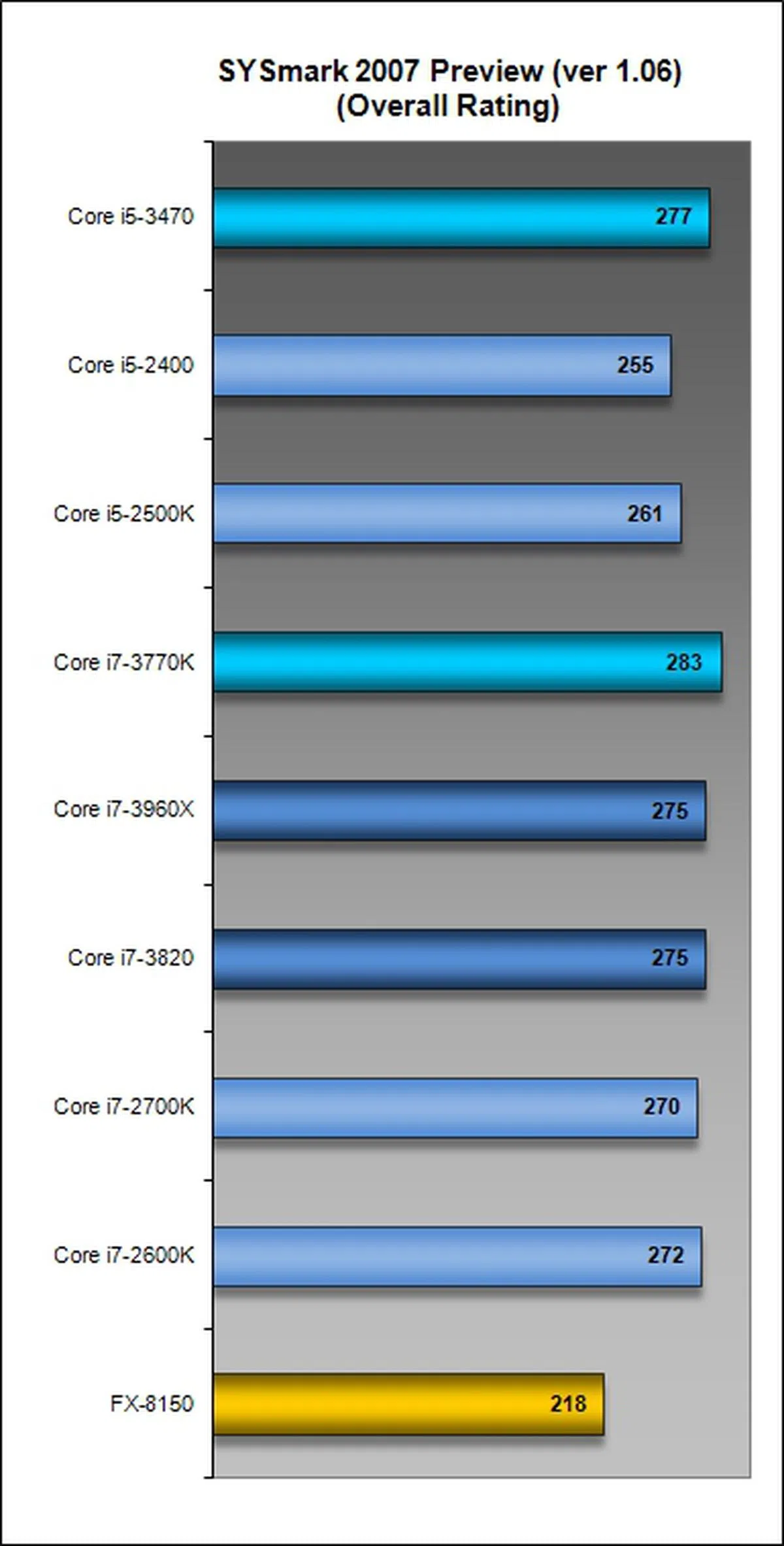
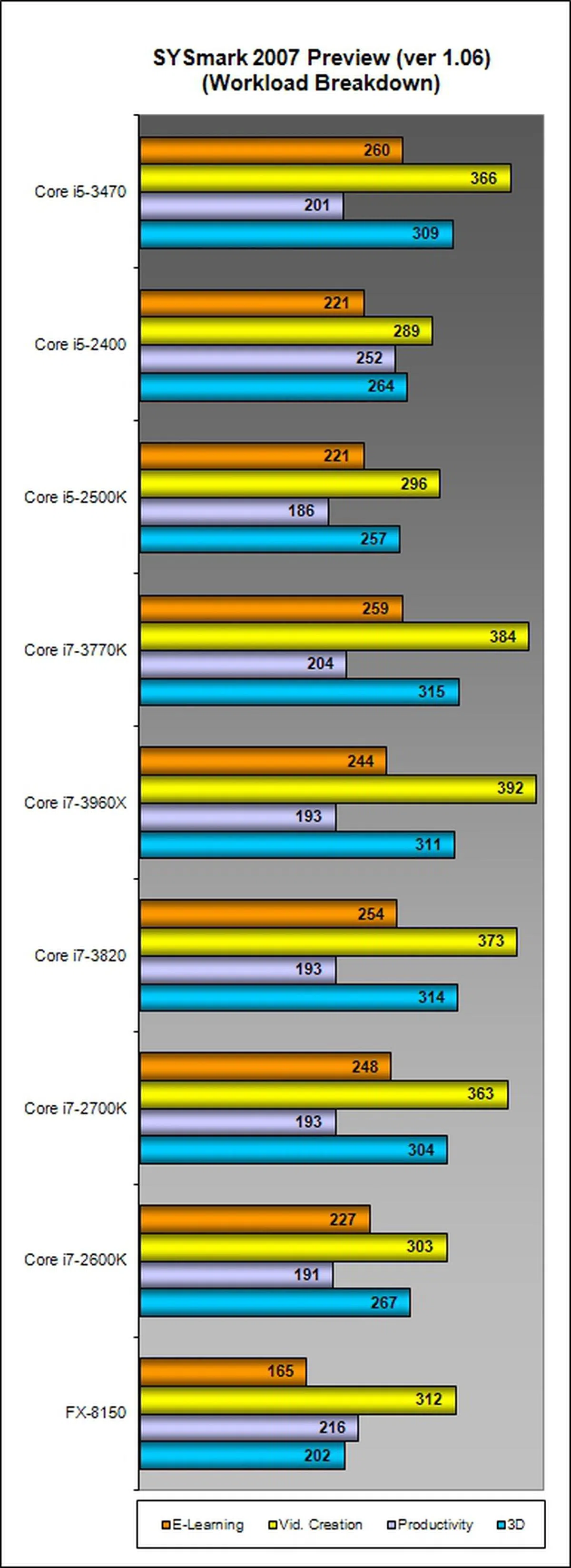
SYSMark is not the best benchmark for tough multi-threaded workloads, so it wasn’t all that surprising to see that the Core i5-3470 wasn’t that far off from the flagship Core i7-3770K, which has HyperThreading. Compared to the Core i5-2500K and Core i5-2400, the new chip achieved an overall score that was about 7% better. And looking at the breakdown, we can see that it has the biggest advantage when it comes to video creation and 3D.
 |  |
Lightwave 3D 9.0 Results
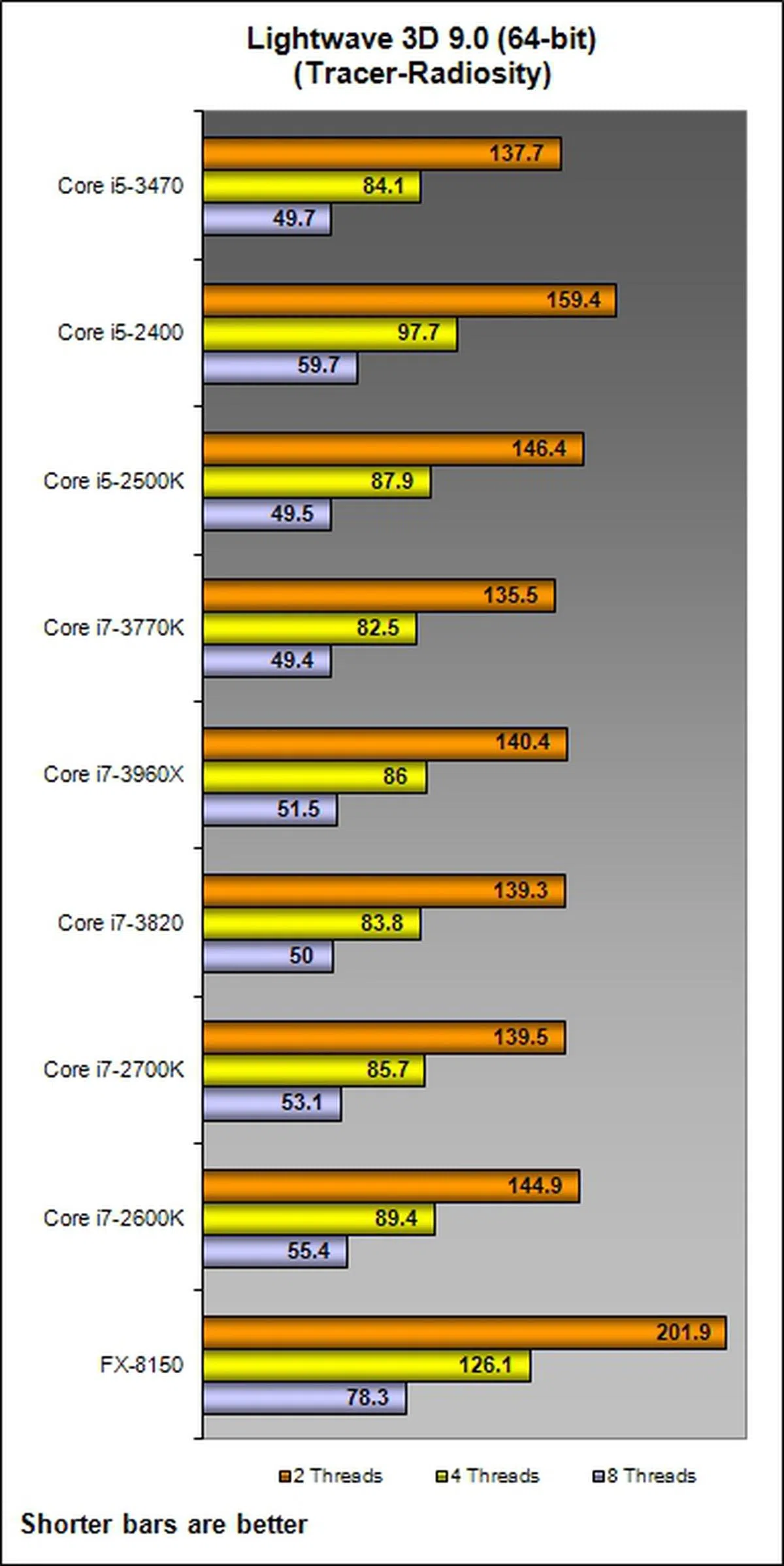
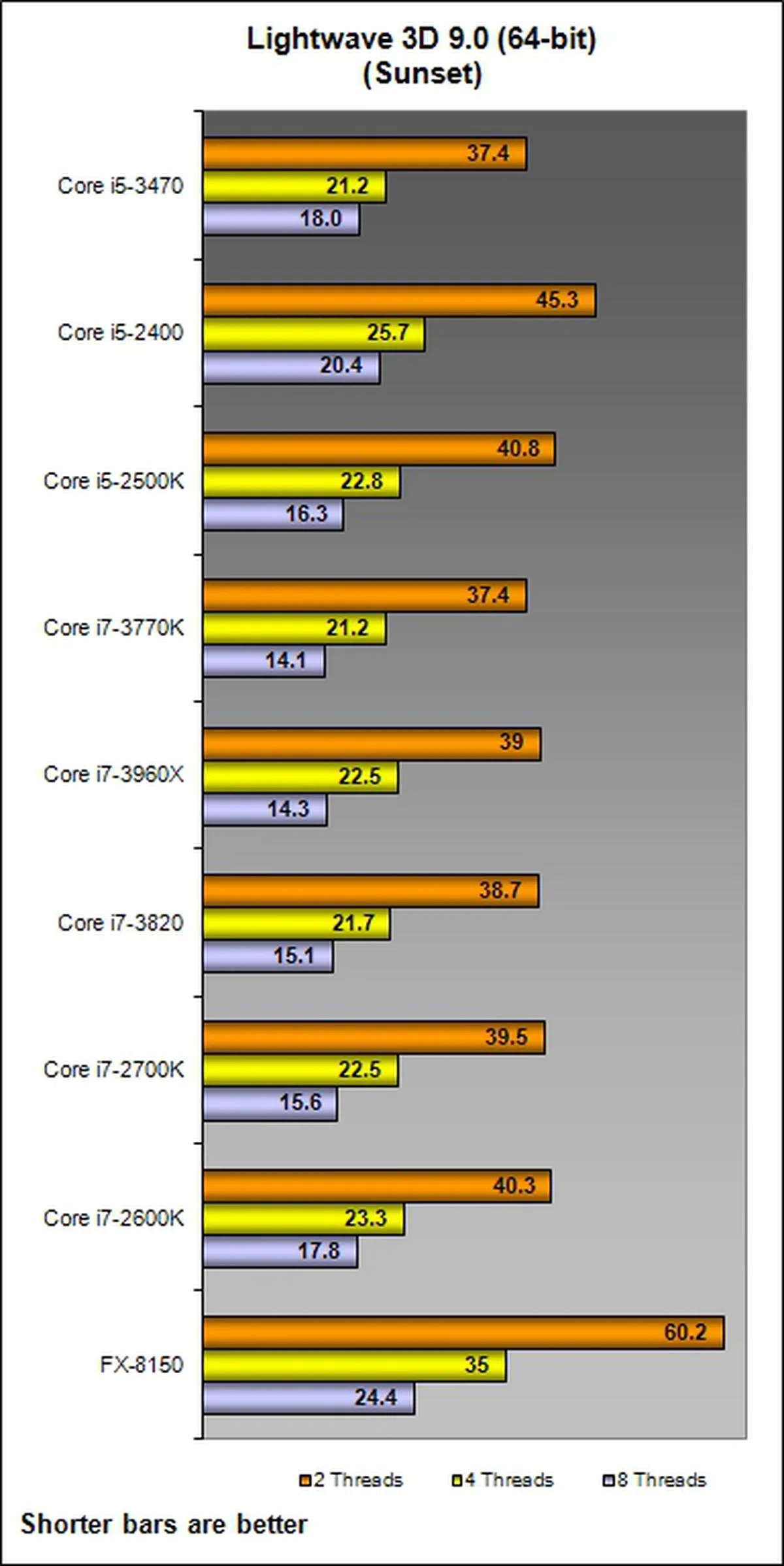
Performance on Lightwave 3D was up to our expectations. On the Tracer-Radiosity scenario, it did noticeably better than the both the Core i5-2400 and Core i5-2500K and was quite a good match for even the Core i7-2700K - up until the 8 threads run where it lost out due to its lack of HyperThreading. It did even better on the Sunset scenario, where it bested every processor except for the Core i7-3770K.
 |  |
Futuremark PCMark Vantage Results
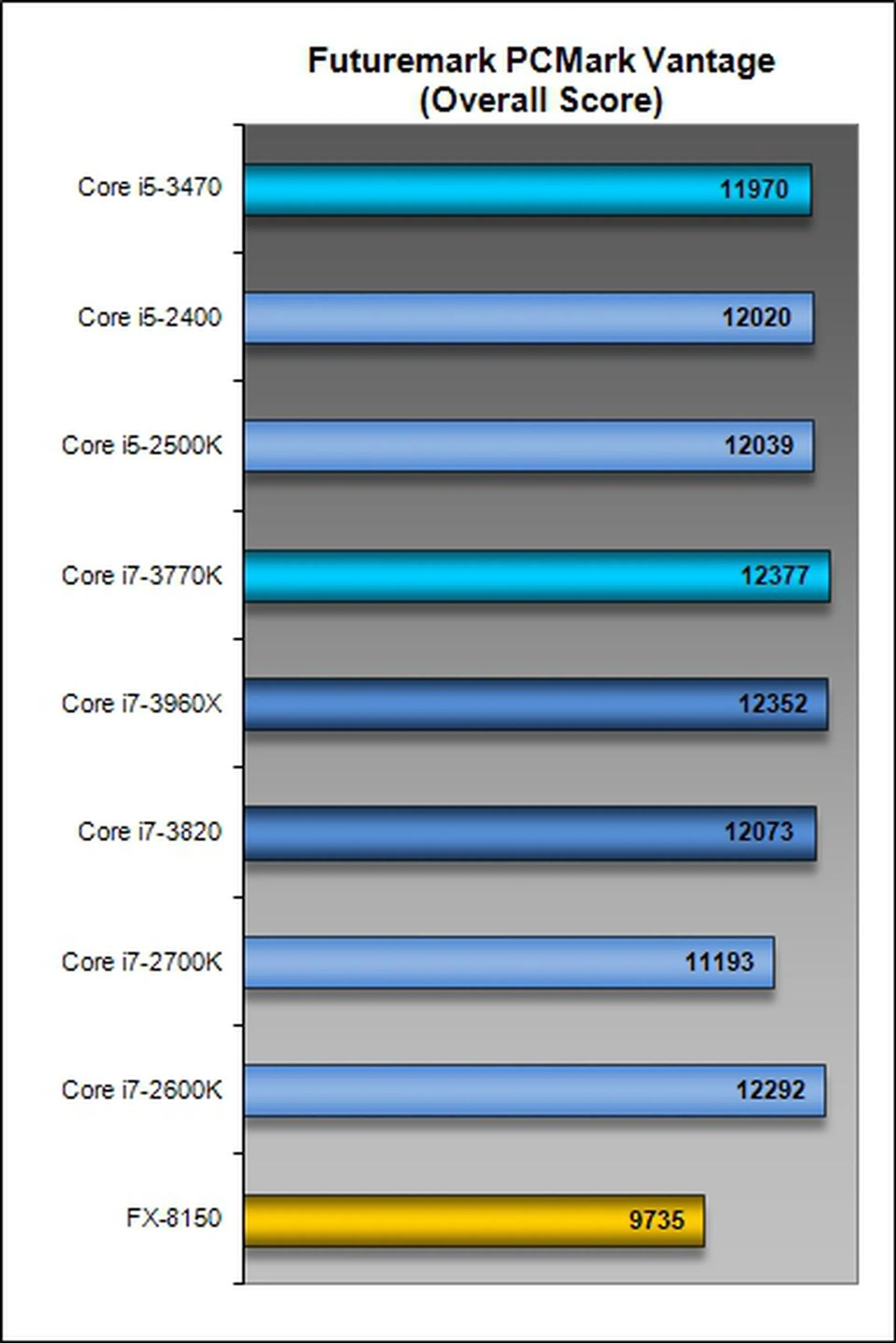
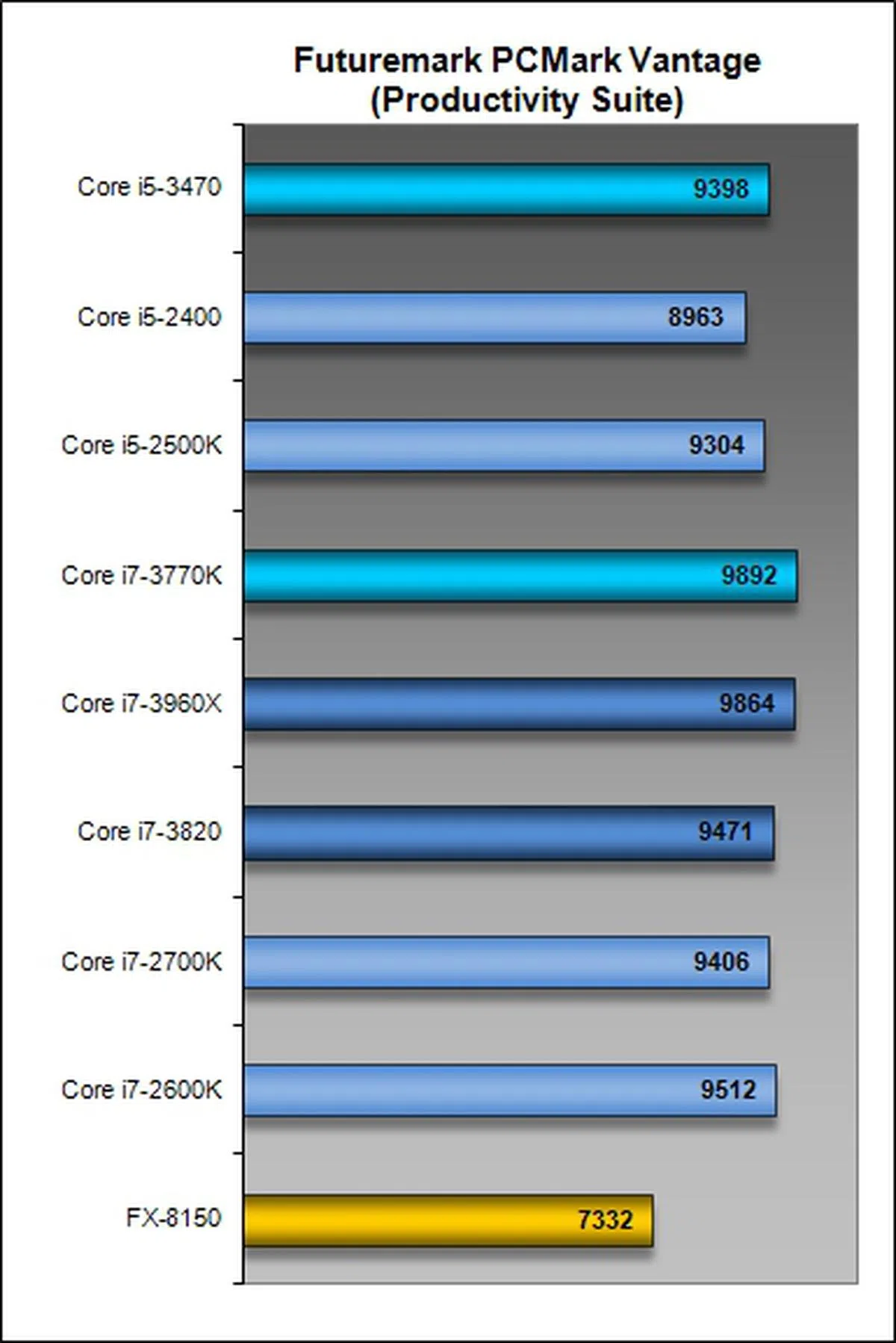
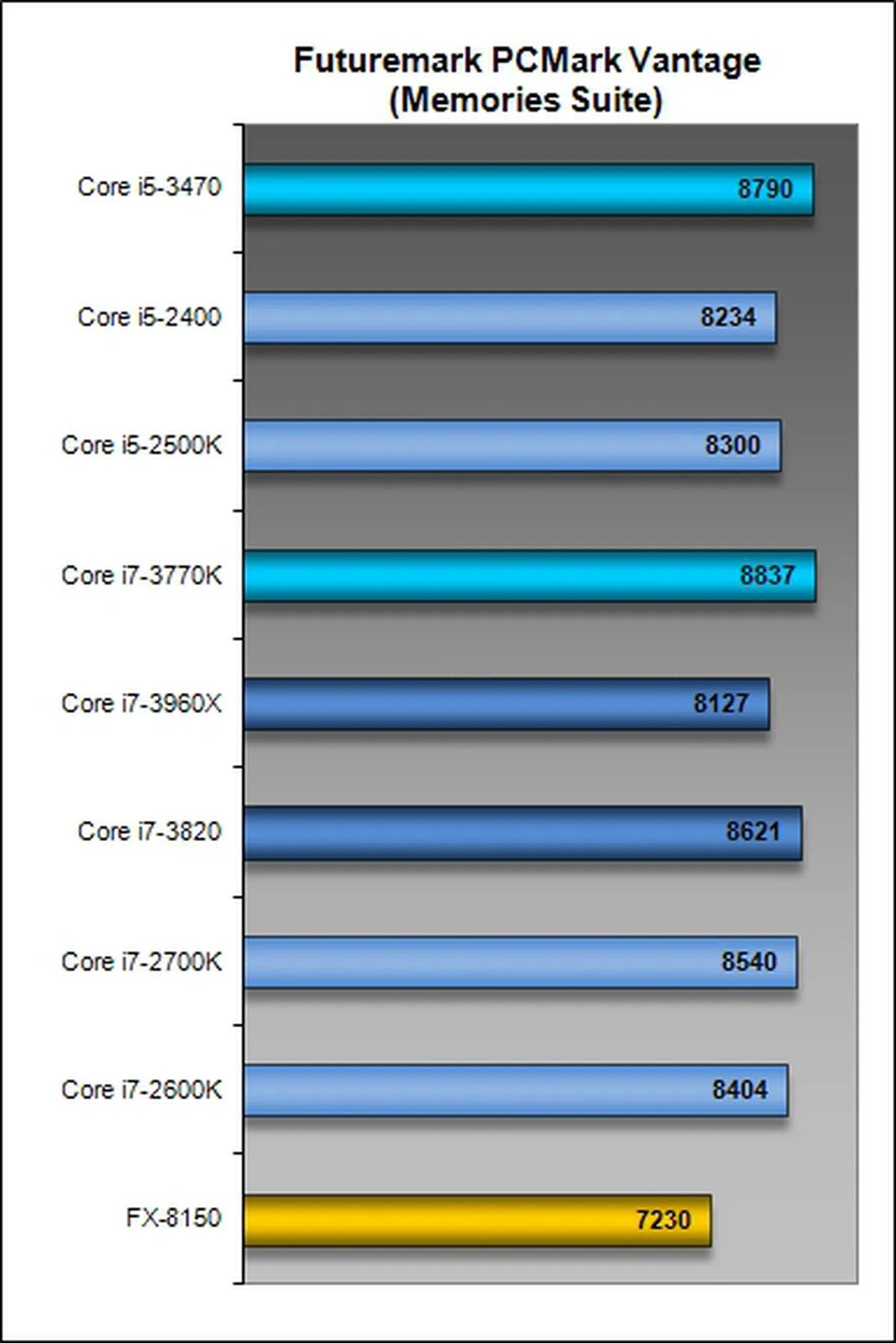
PCMark Vantage measures the system’s performance across a wide variety of common tasks such as photo viewing, photo editing, video, music and productivity. It might be a rather aged benchmark, but its still a good gauge of a CPU’s performance.
Although the Core i5-3470 recorded a marginally lower overall score, it bested both the Core i5-2400 and Core i5-2500 in the Productivity and Memories sub-suites. In fact, on the Memories suite test, its scores were beaten only by the Core i7-3770K. Of course, part of the new processor's advantage comes from testing with DDR3-1600, but given that the DDR3-1333 memory was run with lower latency for the Sandy Bridge processors, the results still seem to favor the new Ivy Bridge counterparts.
 |  |
Futuremark PCMark 7 Results
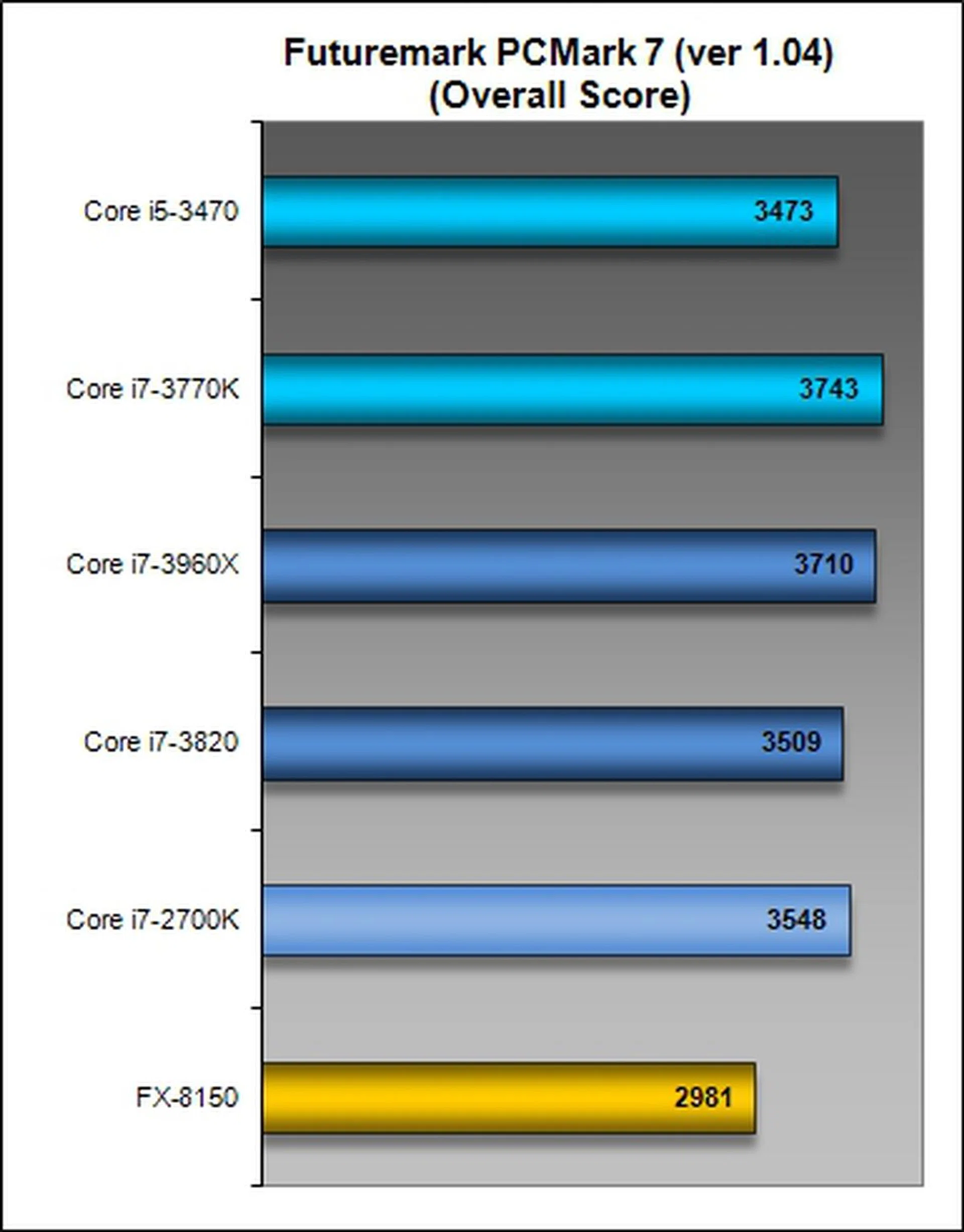
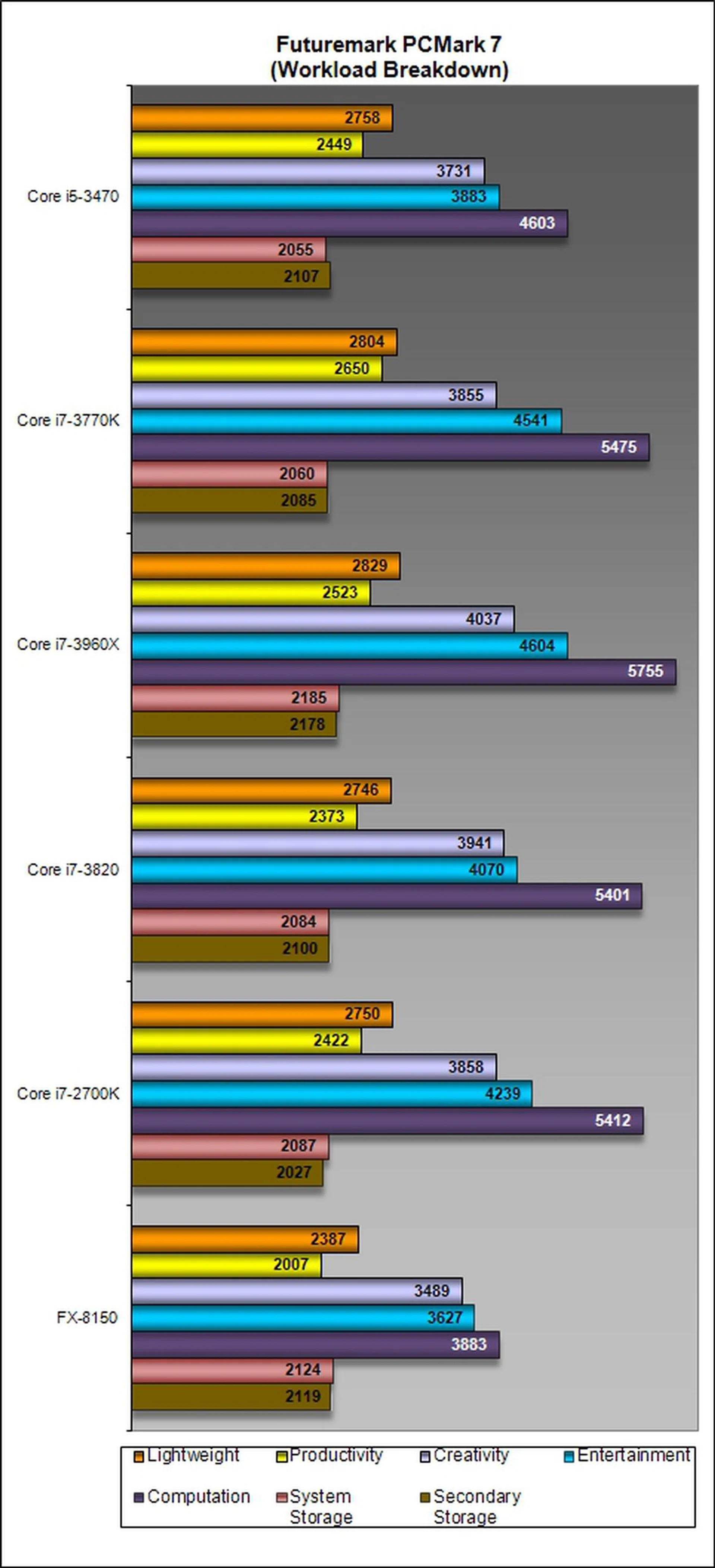
We haven't had a chance to obtain PCMark 7 results for the Core i5-2400 and Core i5-2500K, but looking at the results we've here, the Core i5-3470 looks pretty competitive. Its overall score was just 3% lower than that of the Core i7-2700K. Compared to the Core i7-3770K, it’s not much of a match as the flagship Ivy Bridge chip achieved achieved an 8% advantage over the Core i5-3470. Just as we suspected, HyperThreading isn't really all that helpful for most mainstream users.
Cinebench 11.5 Results
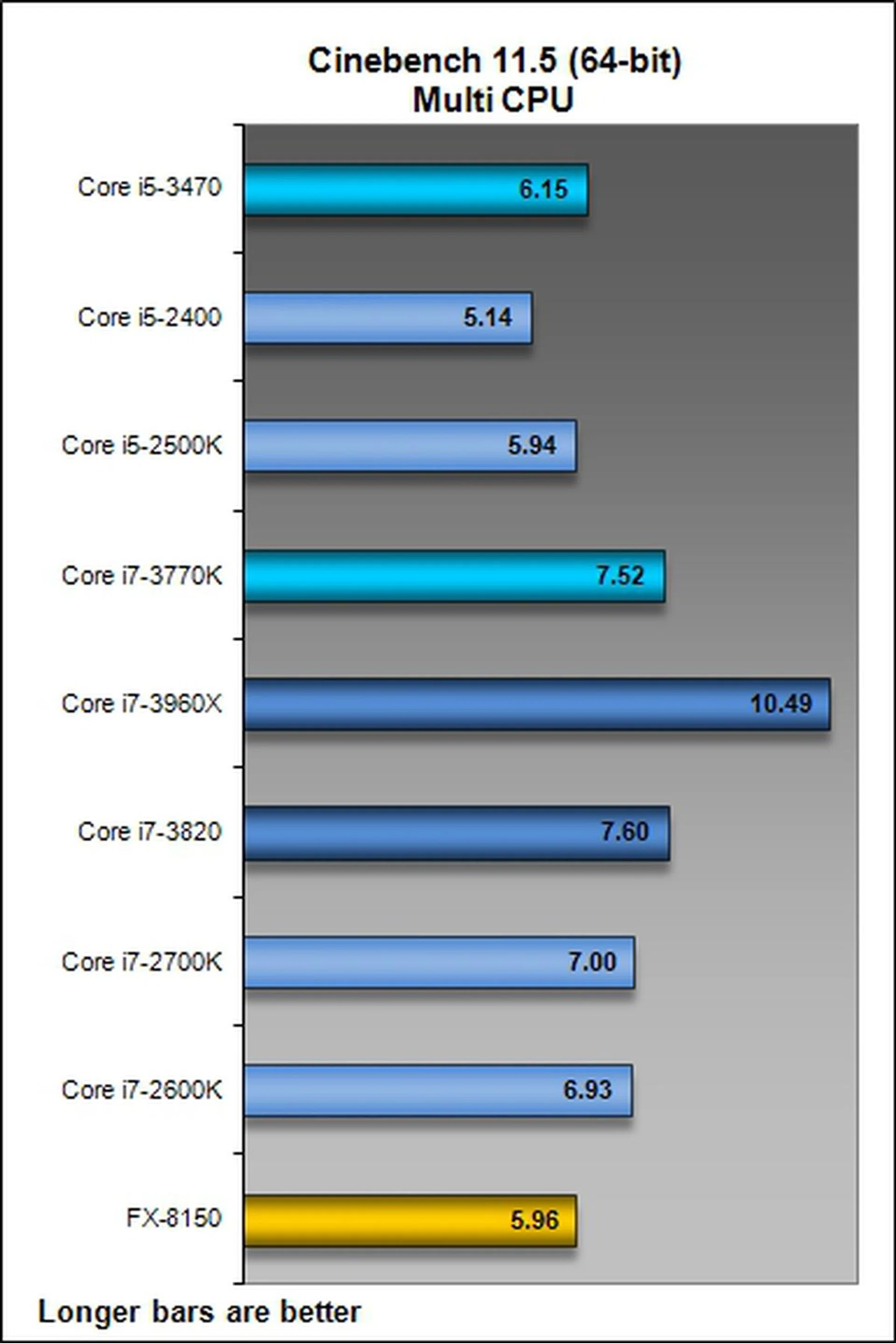
Cinebench is benchmark that favors multi-threaded CPUs. Here, the Core i7-3960X with its 6 physical cores (and 12 virtual ones), leads the pack. Following closely are the Core i7-3770K, Core i7-3820 and Core i7-2700K. Predictably, the new Core i5-3470, Core i5-2500K and Core i5-2400 are a rung below due to the lack of HyperThreading. Amongst the three, the new Core i5-3470 was appreciably faster, proving its improved performance per watt legacy.
Handbrake 0.9.4 Results
On Handbrake, it was pretty much the same story, with the 6-core Core i7-3960X posting the quickest timing. The Core i5-3470 managed the video encoding test just under two minutes, seven seconds quicker than the Core i5-2500K and 40 seconds faster than the Core i5-2400.

3ds Max 8 (SP2) Results
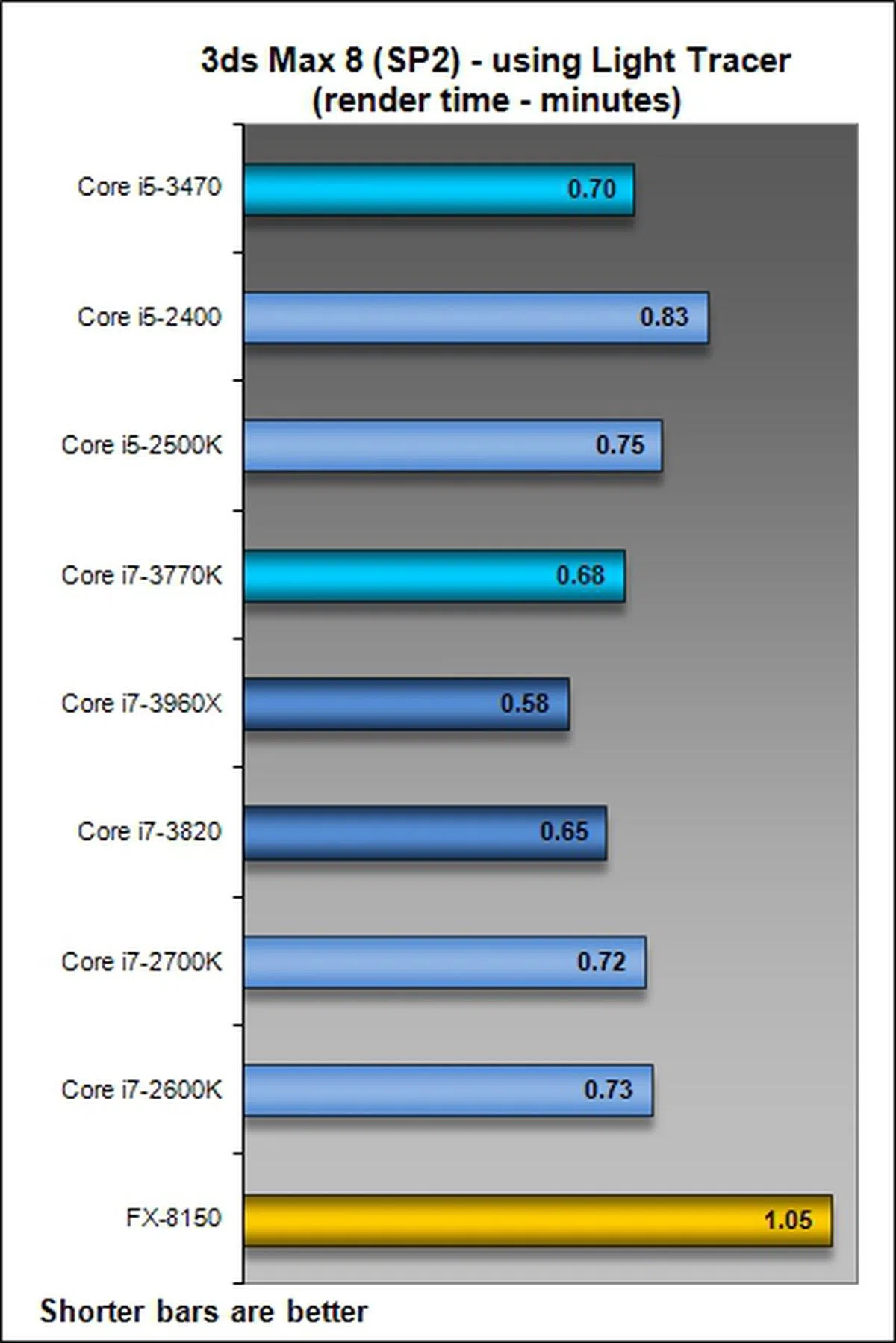
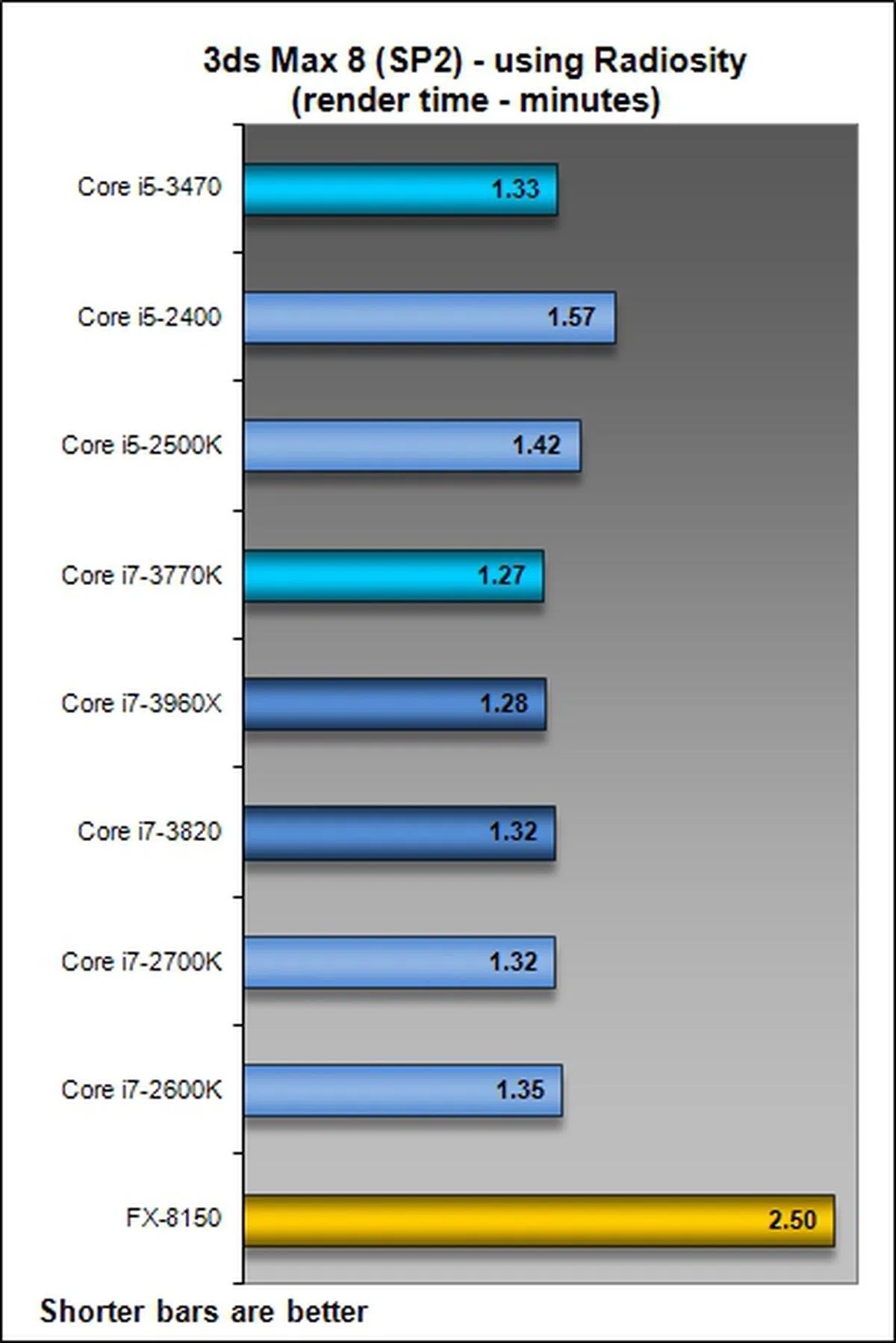
The Core i5-3470 was very competitive on 3ds Max 8, coming pretty close to the Core i7-3770K in both the Light Tracer and Radiosity scenarios. In the Light Tracer scenario, the Core i5-3470’s time of 0.70 minutes was just 0.02 minutes off the Core i7-3770K. It also convincingly bested both the Core i5-2500K, Core i5-2400 and even the HyperThreading-enabled Core i7-2700K. In the Radiosity scenario, it was appreciably faster than both Core i5-2500K and Core i5-2400, and was almost on a par with the Core i7-2700K.
 |  |
Futuremark 3DMark Vantage Results
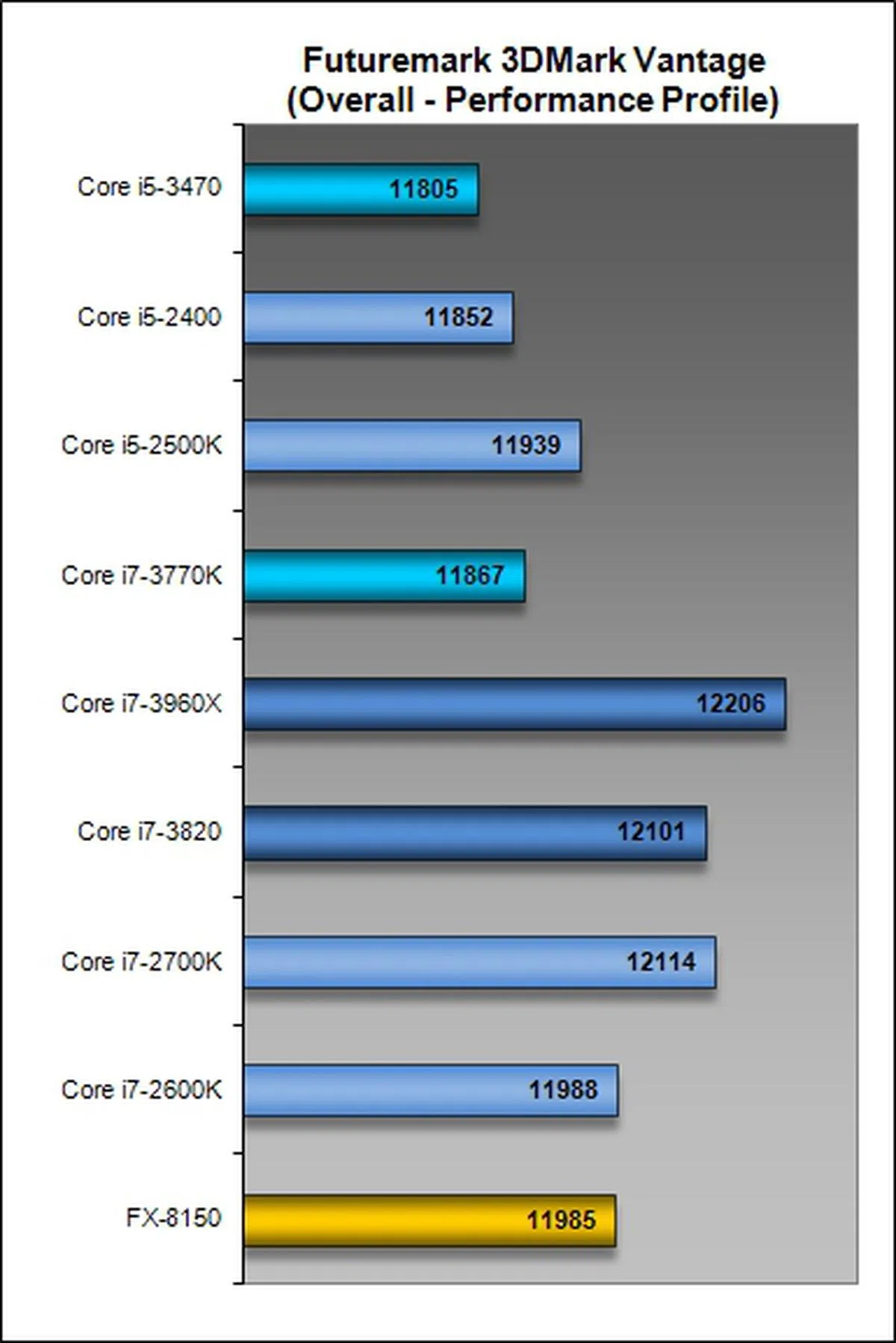
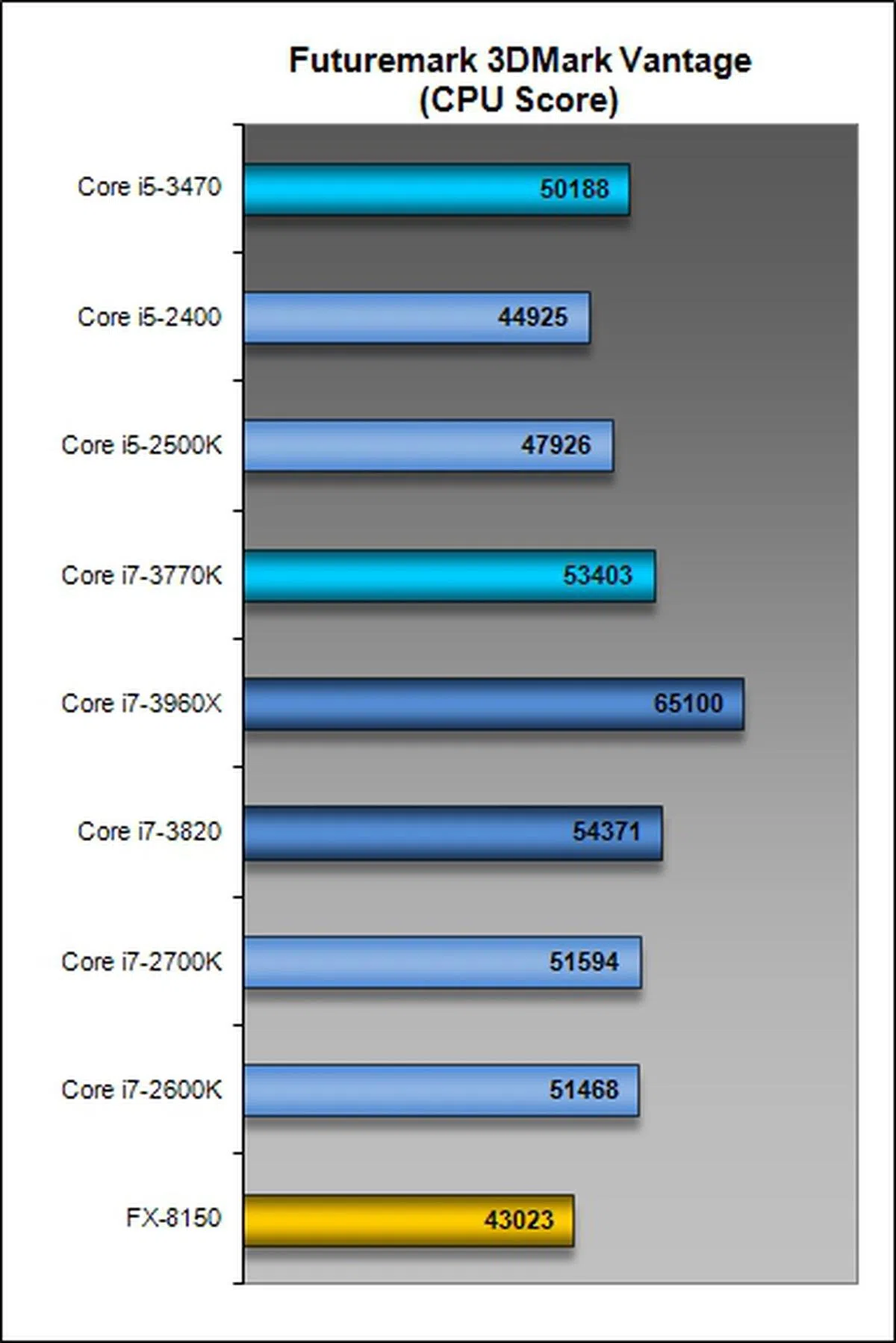
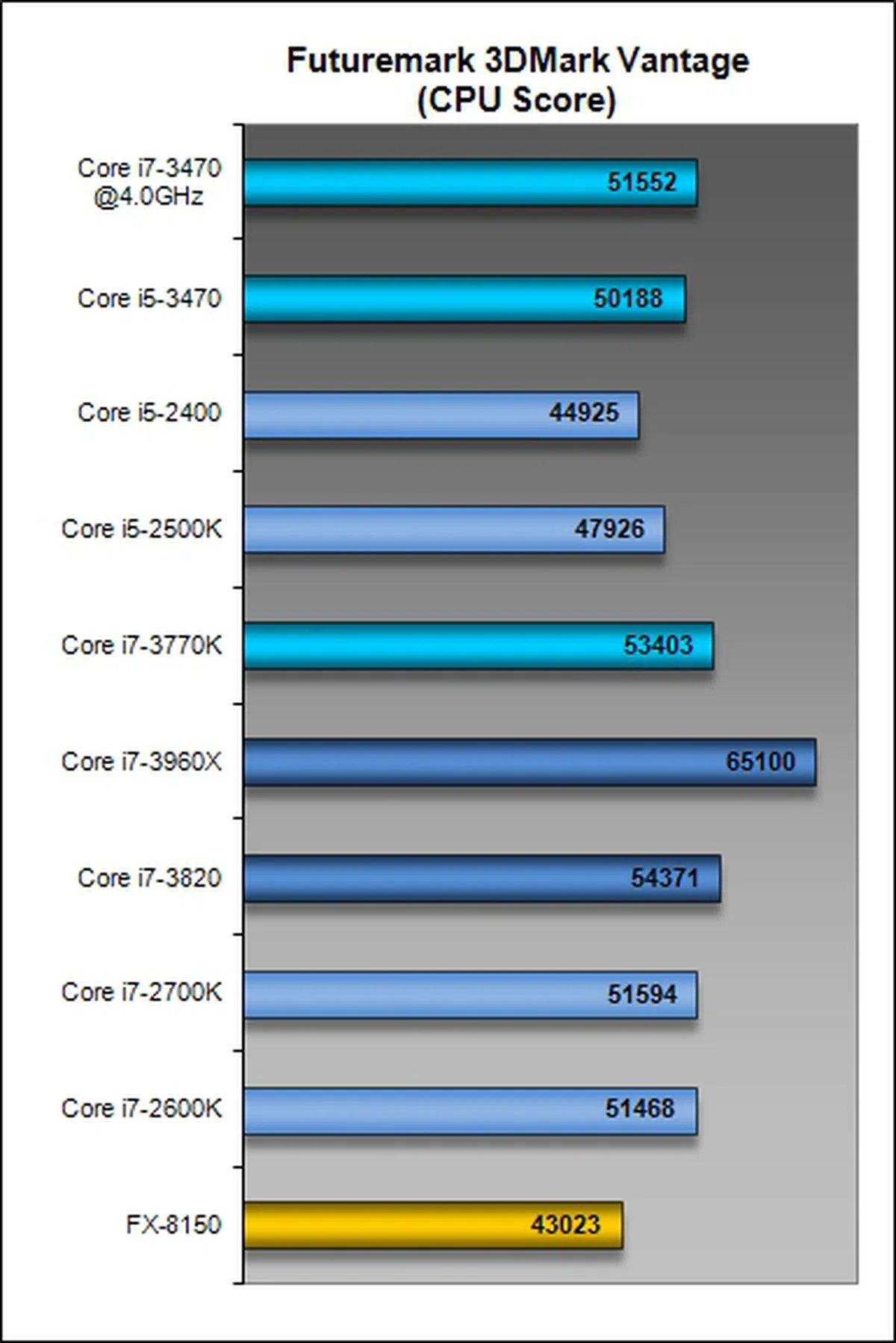
On 3DMark Vantage, the Core i5-3470 attained slightly lower overall scores than both the Core i5-2400 and Core i5-2500K, but bested the two significantly when it came to raw CPU scores. Its CPU score of 50188 is 10% better than the Core i5-2400 and close to 5% better than the Core i5-2500K. Compared to the Core i7-3770K, the Core i5-3470’s CPU score was about 6% lower. Note that these tests were done with a discrete graphics card, and not the integrated GPU. Hit the next page to see if all these theoretical numbers had any impact in actual games.
 |  |
Far Cry 2 Results
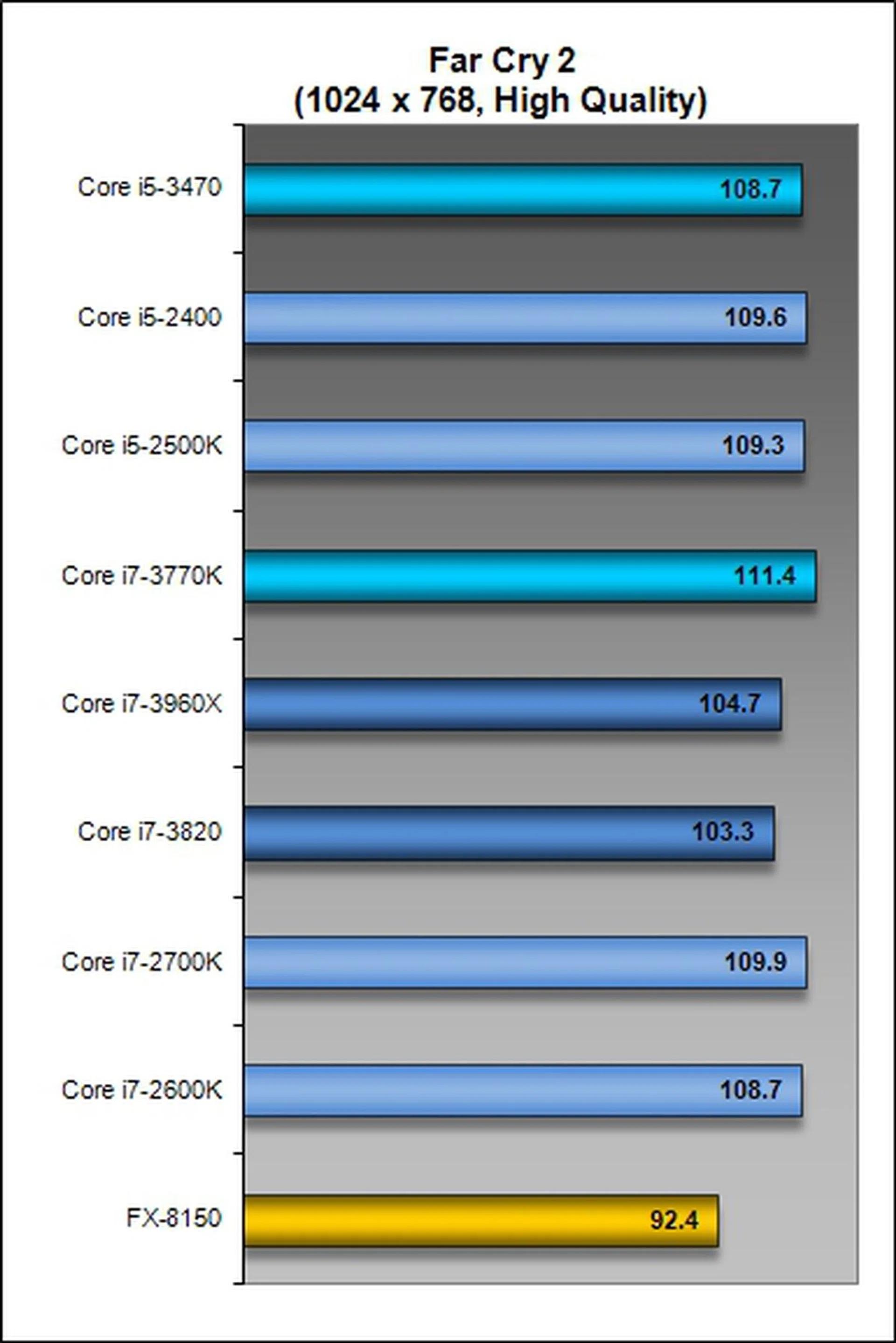
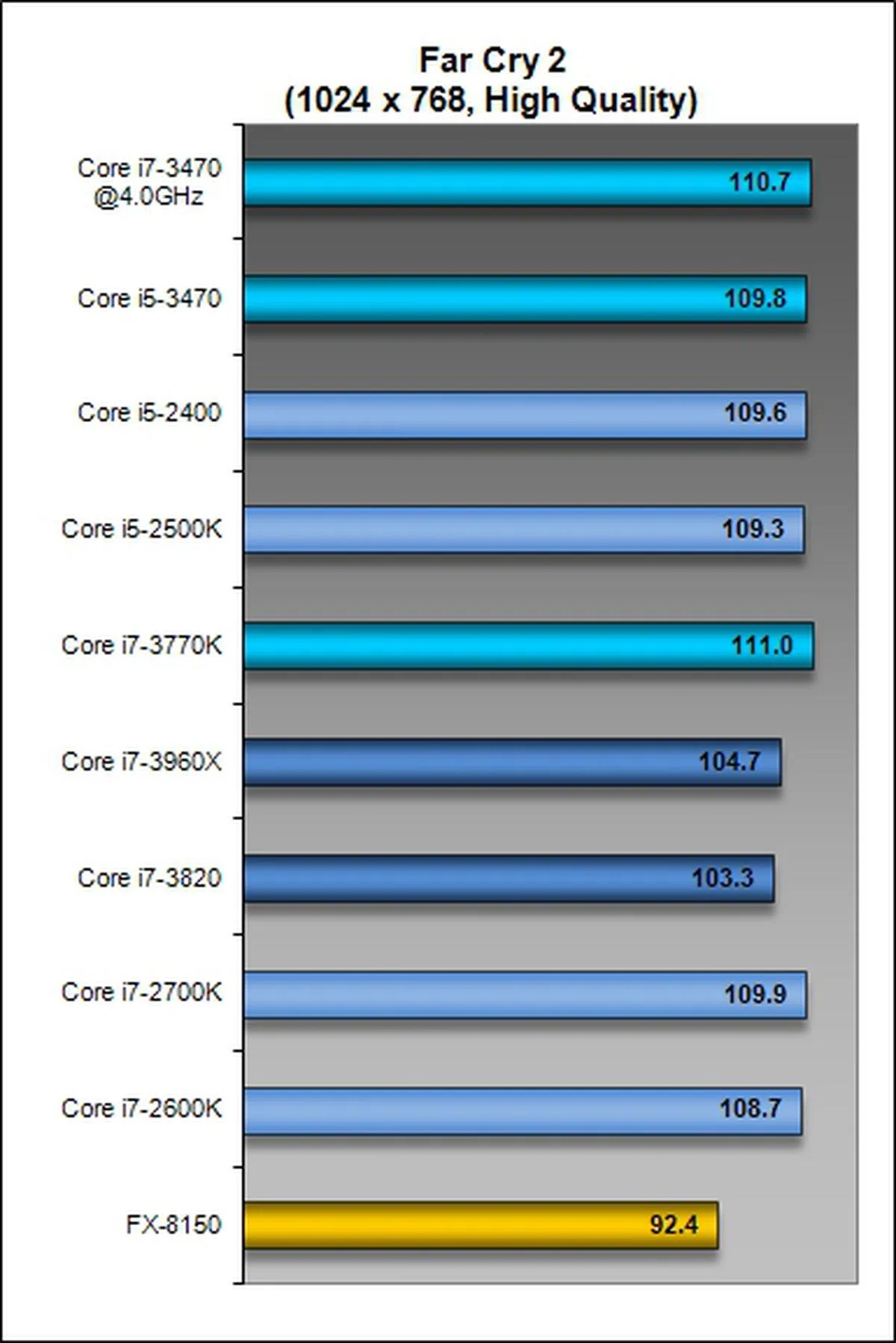
On Far Cry 2, the Core i5-3470 might have posted slightly lower average frame rates compared to Core i5-2500K and Core i5-2400, but the difference is negligible. Also, there’s not much difference between the Core i5-3470 and the Core i7-3770K, proving the age-old point that the performance of the GPU is determines overall gaming performance. Take note that these numbers are based off a discrete graphics card to maintain consistency in pinpointing the CPU's capability.
Battlefield Bad Company 2 Results
On Battlefield Company 2, the Core i5-3470 posted a marginally higher average frame rate, but we doubt it will be noticeable to the naked eye. Elsewhere, we noted that the AMD FX-8150 was very competitive, giving even the Core i7-3770K a run for its money.

Overclocking
We attempted to overclock the Core i5-3470 by setting the CPU Core Ratios over its rated Turbo Frequency of 3.6GHz. We were unable to set all its CPU Core Ratios to the same values; however, we did manage to attain these settings:-
- 1-Core Ratio Limit: 40
- 2-Core Ratio Limit: 40
- 3-Core Ratio Limit: 39
- 4-Core Ratio Limit: 38
Hence, its overall CPU clock speed was 4.0GHz (with stock air cooling) and we needed set the voltage offset to +300mV and push both its Burst and Sustained Modes to the same setting of 500 (as recommended by Intel for the Core i7-3770K processor).
For Cinebench 11.5, our overclocking efforts translated to a paltry gain of about 2.4%. For its CPU Score of the 3DMark Vantage benchmark, the gain was less about the same (only a paltry 2.7% to be exact). For the Far Cry 2 scores, overclocking the processor didn't increase its performance by any significant margin.
We understand that the Intel Core i5-3470 features a locked multiplier but we were curious to see if our attempts to push it beyond its operational boundaries yielded any meaningful results. It seems that to push the CPU further, we would have to start tweaking the board's clock frequency and that would entail installing better rated OC memory modules (for a start). However, given that overclocking the motherboard's base clock frequencies these days are rather futile, it's safe to say that overclocking this CPU isn't worthwhile. Overclockers and tweakers should clearly set their sights for the "K"-SKU processors to avoid disappointment.

 |  |
Power Consumption
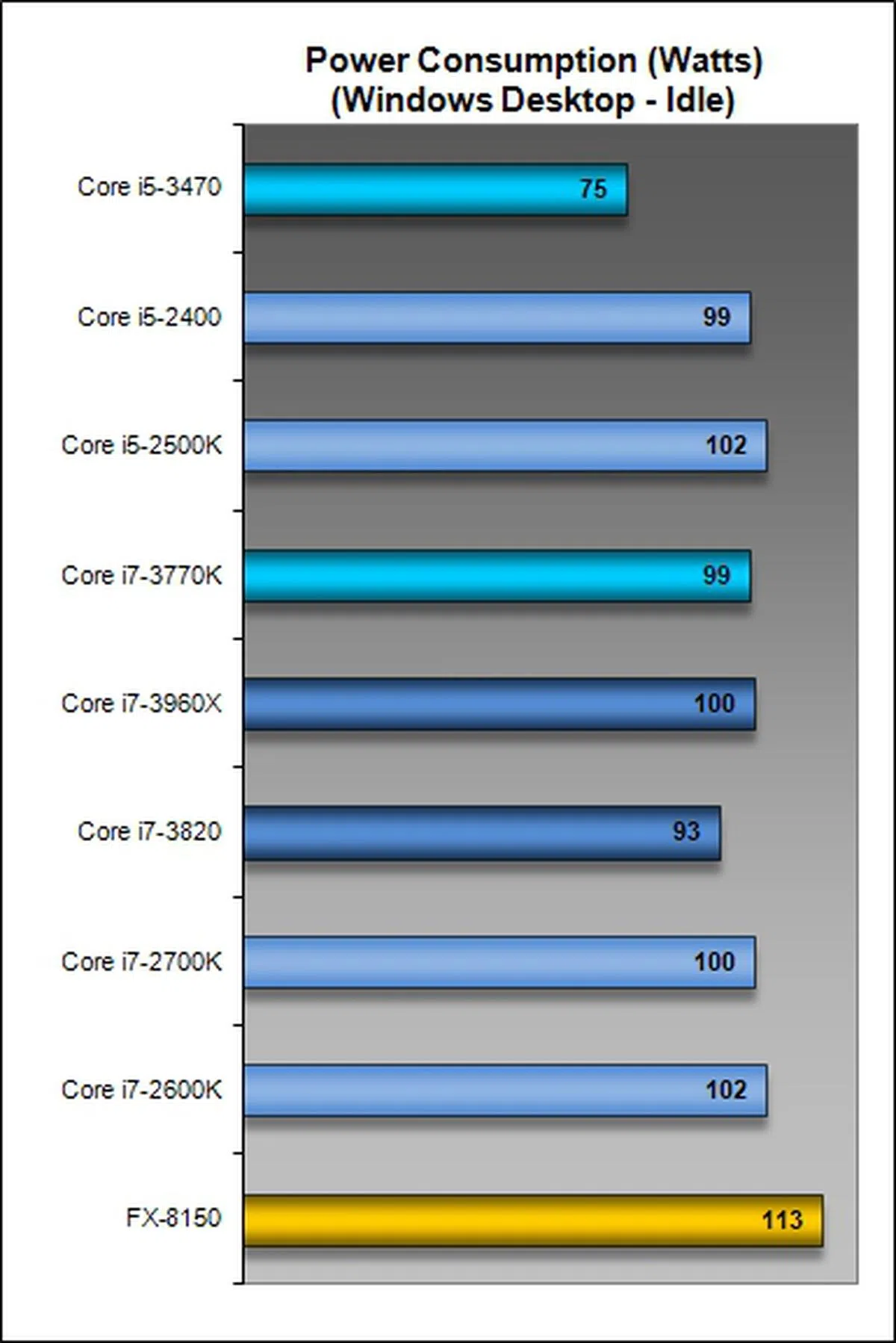
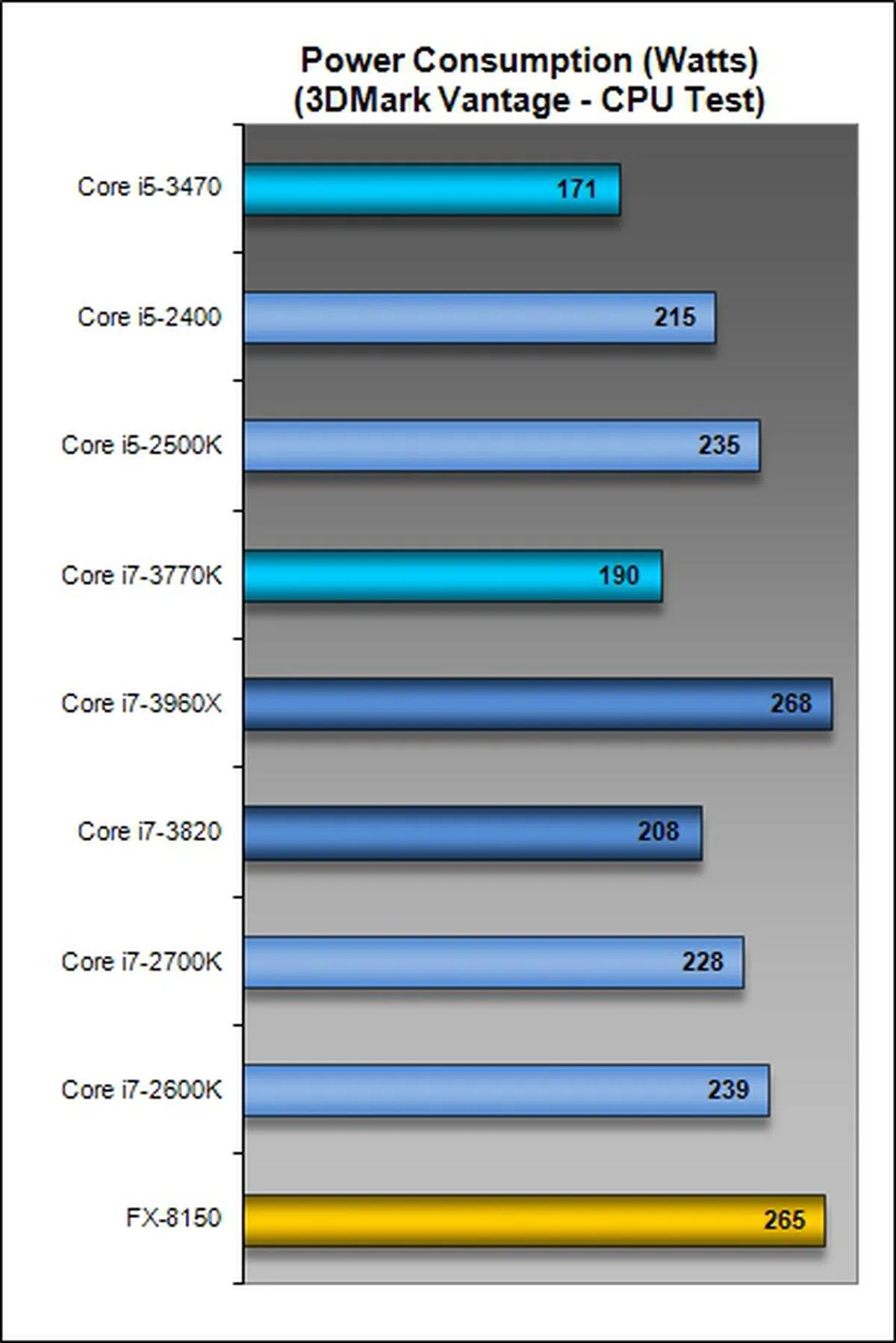
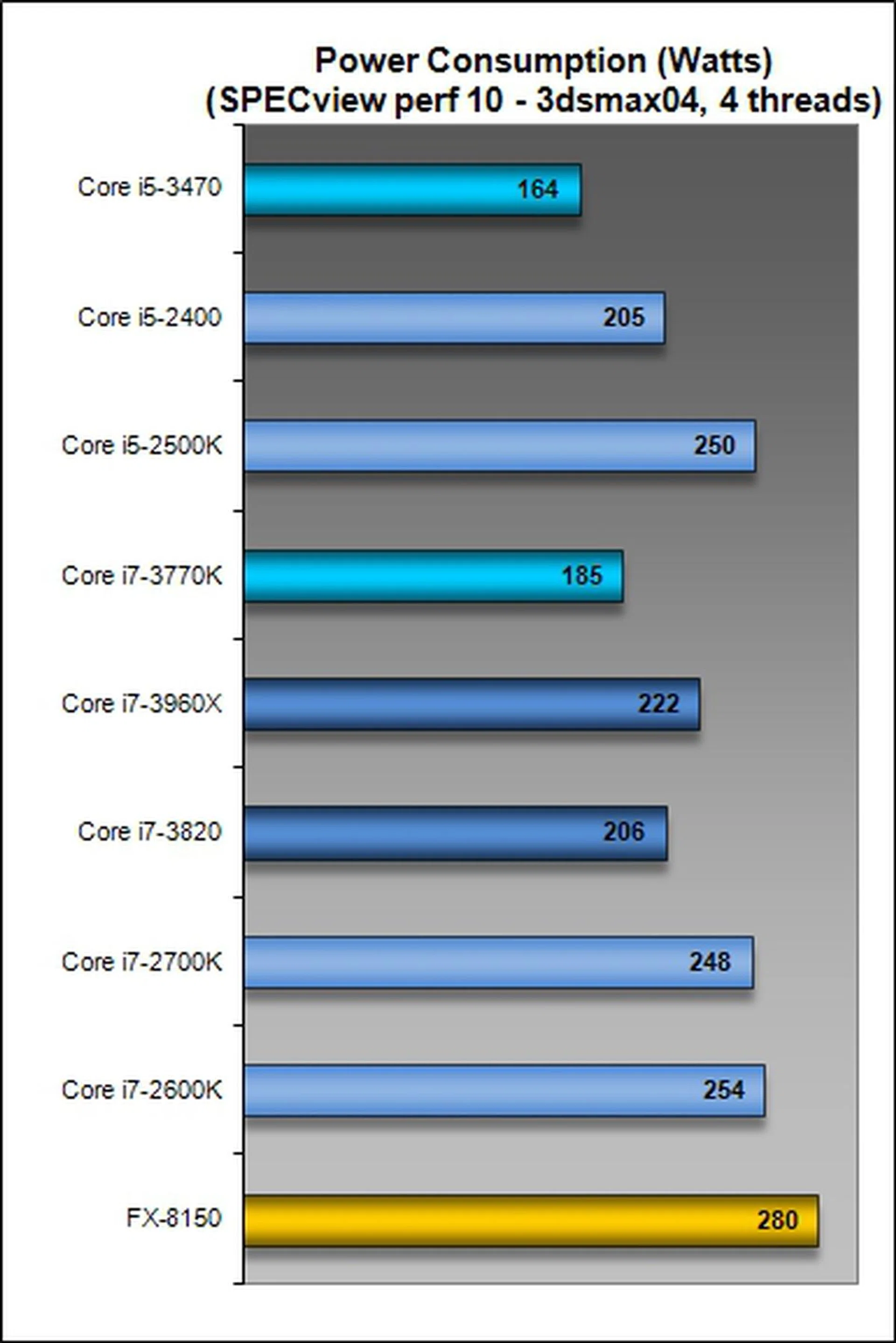
Ivy Bridge was all about optimizing the new architecture set forth by its predecessor. Intel claims that the shrunken 22nm manufacturing process along with innovations such as Tri-gate transistors will significantly reduce power consumption of the new Ivy Bridge processors and looking at the graphs we have, this certainly seems to be the case. The Core i5-3470 recorded the lowest power draw figures of any processor, which is clearly a testament to the power optimization improvements introduced in Ivy Bridge processors. AMD's FX processors clearly pale in comparison.
 |  |
An Incremental Update
The new processors released by Intel will no doubt appeal to mainstream users and value seekers who are looking to hop on the Ivy Bridge bandwagon.
Looking at the Core i5-3470 we have here, from a performance standpoint, the new chip is expectedly quicker than both the Core i5-2500 and Core i5-2400, and in some instances also as quick as or even quicker than the Core i7-2700K. Judging from our benchmarks, the Core i5-3470 was about around 8%-10% quicker than the Core i5-2400, and around 5% faster than the Core i5-2500. Therefore, performance gains are at best decent and nothing to really shout about.
Where the Core i5-3470 really stood out, however, was in our power consumption test. Its idle power draw reading was a good 25% lower than both the Core i5-2400 and Core i5-2500. And even when taxed, power draw readings were still a good 20% lower than both the Sandy Bridge chips.
With a launch price of US$184 (for 1000 units), the new Core i5-3470 has the same launch price as the Core i5-2400 did when it was launched, which means you are now getting slightly more bang for your buck.
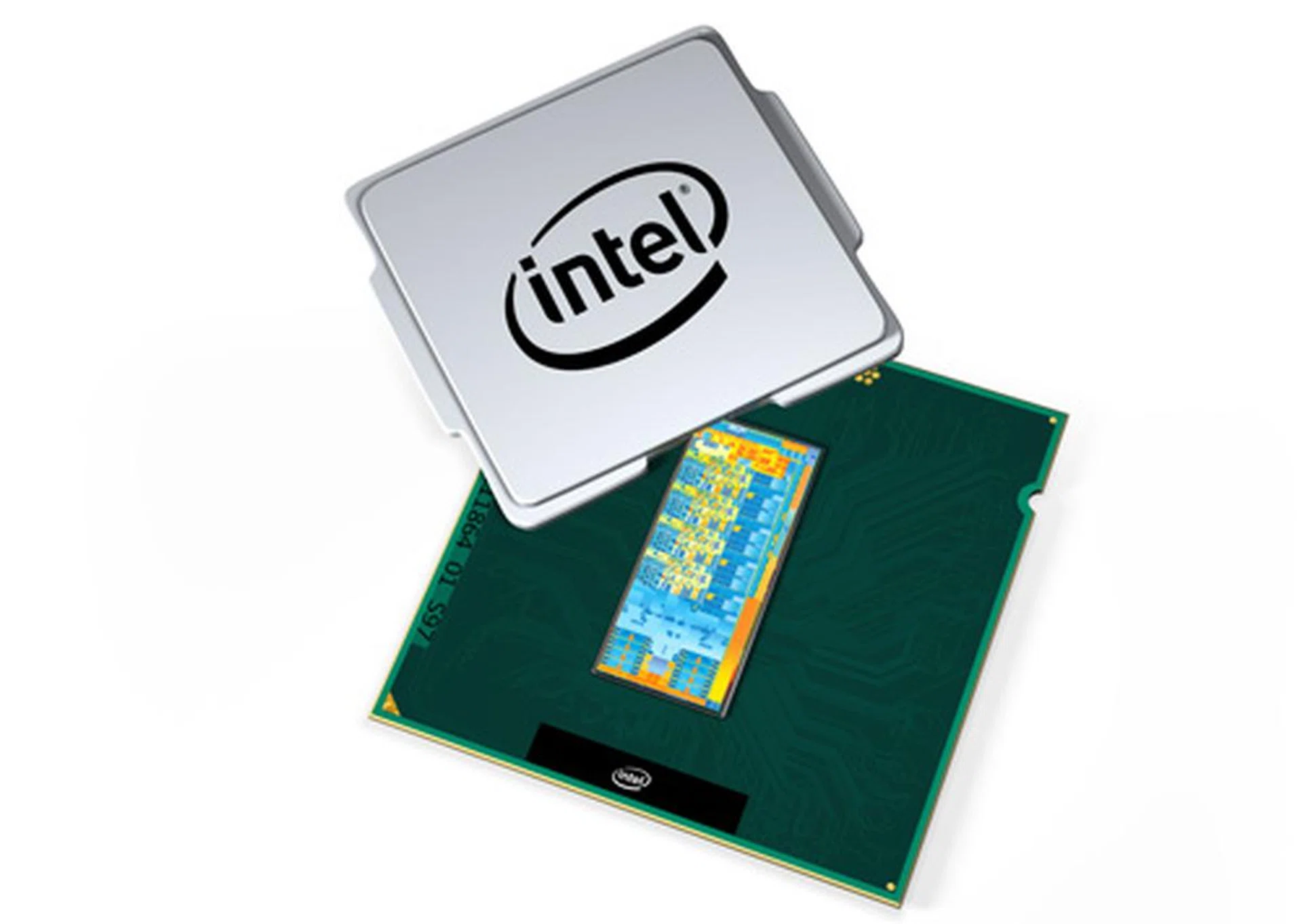
The new Core i5-3470 is a competent mainstream quad-core chip that offers a modest boot in performance. However, we don't think it offers enough for Sandy Bridge users to make the jump.
Overall, the Core i5-3470 is a decent mainstream quad-core chip. From a performance standpoint, it offers decent incremental improvements to both the older Core i5-2400 and Core i5-2500, and it’s also much more power efficient. That said, we don’t think these improvements alone are enough to justify anyone who’s currently on a Core i5-2400 or Core i5-2500 from upgrading - getting the Core i5-3470 would make much more sense if you are coming from a Nehalem processor or older.
Finally before we sign off, the Core i5-3470 is using the new Intel HD Graphics 2500 GPU, which is the replacement to the old Intel HD Graphics 2000. Although both GPUs have the same number of EUs (execution units), Intel says the EUs on the new generation GPUs are much more efficient. We will investigate the performance of the new Intel HD Graphics 2500 GPU in a future article in detail.
Our articles may contain affiliate links. If you buy through these links, we may earn a small commission.