
GeCube Radeon X1650 PRO Platinum Preview
ATI recently rung in the changes for its range of graphics chipsets. The mid-range segment saw the introduction of the Radeon X1650 PRO, a product that looks like the Radeon X1600 XT on paper. We examine GeCube's Radeon X1650 PRO Platinum to find out what's under the hood.

ATI Reboots its Mid-range
The endless speculation generated by news of ATI's reworked graphics chipsets has quickly settled once the benchmark results started coming in from the usual sources () Everyone seems to be singing the same tune generally: ATI's graphics leader now belongs to the new Radeon X1950 XTX but neither its performance nor its architecture is a radical advancement over the former Radeon X1900 XTX. Instead, its distinction lies with a quieter fansink and a technological first in the use of DDR4 memory modules. To many pundits, it is the other 'new' high-end card, the reduced 256MB version of the Radeon X1900 XT that grabs the spotlight due to its attractive price performance ratio. A possible sleeper hit perhaps?
In any case, the higher end graphics card duly stole the limelight as usual. The other cards introduced in the same launch, the Radeon X1650 PRO and the Radeon X1300 XT were quickly forgotten by most. With retail versions of the mid-range Radeon X1650 PRO expected to debut in stores later this month (14th September), we felt that it was the turn of the Radeon X1650 PRO to get some love.
For those who have neglected to check out the specifications of the Radeon X1650 PRO, we can summarize it in one sentence: the Radeon X1650 PRO is a Radeon X1600 XT in disguise. Underneath the coolers and heatsinks, the Radeon X1650 PRO shares the same 90nm R530 core as the Radeon X1600 XT. The architecture is also similar and the pixel and vertex shaders remain the same at 12 and 5 respectively. Only the clock speeds have been given a minor bump upwards; the core clock has gone up from 590MHz to 600MHz while the memory clock has increased from 1380MHz to 1400MHz DDR.
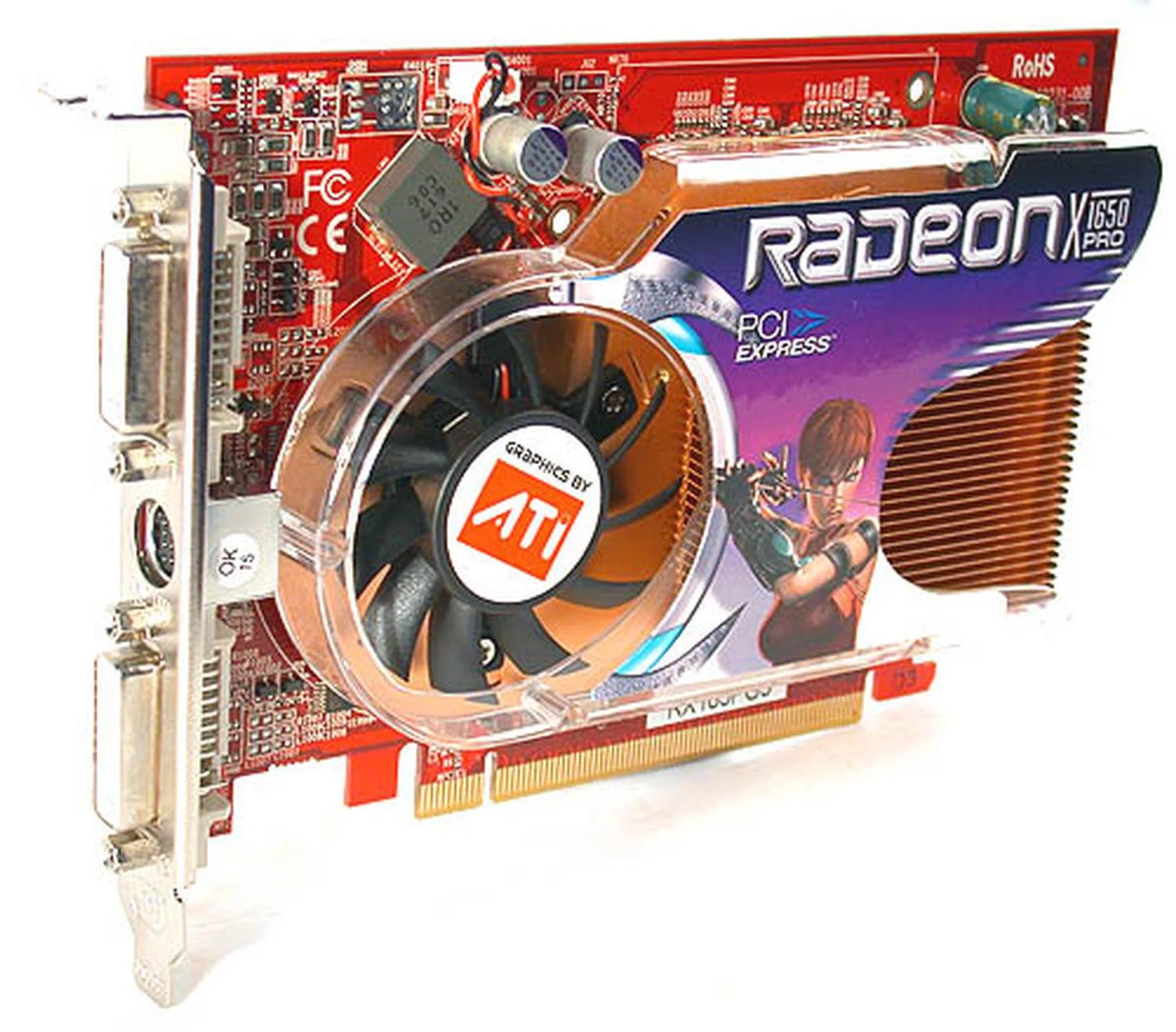
We failed to get our hands on a standard Radeon X1650 PRO graphics card but we went one better by getting the GeCube Radeon X1650 PRO Platinum. GeCube has upped the memory clock of its Radeon X1650 PRO here by 100MHz DDR and hopefully, that would make more of a difference than the cursory speed boosts made by ATI. Here's a look at this 'Platinum' card:
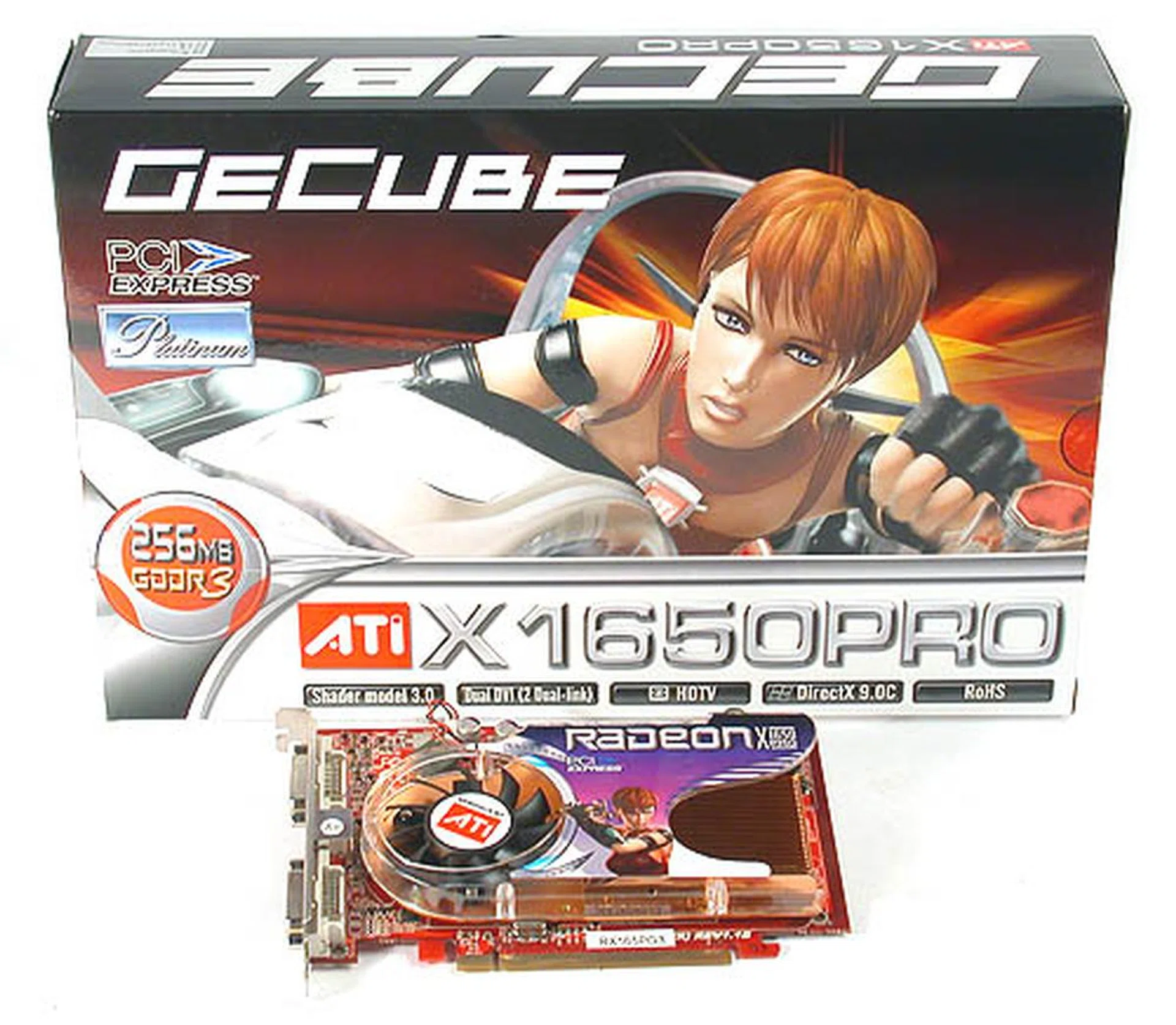
GeCube is quick out of the blocks for its Radeon X1650 PRO Platinum, which gets its 'Platinum' from its slightly overclocked memory frequency.
Nothing Platinum About it
The original reference Radeon X1600 XT seemed like a relic from a previous era due to its loud whiny cooler. It may have looked small and harmless but the fan did generate significant amounts of noise. The actual shipped cards from ATI's partners tend to improve things somewhat, since they have the leeway to introduce versions with silent, passive coolers or third party coolers that worked better than the original.
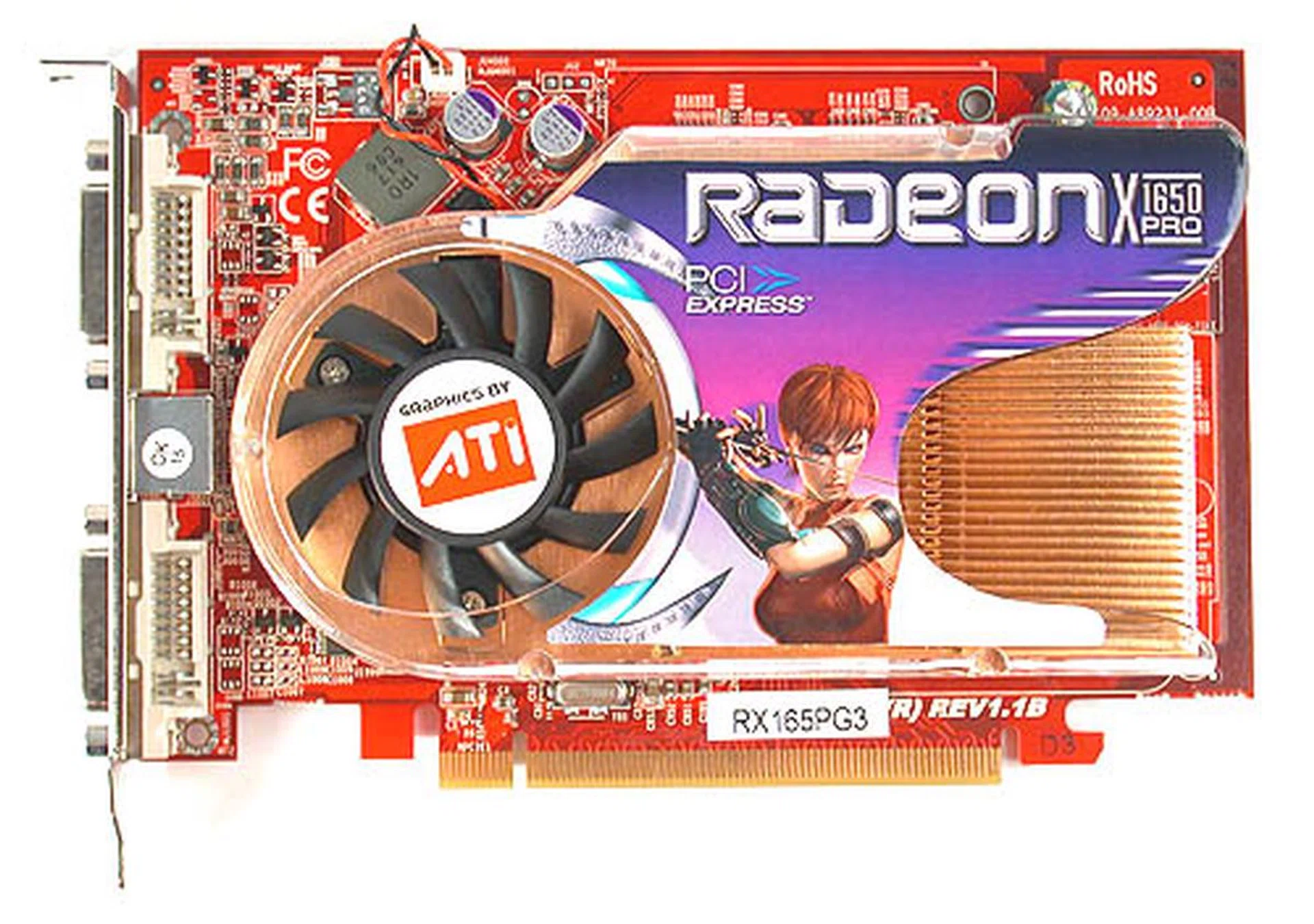
A different choice of cooler from the reference Radeon X1600 XT seems to be the most significant change in the Radeon X1650 PRO. Of course, many retail Radeon X1600 XTs in the market use their own custom coolers.
Someone has obviously been listening to this feedback because the GeCube Radeon X1650 PRO Platinum uses a relatively quiet cooler. Looking like a stripped down version of GeCube's Uni-Wise cooler (the heat pipes on that GeCube proprietary cooler has unfortunately been removed in this case), this copper based cooler with aluminum fins relies on its fan to do the job.
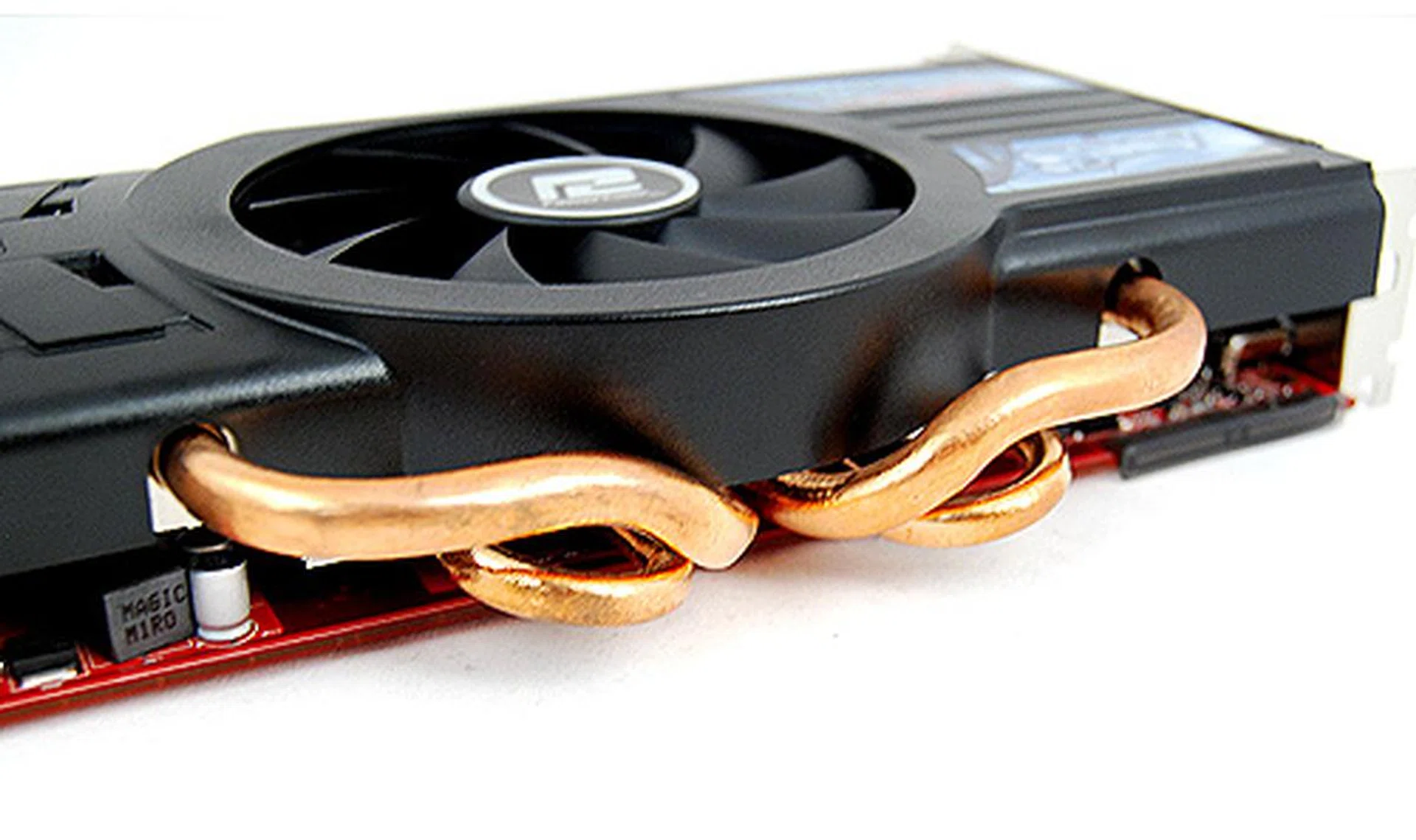
A closer look at this cooler which is much less noisy than previous ones for the Radeon X1600 XT. At least this is a tangible improvement.
GeCube has also overclocked the memory frequency for its Radeon X1650 PRO Platinum, which we presume is the main reason why this Radeon comes with a 'Platinum' tagged to its name. The core clock remains at the standard frequency of 600MHz while the DDR3 memory modules have been bumped to 1500MHz DDR from the 1400MHz default. With such a minor speed bump, we doubt that benchmarks scores would improve much but let's leave that to the results later.
Another major point to note is that unlike most Radeon X1600 XT cards that we have seen, the GeCube Radeon X1650 PRO Platinum does not come with a Rage Theater ASIC. While this is our first Radeon X1650 PRO retail card, we have noticed that the few other such cards on the market all have Rage Theater chips onboard. It seems rather strange that GeCube has chosen to omit this feature. Not many users would likely utilize it but it is always better to include it and stay on par with the competition.
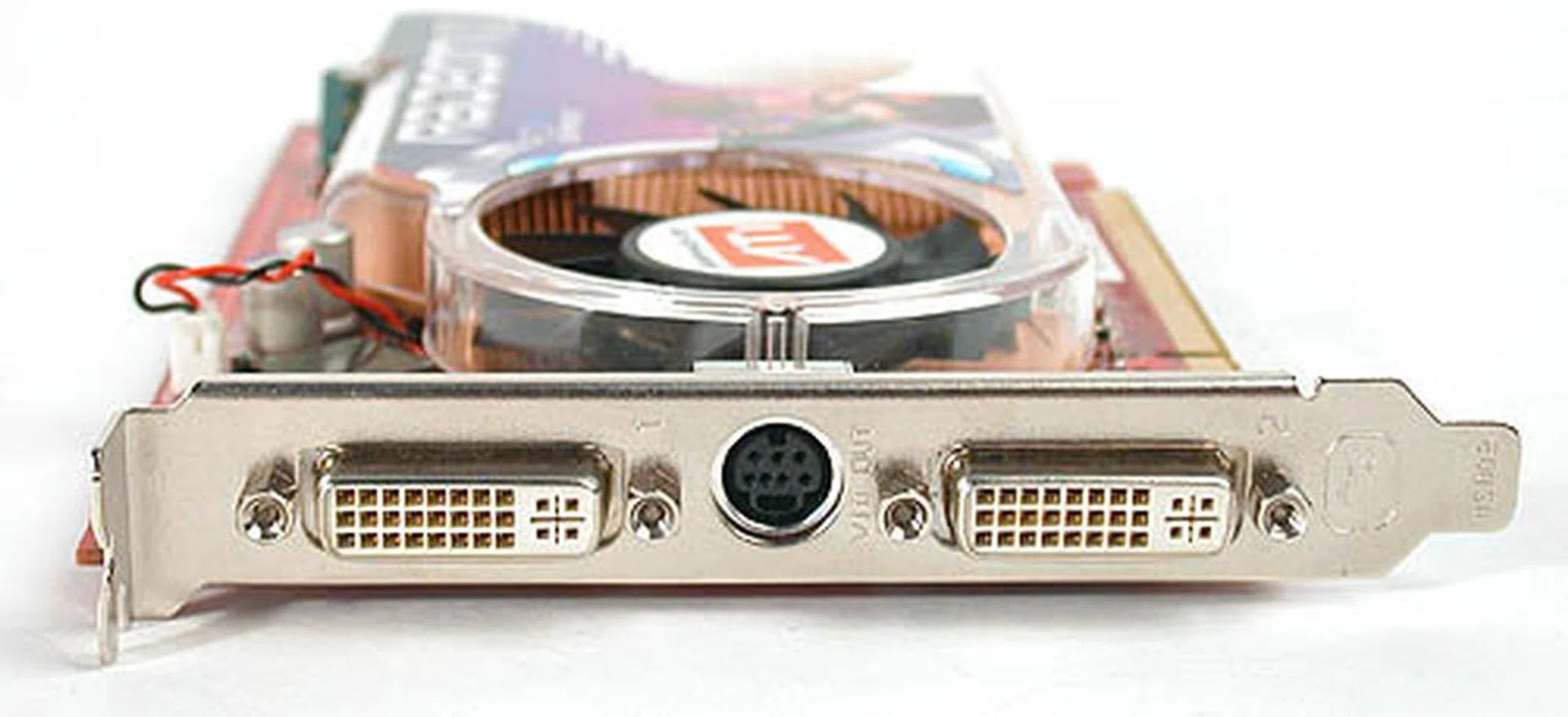
A pair of dual-link DVI outputs is rather standard for modern graphics cards.
True to GeCube's usual practice of bundling only the basics, there are no extras in the package. We did find the standard CD containing the graphics drivers but there are no other applications or games. While half-expected, we were still disappointed since this is after all a 'Platinum' version. Here's what we found in our bundle:
- 1 x DVI-to-VGA adaptor
- 9-pin mini-DIN to Component/S-Video dongle
- 9-pin mini-DIN to S-Video/Composite dongle
- User Manual
- Driver CD
Test Setup
All the benchmarks that we ran the GeCube Radeon X1650 PRO Platinum were conducted on a system with an AMD Athlon FX-55 (2.6GHz) processor. The motherboard used was a MSI K8N Diamond Plus and we also had up to 1GB of low latency DDR400 memory modules from Kingston running in dual channel mode. The hard drive used was a Seagate 7200.7 SATA, which had Windows XP Professional installed and updated with Service Pack 2 and DirectX 9.0c.
The GeCube Radeon X1650 PRO and the reference ATI Radeon X1600 XT were on Catalyst 6.8 drivers. We had to use the drivers provided by GeCube because the standard Catalyst failed to recognize it correctly but besides that, the drivers are essentially the same ones found on ATI's website. The NVIDIA cards were all running ForceWare 91.29 drivers. The following benchmarks were tested:
- Futuremark 3DMark05 Pro (version 120)
- Futuremark 3DMark06 Pro (version 102)
- Tom Clancy's Splinter Cell 3: Chaos Theory (version 1.3)
- Chronicles of Riddick: Escape from Butcher Bay (version 1.1)
- Quake 4
Results - 3DMark05 Pro & 3DMark06 Pro
The 3DMark05 results for the GeCube showed the Radeon X1600 XT almost on par with this card. The difference between them was around 1% or less, making it practically negligible. This trend was repeated in 3DMark06 but here, the overclocked GeForce 7300 GT proved to be a very capable competitor and was effectively the equal of both the GeCube and the Radeon X1600 XT.
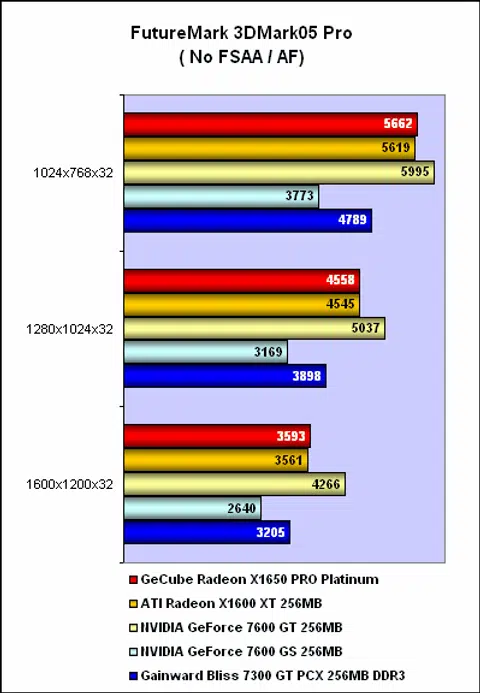
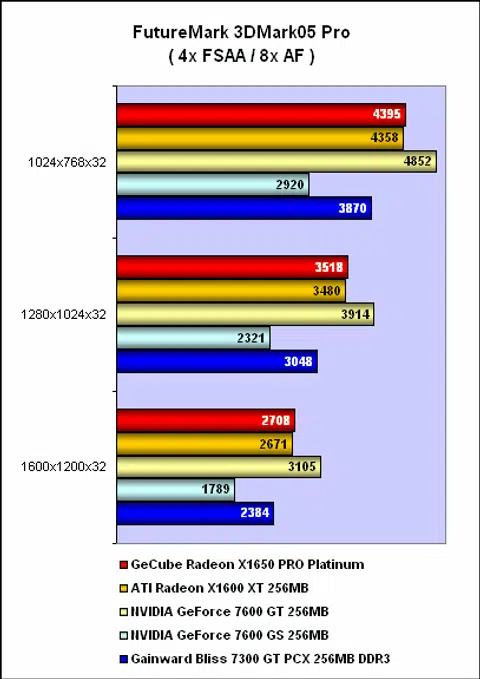
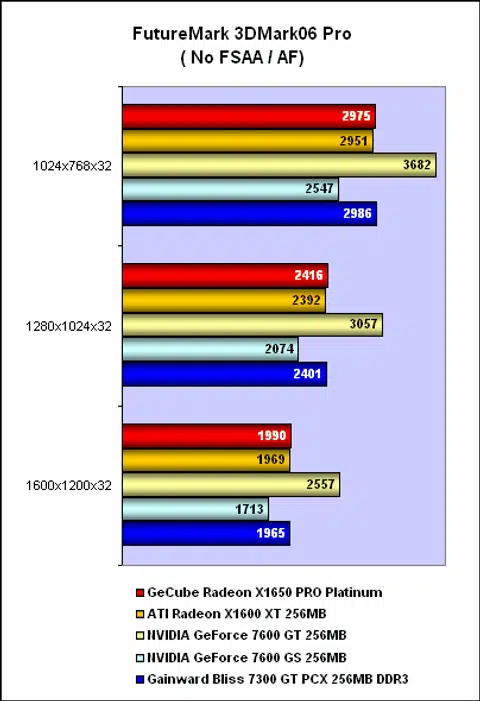
Results - Chronicles of Riddick: EFBB (OpenGL, SM2.0+ Benchmark)
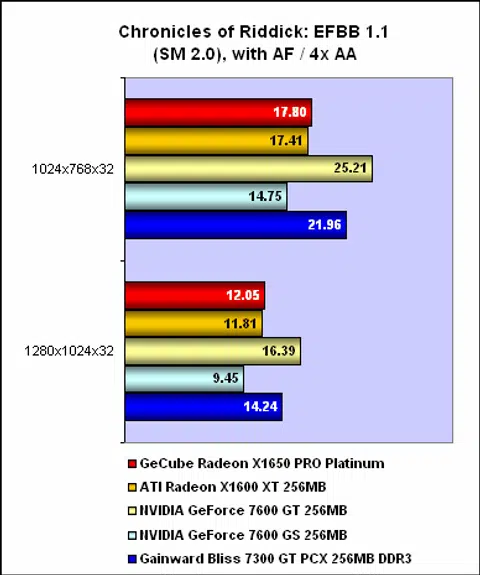
Both the ATI cards and the GeForce 7600 GS were in the same performance ballpark in our first round of tests for Chronicles of Riddick. When antialiasing was enabled later, the GeForce 7600 GS fell behind. However, ATI should be concerned that the faster GeForce 7300 GT variants and of course the GeForce 7600 GT are still significantly ahead in this benchmark.
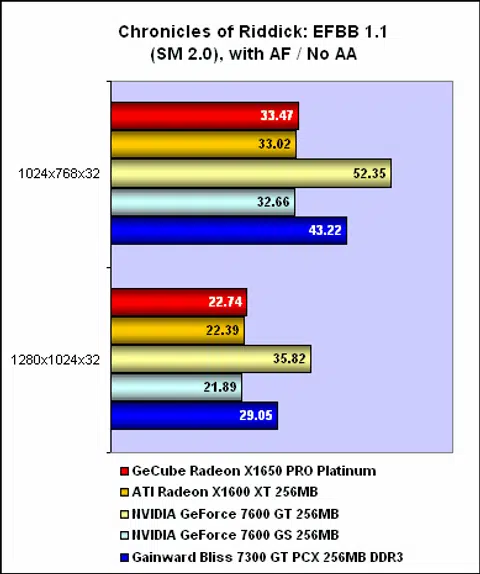
Results - Splinter Cell 3: Chaos Theory (DirectX 9 Benchmark)
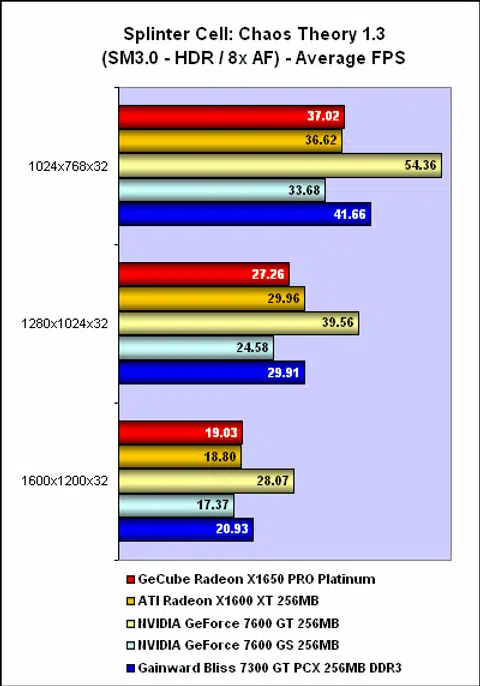
If you still have any doubts that the Radeon X1650 PRO is a rehashed Radeon X1600 XT, you have only to look at our Splinter Cell scores. Despite the supposedly 100MHz DDR difference in memory clock between this GeCube and the standard Radeon X1650 PRO, the GeCube only managed to perform fractionally faster here compared to the Radeon X1600 XT. Additionally, both cards were also upset by the overclocked GeForce 7300 GT that we had included.
Results - Quake 4 (OpenGL SM2.0+ Benchmark)
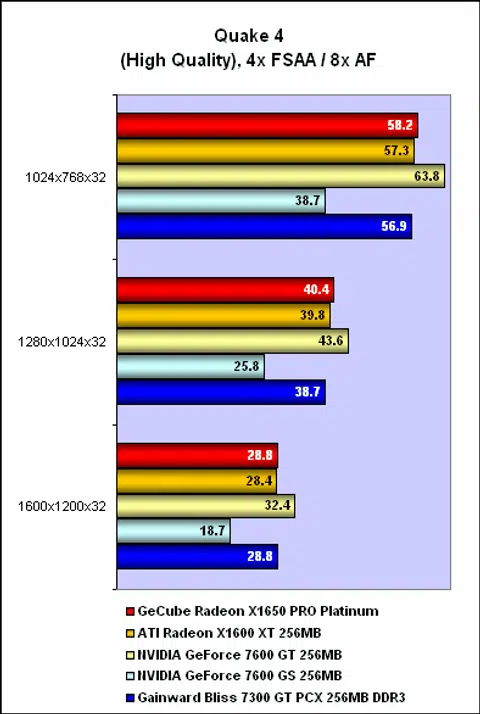
The final benchmark, Quake 4 only confirmed our findings so far: the overclocked GeCube hardly had a lead over the older Radeon X1600 XT. One can easily predict that a normal clocked Radeon X1650 PRO would be level with the Radeon X1600 XT. This also meant that the GeForce 7300 GT, especially the overclocked, DDR3 versions, will again feature prominently as the closest competitor in both price and performance. In Quake 4, it was mostly equal with both ATI cards when antialiasing was enabled and when this was disabled, it emerged the faster.

Temperature Testing
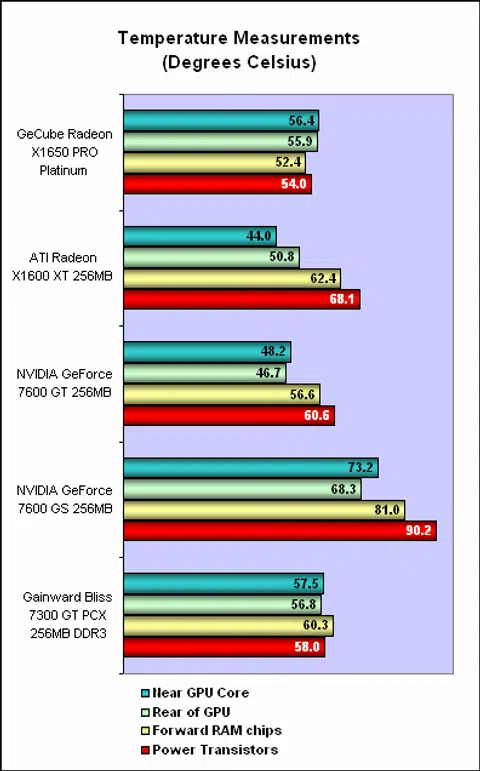
The temperatures on the GeCube were not that much different from the standard Radeon X1600 XT. The heatsink on the GeCube extends to the memory modules so that's an improvement over the typical Radeon X1600 XT and resulted in lower temperature readings when the card is in the thick of running benchmark loops. Compared to the other graphics cards in its category, the GeCube is relatively well positioned in the middle of the pack and does not call attention to itself, which is probably a good thing.
Overclocking
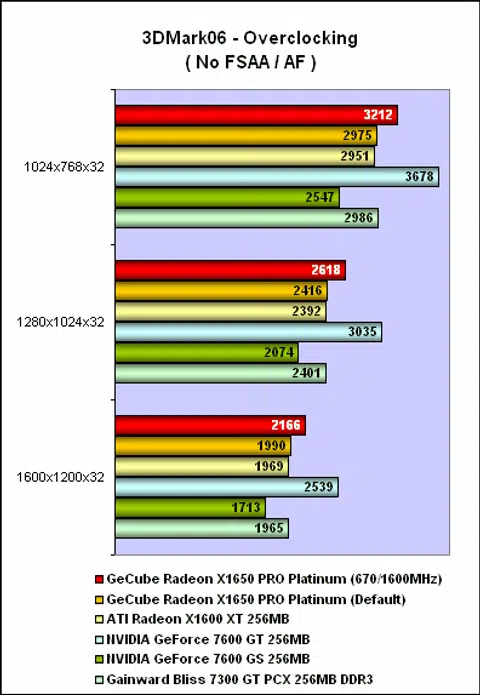
Although the performance of the GeCube was not much better than the standard Radeon X1600 XT, it did perform quite decently in our overclocking segment. The core reached a high of 670MHz while the memory modules could be extended by another 100MHz DDR to hit 1600MHz DDR. The end result: an 8% improvement in 3DMark06. Of course this was still not enough to approach the performance of the GeForce 7600 GT but it does help to put some distance between it and the encroaching overclocked GeForce 7300 GT variants.
Conclusion
Based on our findings for the GeCube Radeon X1650 PRO Platinum, we have to conclude that the Radeon X1650 PRO is the Radeon X1600 XT made good. The most glaring flaw, that noisy reference cooler is gone for good. The increased clock speeds don't sound like much and as we found out through GeCube's mildly overclocked Radeon X1650 PRO Platinum, the performance boost wasn't much either. However, the main attraction is the highly competitive US$99 price point that ATI has promised for the standard Radeon X1650 PRO. While the eventual street price may depend on other factors (including different possible configurations), this recommended retail price should interest those who need a decent mid-range graphics card for cheap. Although NVIDIA's GeForce 7300 GT may seem like a possible threat, the faster, overclocked ones that have 256MB of DDR3 will probably cost much more than the Radeon X1650 PRO so that balances out.
With the Radeon X1650 PRO falling behind the GeForce 7600 GT in all our benchmarks, who then is the true mid-range competitor to NVIDIA's popular mid-range veteran? It seems that the answer may lie with the low profile Radeon X1900 GT. ATI has revised its price to US$249 but this is still more expensive than the typical GeForce 7600 GT (and of course much faster too). So you can probably expect a Radeon X1650 XT to be forthcoming soon to address this. After all, the gap between the US$99 Radeon X1650 PRO and the US$249 Radeon X1900 GT is a large one.
It may be too late but the Radeon X1650 PRO corrects the most glaring faults of the Radeon X1600 XT. Meanwhile, GeCube's overclocked Radeon X1650 PRO Platinum falls rather flat in terms of performance so you shouldn't fall for its Platinum label.
As for the GeCube Radeon X1650 PRO Platinum, let's just say that it fell short of what we had expected. Perhaps these expectations are overly heightened each time we encounter a product with a special label like Platinum. GeCube may not share the same sentiments. However, we believe that our opinions have merit - most consumers would not be too excited about a slight 100MHz DDR increase in memory clock speed, more so when this boost comes with some caveats.
First, the GeCube lacks a Rage Theater ASIC that is usually found on the older Radeon X1600 XT cards and a quick check with most of the initial Radeon X1650 PRO variants launched seem to point that VIVO won't be a standard feature. Next, the bundle of applications and software is non-existent; only graphics drivers are included. Given these flaws, would you exchange them for that minor overclock, which are easily and safely accomplished nowadays using software tools?
It just does not add up to a Platinum worthy product so we are left with its price as the final determinant of its value. GeCube told us that the retail price of this Radeon X1650 PRO Platinum would be US$155, which is substantially more than what we had expected from ATI. However, a survey of a number of other vendors has revealed that they intend to price their products in the US$140 - US$150 price bracket as well for their 256MB DDR3 variants. Moreover, it seems that the promised price point of US$99 from ATI may only be applicable to certain geographical locations like the United States and that too with perhaps DDR2 memory variants which may not be of the same configuration of this GeCube card reviewed.
It's too early to tell if the street price will indeed be more than ATI's optimistic figure but judging from the performance of the GeCube, a US$155 is definitely not going to excite consumers. With the faster GeForce 7600 GT cards going for US$170 and would probably be less now that the US$199 GeForce 7900 GS has been launched, it will be tough arguing for a US$155 Radeon X1650 PRO, overclocked or not.
Our articles may contain affiliate links. If you buy through these links, we may earn a small commission.