
GeCube Radeon HD 3870 512MB GDDR4 (O.C. Edition)
ATI's partners are walking a tightrope producing Radeon HD 3800 series cards that can hold their own against the numerous GeForce 8800 GT cards while maintaining its competitive price. GeCube does it by equipping a custom cooler and a tweaked BIOS to their new overclocked Radeon HD 3870 512MB beast.

Introduction
Despite a generally disappointing 2007 brought about by the less than spectacular R600 core, ATI salvaged the situation somewhat by quickly moving to a 55nm manufacturing process by the latter half of the year and launching the Radeon HD 3800 series as a competitive mid to high-end product competing on price rather than purely performance. This meant that the top GPU from ATI - the RV670 based Radeon HD 3870 - is not significantly any faster than the Radeon HD 2900 XT which uses the original R600.
What it does bring about however includes a core that produces less heat, aided by power saving technologies like ATI PowerPlay and with the Universal Video Decoder that was unfortunately missing on the Radeon HD 2900 XT. Support for new standards like DirectX 10.1, PCIe Express 2.0 are also much welcomed, if only for the sake of preparing for the future.
Together with its competitive pricing, the Radeon HD 3800 series has probably stopped the hemorrhaging of ATI's market share. It may not be a breakthrough success but it is nevertheless a respectable release. To win back the performance crown however, ATI is relying on a dual GPU implementation of the RV670 that is expected to be available in the coming weeks. We hope to bring you more details of this upcoming GPU soon but meanwhile, the healthy state of the Radeon HD 3800 series in the market is good news for the market and reflecting that, we have an overclocked 'turbo' version of the Radeon HD 3870 in our hands today from GeCube.
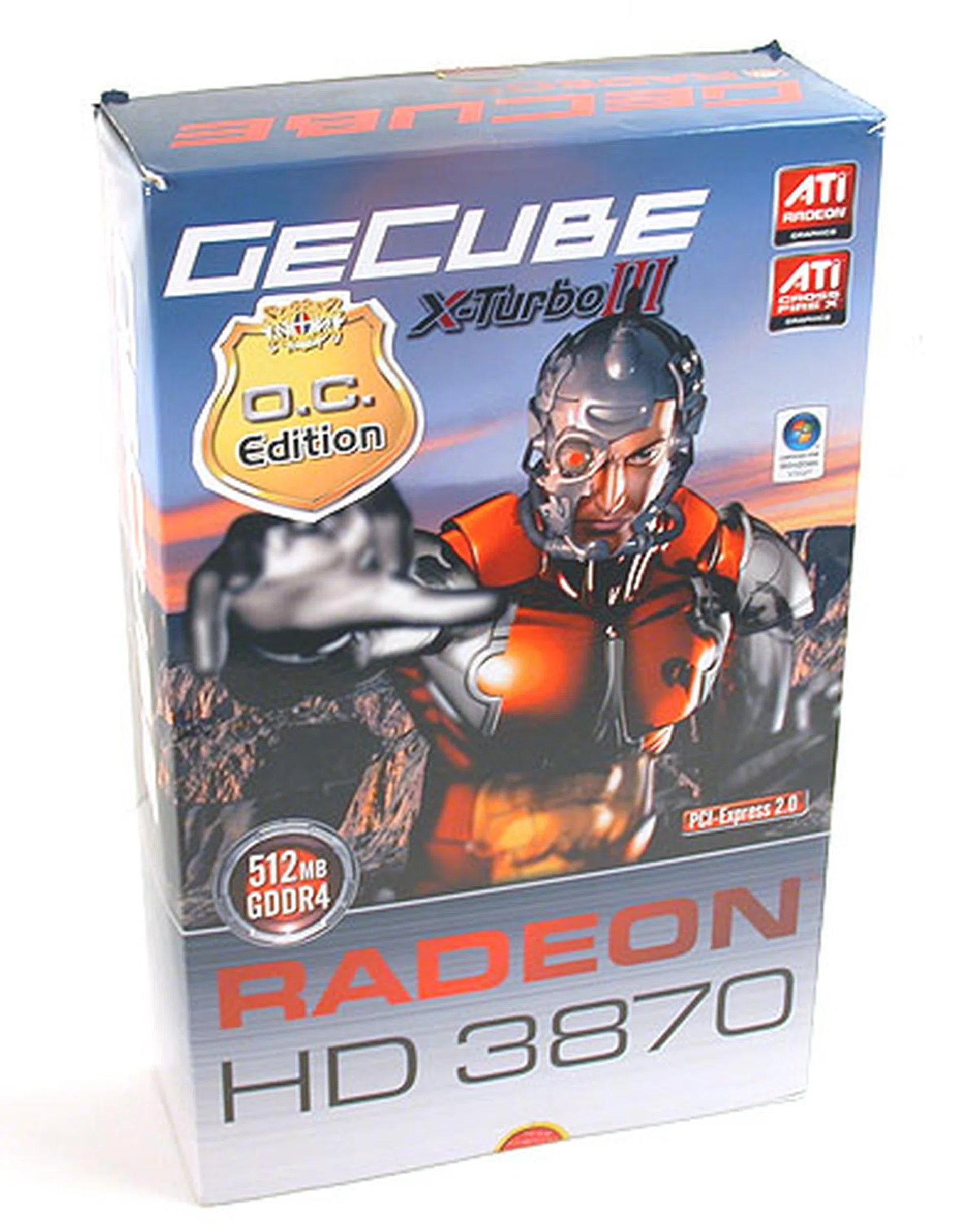
A tall, large and definitely not environmentally friendly package for this GeCube Radeon HD 3870. The hardware itself is RoHS compliant of course.
Featuring its custom X-Turbo III cooler to support its overclocked frequencies, this new card from GeCube faces stiff competition on the performance front, with NVIDIA and its legion of board partners pushing the better performing GeForce 8800 GT 512MB. Can its higher clock speeds narrow the gap enough that consumers start considering its lower price tag? Are the temperatures lower than the reference model? We answer these questions after the jump.
The GeCube Radeon HD 3870 O.C Edition
When GeCube told us about its new X-Turbo III cooler, we were expecting an unique distinctive design. We could not be more wrong however, since the cooler we found on this Radeon HD 3870 card appeared quite similar to the reference model - at least on face value. It turns out that it is indeed different, though in such subtle ways that a quick casual glance won't reveal.
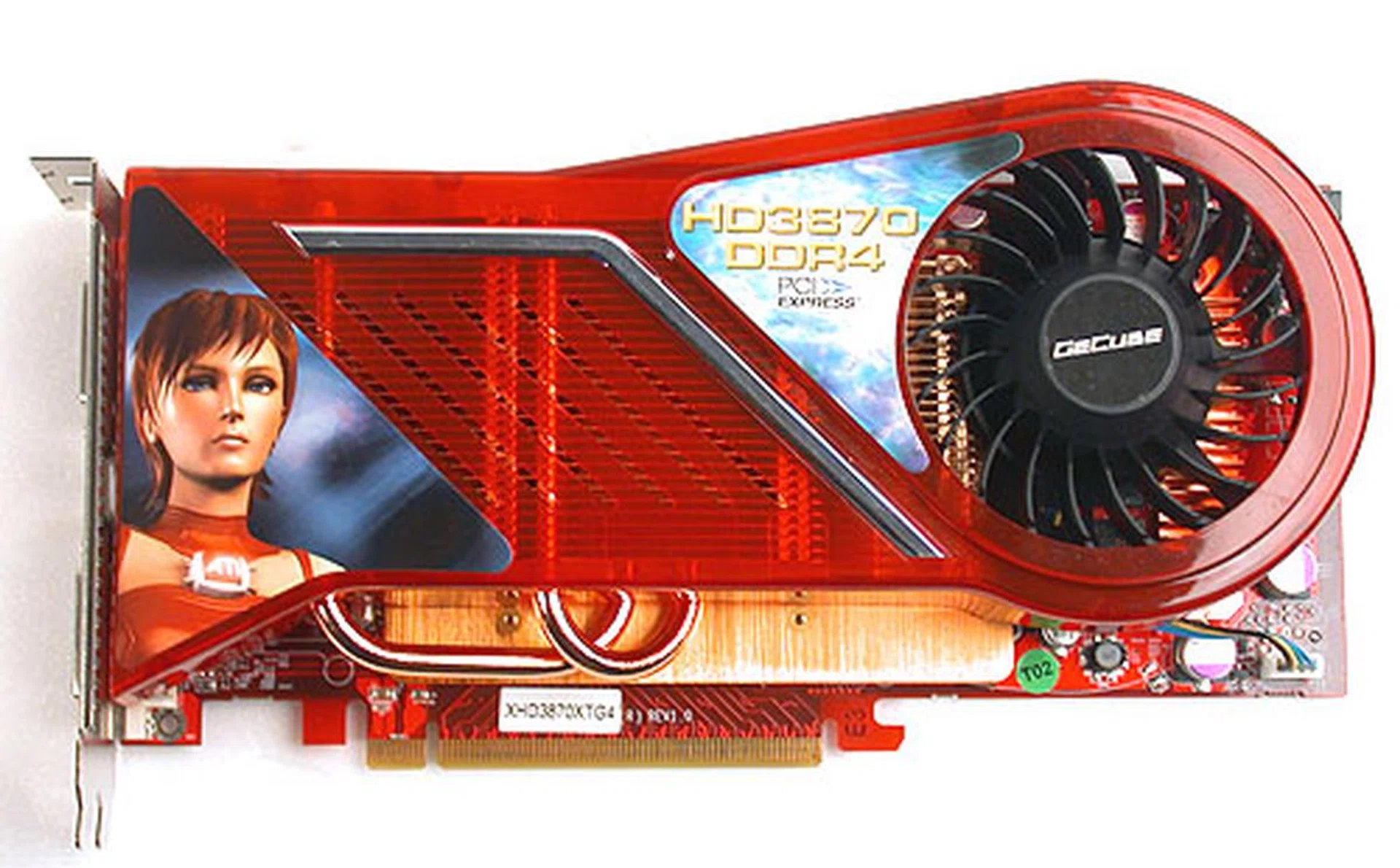
Due to the cooler, this Radeon HD 3870 is slightly taller than the reference model but it shouldn't have any practical difference.
First, while both are dual slot coolers that are encased in a red plastic shroud that covers most of the heatsink, the resemblance ends here. The reference design basically has a fan drawing in cool air outside and passing over the heatsink and then out through the exhaust vents behind. GeCube has built upon this design, adding in two heat pipes while at the same time extending the surface area of the heatsink. This should lead to greater heat dissipation and it is complemented by a slightly larger cooler fan. That's all theory however and only our temperature tests later will reveal if there is any significant improvement.
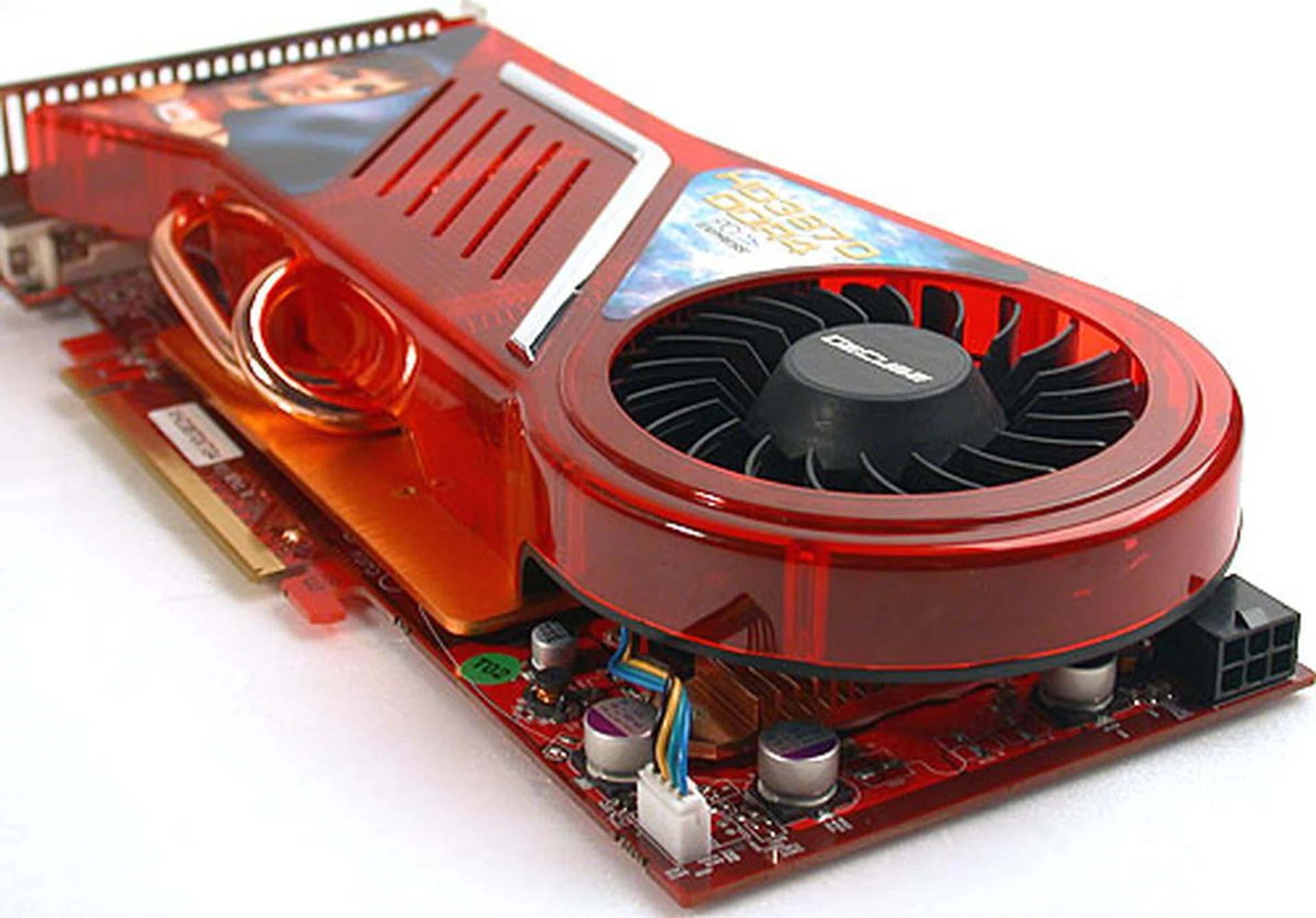
It's too easy to assume the GeCube has the reference cooler, as both are dual-slot solutions.
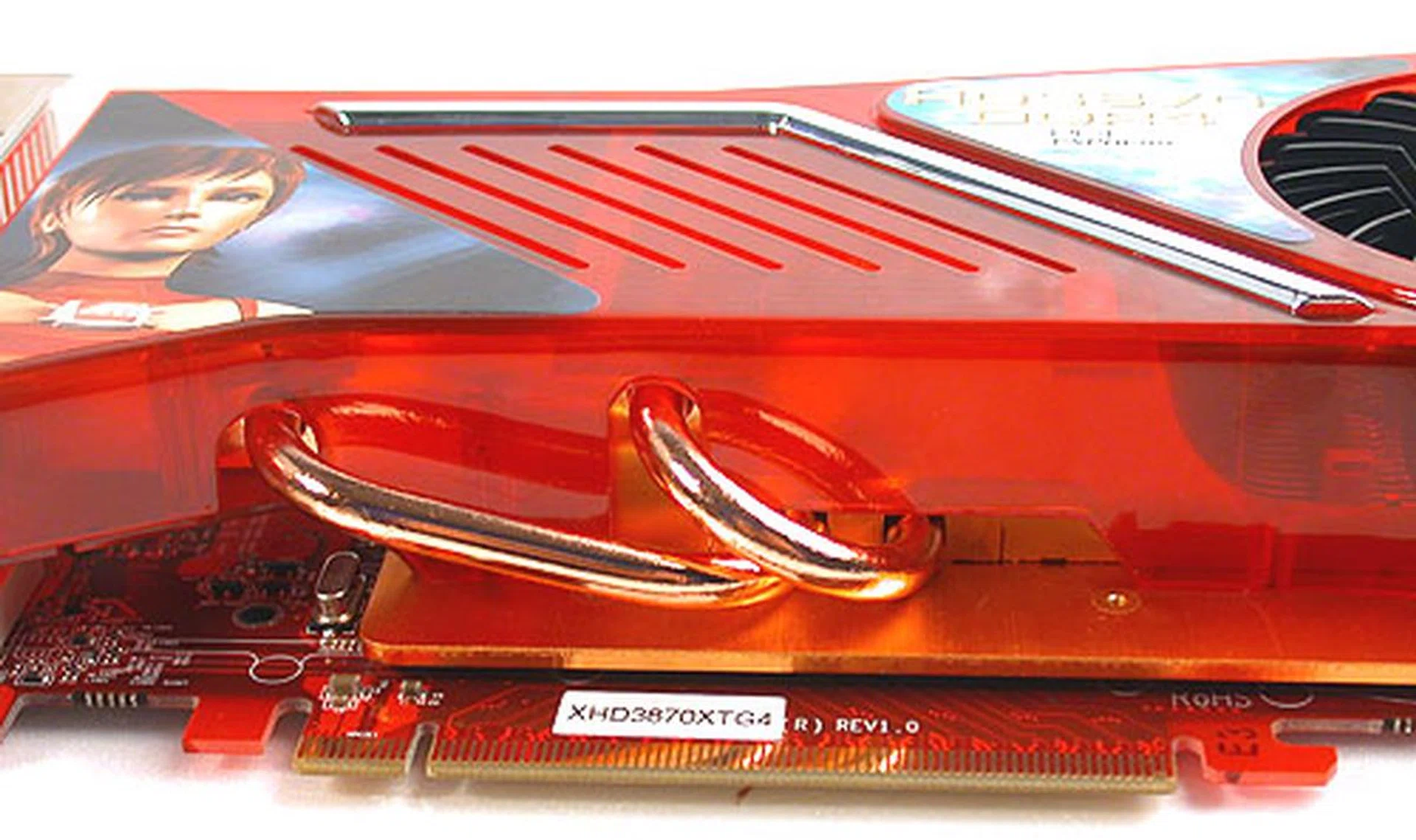
These two heat pipes, together with a larger heatsink is the reason why GeCube is so upbeat about its new X-Turbo III cooler.
Meanwhile, GeCube has also increased the core clock speed of this card from its default of 775MHz to 810MHz. The memory clock stays at 2250MHz DDR and we feel that even with GDDR4, there shouldn't be much allowance left for the memory here. Besides the higher core clock and the custom X-Turbo III cooler, the rest of this card is your standard Radeon HD 3870, with two HDCP ready dual-link DVI outputs and support for multi GPU configurations via CrossFireX.
Like most GeCube offerings, there is only the basic accessories from the vendor. There are no extra applications or games beyond the drivers and we have the full list of items below:
- DVI-to-HDMI adapter
- DVI-to-VGA adapter
- 7-pin mini-DIN to Component dongle
- 7-pin mini-DIN to Composite/S-Video adapter
- 6-pin Molex power connector
- CrossFire bridge
- Driver CD
- Installation guide
Test Setup
We're in the midst of transitioning to a DirectX 10 platform but in the meantime, our trusty test rig is the same Intel Core 2 Duo based system using a E6700 (2.66GHz) processor, an Intel D975XBX 'Bad Axe' motherboard, 2GB of low latency DDR2-800 HyperX memory modules from Kingston and with a Seagate 7200.7 hard drive. The operating system is Windows XP Professional with Service Pack 2 and updated with DirectX 9.0c.
Besides the GeCube Radeon HD 3870, we compared it to a few other cards, including an overclocked version from MSI and the reference model. NVIDIA's GeForce 8800 GT was also included, being the card to beat in this category. Below are the tested cards and the driver versions used:
- GeCube Radeon HD 3870 512MB O.C Edition (Catalyst driver ver 8.45 - newer than the ver 8.442 in the Catalyst 7.12 package)
- MSI RX3870-T2D512E-OC (Catalyst driver ver 8.43)
- ATI Radeon HD 3870 512MB GDDR4 (Catalyst driver ver 8.43)
- PowerColor Radeon HD 3850 Xtreme 512MB GDDR4 (720/1800MHz) (Catalyst driver ver 8.43)
- ATI Radeon HD 2900 XT 512MB GDDR4 (Catalyst driver ver 8.37)
- NVIDIA GeForce 8800 GT 512MB (ForceWare 169.02)
The following benchmarks were tested:
- Futuremark 3DMark06 (ver. 102)
- F.E.A.R
- Company of Heroes (ver 1.3)
- Supreme Commander
- Unreal Tournament 3 Beta Demo
- Crysis
Results - 3DMark06 (ver 102)
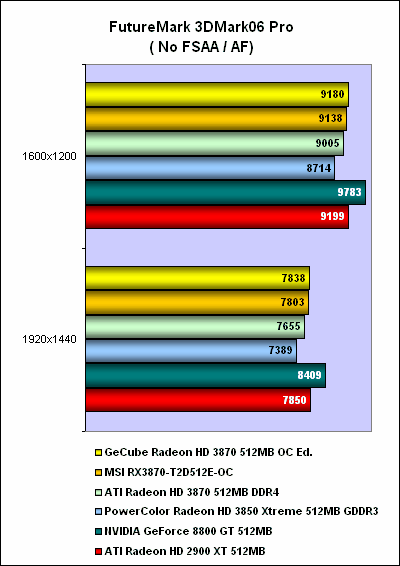
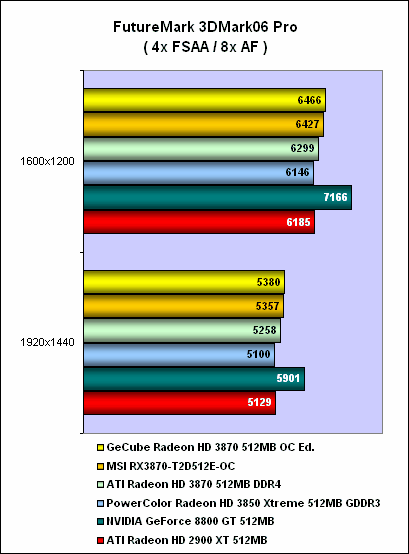
On paper, the GeCube had a very minor clock speed advantage over its MSI competitor and this was reflected in the 3DMark06 scores. However, the limelight was naturally stolen by the GeForce 8800 GT, which easily topped the table while the older Radeon HD 2900 XT showed that it was no slouch either, edging the overclocked Radeon HD 3870 cards despite running on older drivers.
Results - Company of Heroes & F.E.A.R
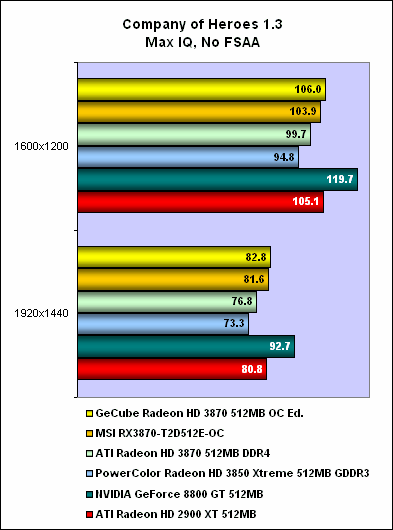
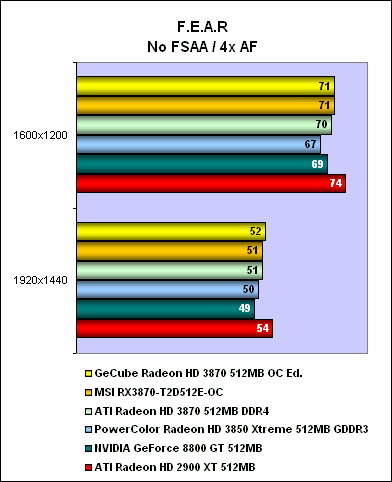
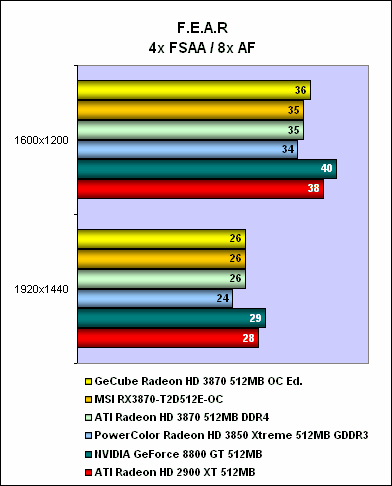
Company of Heroes was again won by the GeForce 8800 GT and by quite a sizable margin too. The overclocked GeCube was just ahead of the MSI, thanks no doubt to its slight clock speed edge. Also, the Radeon HD 2900 XT stayed in contention with the newer Radeon HD cards. F.E.A.R saw most of the cards performing similarly without anti-aliasing, with the GeForce 8800 GT surprisingly losing out here to the ATI cards. This was reversed when anti-aliasing was factored in, though the absolute frame rate difference was around 3 - 4 frames at most. Here, overclocking did not seem to matter too much, with all the Radeon HD 3870 cards performing similarly.
Results - Supreme Commander
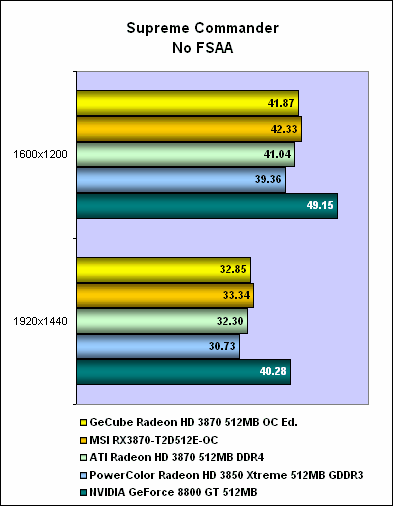
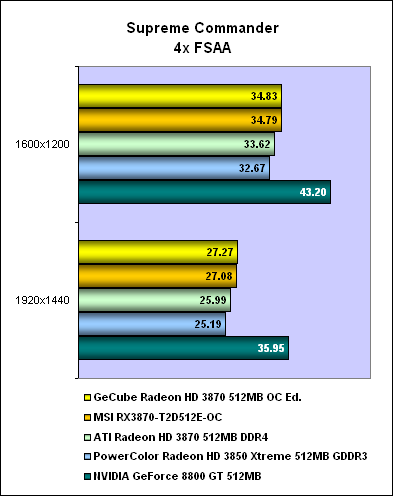
The GeForce 8800 GT was the undisputed leader in Supreme Commander, with all the Radeon HD 3870 cards falling in place according to their clock speeds. That meant the GeCube was the de facto leader for the ATI contingent but looking at the actual difference in scores, anyone will agree that in a practical sense, all the Radeon HD 3870 cards are effectively the same.
Results - Unreal Tournament 3 Demo & Crysis
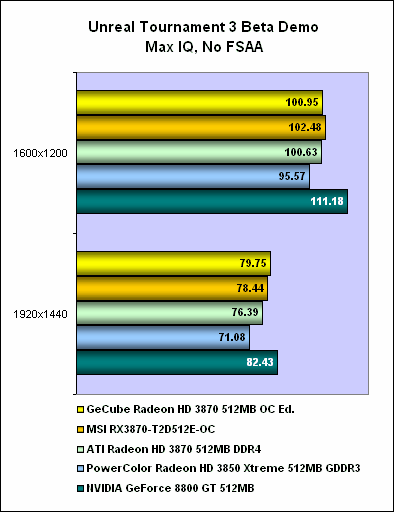
These two games have state of the art graphics, which means even the best graphics cards may flounder on them, especially Crysis. And so it turned out, as at the maximum settings, the Radeon HD 3870 cards managed less than 30 frames. With anti-aliasing enabled, these numbers fell even more. Unreal Tournament 3 was more forgiving to less powerful configurations, though the same trend was observed. At best, the GeCube is marginally faster than the overclocked MSI, but we doubt users can notice the difference. The GeForce 8800 GT however should have quite an impact on performance compared to the Radeon HD 3870.


Temperature Testing
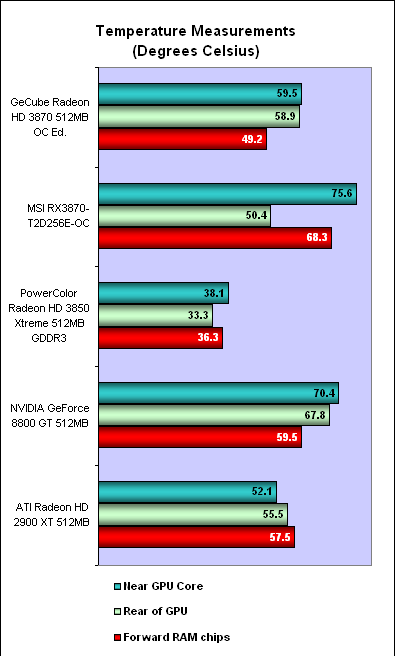
The X-Turbo III did have a positive effect on the GeCube because its temperatures were lower than the overclocked MSI (using the reference design) despite having slightly higher clock speeds. The core in particular showed a fair bit of improvement and this is a cooler that was as quiet as the reference, so we don't see any drawback to it.
Overclocking
GeCube did not merely slap on the O.C Edition onto any ordinary Radeon HD 3870 card, relying on its custom cooler to improve overclocking allowance. Instead, the vendor has a special, tweaked BIOS that purportedly makes a difference when it comes to overclocking. Obviously we had to test it for ourselves.
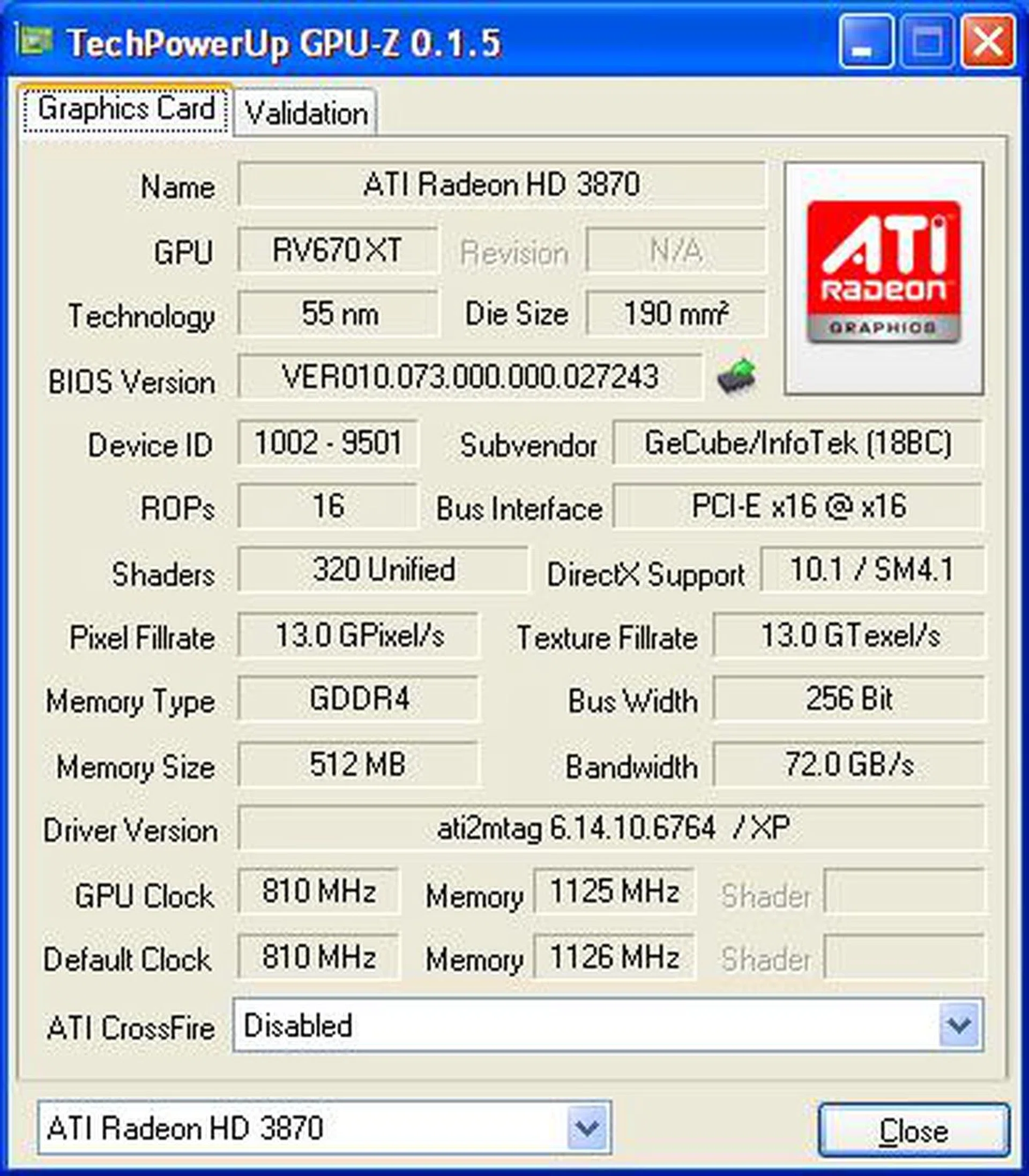
A newer, GeCube exclusive BIOS gives this O.C Edition the extra boost when it comes to overclocking allowance.
The GeCube card comes flashed with this new BIOS and as you can see from our screenshot above, the new version is 010.073 as compared to the 010.071 we find on a standard Radeon HD 3870. Apparently, this is a BIOS exclusive only to this particular O.C Edition. Trying the same trick on other Radeon HD 3870 cards will fail unless you can fool the BIOS into thinking that the hardware (Device ID string) corresponds to this X-Turbo III powered GeCube card. It won't even work on other GeCube Radeon HD 3870 cards besides this O.C Edition. However, some users have managed to get around this with a modified BIOS and you should be able to find it circulating online.

So does this new BIOS live up to the hype we have been hearing? Well, compared to the MSI card that we tested before, the GeCube saw a significant jump in overclocking allowance using the newer BIOS. Core clock went up to 906MHz while the memory was stable at 2520MHz DDR. This meant that this GeCube can overtake a normal GeForce 8800 GT 512MB in 3DMark06 at least. It's certainly good news for enthusiasts, though we have to add the usual warnings about heat and risks of damaging your card. Interestingly though, GeCube guarantees that the card will safely operate at OverDrive speeds of 885/2400MHz DDR. So that's something to think about.
** Updated on 11th January 2008**
Conclusion
ATI's upcoming dual RV670 graphics card is reminiscent of NVIDIA's own GeForce 7950 GX2. While a 55nm core should alleviate some of the power consumption and heat issues that plagued the GeForce 7950 GX2, it will likely still be an important concern that we hope has been addressed adequately. With the less than stellar performance scaling for CrossFireX, it's hard to imagine this dual GPU card winning against a comparable SLI setup but as a 'single' card, it's all ATI has in the short term to counter NVIDIA's winning streak. NVIDIA however isn't sitting still and their counter is expected soon after ATI makes its move.
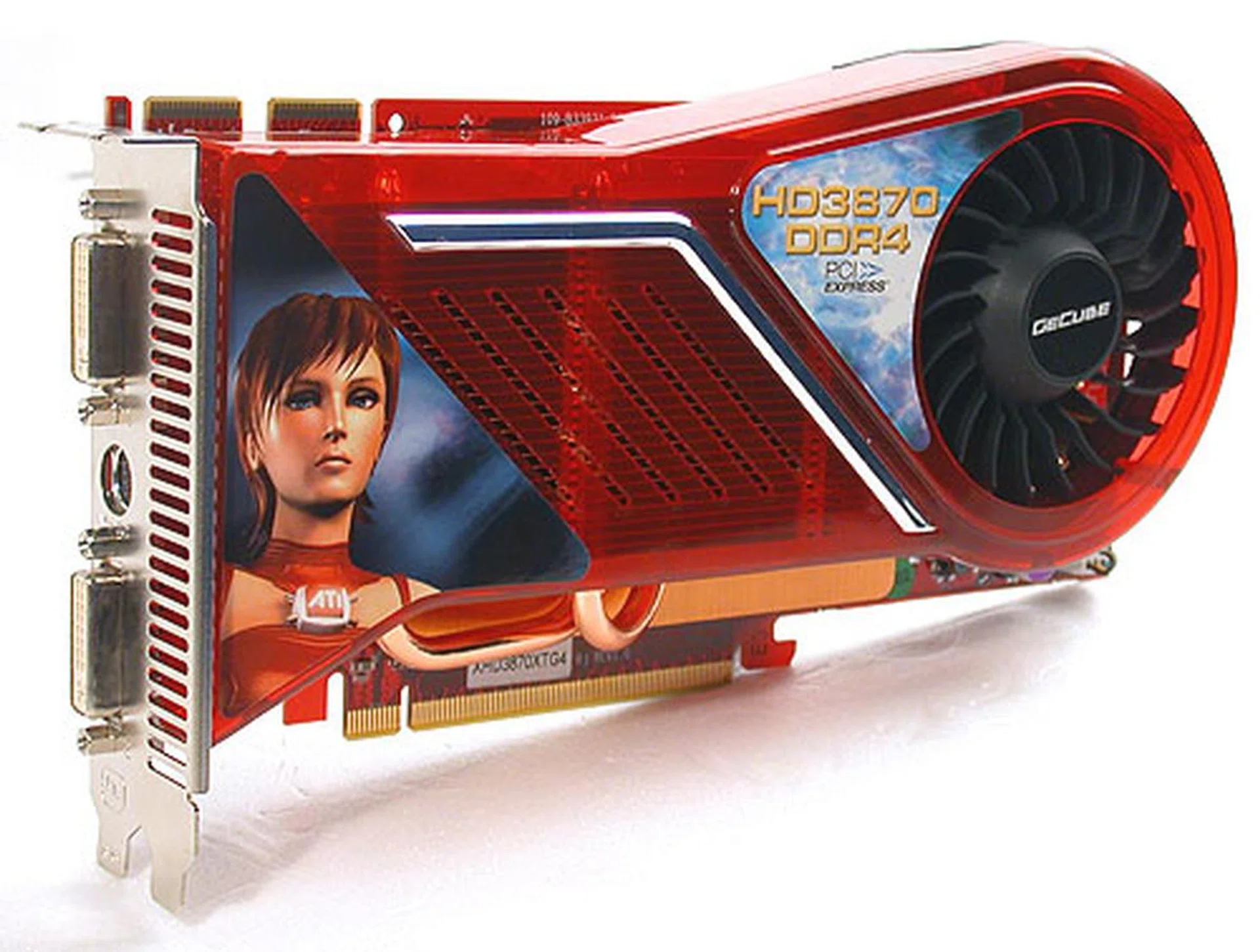
It's a typical GeCube product, from its custom cooler to the lack of extras, but the hardware is what counts most and GeCube delivers that well.
For the rest of us, a single graphics card that operates cool, quiet and in an energy efficient manner is probably what we're looking for. Of course, performance matters too but if you're already considering a Radeon HD 3800 series card, that is probably not your main or only criteria. GeCube's new X-Turbo III powered Radeon HD 3870 easily fulfills the cool and quiet quotient, thanks to its heavy duty cooler that packs more cooling performance than the reference. The 3D performance itself is also reinforced by its higher than usual clock speeds, though the actual improvements that you'll see will vary from game to game. Even then, it's still quite unlikely for this overclocked Radeon HD 3870 to overtake the GeForce 8800 GT. After all, the new BIOS from GeCube was just about sufficient for our overclocking to reach the level of a standard GeForce 8800 GT, so let's not mention the many overclocked versions on sale now. Although a point to note here is that GeCube does assure that the card is fit for operating at its maximum OverDrive mode at 885/2400MHz DDR. At this level, it may not yet overtake the GeForce 8800 GT, but it can certainly give it some good competition.
Finally, where the Radeon HD series has the edge at the moment is in pricing. No doubt the price performance ratio may yet be a draw or favor NVIDIA but in terms of absolute dollars and cents, ATI's offerings are cheaper and for those on a budget, these may be the DirectX 10 cards that you're willing to pay. Locally, the GeCube Radeon HD 3870 O.C Edition has a suggested retail price of S$389, giving it a slight premium of S$10 - 20 more than its competitors.
GeCube also has its own standard version Radeon HD 3870 that you can get for around S$369, so the overclocking and the X-Turbo III cooler actually cost you S$20, which is quite reasonable for its performance. No doubt, only the bare essentials are included in the bundle but GeCube has produced a decent piece of hardware here. The only trouble is that the NVIDIA GeForce 8800 GT is also only slightly higher than this price tag, so those looking for the best performance will surely go for an NVIDIA card. If you're set on an ATI card though (and for its lower price point), the GeCube Radeon HD 3870 O.C. Edition has enough going for it to present itself has a worthy alternative when you consider its OverDrive performance, the overclocking friendly BIOS and a swell cooler that will keep the card cooler than the GeForce 8800 GT while giving you performance within striking distance of it.
Our articles may contain affiliate links. If you buy through these links, we may earn a small commission.