
ATI Radeon HD 2400 XT 256MB
Joining in the fray for mainstream DirectX 10 graphics cards is ATI, which follows up its high-end R600 launch with two new series based on a different 65nm core. Read on to find how the budget oriented Radeon HD 2400 XT fares in our benchmarks.

Introduction
As numerous reviews and benchmarks have shown, the highly anticipated ATI Radeon HD 2900 XT (R600) has not been the world-beater that some enthusiasts have been hoping for. With NVIDIA dominating the fledgling DirectX 10 scene so far, having a decently competitive ATI for balance's sake is probably a good thing. However, given the complex architecture of the R600 and the constraints imposed by its 80nm manufacturing process, going directly against NVIDIA's extravagant but powerful GeForce 8800 Ultra is foolhardy and unlikely to be successful. Hence, ATI has been forced to concede the performance crown for now and has targeted the more manageable GeForce 8800 GTS instead with the Radeon HD 2900 XT.
While there will be no doubt some loss of prestige and brand awareness as a result of not obtaining the pole position, yet as analysts will tell you, the high-end is usually not where the majority of the profits are derived. It is the mainstream cards that will be found in more systems, particularly from the big OEM builders. More importantly, with the rapid growth of the notebook segment (with a corresponding slowdown of the desktop PC market), it is the mobile versions of these mainstream SKUs that are usually featured in notebooks. In short, the money is in the potentially huge volume of the mainstream segment, for both desktop and mobile versions.
This is the focus of today's article, where we have managed to get our hands on a budget Radeon HD 2400 XT from PowerColor for benchmarking. Representing the 'pinnacle' of the low end DirectX 10 series (Radeon HD 2400 series includes a slower Radeon HD 2400 PRO) from ATI, this graphics card will be available shortly (practically all the major graphics vendors had them on display at the recent Computex 2007) and already there have been sightings of these cards on the Internet. Based on a 65nm process, the GPU of Radeon HD 2400 XT uses a RV610 core with a relatively modest (by modern GPU standards) transistor count of 180 million. The main characteristics of ATI's current DirectX 10 graphics architecture are all present, with features like Avivo HD technology, integrated HD audio controller, HDCP and HDMI support, a hardware tessellation unit and new anti-aliasing modes. You can refer to our article on the R600 for more architectural details, as they are mostly similar for all the Radeon HD series.
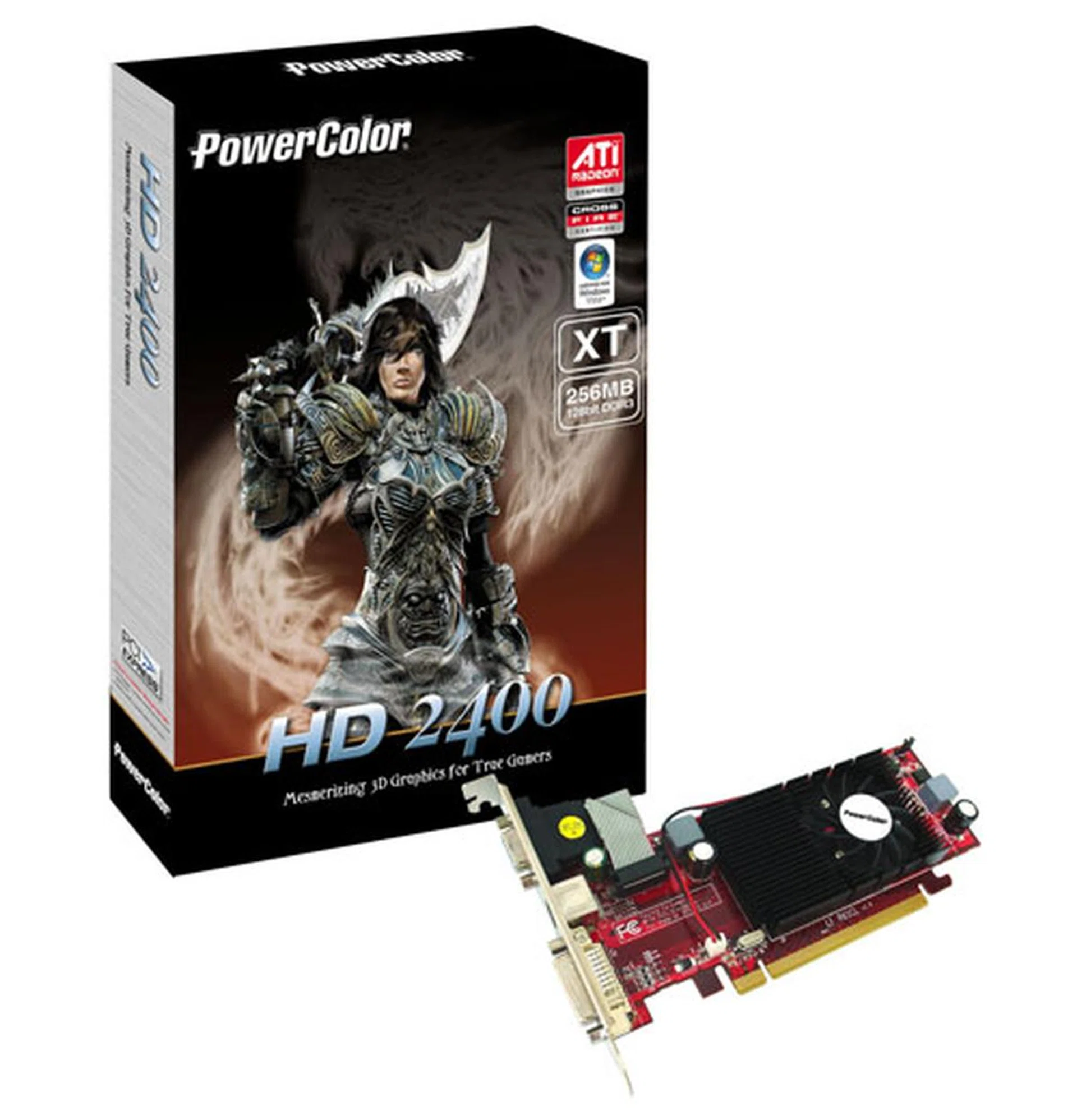
PowerColor sent us its Radeon HD 2400 XT in a plain vanilla box with no frills. However, there will be two editions of the XT for retail though both should have a similar box art like this.
What it does not have is the distinctive ring bus memory architecture; ATI has replaced this with a suitably low-end traditional 64-bit memory bus that may put it at a slight bandwidth disadvantage against NVIDIA's typically128-bit memory bus based cards in the upper range of the entry-level GeForce 8 cards like the GeForce 8500. The general-purpose stream processors are drastically reduced in number compared to the high-end Radeon HD 2900 series, only 40 instead of 320. Memory frequencies are also expectedly lower, with our Radeon HD 2400 XT card clocking 1400MHz DDR and using DDR3 chips. Naturally, with its smaller core and transistor count, power consumption is rated far lower than the Radeon HD 2900 XT at a very nice 25W. Below is a summary of the specifications of the Radeon HD 2400 XT as compared to some current and older competing products (which will be included in our benchmarks later).
GPU/VPU | ATI Radeon HD 2400 XT 256MB | NVIDIA GeForce 8500 GT 256MB | Radeon X1650 PRO 256MB | Radeon X1300 XT 256MB |
Core Code | RV610 | G86 | RV530 | RV530 |
Transistor Count | 180 million | 210 million | 157 million | 157 million |
Manufacturing Process (microns) | 0.065 | 0.08 | 0.09 | 0.09 |
Core Clock | 700MHz | 450MHz | 600MHz | 500MHz |
Vertex Shader Pipelines | 8 Shader Processors (consisting of 40 Stream Processing Units in total) | 16 Stream Processors | 5 | 5 |
Rendering (Pixel) Pipelines | 12 | 12 | ||
Shader Processor Clock | 700MHz | 900MHz | 600MHz | 500MHz |
Texture Mapping Units (TMU) or Texture Filtering (TF) units | 4 | 8 | 4 | 4 |
Raster Operator units (ROP) | 4 | 8 | 4 | 4 |
Memory Clock | 700MHz (1400MHz DDR3) | 400MHz (800MHz DDR2) | 700MHz (1400MHz DDR3) | 340MHz (680MHz DDR3) |
DDR Memory Bus | 64-bit | 128-bit | 128-bit | 128-bit |
Memory Bandwidth | 11.2GB/s | 12.8GB/s | 22.4GB/s | 10.8GB/s |
Ring Bus Memory Controller | NIL | NIL | 256-bit (for memory reads only) | 256-bit (for memory reads only) |
PCIe Interface | x16 | x16 | x16 | x16 |
Molex Power Connectors | NIL | NIL | NIL | NIL |
Multi GPU Technology | Yes (CrossFire) | Yes (SLI) | Yes (CrossFire) | Yes (CrossFire) |
DVI Output Support | 1 x Dual-Link | 1 x Dual-Link | 1 x Dual-Link 1 x Single Link | 1 x Dual-Link 1 x Single Link |
HDCP Compliance | Yes | Vendor Dependant | No | No |
Estimated Retail Price (US$) | ~US$85 | ~US$80 - 100 | ~US$90 - 120 | ~US$80 |
The PowerColor Radeon HD 2400 XT 256MB
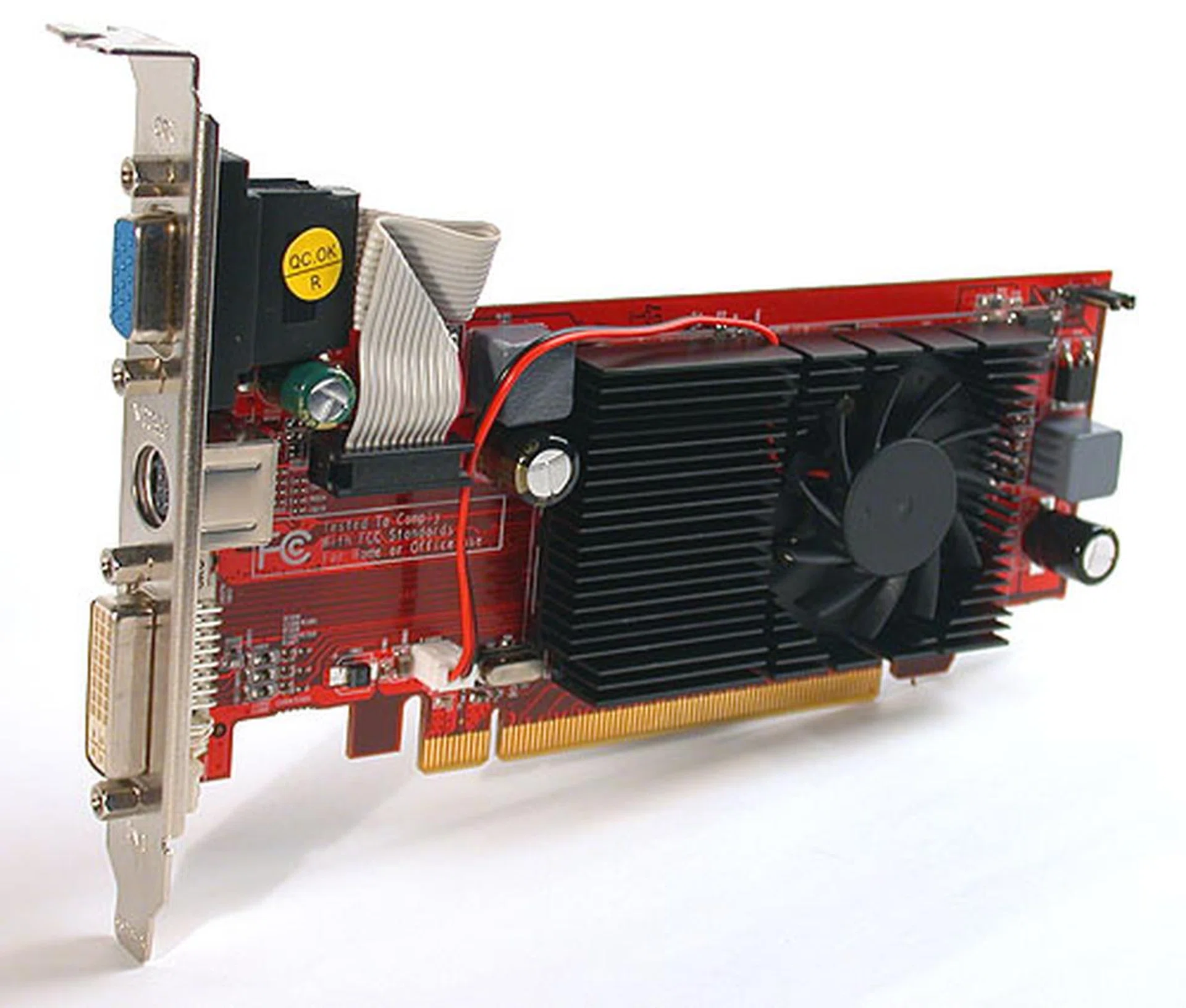
PowerColor provided us with its Radeon HD 2400 XT 256MB, which comes in a low profile version that is quite typical of budget cards. Since these low-end cards usually do not require a large PCB, manufacturers can afford to save cost and at the same time, these low profile cards can fit very comfortably into smaller chassis and HTPC casings, extending the potential market. A quiet, almost silent small cooler is also sufficient for this card, which is not unexpected for its class.
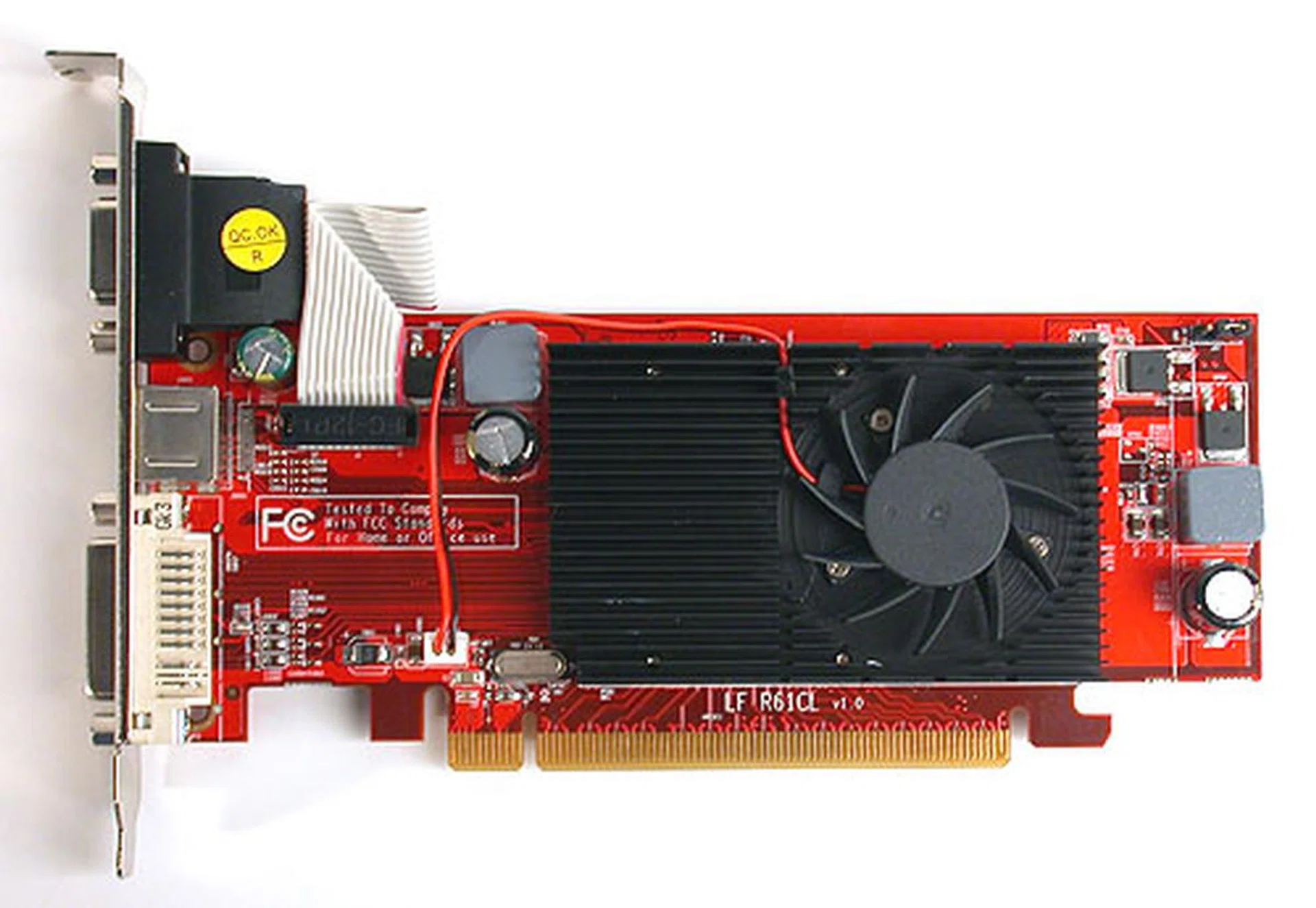
This PowerColor Radeon HD 2400 XT is a low profile graphics card that makes it suitable for smaller chassis. We can imagine it being used in a HTPC setup for one, especially with its UVD.
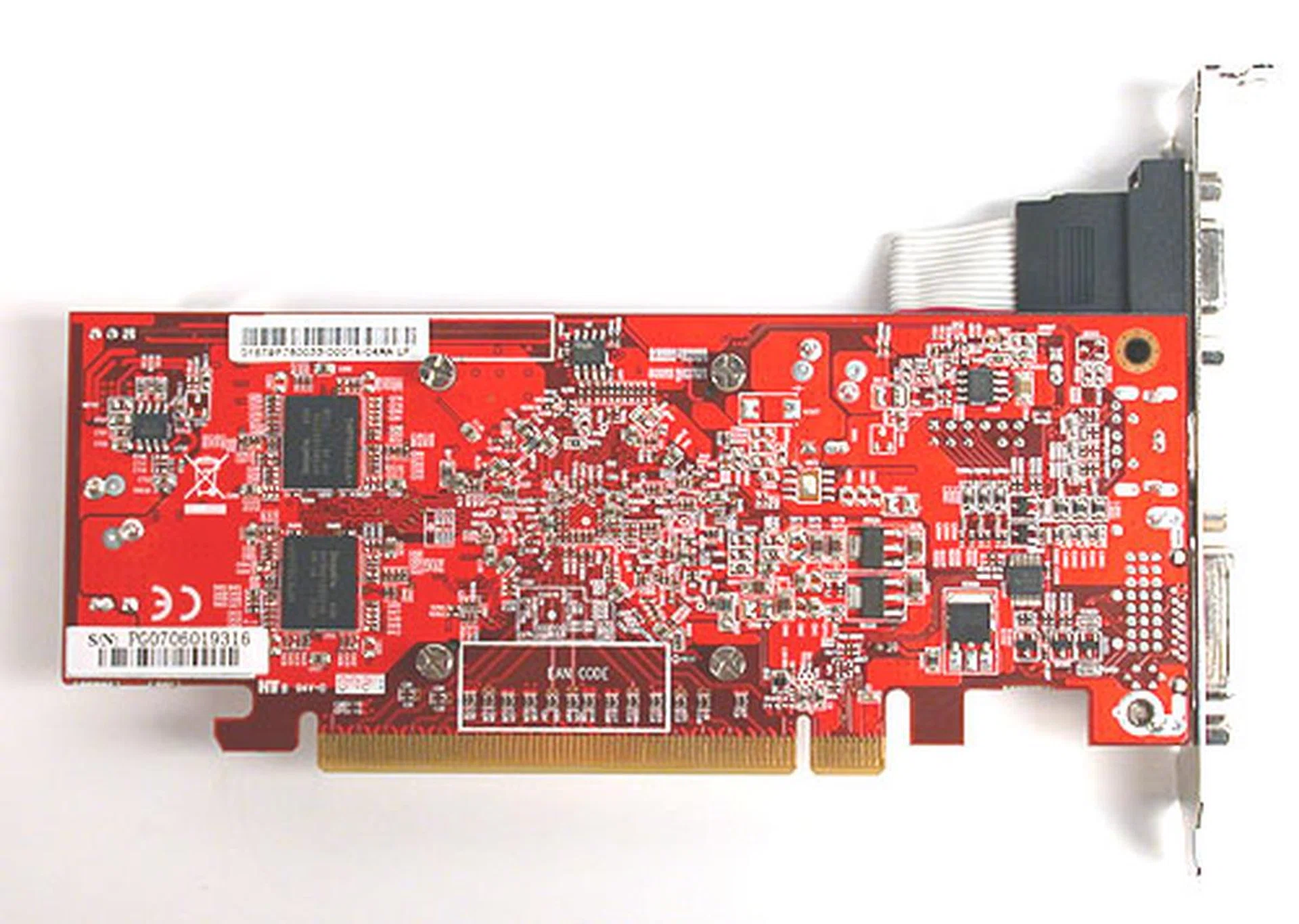
Some of the memory chips were mounted on the other side of the card.
The 65nm RV610 core is clocked at 700MHz, making it the fastest of the Radeon HD 2400 series. Connected to this is 256MB of DDR3 memory, all of which are rated at 1.4ns and running at a decent 1400MHz DDR. The Radeon HD 2400 XT will also conscript system memory by default, doubling its total frame buffer to 512MB through ATI's HyperMemory technology. However, like we mentioned earlier, the local memory bandwidth is restricted by its 64-bit bus so all that memory may not be as useful as one would think.
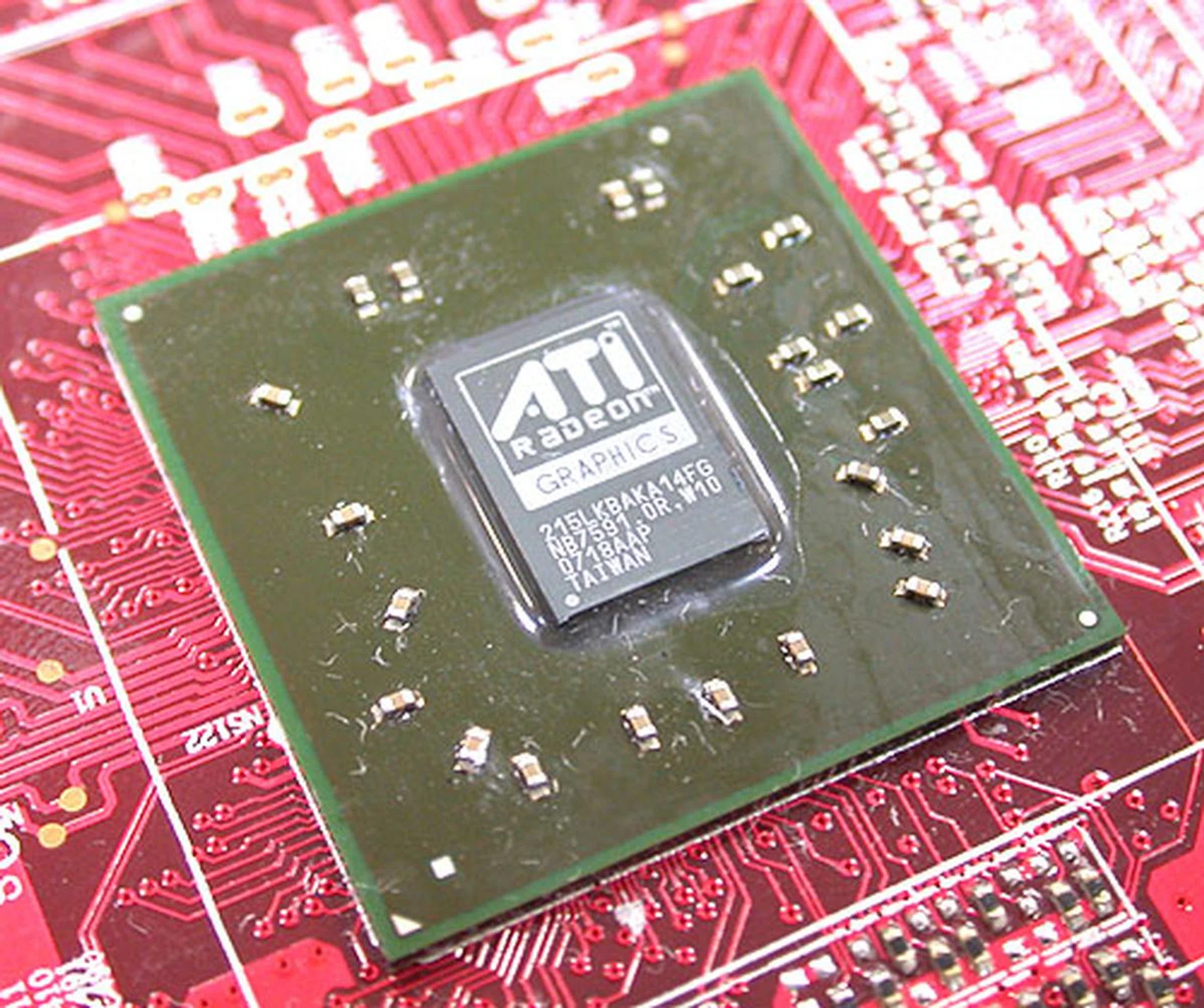
The RV610, a 65nm core with a transistor count of 180 million. Integrated too onboard is a hardware tessellation unit and AVIVO HD technology, notably the Universal Video Decoder (UVD).
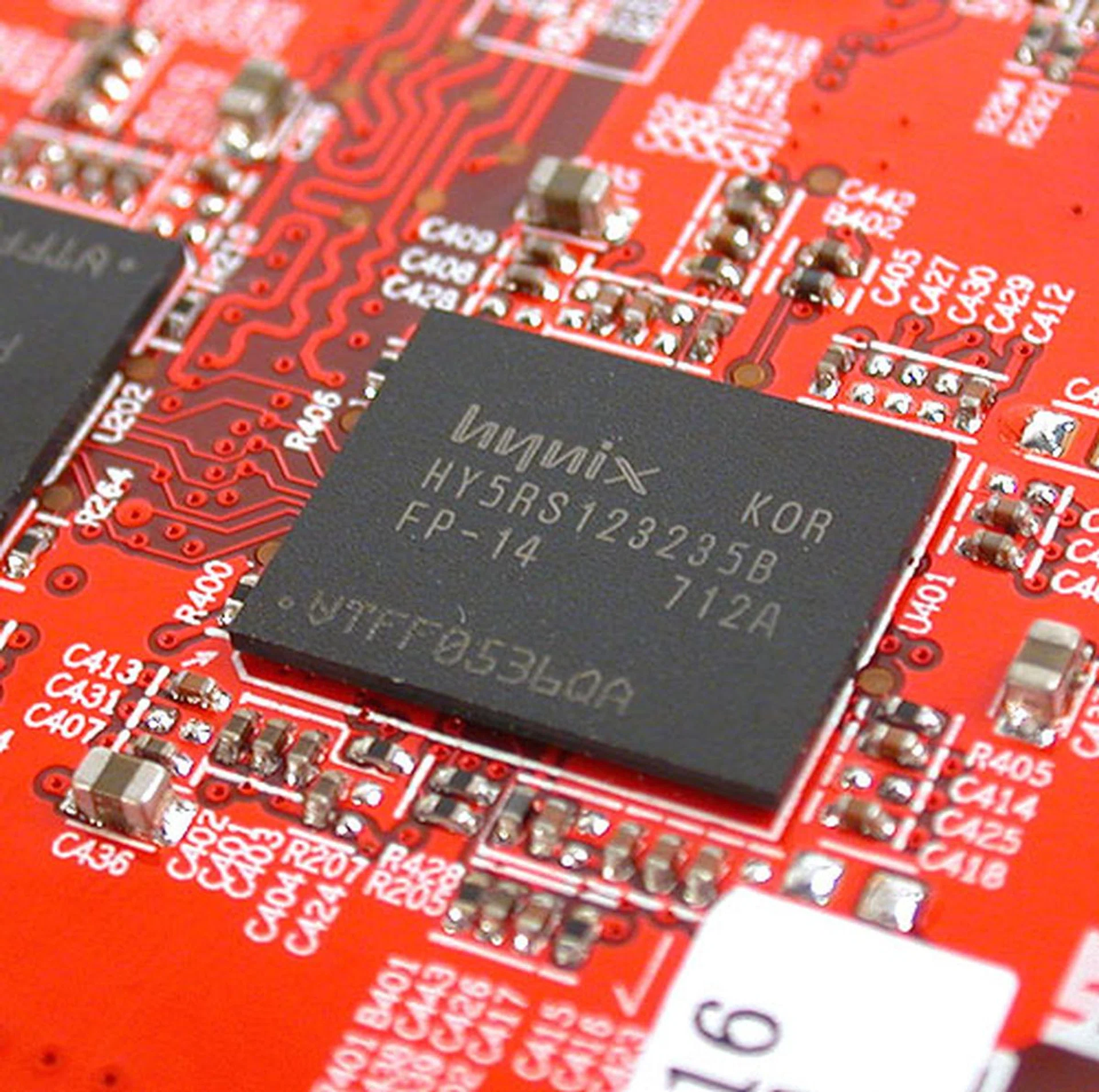
Hynix's 1.4ns DDR3 memory chips were preferred for this graphics card.
In terms of having hardware unique to the Radeon HD series, the Radeon HD 2400 XT has the full complement, from a programmable hardware tessellation unit to the Avivo HD suite of technologies. Pertinent to most users would be its HD video decoder, with the Radeon HD 2400 XT possessing ATI's new Universal Video Decoder (UVD) and Advanced Video Processor (AVP) are both onboard to handle HD video playback tasks instead of the CPU. Unfortunately, this is one aspect that we are unable to test comprehensively at the moment due to the lack of a Blu-ray or HD DVD drive but we're working on it. For a budget product like this Radeon HD 2400 XT however, it should be a major selling point if it works as advertised.
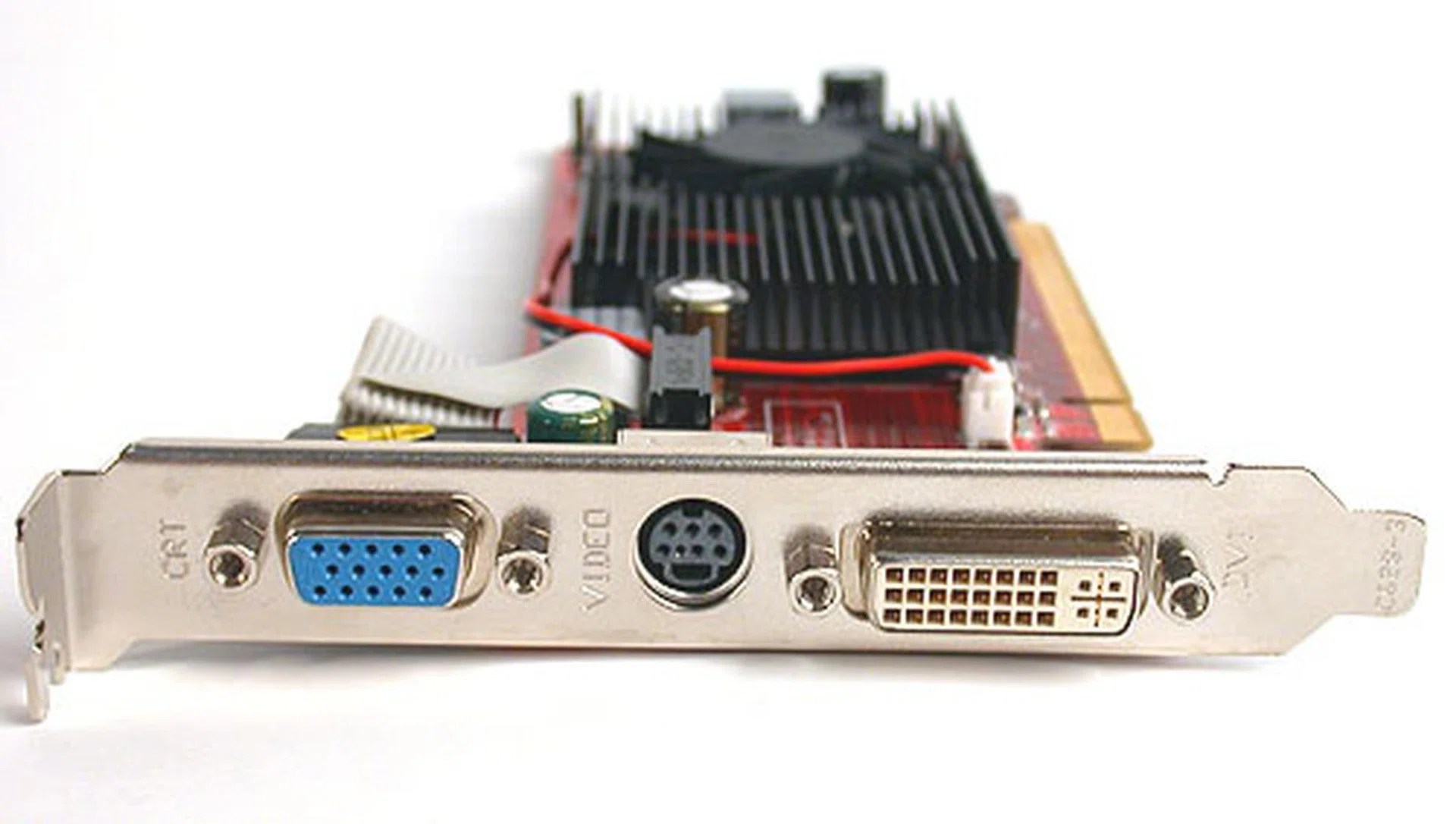
There's only one DVI output but it is HDCP compliant and with a DVI-to-HDMI converter, you can connect this card to a device that accepts HDMI input. Sound is handled by the onboard HD audio controller.
Besides the onboard video processors, there is also a HD audio controller for ATI's version of an all-protected content path for hassle free HDMI support. You'll need a DVI-to-HDMI converter to output the combined digital stream to your HDMI device, e.g. a HDTV and sadly for us that doesn't seem to be included in our review unit. However, PowerColor's retail offering should include an edition with this dongle included. Nevertheless, HDCP compliance is a given, since that goes along with the HDMI support and ATI has stated that this will be true for all Radeon HD series card currently, even for the budget offerings. Together with the DVI output, there is a standard analog output and the mini-DIN output. A rather common configuration of connectors for such a low-end card. CrossFire, though not the most important requisite for a low-end card, is also handled internally via software and no interconnecting bridges are required.
Since the card is closer to an entry-level offering, no applications or games were bundled other than the bare essentials as listed here:-
- DVI to DB15 VGA converter
- S-Video to Composite converter
- Drivers CD
- PowerColor manual
In any case, Valve is already offering free downloads like Half Life 2: Deathmatch and Lost Coast for all Radeon owners (regardless of model as long as it's a Radeon) so that should be available for the new Radeon HD 2400 and 2600 series too.
Test Setup
The Radeon HD 2400 XT 256MB and the other graphics cards in our comparison were all tested on a system using an Intel Core 2 Duo E6700 (2.66GHz) and an Intel D975XBX 'Bad Axe' motherboard. This was supplemented by 2GB of low latency DDR2-800 HyperX memory from Kingston, running in dual channel mode. A Seagate 7200.7 SATA hard drive was also chosen and installed with Windows XP Professional with Service Pack 2 and DirectX 9.0c.
Building on our previous review of the NVIDIA mainstream DirectX 10 graphics cards, the GeForce 8600 and 8500 series, we have identified the GeForce 8500 GT as the main competitor for the Radeon HD 2400 XT. And as established in that article, the GeForce 8500 GT performs quite similarly to a typical GeForce 7300 GT so if you have one of those, you know which bar on the graph to follow. Both the Radeon HD 2400 XT and the GeForce 8500 GT are in a similar price range of just under US$100, so that makes it all the more ideal for comparison.
From ATI's lengthy list of lower end cards, we chose the Radeon X1650 PRO, since it's the slowest of ATI's mid-range and it would interesting to see how it compares against the new low-end Radeon HD 2400 series. Then, there is the Radeon X1300 XT, which is essentially a rebadged Radeon X1600 PRO. A former mid-range graphics card, it has been 'downgraded' to budget status with the advent of faster GPUs and we'll see if it will stand against the newest low-end graphics card from ATI.
All the graphics cards were tested at reference clock speeds. The drivers used for the NVIDIA card is ForceWare 158.16 while the older ATI Radeons were on Catalyst 7.2. We tried using the latest Catalyst 7.6 for the PowerColor Radeon HD 2400 XT but for some reason, it found our hardware incompatible and refused to install, despite the fact that ATI's own release notes claim to support it. In the end, we had to rely on a beta driver package (version 8.39 RC4, which is a slightly newer variant of the Catalyst 7.6 drivers) to get our card running. The benchmarks tested are listed below:
- Futuremark 3DMark05 (ver. 120)
- Futuremark 3DMark06 (ver. 102)
- Tom Clancy's Splinter Cell: Chaos Theory (ver 1.3)
- FarCry (1.4 Beta)
- F.E.A.R
- Company of Heroes (ver 1.3)
- Quake 4 (ver 1.2)
Result - 3DMark06 Pro
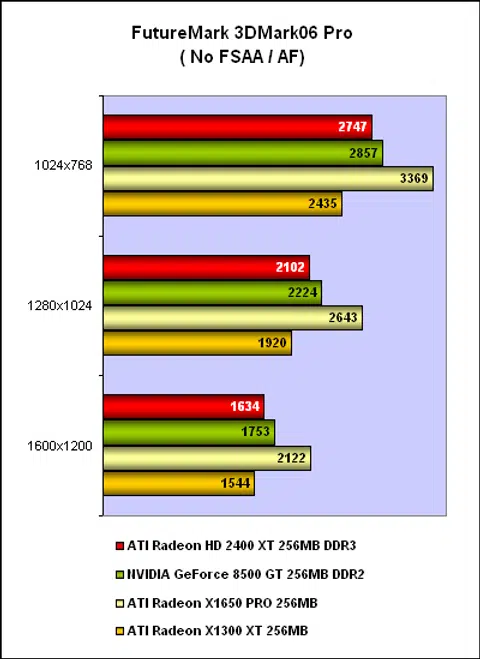
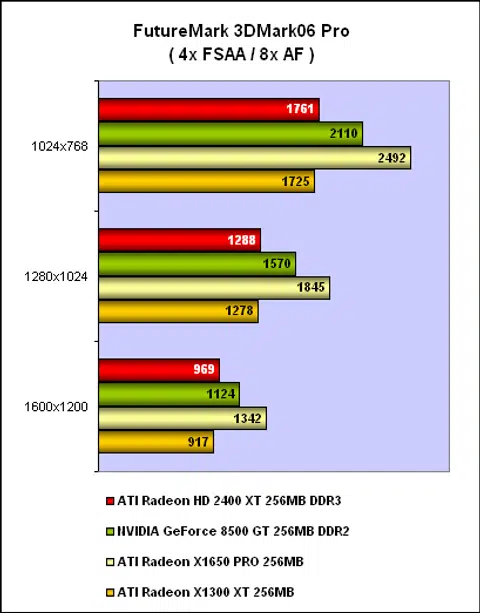
Between the two newcomers, the GeForce 8500 GT scored higher in 3DMark06 Pro, with an initial lead of 5 to 7% that increased to around 20% once anti-aliasing was enabled. It was not the most auspicious of starts from the Radeon HD 2400 XT, though it was at least better or equal to the Radeon X1300 XT (aka Radeon X1600 PRO). The sharp decline in the scores of the Radeon HD 2400 XT when anti-aliasing was enabled is noteworthy and points to the 64-bit memory bus as a likely weakness. The Radeon HD 2400 XT may be using faster DDR3 memory compared to the GeForce 8500 GT but this is of limited utility when confronted with the bottleneck caused by the limited memory bus width.
Results - Splinter Cell: Chaos Theory & FarCry 1.4 Beta (DirectX 9 Benchmarks)
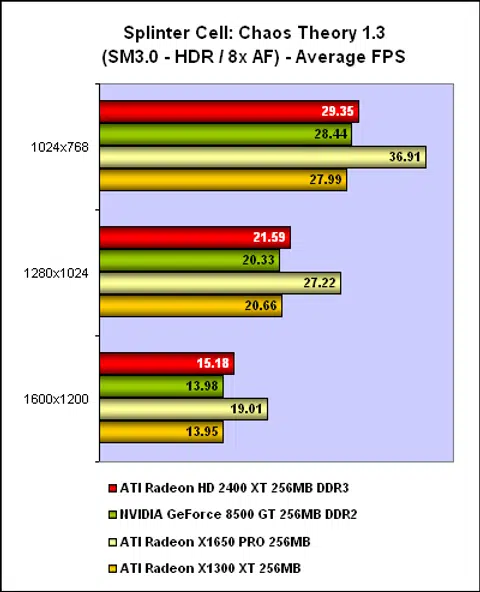
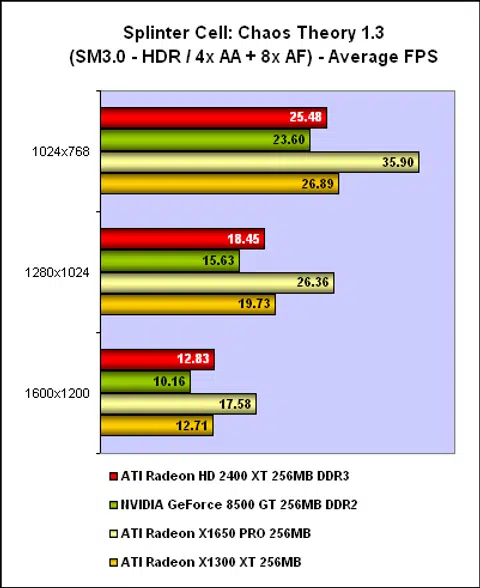
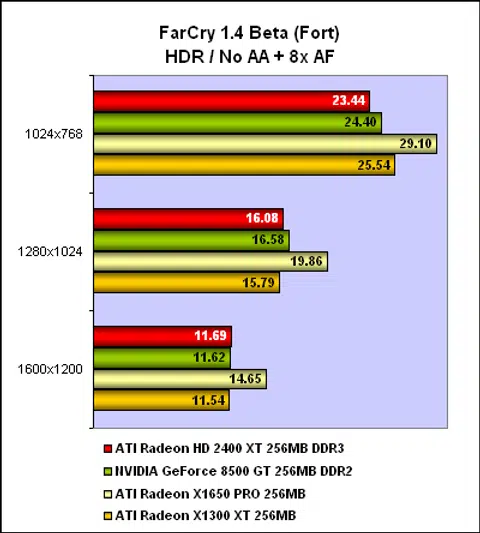
Splinter Cell saw the Radeon HD 2400 XT take a slight lead over the GeForce 8500 GT but ultimately it was still outclassed by the mid-range Radeon X1650 PRO. Anti-aliasing did not have that much of an impact on its lead and the Radeon HD 2400 XT retained its advantage over its NVIDIA rival. However, when one just isolated the Radeon HD 2400 XT against the Radeon X1300 XT, it was obvious that with anti-aliasing the performance of the new card took a hit unlike the Radeon X1300 XT. In FarCry, all the lower end graphics cards are more or less in the same ballpark, especially at the higher resolutions and the Radeon HD 2400 XT did not really distinguish itself.
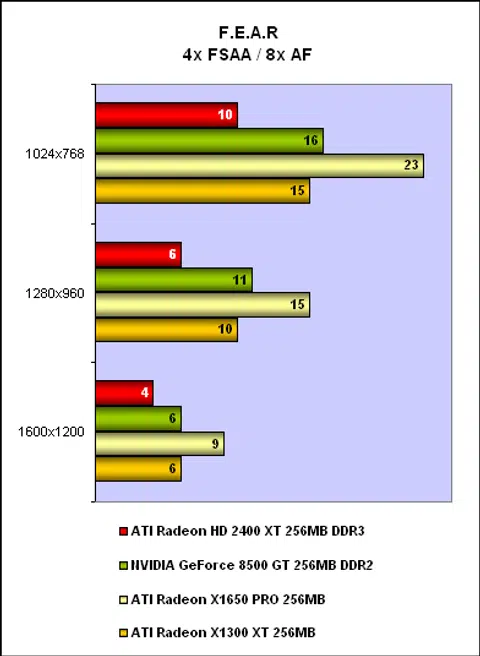
Results - F.E.A.R (DirectX 9 Benchmark)
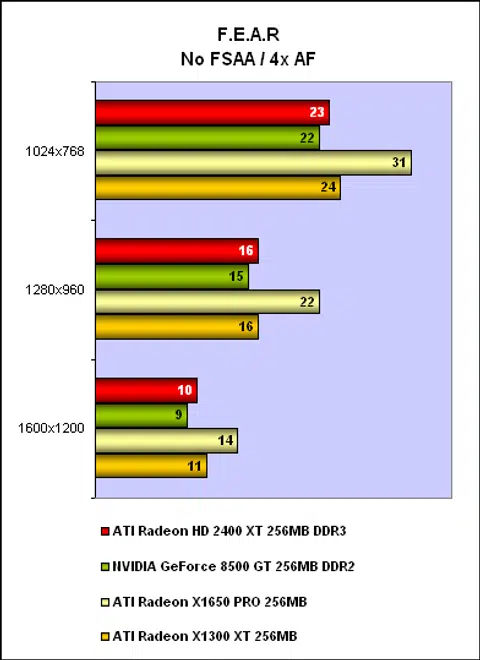
Another example of how anti-aliasing may not be for this Radeon was in F.E.A.R, where the slight single frame lead of the 2400 XT quickly turned into dust in the latter where anti-aliasing was enabled. The GeForce 8500 GT captured a significant lead over its rival when that was factored in and even the Radeon X1300 XT (128-bit memory bus) did better than the new Radeon HD 2400 XT.
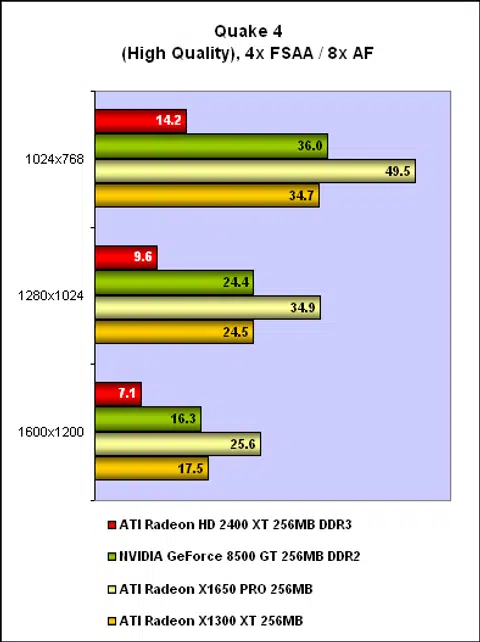
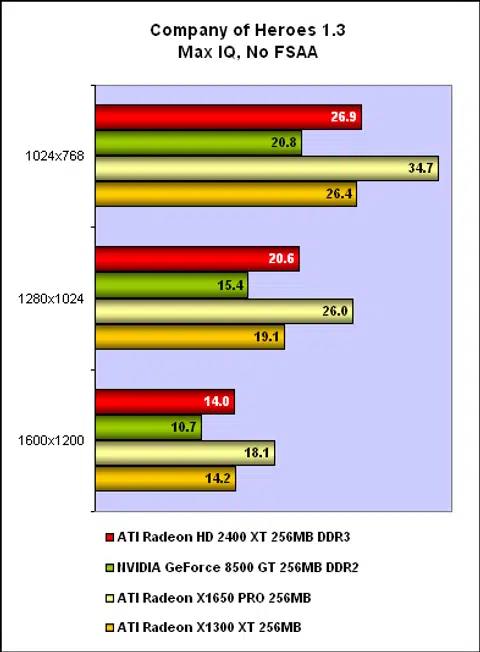
Results - Quake 4 & Company of Heroes (SM2.0+ Benchmarks)
Our results in Quake 4 was quite a shocker, as the Radeon HD 2400 XT finished last by quite a wide margin. We aren't quite too sure about the actual reason for these scores, since in other games, even F.E.A.R, we had not seen such differences in scores. Perhaps the beta nature of the drivers we were using could be a reason for such unexpectedly low scores. The Radeon HD 2400 XT actually did quite decently in Company of Heroes and was consistently beating the NVIDIA card here. However, it was still firmly in budget territory as it was slower than the Radeon X1650 PRO.
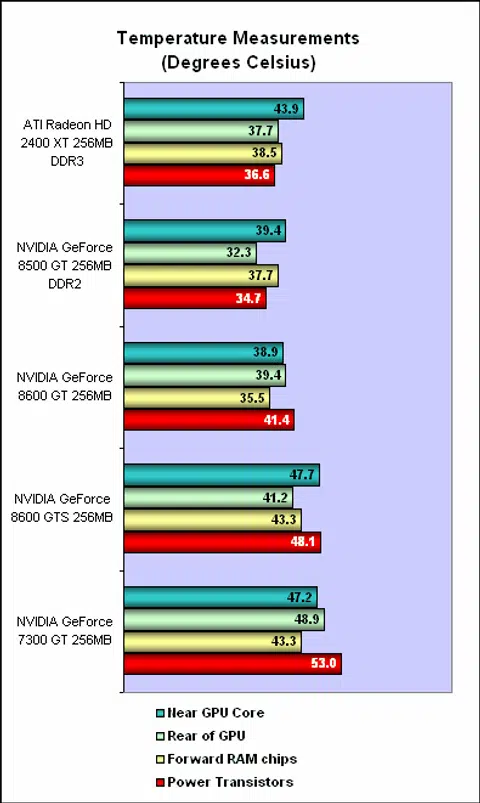
Temperature Testing
Despite higher frequencies for core and memory than the competing GeForce 8500 GT, ATI has managed to keep temperatures relatively low on the Radeon HD 2400 XT thanks to its small 65nm die. Power consumption as mentioned earlier is also modest at an estimated 25W so there should be no issues about heat or noise; in fact passively cooled versions are likely to be introduced by the vendors themselves.
Overclocking
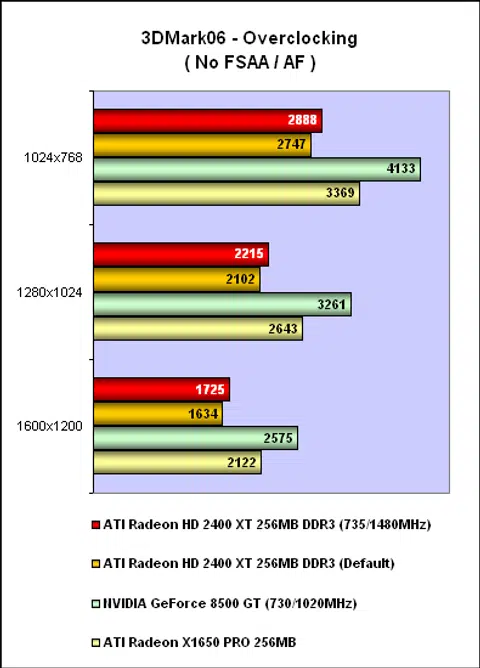
Unlike the GeForce 8500 GT which had a rather impressive amount of head room for overclocking, the already high clock speeds on the Radeon HD 2400 XT meant that there wasn't a generous margin for overclockers. It was in fact quite an insignificant amount that we managed using the Overdrive feature in the Catalyst Control Center. The slight increase in scores we got from our attempt was quite forgettable.
Conclusion
ATI's mainstream volley of DirectX 10 graphics cards consisting of two models each in the mid-range Radeon HD 2600 series and the low-end budget Radeon HD 2400 series brings along much needed competition to the largest market segment in the graphics business. By virtue of its head start, NVIDIA has gained much market share, especially among consumers planning ahead to jump on the DirectX 10 bandwagon. Still, with no killer applications or games for DirectX 10 launched so far, ATI has probably not suffered too badly from the delayed introduction. The key question now of course is whether these new mainstream cards can really stand on its own in the market.
As a budget card, don't expect high scores on benchmarks but for those who require a versatile card for multimedia applications, the Radeon HD 2400 XT is a candidate for cheap.
Looking at the top Radeon HD 2400 card currently, the Radeon HD 2400 XT, our main gripe is with its 64-bit memory bus. ATI's previous budget cards, like the Radeon X1300 series had a 128-bit memory bus and while it may be true that with its higher memory clocks, the Radeon HD 2400 XT did end up with decent overall memory bandwidth numbers, it was still inferior to NVIDIA's competing GeForce 8500 GT (11.2GB/s versus 12.8GB/s) and our benchmarks seem to show instances where anti-aliasing and its heavier demands took its toll on the scores of the Radeon HD 2400 XT with its constricted 64-bit memory bus. Overall, the Radeon HD 2400 XT stayed sufficiently close to the GeForce 8500 GT for most of the non-taxing benchmarks to be a viable alternative though we won't recommend either card for aspiring gamers.
What these budget cards do provide in general, both from ATI and NVIDIA, are HD video decoders that relieve the CPU's workload during HD video playback. As both companies have reiterated quite often, the goal now is to develop a card to meet the growing high definition multimedia needs of consumers, especially for the mainstream and low-end segments where it is not so much a choice between ATI and NVIDIA as one between integrated and discrete graphics. Intel too has been working on its integrated solutions in a similar direction with its Clear Video technology. At the moment, we feel that ATI has the slight edge in this aspect, mainly due to its integration of a HD audio controller so as to provide HDMI support and HDCP compliance throughout the entire family without relying on external factors. With no real testing done yet, we can't say for sure whether ATI's claims of a more complete video decoder (that provides hardware support for both H.264 and VC1 unlike NVIDIA's which only has H.264) is really that much better. You can however expect an article from us to dissect those matters in due time just like we've done previously.
As such, the Radeon HD 2400 XT seems to be a versatile graphics card for the coming HD era, even if its raw performance doesn't seem to translate too well in the games and benchmarks tested. These extra features will probably help to sell such mainstream and low-end products, given that consumers are probably not looking chiefly for 3D performance anyway. Its low power consumption and low noise/heat output due to the use of the 65nm manufacturing process ensures that the Radeon HD 2400 XT and the series in general will be a contender for budget and HTPC system builders. Priced at around the US$85 range for the XT and even less for the Radeon HD 2400 PRO, it faces off directly against NVIDIA's GeForce 8500 GT but with a lower entry price to compensate for its performance drawbacks. Hopefully, it can inject some competitive flair into the mainstream DirectX 10 graphics market and generate a larger user base for those games and applications we have been hearing about for so long.
Our articles may contain affiliate links. If you buy through these links, we may earn a small commission.