
ASUS Ares - God of War Cometh
Named after the Greek god of warfare and bloodshed, the ASUS Ares packs twin Radeon HD 5870 GPUs running in full speed on a single graphics card for unparalleled graphics processing power.

Power of the Gods
In Greek mythology, Ares is the God of War and Bloodshed. He personifies violence and all that is terrible and horrible about war. Hence, it is fitting that ASUS’s latest and possibly greatest graphics card be christened “Ares”.
What makes the Ares card deserving of sharing a name with a Greek god you might wonder? For starters, it has a massive triple-slot custom cooler that features extensive use of aluminum and copper. And then its equally hefty weight of 2.1kg - a single Radeon HD 5870 (not a small card by any means) in comparison weighs merely 0.95kg.
But most of all, it's the hardware underneath that makes the Ares a beast of a graphics card. While the dual-GPU Radeon HD 5970 might be ATI’s top dog at the moment, it actually uses two down clocked Cypress XT chips. Not only are the GPUs on the Radeon HD 5970 down clocked - from 850MHz to 725MHz - so is the memory - from 4800MHz DDR to 4000MHz DDR. ASUS’ Ares, on the other hand, offers the full package, packing twin Cypress XT chips clocked at 850MHz with memory running at a heady 4800MHz DDR. What’s more, it comes with a whopping 4GB of super quick GDDR5 framebuffer. In short, the Ares is nothing less than a beast of a graphics card.
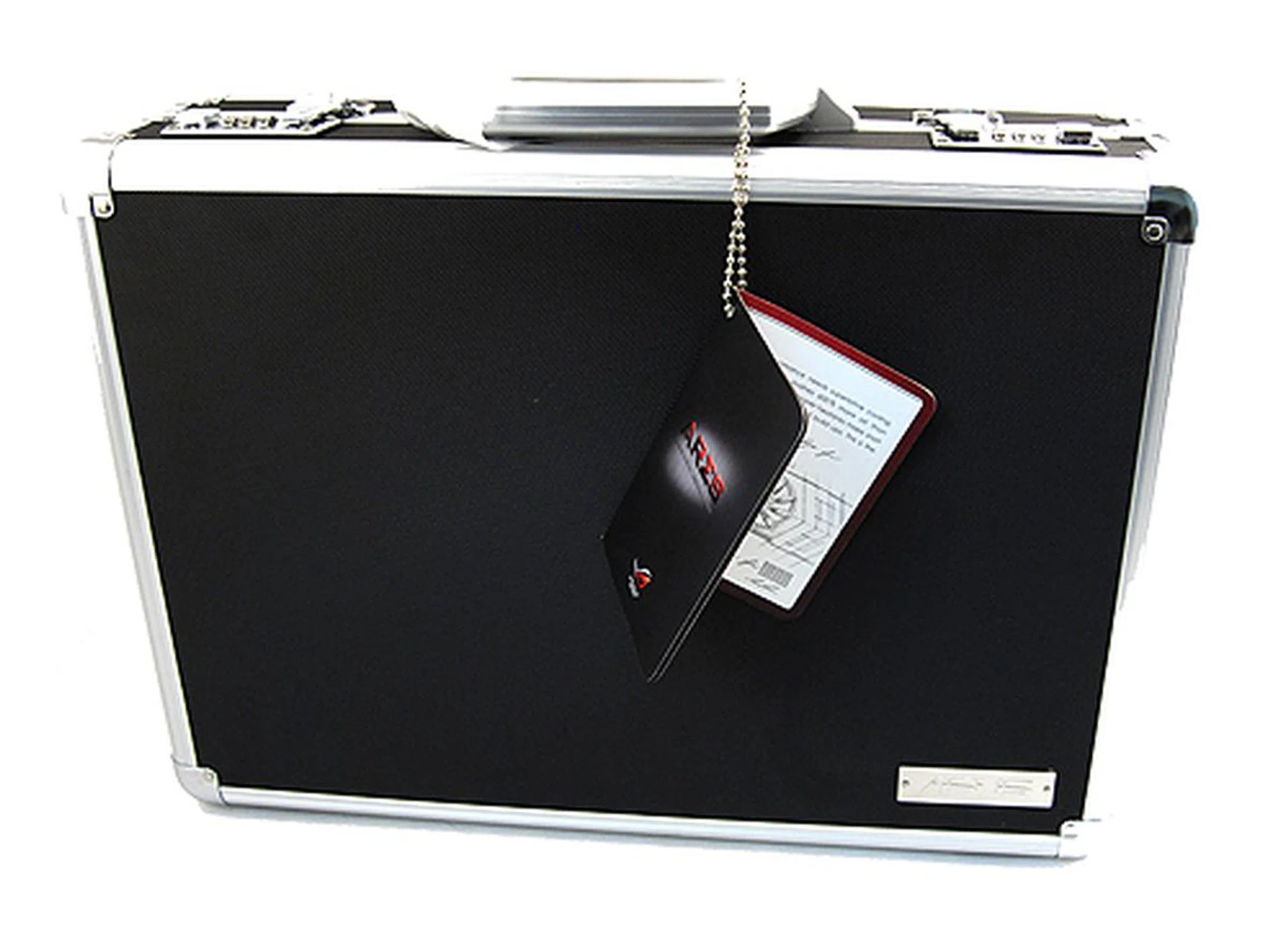
As befits a special card, the ASUS Ares comes in a special briefcase. Cool or trying too hard? You decide.
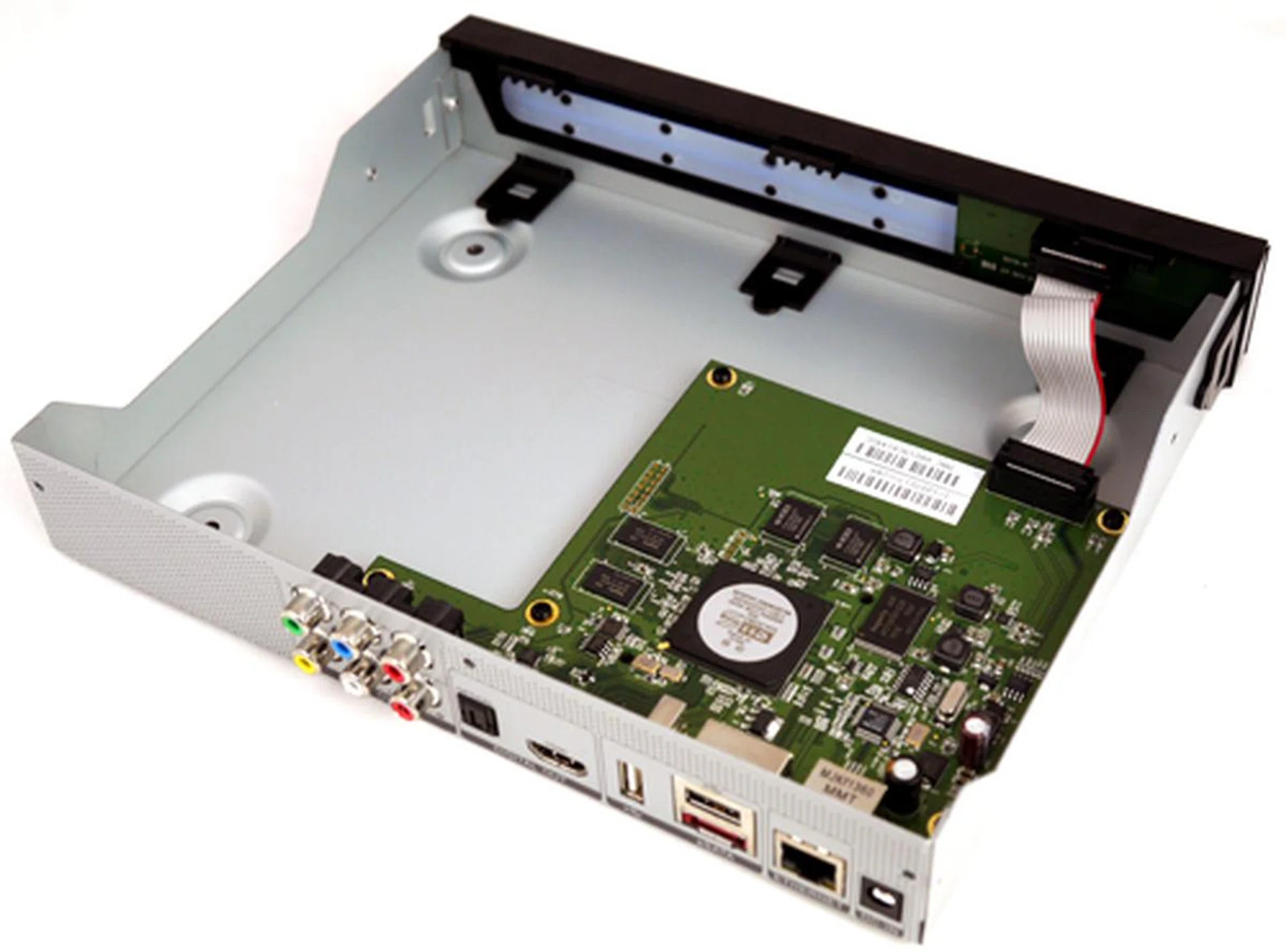
Inside, you'll find the card along with basic accessories such as a HDMI to DVI adapter, PCIe connectors, and a ASUS ROG gaming mouse.
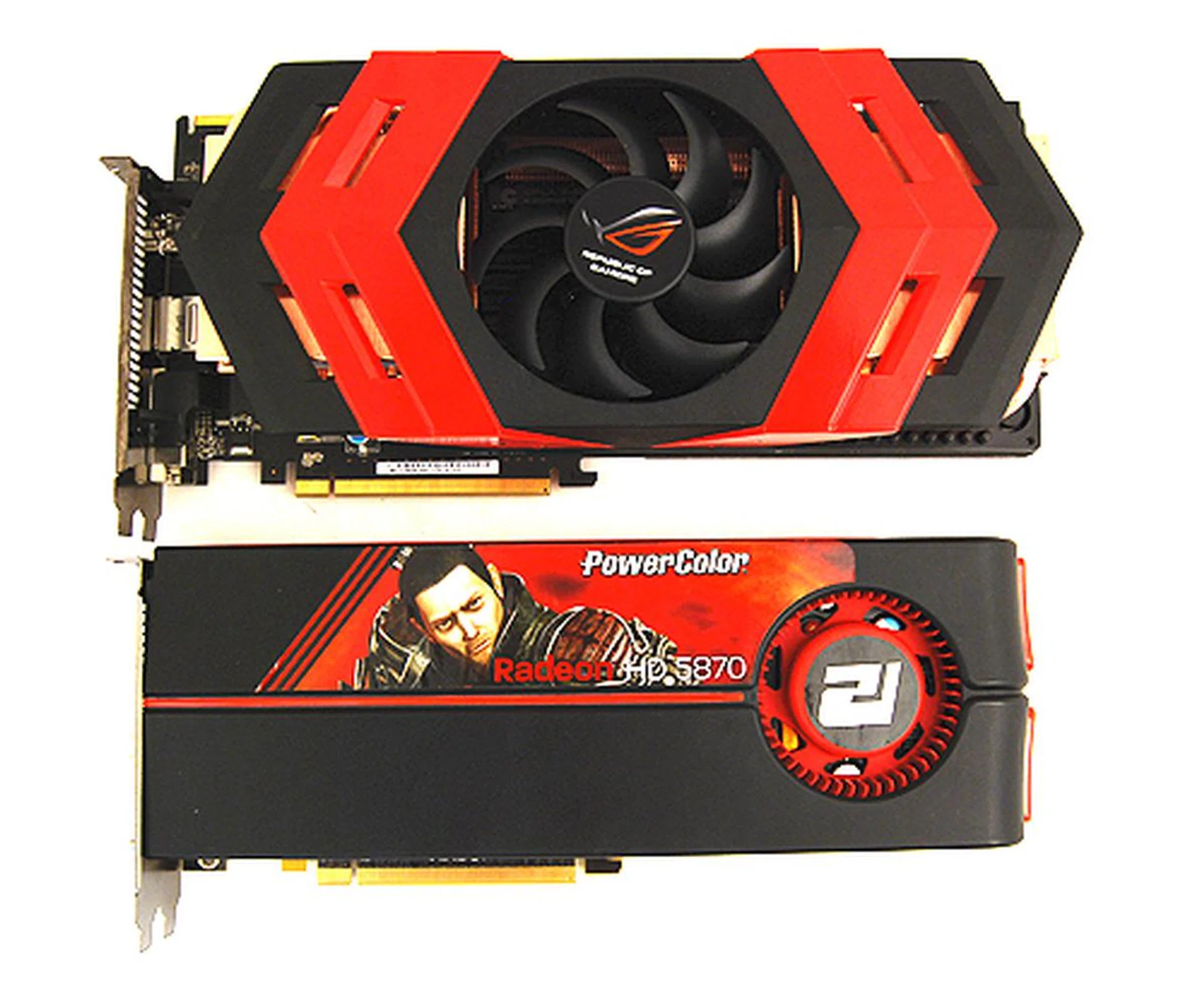
The Radeon HD 5870 is not a small card, but look how the Ares dwarfs it.
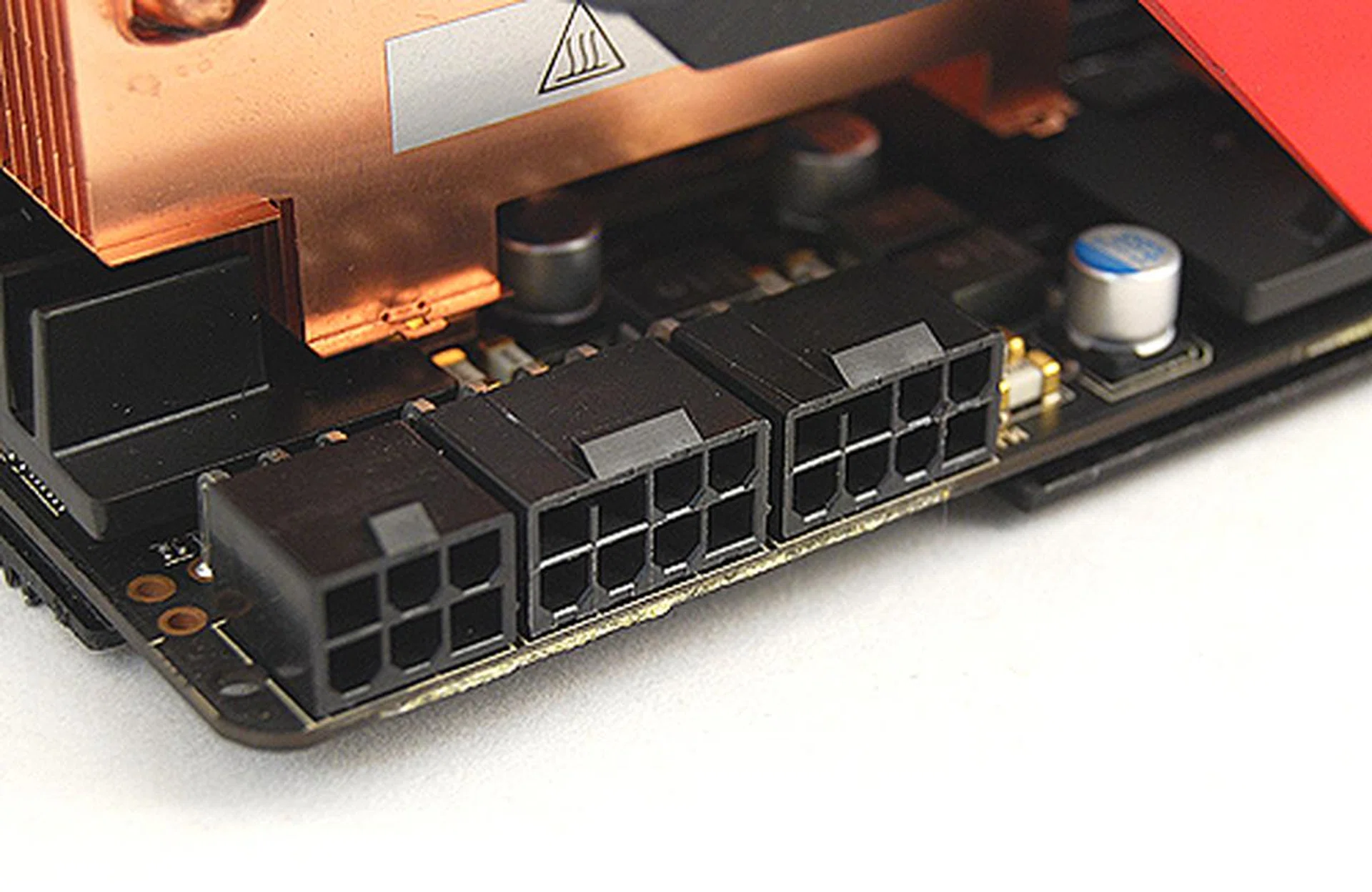
To power this behemoth of a graphics card, you'll need two 8-pin and a single 6-pin PCIe power connector.
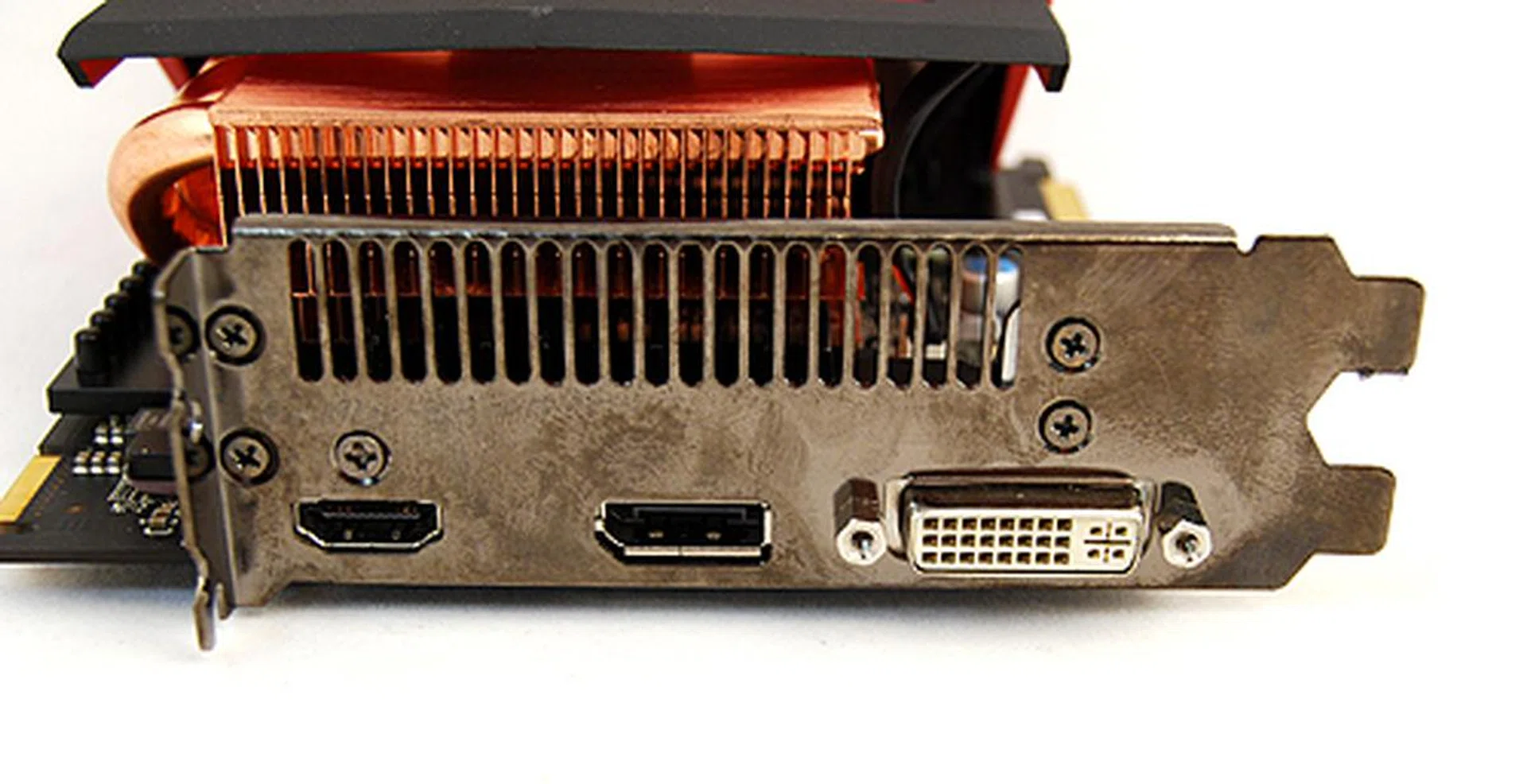
The Ares makes do with a single DVI, HDMI and DisplayPort for video output.
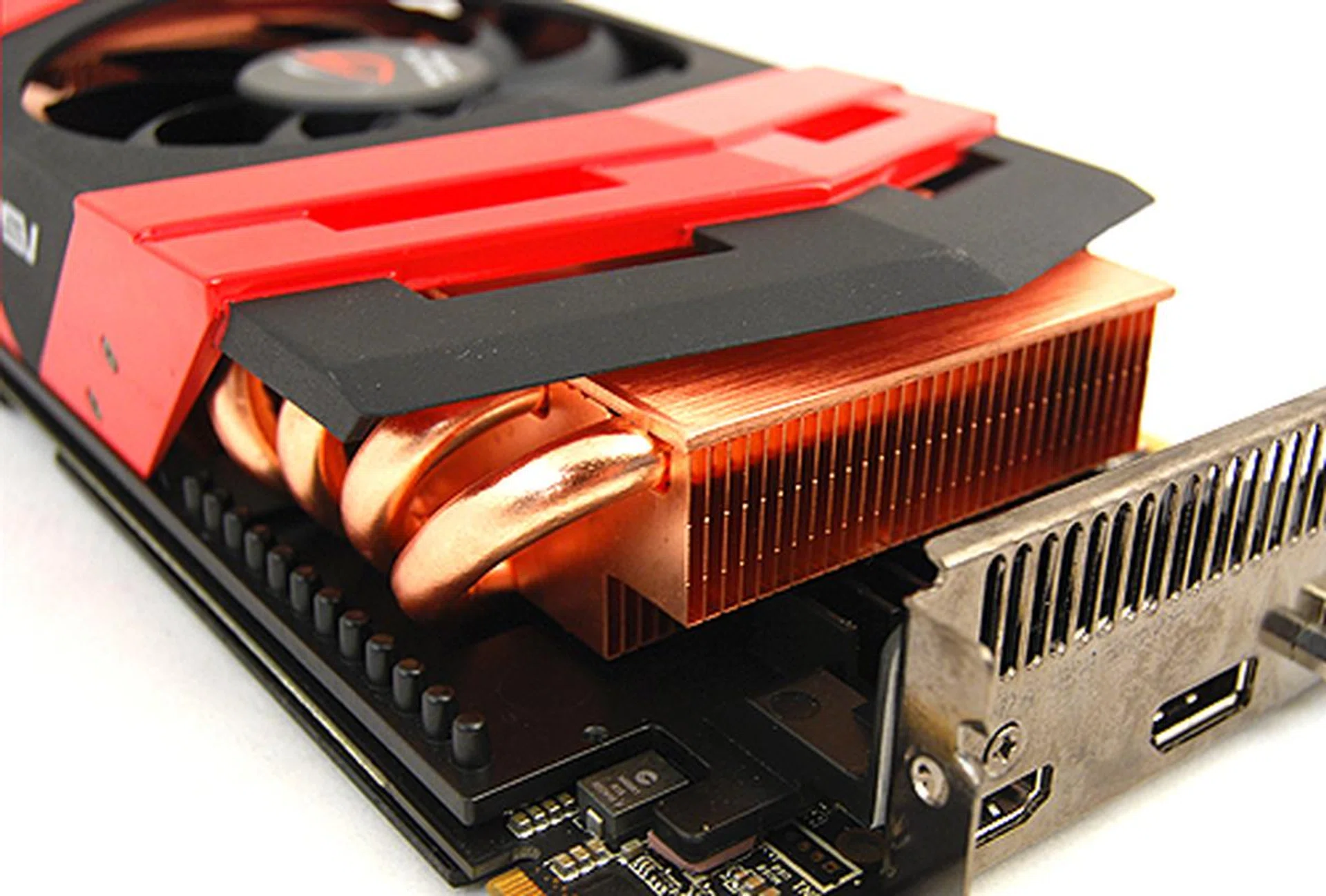
Thick copper heat pipes ensure the GPUs are kept cool.
Test Setup
The ASUS Ares will be tested on our high-end X58 system which has following specifications:
- Intel Core i7-975 (3.33GHz)
- Gigabyte GA-EX58-UD4P motherboard
- 3 x 1GB DDR3-1333 OCZ memory in triple channel mode
- Seagate 7200.10 200GB SATA hard drive
- Windows 7 Ultimate
Our testbed is powered by a 850W Corsair PSU that is certified 80 Plus Silver. This PSU has served us well thus far, and has even powered a 3-way Radeon HD 5870 CrossFireX setup in the past. Hence, it should be more than sufficient for the Ares. But in this case, the card refused to work properly with the PSU, causing our system to freeze up on a number of occasions. Incidentally, ASUS recommends a PSU rated for at least 750W so the Corsair should suffice. In any case, we decided to swap the 850W Corsair PSU for a 1000W Antec Quattro and all was well.
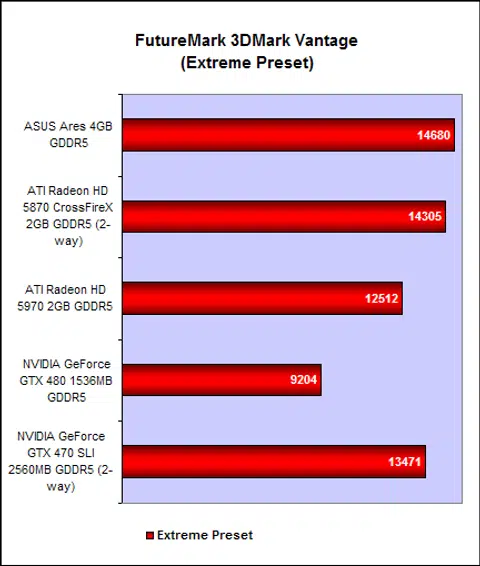
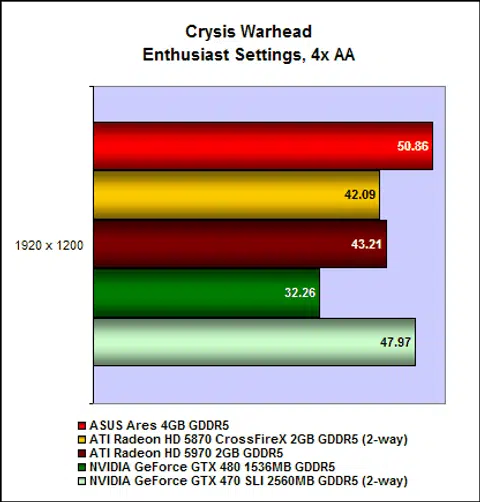
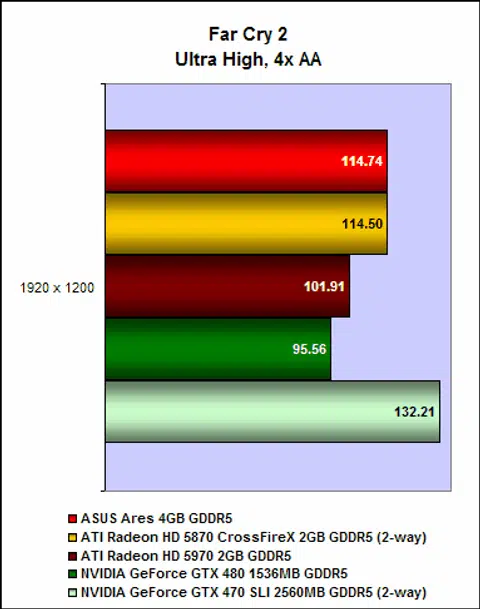
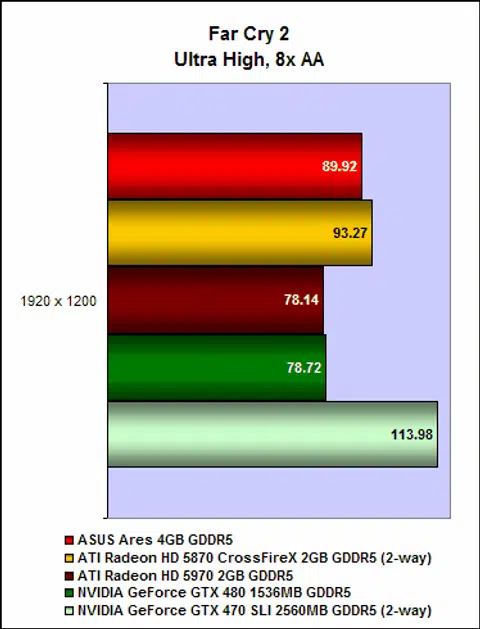
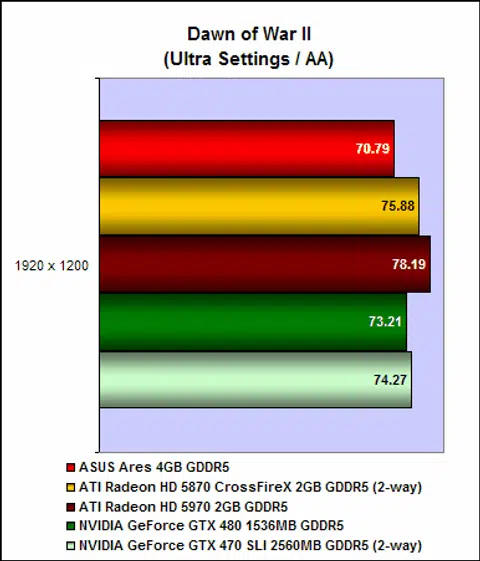
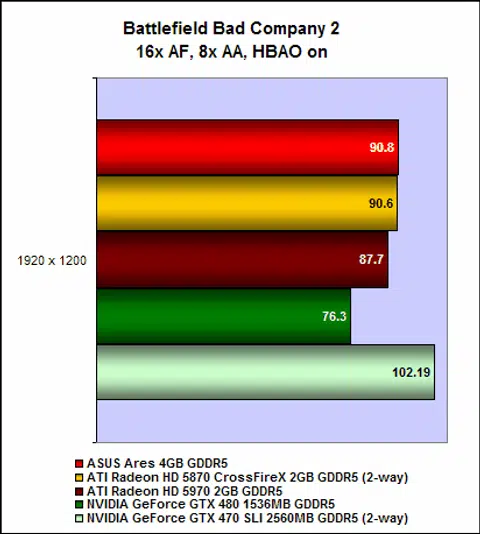
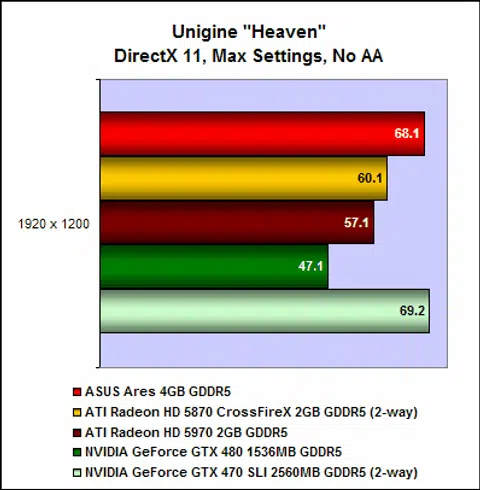
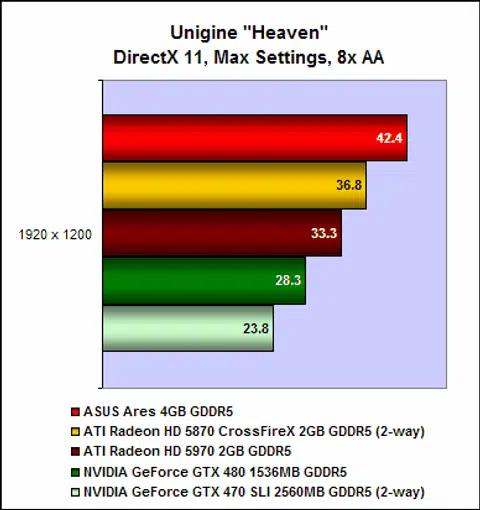
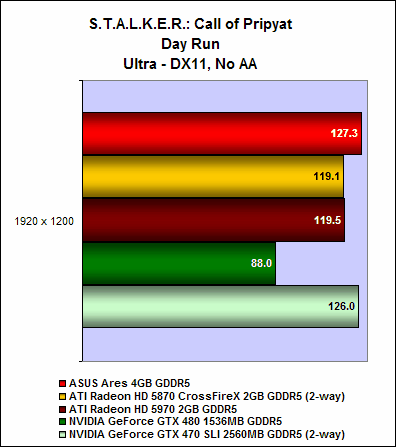
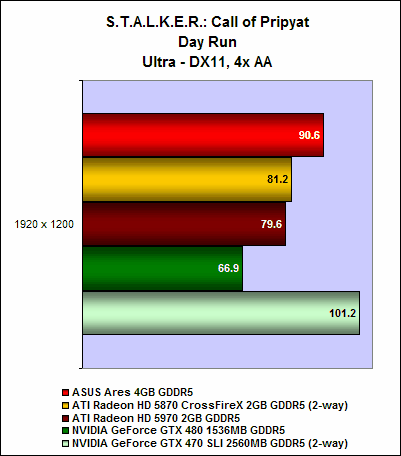
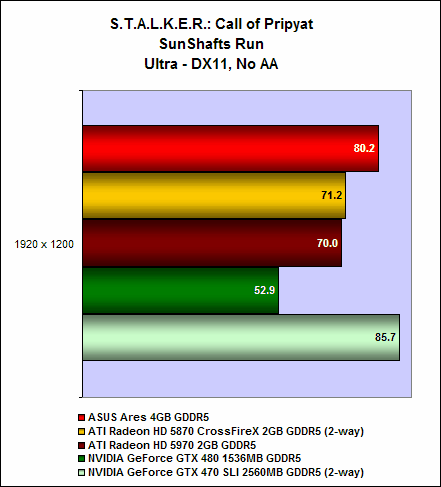
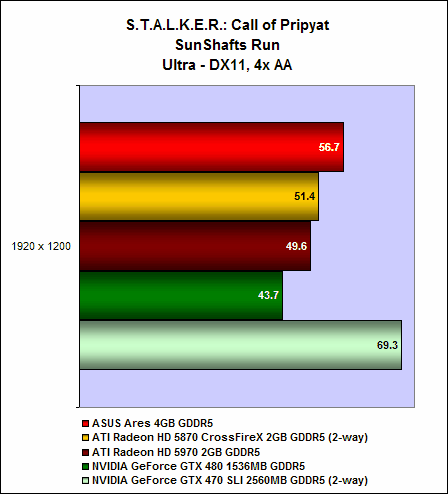
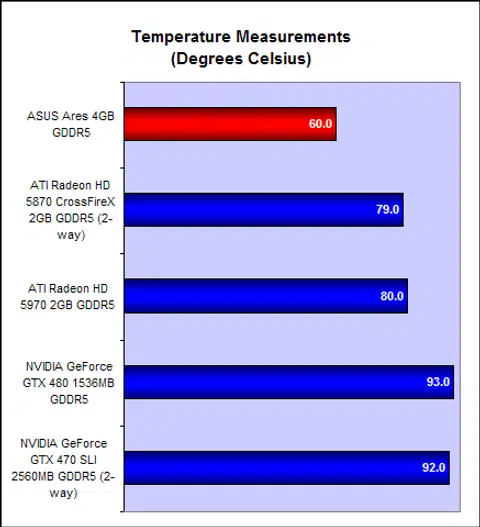
Due to the extremely limited numbers of the ASUS Ares, we only had the Ares for a short time and didn’t have time to update results of its closest competitors. Nevertheless, pitting the Ares against two Radeon HD 5870 in CrossFireX and the Radeon HD 5970, albeit running on older drivers, would still give us a good idea of its performance. We expect the Ares to be on a par with twin Radeon HD 5870 in CrossFireX configuration, but it’ll be interesting to see how it performs on the temperature and power consumption front.
We’ve also included results of the GeForce GTX 480 and also the GTX 470 in SLI configuration to see how it stacks up against NVIDIA’s finest.
Here are the complete list of cards and driver versions tested:
- ASUS Ares (Catalyst 10.7a)
- ATI Radeon HD 5870 (2-way CrossFireX) (Catalyst 10.2)
- ATI Radeon HD 5970 (Catalyst 10.2)
- NVIDIA GeForce GTX 480 (ForceWare 197.41)
- NVIDIA GeForce GTX 470 (2-way SLI) (ForceWare 197.75)
The list of benchmarks used:
- Futuremark 3DMark Vantage
- Crysis Warhead
- Far Cry 2
- Warhammer: Dawn of War 2
- Battlefield Bad Company 2
- "Heaven" from Unigine v1.0
- S.T.A.L.K.E.R.: Call of Pripyat
3DMark Vantage
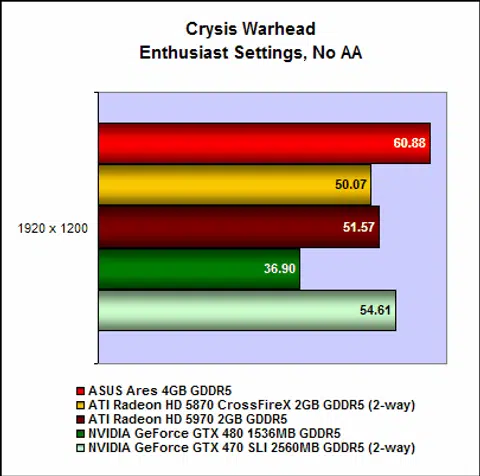
Crysis Warhead
Far Cry 2
Dawn of War 2
Battlefield Bad Company 2
Unigine "Heaven" Results
S.T.A.L.K.E.R.: Call of Pripyat
 |  |
 |  |
Temperature
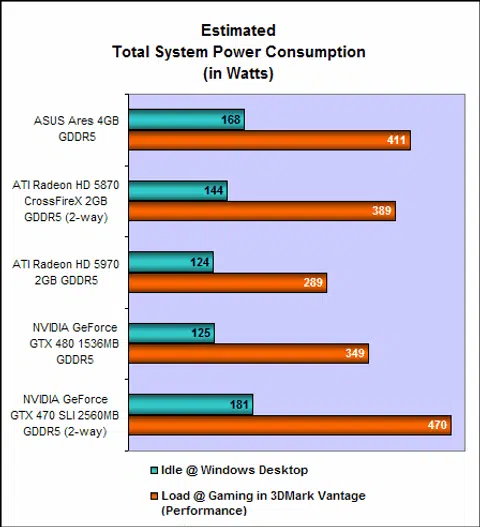
Power Consumption
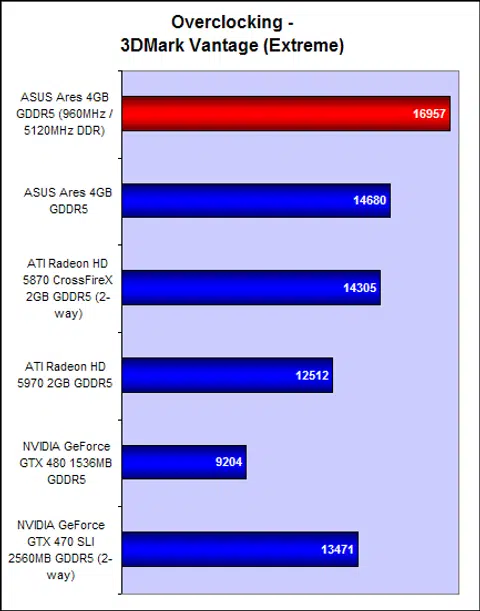
Overclocking
Godly Fast
As we expected, the ASUS Ares is comparable to twin Radeon HD 5870 cards in CrossFireX (once you factor in the drver differences) and significantly quicker than the Radeon HD 5970. Hence, the Ares is easily the most powerful and fastest single graphics card in the world, trumping the slower clocked Radeon HD 5970.
What’s more, its operating temperature of a mere 60 degrees Celsius is amazing for a card boasting two high-end GPUs on a single PCB, and we were impressed by its overclocking abilities. To be able to hit 960MHz at the both cores and 5120MHz DDR at the memory, is a commendable feat that most single-GPU Radeon HD 5870 cards are not even capable of. Hence, the Ares is quite possibly the single most performance-focused card in the market and we're giving it the Innovative Award for the engineering that went into making this card.
There are, however, a couple of drawbacks to this ferociously quick card. For one, mounting the card on your motherboard without any additional support might cause the card’s PCIe connector to break under its own titanic weight.
And then there’s its cooler. As a triple-slot cooler, it means possibly forgoing a neighbouring PCIe x16 slot; furthermore, the cooler is also unbearably noisy when the card is taxed. It sounds like it’s going to take off. We recommended that you use headphones because the noise it makes is loud enough to be a proper nuisance.
Then there's also power considerations. It's maximum power draw reading of 411W is surpasses that of two Radeon HD 5870 in CrossFireX configuration and is substantially more than a Radeon HD 5970, which manages a more modest 289W. This means the Ares requires a beefier PSU.
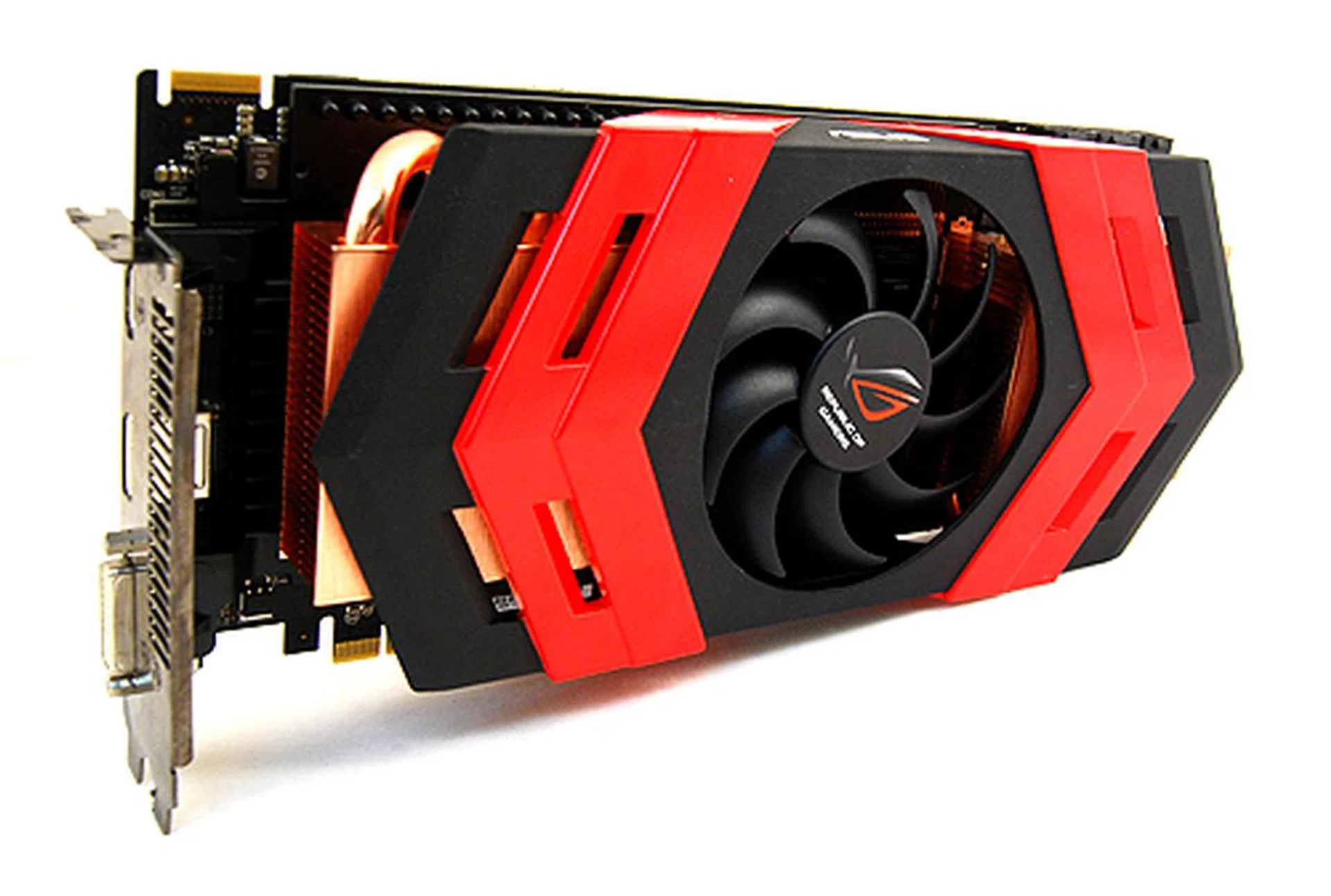
Fast, but extremely pricey. The Ares is not one for the faint of heart and wallet.
And then its price - a whopping S$1999. For that money, you could get two Radeon HD 5970 cards, or easily get three Radeon HD 5870 for a 3-way CrossFireX setup. But even if you were willing to shell out the cash, the bad news is that ASUS only made 1000 Ares cards worldwide and all of them have already been accounted for. So the only way you are going to get one is off the second-hand market.
The Ares, therefore, lives up to its godly name and is not for mere mortals. Instead, it is for hardcore enthusiasts who can appreciate the amount of engineering that went into this card and the sheer unrivaled performance it delivers for a single graphics card.
Our articles may contain affiliate links. If you buy through these links, we may earn a small commission.