
SiS672FX - Budget for Budget's Sake
The SiS672FX is a chipset featuring an updated Mirage 3+ IGP engine that is now certified for Windows Vista Premium. It supports all current Intel 1066MHz FSB processors including the Core 2 Quad and features very impressive energy efficiency operation - at a price. Read on.
Introduction
There is a new Intel Core 2 Duo chipset on the block that is vying for a position in the mainstream entry-level desktop scene and that is the SiS672FX. This is actually a very interesting turn of events since SiS' previous SIS671FX based boards has only entered the market in recent times. Showcased in all major trade shows this year such as CeBIT and Computex, it came to our attention that the new SIS672FX is really just a minor update to the SIS671FX featuring a refreshed Mirage 3 IGP engine dubbed the Mirage 3+, which is now certified for Vista Premium Edition (the SiS671FX was only certified up to Vista Basic).
The actual specifications of the SiS672FX chipset is pretty straightforward, sharing almost all the characteristics of its predecessor, the SiS671FX except for the enhanced graphics engine. The chipset is made up of two parts, the SiS672FX Northbridge and SiS968 Southbridge. The Northbridge is an advanced core logic chipset that fully supports dual and quad-core processors on Intel's LGA775 platform including the Core 2 Duo and Core 2 Quad. However, according to SiS, the chipset only supports a system bus up to FSB 1066MHz, which may rule out official support for Intel's new FSB 1333MHz processors.
The SiS968 Southbridge is also one of SiS' newer Southbridges that was launched at the beginning of the year. It features two PCIe x1 lanes, two SATA 3.0Gbps ports with RAID and AHCI capabilities, one IDE port, eight USB 2.0 ports, Gigabit LAN and HD Audio. The Northbridge and Southbridge is connected via SiS' proprietary MuTIOL 1G interface.
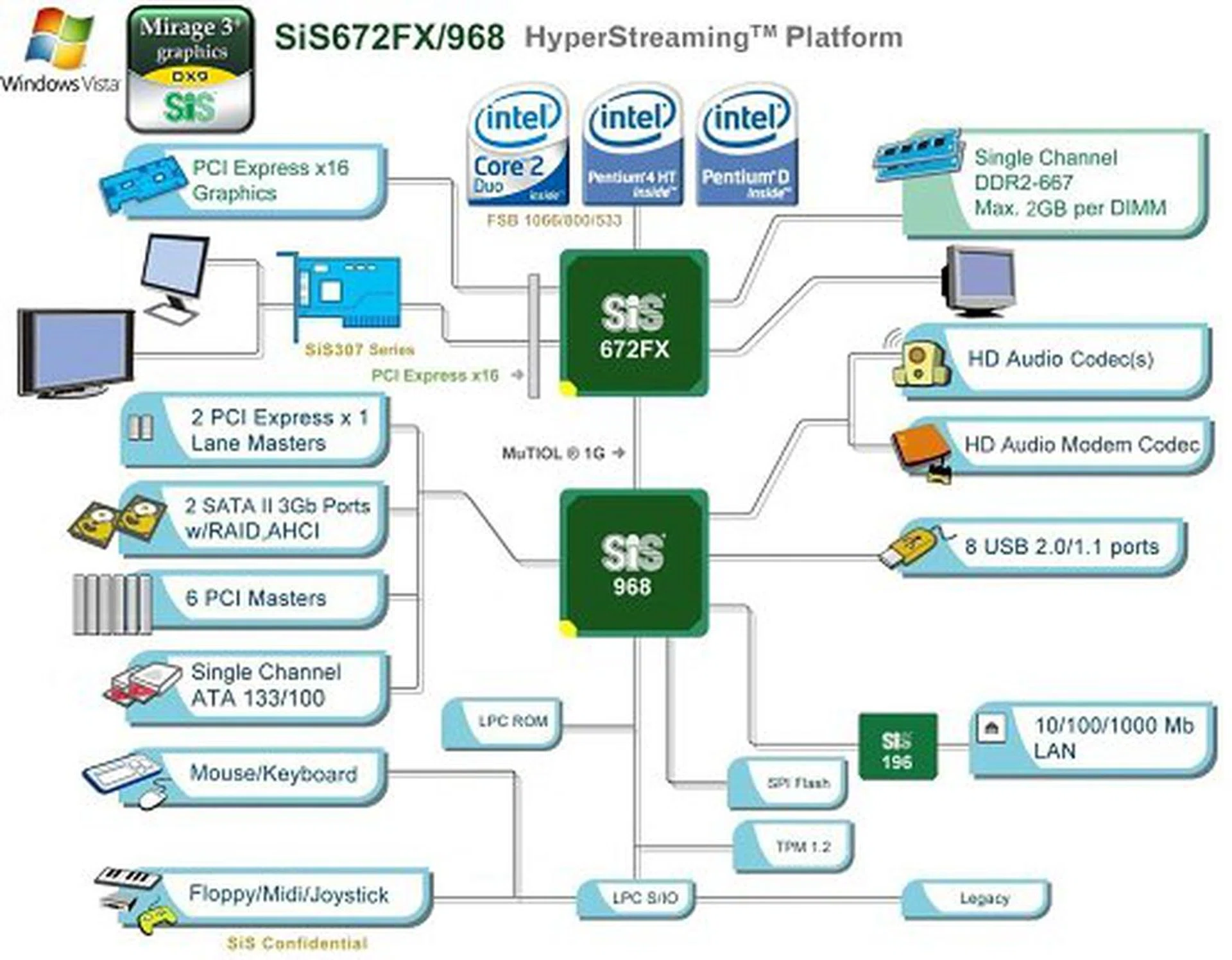
As mentioned, the SiS672FX will feature a slightly enhanced Mirage 3+ IGP engine. The Mirage 3+ is a DirectX 9.0 / OpenGL 1.5 part supporting Pixel Shader 2.0 only with no Vertex Shaders as yet. It can be configured for up to 256MB shared memory, and while not particularly improved over the Mirage 3, it is capable enough to support Vista's Aero interface. According to SiS engineers, the gist of the improvements in the Mirage 3+ engine is that the graphics core runs at a faster clock rate than its predecessor and now qualifies for Vista Premium Edition certification. The Mirage 3+ may not be as advanced as either NVIDIA or ATI or Intel's IGP offerings, but it does include SiS Real Video technology with notable features such as motion adaptive de-interlacing, noise reduction and 3:2/2:2 pull-down detection.
Its memory controller on the other hand is underwhelming, especially considering today's standards and the fact that the SiS672FX is an IGP chipset. When SiS announced the SiS672FX, we had initially thought that the memory controller would see an upgrade as well, but the SiS672FX still supports single-channel memory configurations with only two slots supporting a maximum 4GB memory capacity. Officially, the chipset supports up to DDR2-667, but we've tested it to work well with DDR2-800. Now, if we follow the official configuration, a single-channel DDR2-667 setup will only give you a measly 5.4GB/s memory bandwidth. Using DDR2-800 will give you 6.4GB/s, hardly enough to even support the 8.5GB/s CPU bandwidth (of the current 1066MHz FSB Intel processors), let alone having to share with onboard graphics.
The main feature of the SiS672FX is its advanced power management features and low operational TDP. The chipset supports throttling of the graphics core in 2D mode to save power and reduce heat and to prove a point, the reference motherboard from SiS works without any form of cooling on the chipset.
NorthBridge | Chipset |
|
CPU Support |
| |
Memory |
| |
Graphics |
| |
Southbridge | Chipset |
|
Storage |
| |
Audio |
| |
Networking |
| |
Expansion Ports |
| |
USB 2.0 |
| |
Advanced Power Management |
|
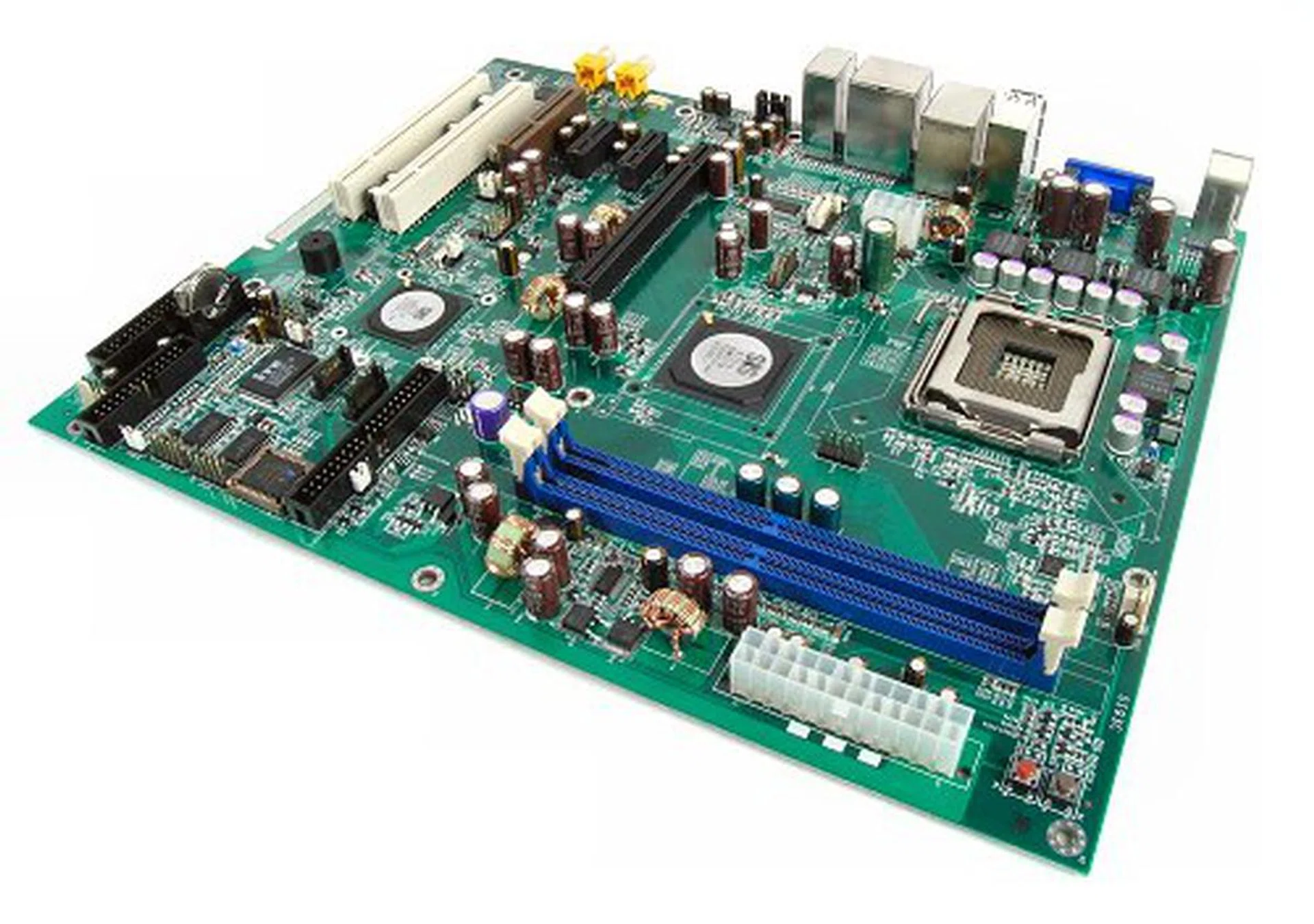
SiS672FX Reference Board
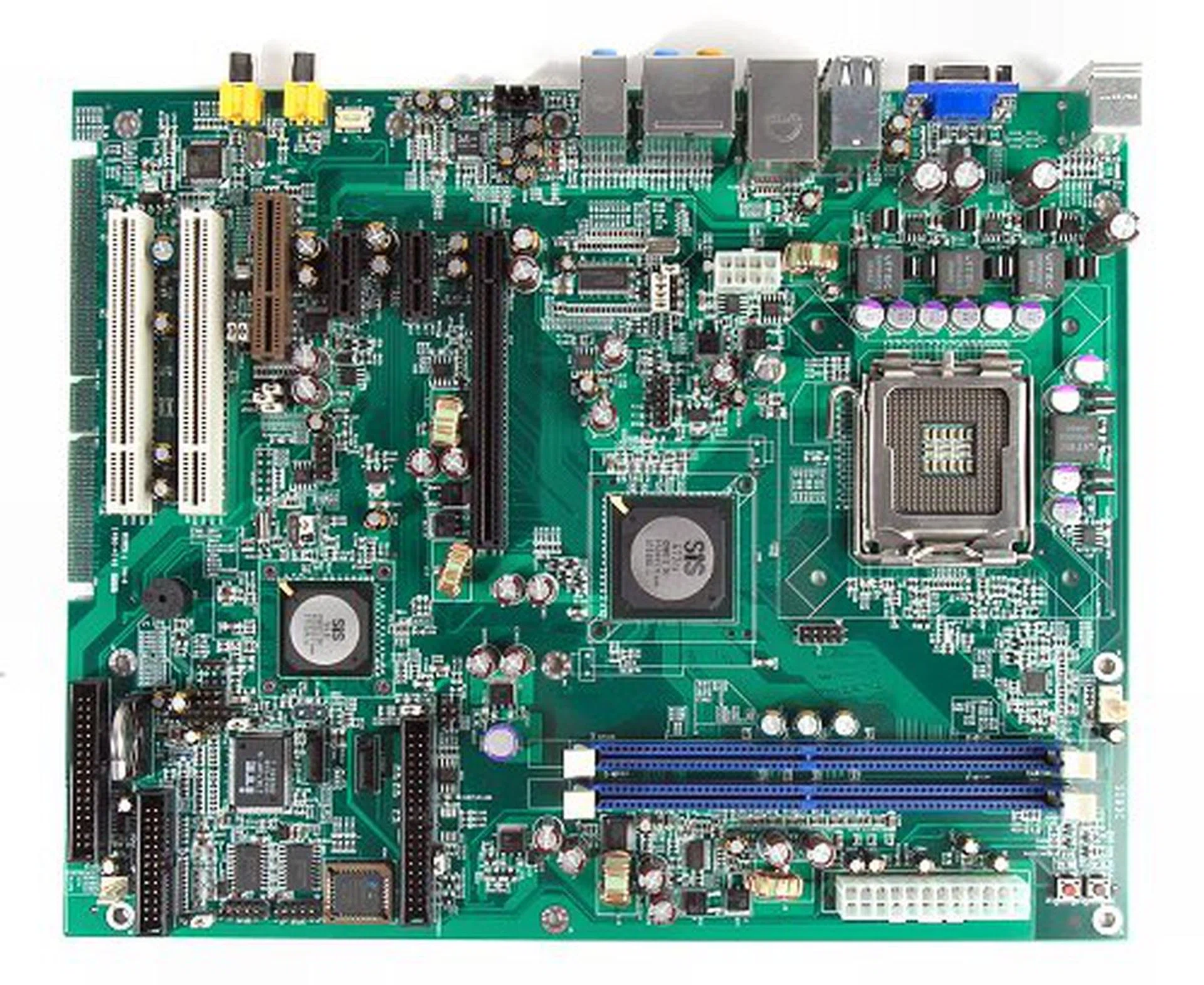
Reference motherboard from SiS based on the new SiS672FX chipset. Bear in mind that this is NOT a retail sample or even a retail reference design. This is purely an engineering PCB for testing the chipset.
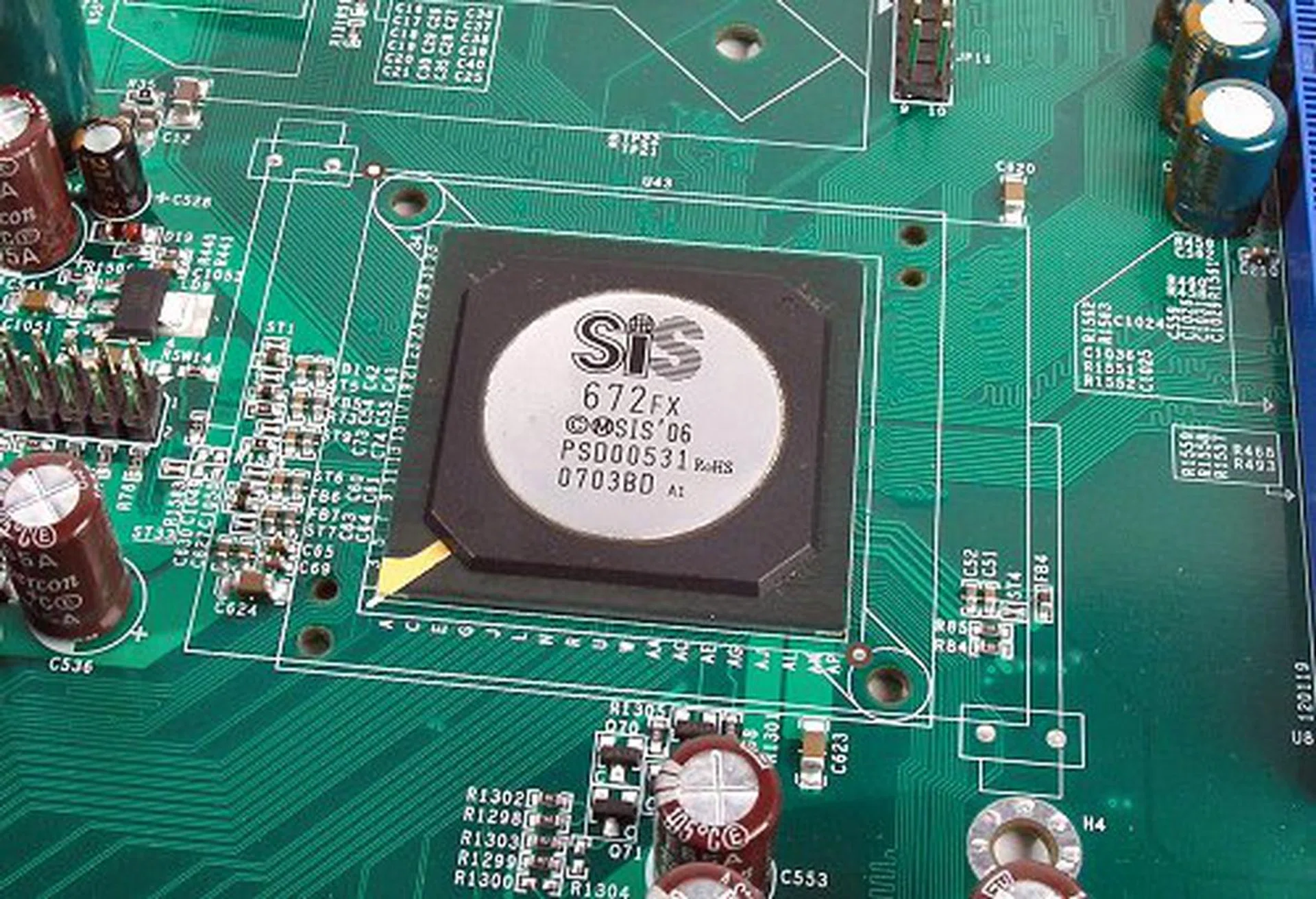
The SiS672FX chipset is so cool, it works without any cooling.
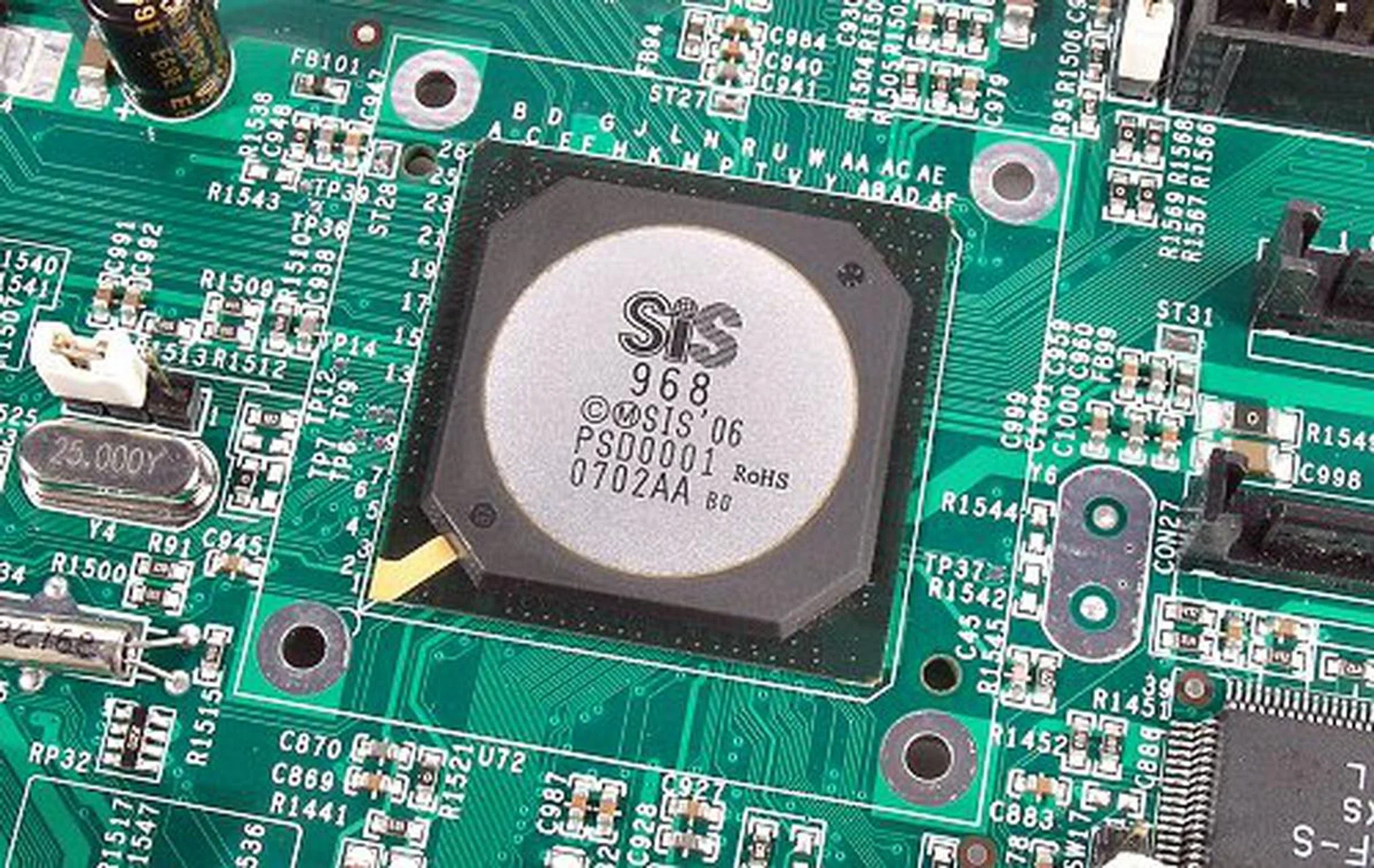
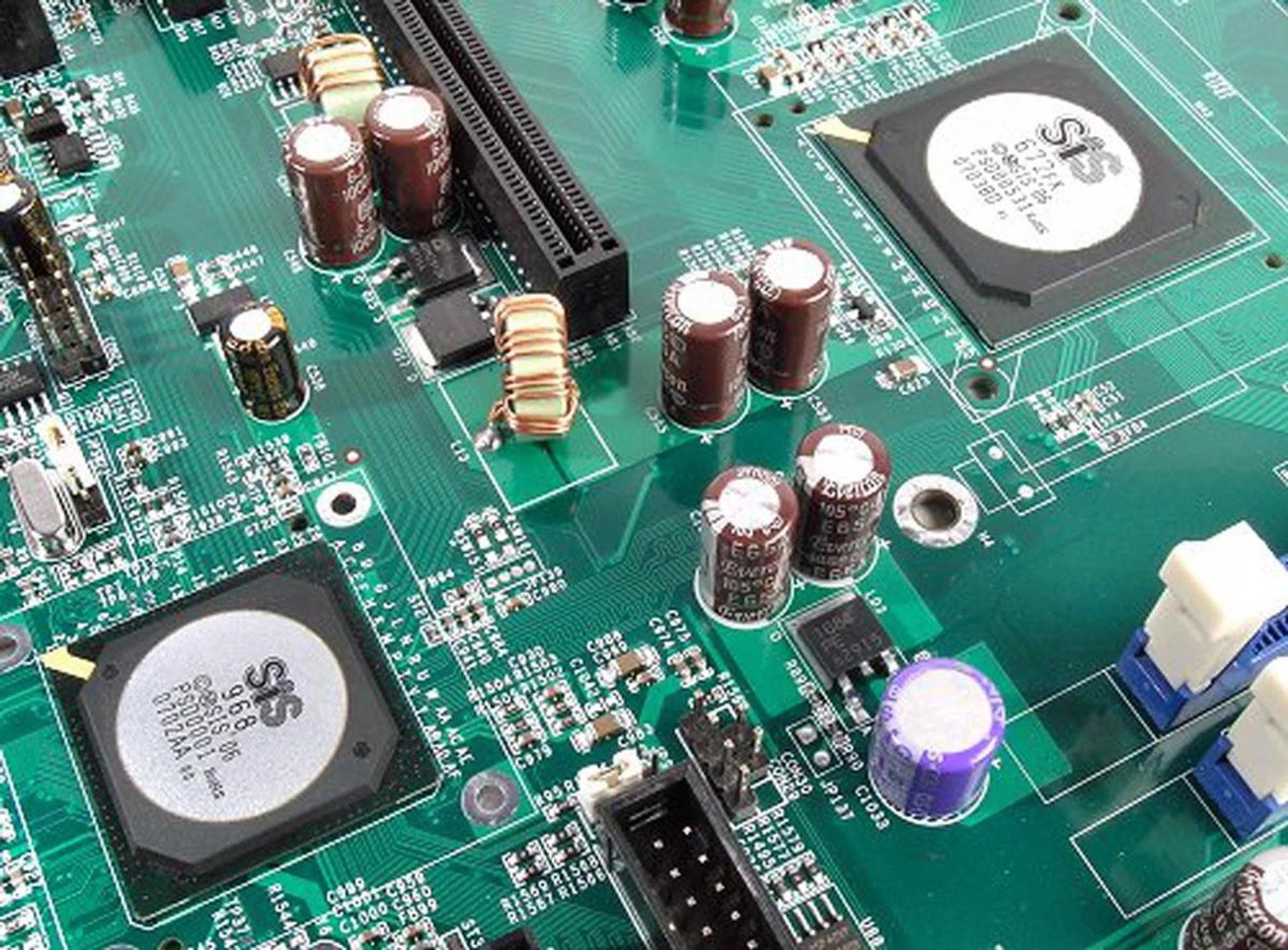
Close up of the SiS968 Southbridge.
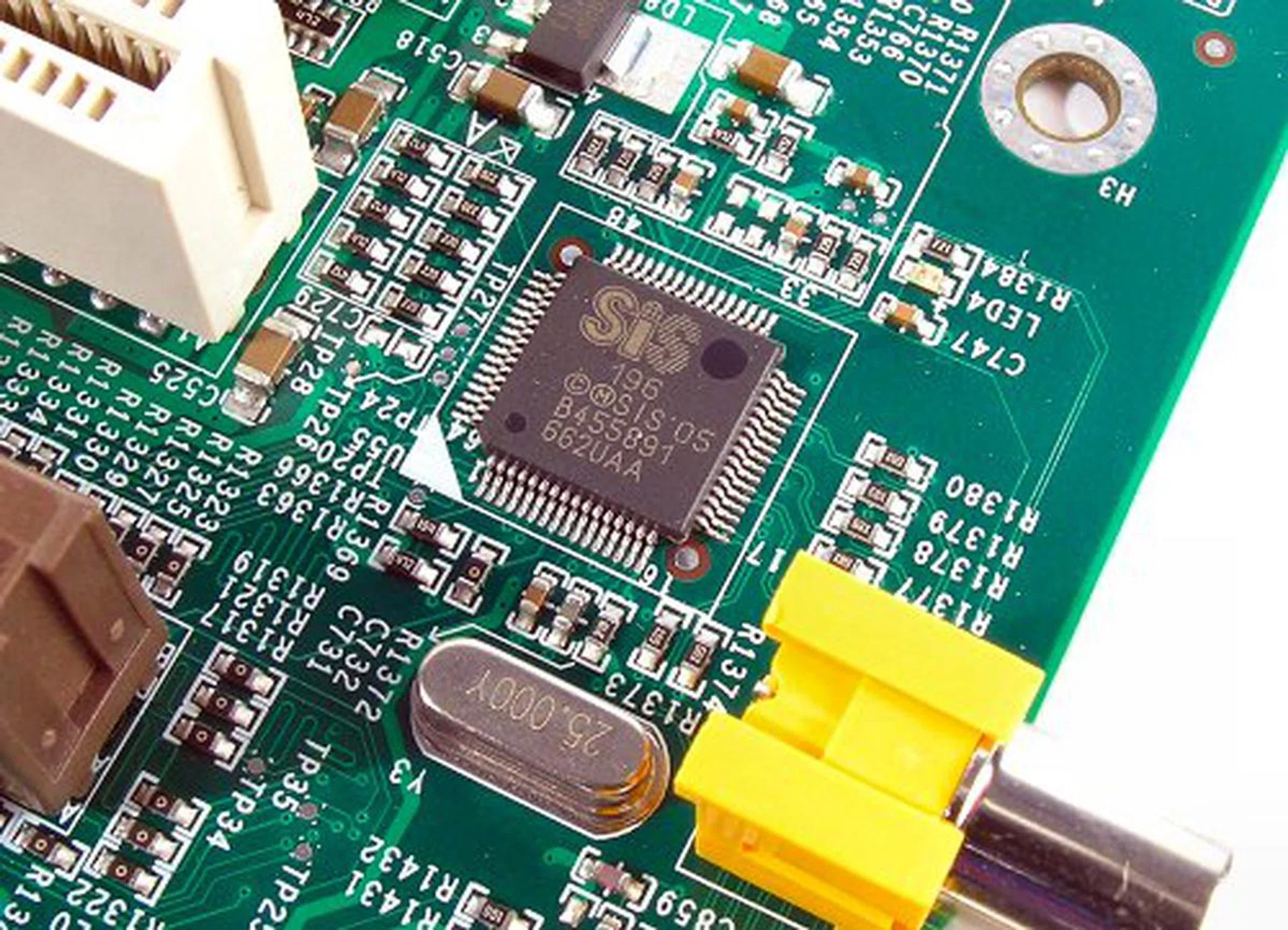
The SiS196 ASIC seen here is actually the Gigabyte PHY chip.
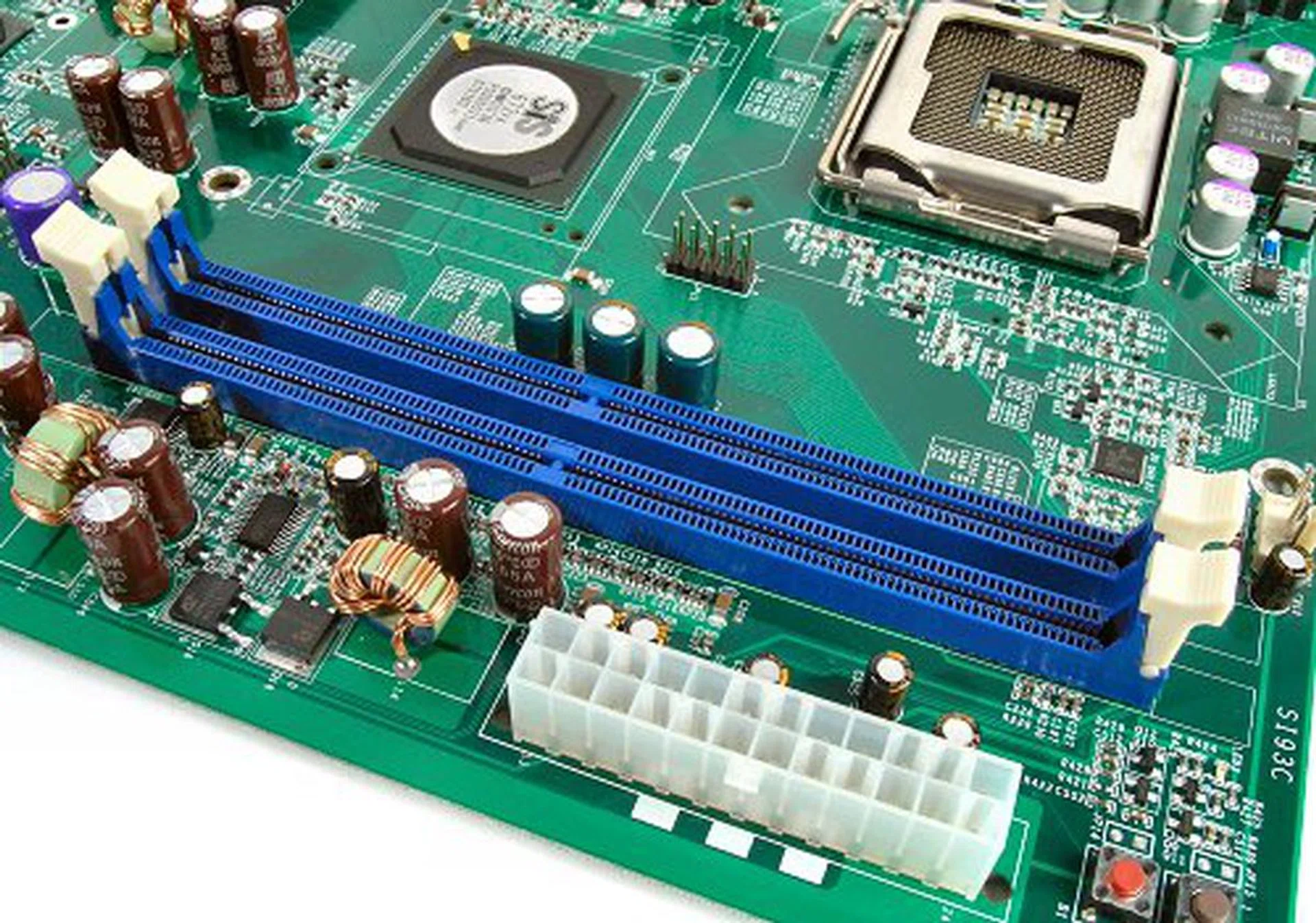
Only two DIMM slots are supported by the SiS672FX for a maximum memory configuration of 4GB single-channel DDR2.
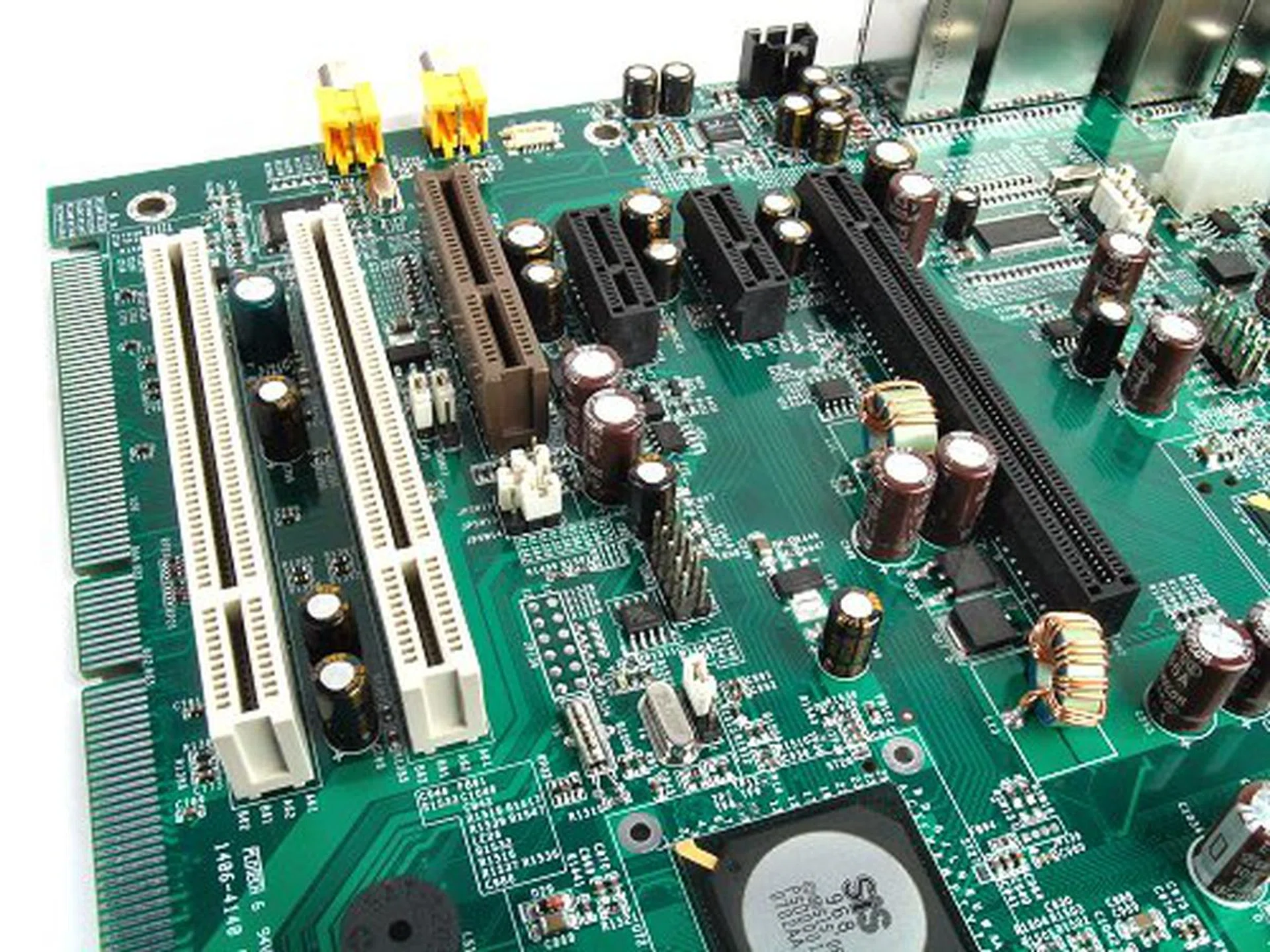
The SiS672FX supports one PCIe x16 slot (Northbridge) and two PCIe x1 slots (Southbridge). The middle slot on the board looks like an AMR slot, but remember that this is not a retail reference board, you don't have to worry about the weird looking slots and contacts seen here.
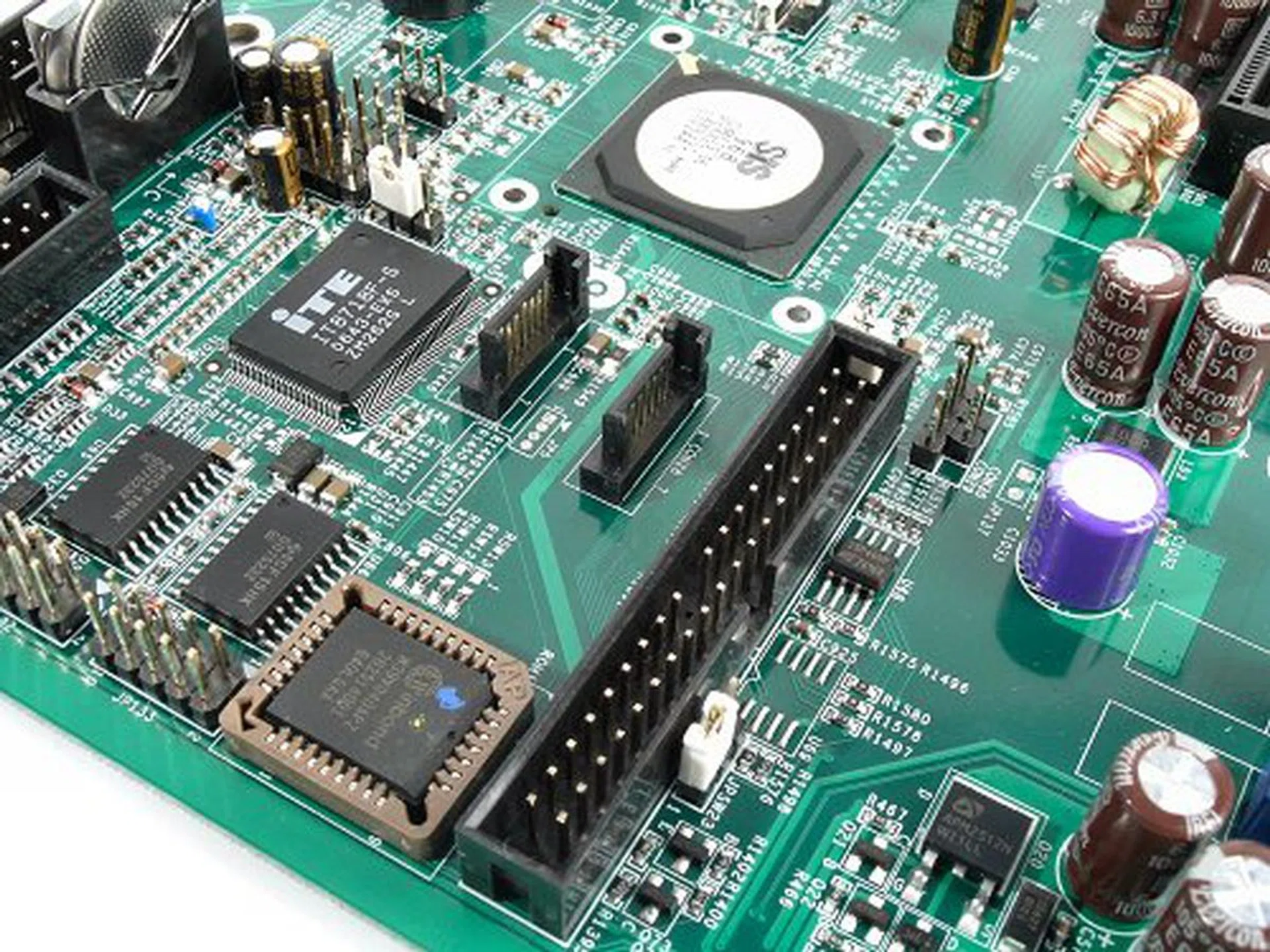
Only two SATA 3.0Gbps ports are supported by the chipset.
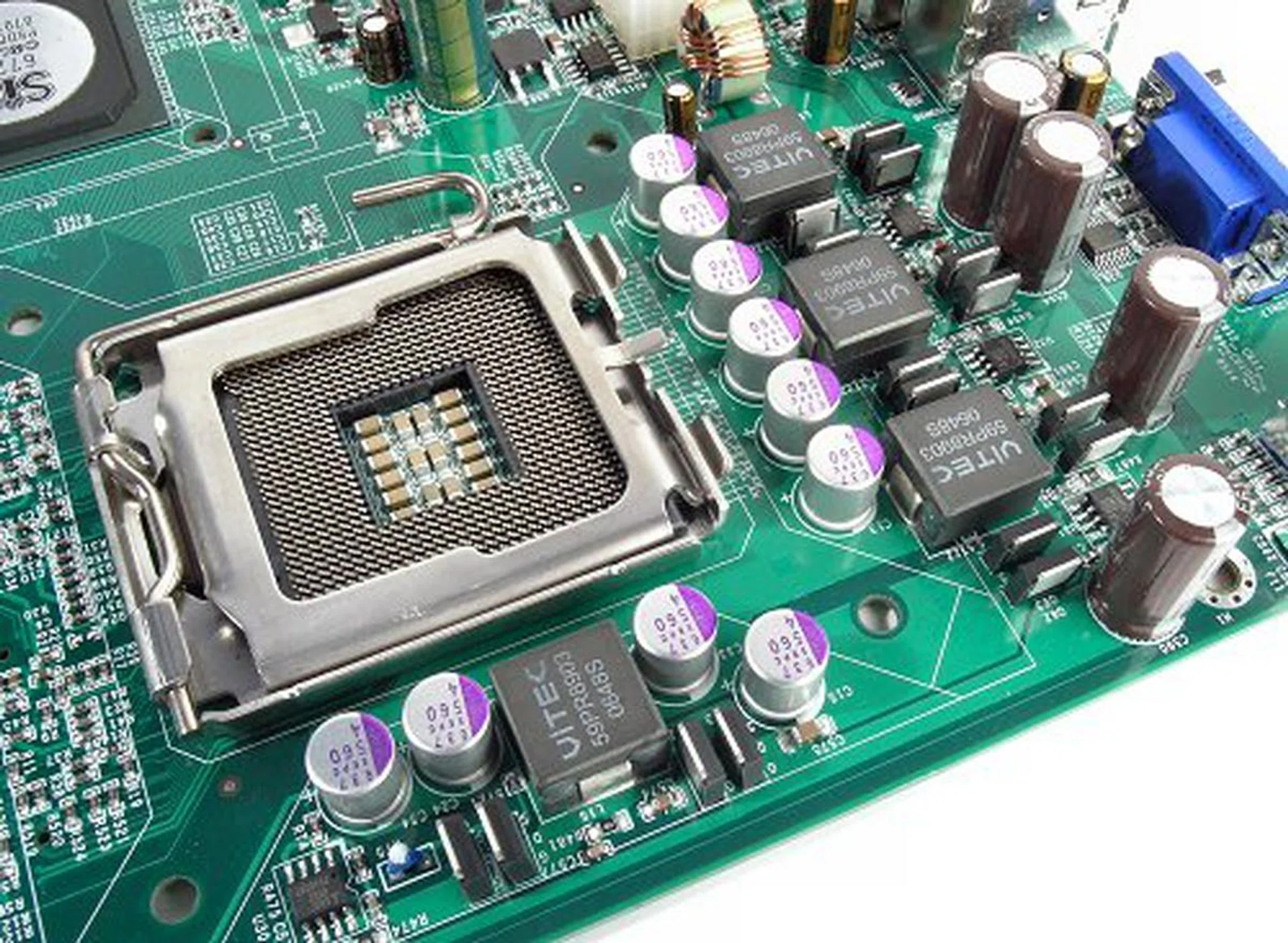
Though the rest of the board looks simple, the PWM components around the CPU socket uses solid capacitors and what looks like digital MOSFETs.
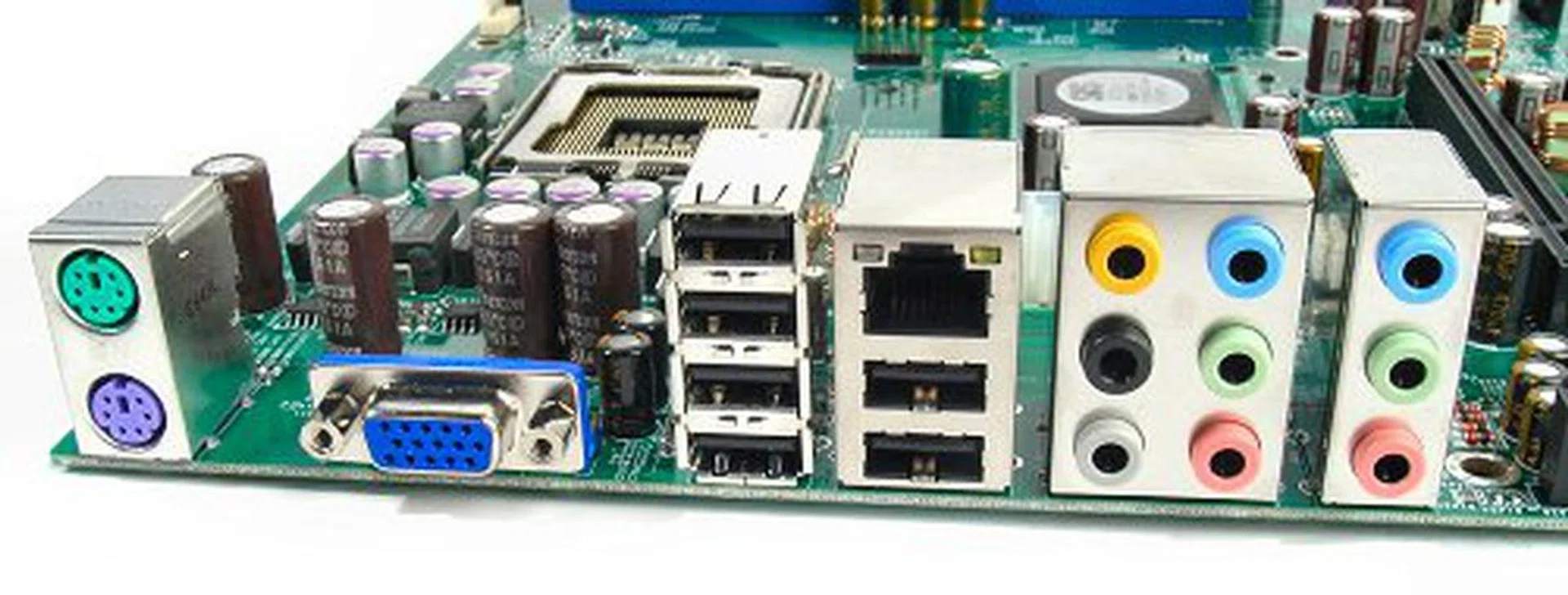
No, the board does not have 14-channel surround audio capabilities.
Test Setup
For this benchmarking segment, we compare the SiS672FX against two of Intel's contemporary IGP chipsets, the older 945G Express featuring the GMA950 and the newer G965 that comes with the GMA X3000 graphics core. Also, in an effort to have a more direct memory controller comparison for single channel performance, we will run a second set of benchmarks on the Intel G965 with forced single channel operation. Because the Intel G965 board forces similar memory timings as the SiS672FX, its single and dual channel memory results will be a good gauge on mainstream desktop performance today.
SiS672FX Reference Platform
- Intel Core 2 Extreme X6800 processor (2.93GHz)
- 2 x 1GB AENEON XTUNE DDR2-800 @ 5-5-15 CAS 4.0
- SiS Mirage 3+ 256MB – with SiS 3.81 drivers
- Seagate Barracuda 7200.7 80GB SATA hard disk drive (one single NTFS partition)
- SiS AHCI 4.11a driver set
- Microsoft Windows XP Professional with Service Pack 2 (and DirectX 9.0c)
Intel G965 and 945G Reference Platforms
- Intel Core 2 Extreme X6800 processor (2.93GHz)
- 2 x 1GB Kingston HyperX DDR2-800 @ 5-5-15 CAS 5.0 (G965 only)
- 2 x 1GB Kingston HyperX DDR2-800 @ 4-4-12 CAS 4.0 (945G only)
- Seagate Barracuda 7200.7 80GB SATA hard disk drive (one single NTFS partition)
- Intel GMA X3000 (DVMT 256MB) - with beta drivers 6.14.10.4764 (G965 only)
- Intel GMA950 (DVMT 256MB) - with beta drivers 14.25.0.4666 (945G only)
- Intel INF 8.1.1.1001 and AHCI 6.1.0.1022 driver set
- Microsoft Windows XP Professional with Service Pack 2 (and DirectX 9.0c)
Additional Notes
- Both the SiS672FX and our G965 reference motherboards have limited memory timing options, forcing the boards to run at their SPD timings, which at DDR2-800 is 5-5-5-15. The SiS672FX is set to CAS 4.0 however, in an effort to compensate however slightly for its single-channel controller.
- Due to system instability running Kingston HyperX memory at DDR2-800 with the default voltage, the benchmarks for the SiS672FX will be conducted with AENEON XTUNE DDR2-1066 memory downclocked to DDR2-800.
Benchmarks
The following benchmarks will be run to determine the performance potential of the SiS672FX chipset:-
- BAPco SYSmark 2004
- Futuremark PCMark05
- SPECviewperf 9.0
- Futuremark 3DMark06
- AquaMark3
Results - BAPco SYSmark 2004
Overall, the SiS672FX was about 10-12% slower than the Intel G965 and and 945G chipsets. The performance gap wasn't as noticeable in the Internet Content Creation workloads where applications are more multimedia related. However, there was a much bigger difference in performance with the Office Productivity workload where there is more memory intensive activity.
Here, you can see Intel's improvements to its memory controller from the 945G to G965. The newer G965 led the pack and was able to outperform the 945G even in single channel mode. The SiS672FX suffered the most in this workload, with a 20% performance deficit against the dual channel G965 (and still a 15% differential with single channel scores) while against the 945G, the delta stood at 13%.
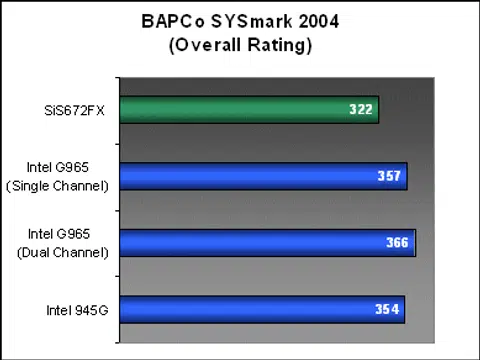
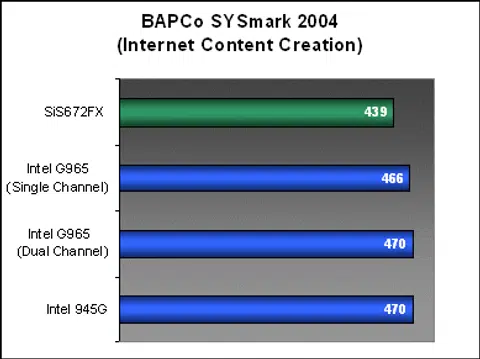
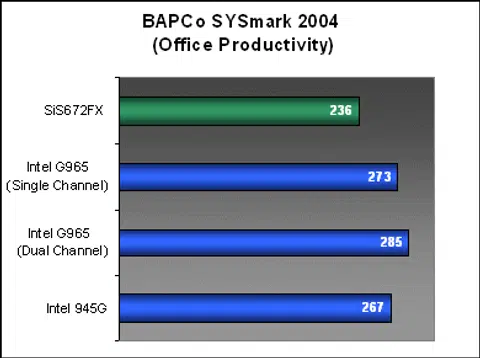
Technologically speaking, this level of performance difference works against the SiS672FX chipset, but one must consider that this was never meant for the mainstream market but was seriously a low-end part aimed at the OEM and system integrators market. Here, every dollar shaved off can make or break the contractual agreements as they generally move these products in much larger quantities than in the channel business. Given, this market segmentation, an overall 10% performance deficit against the market leader isn't too bad at all since the difference isn't really perceivable. However, would this trend continue and how would this translate to the actual board cost? Read on!
Results - Futuremark PCMark05
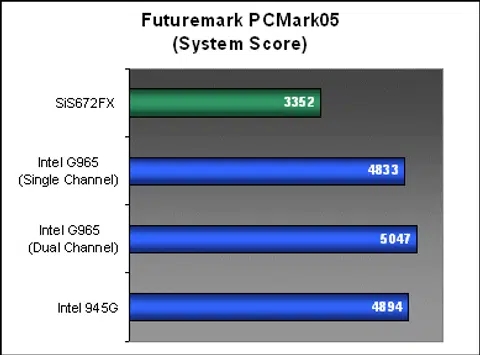
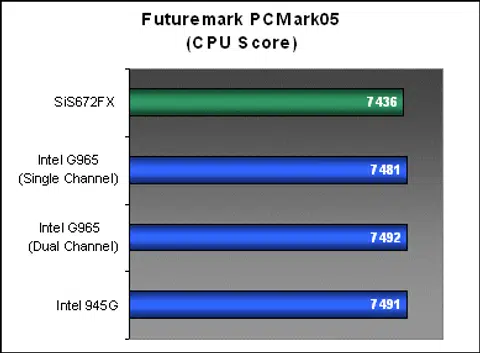
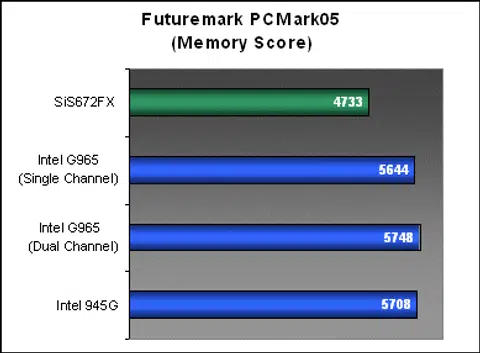
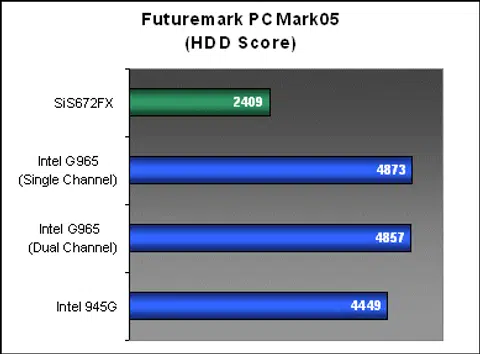
The good news is that the SiS672FX was able to match up with the Intel chipsets in terms of CPU performance, which shows a robust implementation of the LGA775 connection. However, that's where the comparison ends. The chipset was not able to keep up with any of the other workloads, taking more than a 30% hit in the System workloads against the Intel chipsets and about an 18% drop in memory performance. As before, the Intel G965 showed superior dual channel memory performance and single channel performance that could even match the older 945G chipset.
Surprisingly, the HDD performance of the SiS672FX was nowhere near where we'd expected them to be. As the SiS968 Southbridge has been known to be a pretty robust Southbridge, its performance should not have been this low. We've already enabled AHCI, installed the latest drivers, double and triple checked the results, but its PCMark scores remain unchanged.
Results - SPECviewperf 9.0
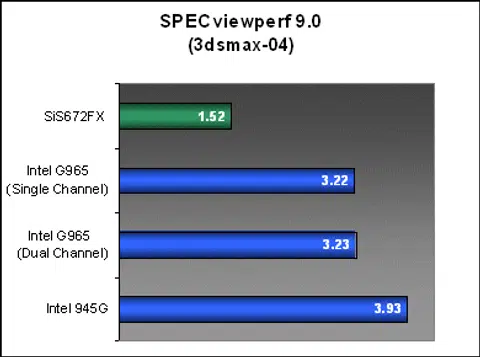
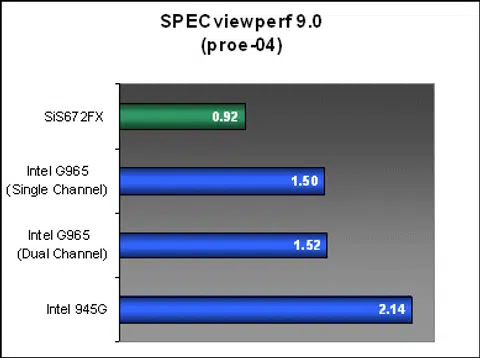
There is really nothing that needs to be said about these SPECviewperf 9.0 scores either way since none of the IGP cores and their drivers are optimized for OpenGL performance. Even so, we can see the direct effects of IGP architecture, drivers and memory subsystem on overall performance in these tests. Here, the Intel G965 was actually slower than the 945G probably because of its CAS 5 timing, compared to CAS 4 for the 945G. However the real crux of the outcome is due to the different IGP architecture of the GMA X3000 and that of GMA X950 whereby Intel has yet to capitalize on the GMA X3000's hardware potential with good drivers - something which they don't seem to be very good at this point of time, more so because it's an OpenGL API. This is not the first time we've encountered this, thus the scores are quite normal and expected.
That aside, again we noted that the G965 did not really lose much performance between single and dual channel modes. The SiS672FX on the other hand, can be considered quite dismal, in both the graphics and memory subsystem performance.
Results - Futuremark 3DMark06
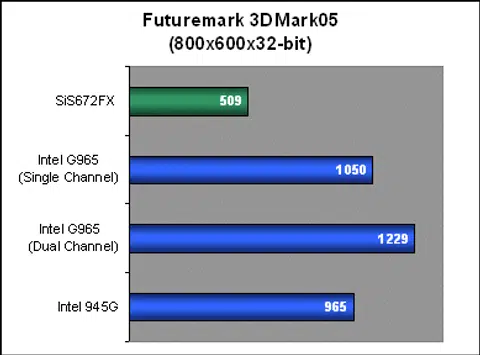
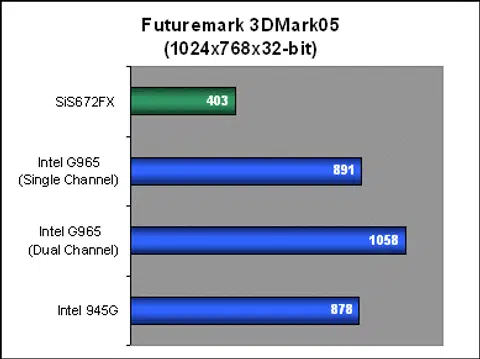
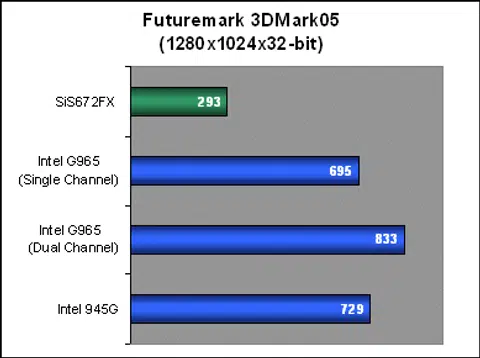
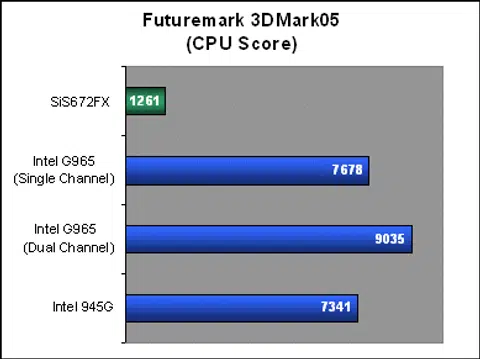
Moving on to more GPU oriented gaming benchmarks, the more advanced Intel G965 and its GMA X3000 IGP takes the lead in 3DMark06 (and thankfully its Direct3D performance wasn't hampered like in the OpenGL API). Again, the chipset managed to outperform its predecessor even in a single channel memory configuration. The performance of the SiS672FX on the other hand, isn't even worth mentioning about. Even at 800x600, the Mirage 3+ was nearly 60% slower than the GMA X3000 and almost half the scores of the GMA950.
Results - AquaMark3
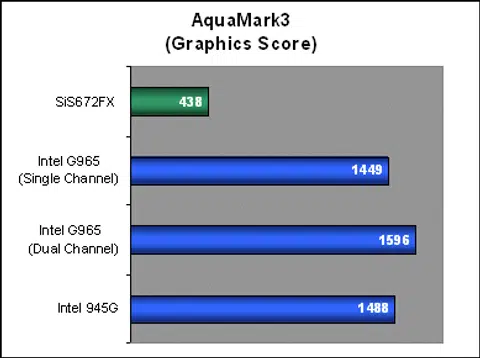
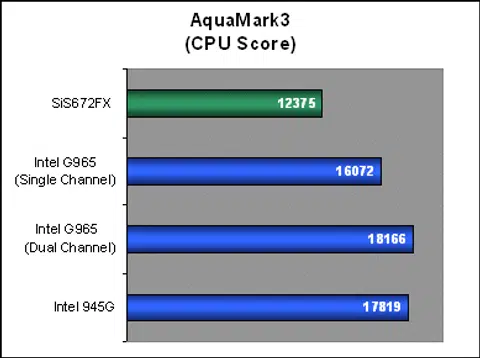
The same goes for AquaMark3 as the Mirage 3+ IGP on the SiS672FX could only manage a slide show average of 4fps throughout the benchmark. The Intel G965 on the other hand, continued to score much better regardless of its memory configuration.
Overclocking
According to the official specifications for the SiS672FX, the chipset only supports processors with up to a 1066MHz FSB. However, we found some rudimentary overclocking features on our reference board and decided to see if it would work with a 1333MHz bus. The BIOS offered us CPU ratio control as well as FSB tweaking up to 355MHz, which suited our purposes just fine for this test. Firstly, we overclocked the board to 333MHz (1333MHz) and found that it was completely stable, which means that even though SiS' official stance for both FSB and memory is at 1066MHz and DDR2-667 respectively, the chipset can handle newer 1333MHz FSB and DDR2-800 just fine without requiring additional voltage adjustments, maintaining its power efficiency.
The next step was to see if the board could be overclocked in its current state with a naked chipset (no cooler) and no voltage tweaks. In this scenario, we managed to get the board working in a stable condition up to 350MHz, which is near the maximum allowed by our reference board. Not bad at all.
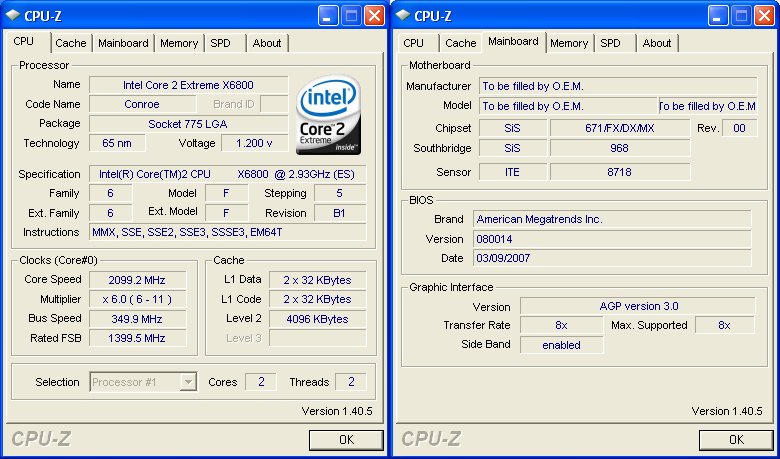
CPU-Z overclocking screenshot. Click for full size image.
Power Consumption
The mainstay feature of the SiS672FX is its low power consumption and TDP. As mentioned at the beginning of this article, the chipset is cool enough to run without any form of cooling at all and in our overclocking tests above, it even handled a 350MHZ FSB just fine without breaking a sweat. However, just how much power savings are we talking about here? By using a power meter plugged directly to the main power socket, we tested the total platform power draw for the SiS672FX and compared it against the Intel G965. System configuration used is the same as the benchmarking test setup for both boards. All power saving features available to the Intel Core 2 Extreme processor, chipset and Windows have been enabled to ensure maximum power efficiency for this test.
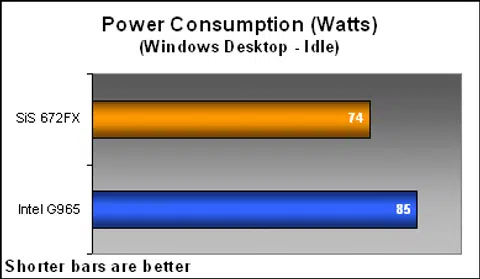
Idling on Windows Desktop
Under full idling conditions, the SiS672FX draws on average 11W less power than an equally configured Intel G965 board. For a chipset level change, this is a pretty impressive result from the SiS672FX. Overall, this comes to 12% power savings over the Intel G965.
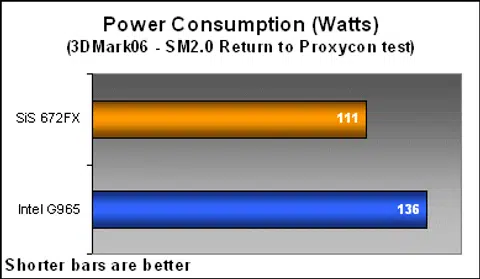
3DMark06 SM2.0 Return to Proxycon test
For full system load tests, we usually run the SM3.0/HDR workload from 3DMark06, but since the Mirage 3+ engine on the SiS672FX only supports SM2.0, we chose to run the Proxycon test instead. Since the SiS672FX and Intel G965 chipsets are IGP chipsets, running the graphics workload off 3Dmark06 will effectively stress the whole system to represent full load power draw. Here, the SiS672FX draws a full 25W less power than the Intel G965 (or about 19% less power draw). Impressive numbers, but you'll have to remember that the graphics performance is drastically much less on the SiS chipset platform too, which is not suitable for any form of modern gaming no matter how light it is. However Solitaire and the likes are fine still.
Conclusion
The Hype
On paper specifications, the SiS672FX certainly looks like a very decent mainstream contender. It has good processor support up to Intel's quad-core Core 2 Quads, DDR2 memory, HD Audio, DirectX 9 graphics with video acceleration, PCI Express, Gigabit LAN, SATA with AHCI and NCQ, and to top it off, it is also one of the coolest and most low powered desktop chipsets available today. However, in a real work scenario, everything else about the SiS672FX is borderline functional, from its immensely crippled memory controller to the graphics core.
With the current industry focus on energy efficiency, the SiS762FX chipset comes just in time to make a point that low power, ultra cool desktop computing is possible, but just how much performance are you willing to sacrifice?
Forget about having DirectX 9.0 or Pixel Shaders or T&L engines or anything 3D related though, as these features aren't the least bit important, no matter what the SiS marketing machine wants you to think. With the kind of 3D performance the IGP pushes out, you'll be lucky if you even get a smooth slide show to look at. The Mirage 3+ might as well be a full 2D engine. Yes, it is now Vista Premium certified, but being able to run Vista's Aero GUI isn't a benchmark for performance. Take AquaMark3 for instance, this benchmark is based on an SM2.0 gaming engine released in 2003, which is theoretically right up the alley of the Mirage 3+, but it could hardly push out a consistent 4fps. That's single digit gaming performance.
The overall performance of the SiS672FX is greatly impacted in all aspects and while the blame can be hastily pinned solely on the single channel memory controller, it is not the case. We specifically ran the Intel G965 in single channel mode to determine the level of performance in today's contemporary chipsets and the difference between single channel and dual channel with the G965 was almost non-existant. In contrast, the SiS672FX under-performed anywhere between 10-30% of the Intel chipsets, which is not reassuring at all.
We've already ruled out gaming, and although the chipset is fairly competent for video processing in a HTPC, the limited storage capabilities of the Southbridge keeps it from being truly effective as a media player. SiS had an opportunity to bring about a significant chipset refresh over the SiS671FX just by updating the memory controller alone, but failed to do so.
The Reality
Don't get us wrong, the SiS672FX isn't a bad chipset all around. We're not condemning it to the pits of chipset hell either. What we're trying to drive at is that the SiS672FX looks incredibly dated in terms of performance and features compared to today's standards and market availability. Take the Intel Pentium III. It was a great processor then, good architecture, highly scalable performance and you can probably still find people running a Pentium III system today. However, if you review a Pentium III now, taking into context today's needs, today's applications and today's performance requirements, where would it stand?
The SiS672FX chipset is designed for one purpose and one purpose only, and that is to carve up a slice of the ultra budget market. Basically, you're looking at a chipset that is designed from a notebook standpoint and implemented into a desktop environment, favoring power consumption and heat generation over performance. Indeed, the power savings that the SiS672FX can give you is very impressive. Not only will the chipset draw alot less power, but you will also save more from cooling.
It is a functional chipset for users who aren't demanding, or more precisely, those who wouldn't care less. For instance, if you're in charge of purchasing new office PCs where the only official 'work' is word processing, spreadsheet and general desktop productivity. Performance never comes into play, you only want the most cost effective solution, great power savings over time and minimal maintenance. Here, the integrated SiS672FX ranks as one of the top choices you can make. For the home user, the chipset would also be an ideal solution for a file server or remote terminal where it can probably be left to operate 24/7 with little concern.
Bottom Line
The performance metric of the SiS672FX is not in Frames Per Second (FPS) or a PCMark score, but in its ability to deliver an extremely power efficient budget platform while supporting multi-core processing technologies. Still, for SiS to release this chipset at this time, the SiS672FX is mediocre at best and mirroring extremely high-end products, its usefulness is limited to a niche segment in the channel market.
However in the OEM market where every dollar counts despite the performance where the only real prerequisites are a fairly up-to-date platform that's reliable and dependable, the SiS672FX definitely stands a chance to garner a decent market share. With that said, it's unfortunate that we can't yet compare the SiS672FX platform's price proposition to verify it's true value since motherboard vendors have not yet launched these boards yet. Although if we were to take some comparisons of the available SiS671FX boards, they are notably less expensive than their Intel 945G counterparts with retail board savings going up as much as US$30. While we expect the OEM channel to feature less fancy boards and as such have a smaller delta of savings, the point is clear that the SiS672FX platform manages a somewhat decent proposition for its target market. However for the rest of the consumer market, there's nothing to see here, so move along.
Our articles may contain affiliate links. If you buy through these links, we may earn a small commission.